
ICP-OES (Inductively Coupled Plasma-Optical Emission Spectrometer) rapid determination method for contents of chromium and iron in nickel-based superalloy
A nickel-based superalloy, rapid determination technology, applied in the field of spectral analysis, can solve the problems of rapid detection of unsuitable element content, many factors affecting the results, complex content determination methods, etc., to overcome the influence of physical interference and matrix effect, improve Accuracy, the effect of reducing reagent consumption
Patent Information
- Authority / Receiving Office
- CN · China
- Current Assignee / Owner
- Publication Date
- 2021-05-25
Smart Images
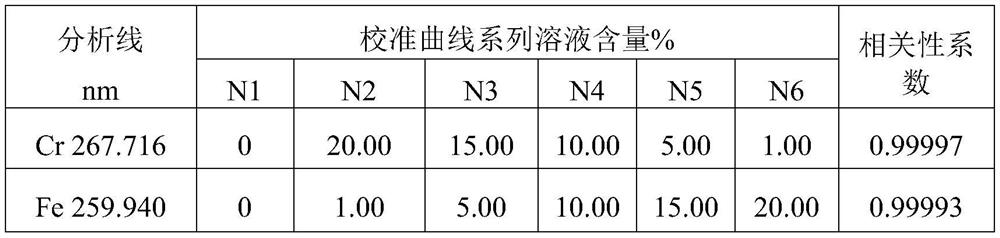
Figure 1
Abstract
Description
technical field
[0001] The invention belongs to the technical field of spectral analysis, and in particular relates to an ICP-OES rapid determination method for chromium and iron content in nickel-based superalloys. Background technique
[0002] Nickel-based superalloys are superalloys with nickel as the matrix (generally more than 50%) in the range of 650-1000 °C with high strength and good oxidation resistance and gas corrosion resistance. Chromium and iron elements can improve the plasticity and strength of materials in alloys. The chemical composition of modern nickel-based alloys is very complex, and the saturation of the alloy is very high. Therefore, it is required to strictly control the content of each alloy (especially the main strengthening element), otherwise harmful phases will be easily precipitated during use and damage the alloy. Strength and toughness. Therefore, it is of great significance to determine the content of elements in nickel-based superalloys. ...
Examples
Embodiment 1
[0030] (1) Preparation of calibration solution:
[0031] Drawing of the calibration working curve matched with the nickel matrix: pipette 5.00mL nickel matrix solution into several 200mL plastic volumetric flasks, add appropriate amount of chromium and iron standard solutions according to Table 1, add 2.00mL yttrium internal standard solution respectively, and dilute with water To the mark, mix well; prepare a reagent blank along with the test solution.
[0032] Table 1 Nickel-based calibration working curve
[0033]
[0034] (2) Preparation of sample solution:
[0035] Weigh 0.2000g sample (see Table 2) into a 100mL polytetrafluoroethylene beaker, add 15mL of mixed acid of hydrochloric acid and nitric acid with a volume ratio of 1:3, add 0.5mL of hydrofluoric acid and heat slowly on a 45°C low-temperature electric heating plate dissolve. After the sample is completely dissolved, remove it, cool to room temperature, transfer to a 200mL volumetric flask, add 2.00mL yttriu...