
Approximate query processing algorithm based on conditional generative model
A technology for conditional generation and processing algorithms, applied in the field of information retrieval, can solve difficult problems such as internal network balance and model collapse, and achieve the effects of performance improvement, collapse elimination, and error reduction
Patent Information
- Authority / Receiving Office
- CN · China
- Patent Type
- Patents(China)
- Current Assignee / Owner
- Publication Date
- 2022-06-17
Smart Images
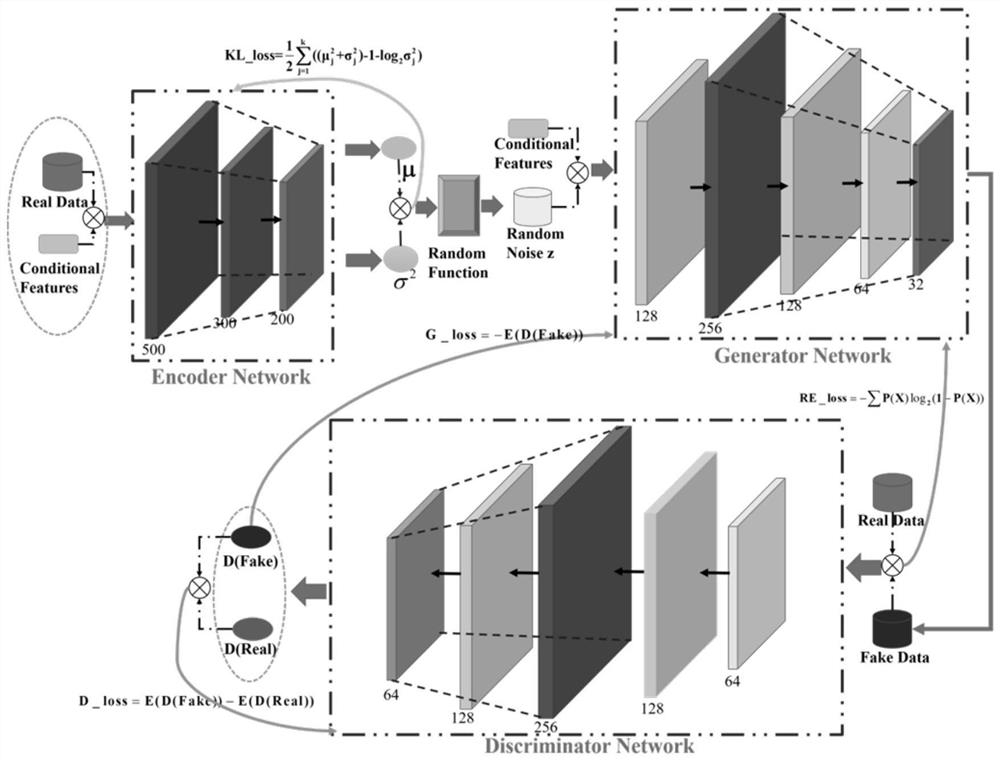
Figure 1 
Figure 2 
Figure 3
Abstract
Description
technical field
[0001] The invention belongs to the technical field of information retrieval, and in particular relates to an approximate query processing algorithm. Background technique
[0002] With the rapid development of information technology, the amount of data continues to grow at an explosive rate, making it difficult for traditional database system software to answer users' aggregated queries within the interactive response time. In specific decision analysis tasks, users usually only need to obtain general trends from the data, and do not require precise results. Moreover, in practical situations, the data distribution is not uniform, and there is a serious skew problem. Therefore, it is of great significance to obtain query results with higher precision with faster response speed in massive skewed data.
[0003] Approximate Query Processing (AQP) algorithm (CHAUDHURI S, DINGB, KANDULA S.Approximate query processing:no silver bullet[C] / / Proceedings of the 2017AC...
Examples
Embodiment Construction
[0036] The approximate query processing algorithm based on the conditional generation model provided by the present invention, the specific implementation process and steps are described in detail as follows:
[0037] 1. Construction of the Conditional Variational Generative Adversarial Network Model Based on Wasserstein The Conditional Variational Wasserstein Generative Adversarial Network (CVWGAN) provided by the present invention is based on the network structure of CGAN and is integrated into the coding in CVAE network to ensure the stability of the overall model. The specific structure of the model is as figure 1 shown.
[0038] The model consists of an encoder network (Encoder, E), a generation network (Generator, G) and a discriminator network (Discriminator, D). Among them, the encoding network maps the unknown distribution of the real data to the common distribution in the latent space (LS). There are three layers in total. The real data X and the corresponding cond...