
Method for preparing catalytic activity biochar from iron-containing excess sludge and removing antibiotics
A technology of excess sludge and catalytic activity, applied in chemical instruments and methods, catalyst regeneration/reactivation, alkali metal compounds, etc., can solve the problems of complex preparation, high cost, unsatisfactory application effect, etc. The effect of void structure, high specific surface area and good adsorption effect
Patent Information
- Authority / Receiving Office
- CN · China
- Patent Type
- Applications(China)
- Current Assignee / Owner
- Publication Date
- 2022-03-25
Smart Images
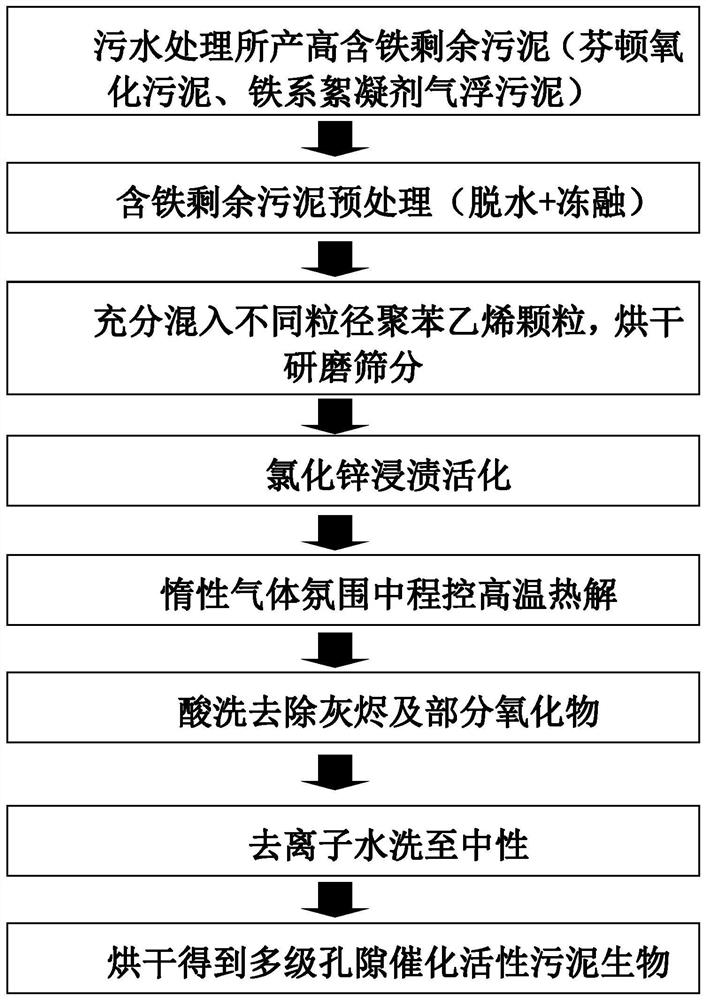
Figure 1 
Figure 2 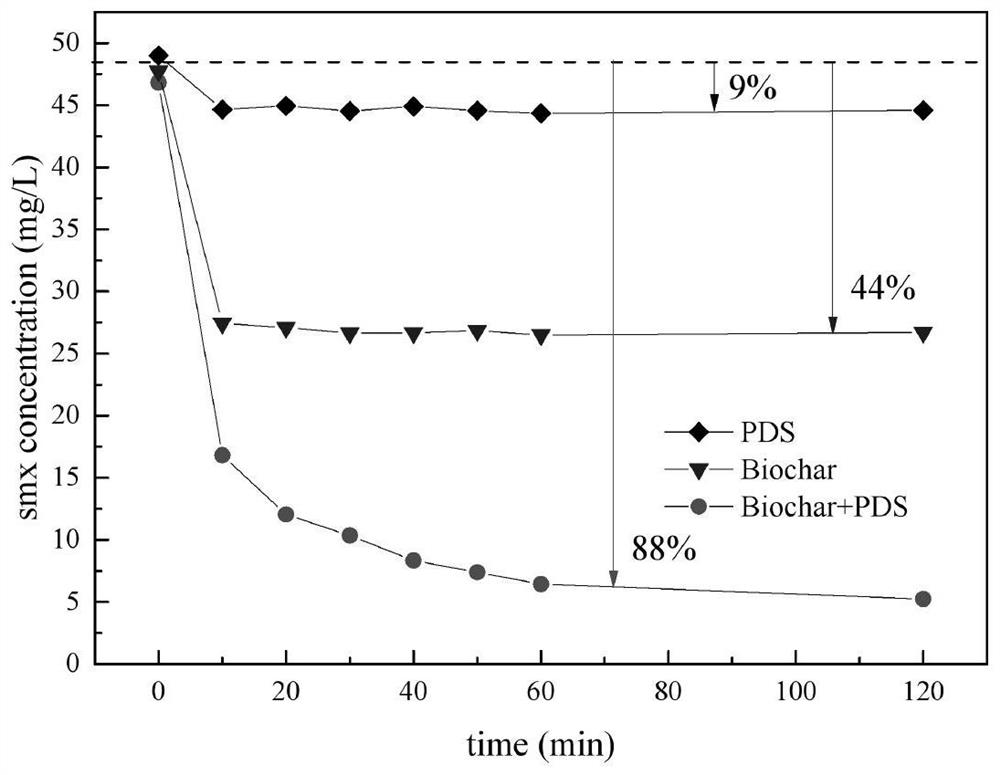
Figure 3
Abstract
Description
technical field
[0001] The invention relates to the technical field of sludge resource utilization, biochar and water pollution prevention and control, in particular to the technical field of preparing biochar by recycling industrial waste and applying it to water pollution prevention and control. Background technique
[0002] In the process of municipal sewage treatment and industrial wastewater treatment, a large amount of excess sludge will be produced, which contains a large number of microorganisms and pollutants adsorbed by sludge flocs, especially metal residues caused by the application of metal salts in sewage oxidation and sludge flocculation, such as Fenton oxidation sludge in industrial sewage treatment is even listed as hazardous solid waste. It has become a research hotspot in the field of water treatment to carry out safe and low-cost effective treatment and disposal of such wastes through resource technology. At the same time, as an indispensable drug in the...
Examples
Embodiment 1
[0046] refer to figure 1 , biochar with catalytic activity was prepared by pyrolysis of dehydrated iron-containing excess sludge by the following steps:
[0047] (1) After dehydrating the iron-containing excess sludge in Fenton's sewage treatment process, freeze it for 18 hours at minus 20°C, and then thaw it naturally for 6 hours;
[0048] (2) crushing polystyrene plastic foam with an ultrafine crusher to obtain polystyrene plastic foam particles with a particle size of about 100 microns;
[0049] (3) Fully mix the sieved iron-containing excess sludge with polystyrene foam particles, then place in an oven to dry at 105°C for 4 hours, and pass through a 50-mesh sieve after crushing;
[0050] (4) impregnating and activating the dried mixture with a 3mol / L zinc chloride solution for 24 hours to obtain a biochar preparation precursor mixed with iron-containing residual sludge and polystyrene particles;
[0051] (5) The obtained biochar preparation precursor was heated up to 800...
Embodiment 2
[0055] Use the biological charcoal that embodiment 1 makes to activate peroxodisulfate to degrade sulfamethoxazole, and its steps are as follows:
[0056] (1) Prepare 50 mg / L sulfamethoxazole solution. Since sulfamethoxazole is extremely difficult to dissolve in water, when preparing the solution, first ultrasonicate it in a small amount of deionized water for 5 minutes, then transfer it to a volumetric flask, and then magnetically Stirrer, at the speed of 800rpm / min, stir for 10h to ensure that it is fully dissolved;
[0057] (2) Get the prepared concentration and add 100 mg of potassium peroxodisulfate and 50 mg of biochar into 100 ml of 50 mg / L sulfamethoxazole solution;
[0058] (3) Stir the reaction at a rotating speed of 200rpm / min, take samples every 10min, and utilize high-performance liquid chromatography to quantitatively analyze the content of SMX within 24h.
[0059] The result of high-performance liquid chromatography detection is: the degradation rate of sulfame...