
Preparation of trans-4-isopropyl cyclonaphthenic acid
A technology of propylcyclohexanecarboxylic acid and propylcyclohexane, applied in the field of preparation of trans-4-isopropylcyclohexanecarboxylic acid, can solve the problem of high price of 4-isopropylcyclohexanecarboxylic acid and catalytic hydrogenation of benzene ring Low activity, low total reaction yield and other problems, to achieve the effect of abundant raw materials, low cost and low price
Patent Information
- Authority / Receiving Office
- CN · China
- Patent Type
- Patents(China)
- Current Assignee / Owner
- Publication Date
- 2006-09-20
- Estimated Expiration
- Not applicable · inactive patent
Smart Images
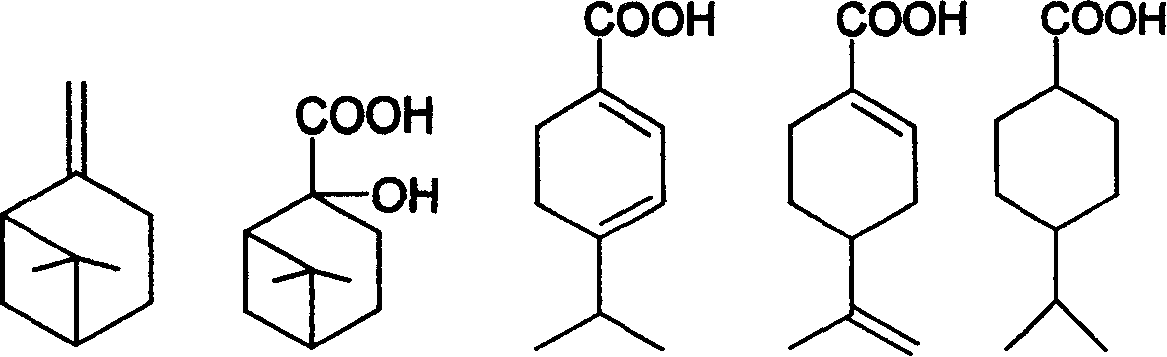
Figure 1 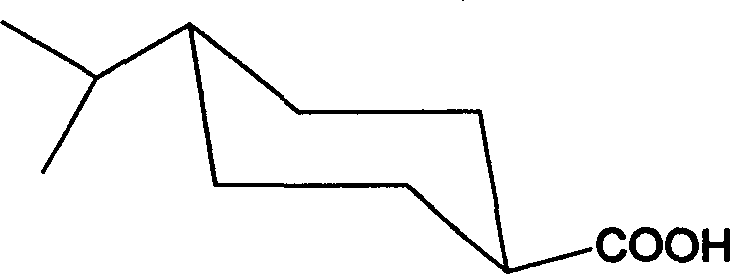
Figure 2 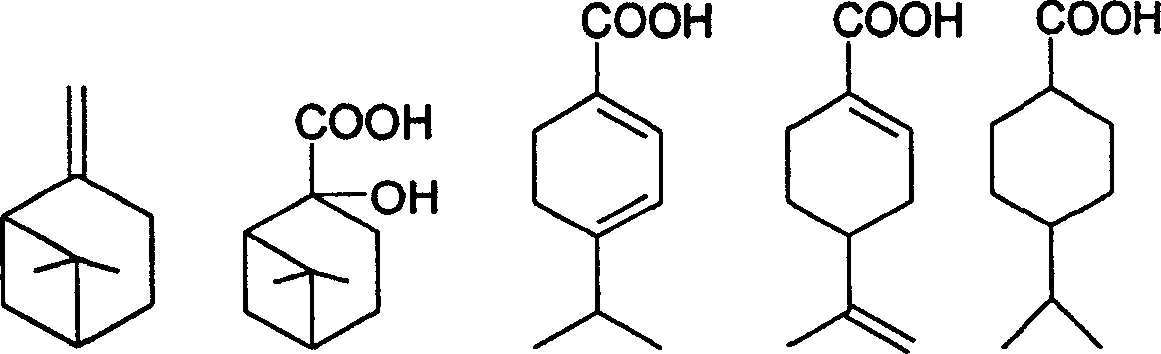
Figure 3
Abstract
Description
technical field
[0001] The invention relates to a method for preparing trans-4-isopropylcyclohexanecarboxylic acid, in particular to a method for preparing trans-4-isopropylcyclohexanecarboxylic acid from β-pinene. Background technique
[0002] Nateglinide is a new anti-diabetic drug listed in Japan in 1998. It has developed rapidly and has been listed as a class II new drug in my country. Because of its raw material N-(trans-4-isopropylcyclohexyl-1 -Formyl)-D-phenylalanine (N-(trans-4-isopropylcyclohexanecarbonyl)-D-phenylalanine) is simple to synthesize and has good efficacy. Trans-4-isopropylcyclohexanecarboxylic acid (Trans-4-isopropylcyclohexanecarboxylic acid) is one of the two raw materials for the synthesis of nateglinide. At present, the synthetic methods of trans-4-isopropylcyclohexanecarboxylic acid are all based on 4-isopropylbenzoic acid is the starting material, and the mixture of cis-trans isomers of 4-isopropylcyclohexanecarboxylic acid is obtained through ca...
Examples
Embodiment 1
[0022] Add 31g of potassium permanganate, 4g of sodium hydroxide and 400g of water into a three-necked flask with an electric stirrer, add 13.6g of β-pinene in four times within 2 hours, and control the reaction temperature at 15-50°C in an ice bath , After the addition, react at room temperature for 5 hours and stop. After filtration, the filtrate was evaporated to remove water to obtain a white solid of nopinate sodium. The white solid was acidified and extracted three times with chloroform, and the chloroform layer was evaporated to remove the solvent to obtain 6.0 g of nopinate.
[0023] Add 10 g of nopinic acid and 200 mL of 20% sulfuric acid aqueous solution to reflux for 2 hours, cool, and filter to obtain 8 g of the product.
[0024] 10g of the product from the previous step, 0.4g of Pd-C and 60g of ethanol, evacuated hydrogen gas, repeated three times, repeated hydrogen gas at room temperature until the hydrogen pressure no longer drops, stop; filter, evaporate ethano...
Embodiment 2
[0027] Add 43g of potassium permanganate, 4g of sodium hydroxide and 600g of water into a three-necked flask with an electric stirrer, add 13.6g of β-pinene in four times within 2 hours, and control the reaction temperature in an ice bath at 15-50°C. After the addition, react at room temperature for 6 hours and stop. After filtration, the filtrate was evaporated to remove water to obtain 6.6 g of sodium norpinate as a white solid.
[0028] Add 10 g of sodium pinoleate and 200 mL of 20% sulfuric acid aqueous solution to reflux for 2 hours, cool and filter to obtain 7.6 g of the product.
[0029] 10g of the product from the previous step, 0.3g of Pd-C, 60g of methanol, evacuate hydrogen, repeat three times, repeat hydrogen at room temperature until the hydrogen pressure no longer drops, stop; filter, distill off methanol under reduced pressure to obtain 4-isopropyl Cyclohexanecarboxylic acid 9.2g.
[0030] Dissolve 17g of 4-isopropylcyclohexanecarboxylic acid in 100g of toluen...
Embodiment 3
[0032] The data of the melting point, hydrogen spectrum and mass spectrum of embodiment 1,2 product are as follows:
[0033] Melting point: 93~95℃
[0034] Hydrogen spectrum: 1 HNMR (CDCl 3 ): δ=0.85(d, 6H), 1.2(m, 3H), 1.5(m, 3H), 1.8(d, 2H), 2.1(d, 2H), 2.3(m, 1H)
[0035] Mass spectrum: MS (EIMS, 70ev), the m / z value of relevant mass point and fragment: 170 (M + , 10), 152 (M-H 2 O, 12), 127 (M-Pro, 30), 109 (47), 81 (100), 67 (13), 41 (22).