
Steered current source for single-ended class-A amplifier
a current source and amplifier technology, applied in the field of audio amplifiers, can solve the problems of reduced efficiency, unsatisfactory sound quality and performance of transistors and integrated circuits in audio equipment (e.g., stereo amplifiers), and inability to meet the sound quality and performance of stereo amplifiers, and achieve the effect of increasing power
Patent Information
- Authority / Receiving Office
- US · United States
- Patent Type
- Patents(United States)
- Current Assignee / Owner
- Publication Date
- 2019-04-09
Smart Images
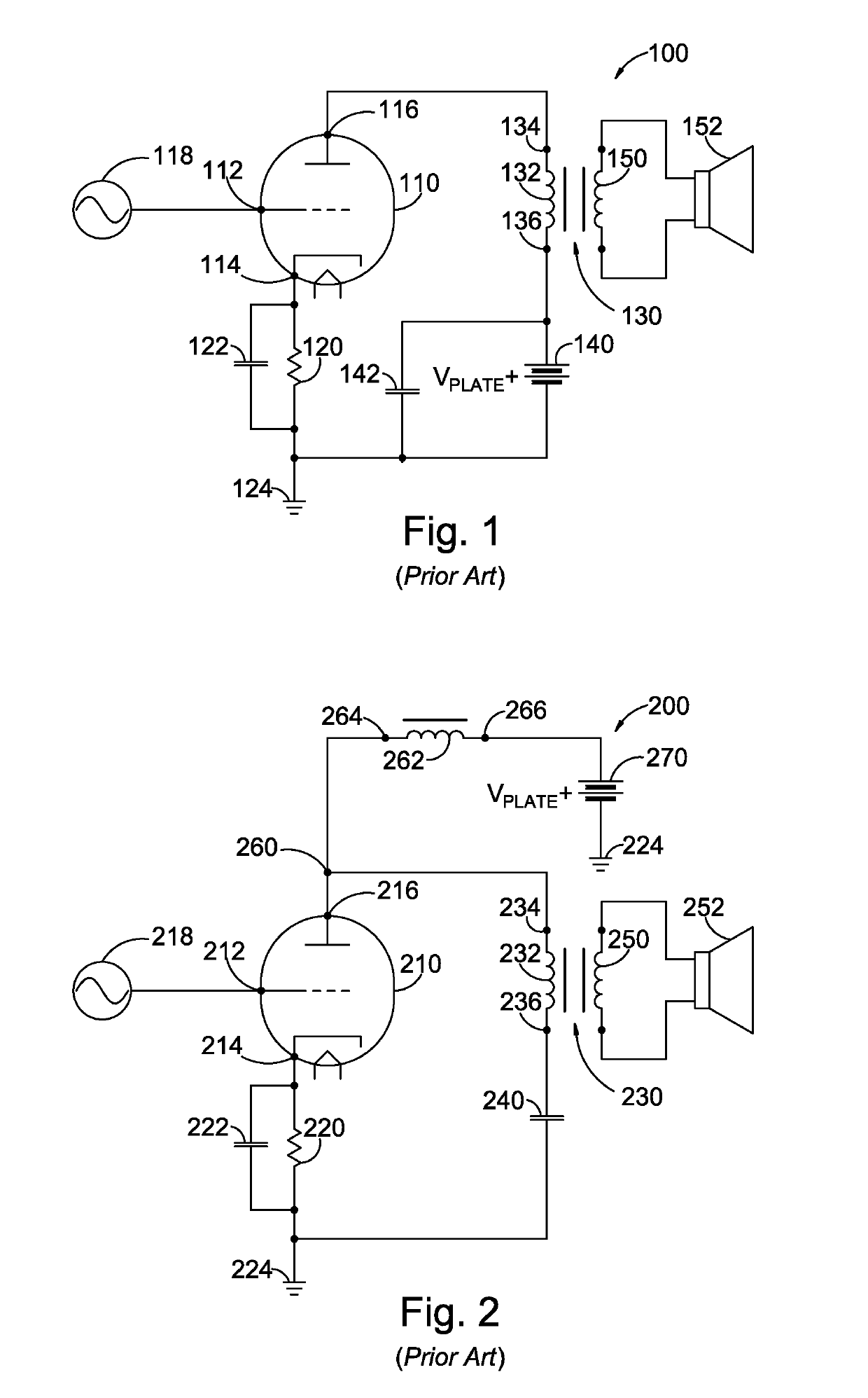
Figure 1 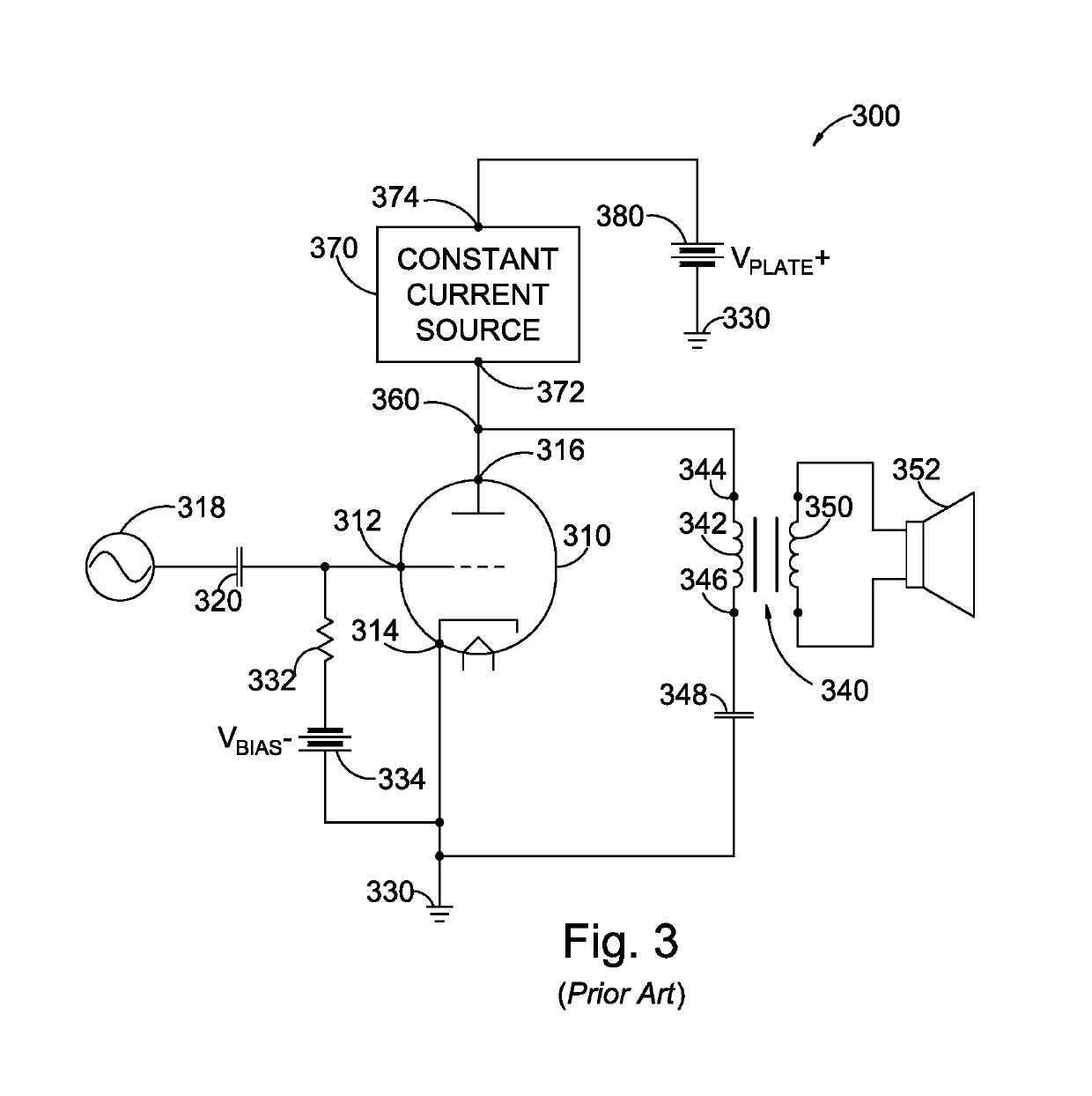
Figure 2 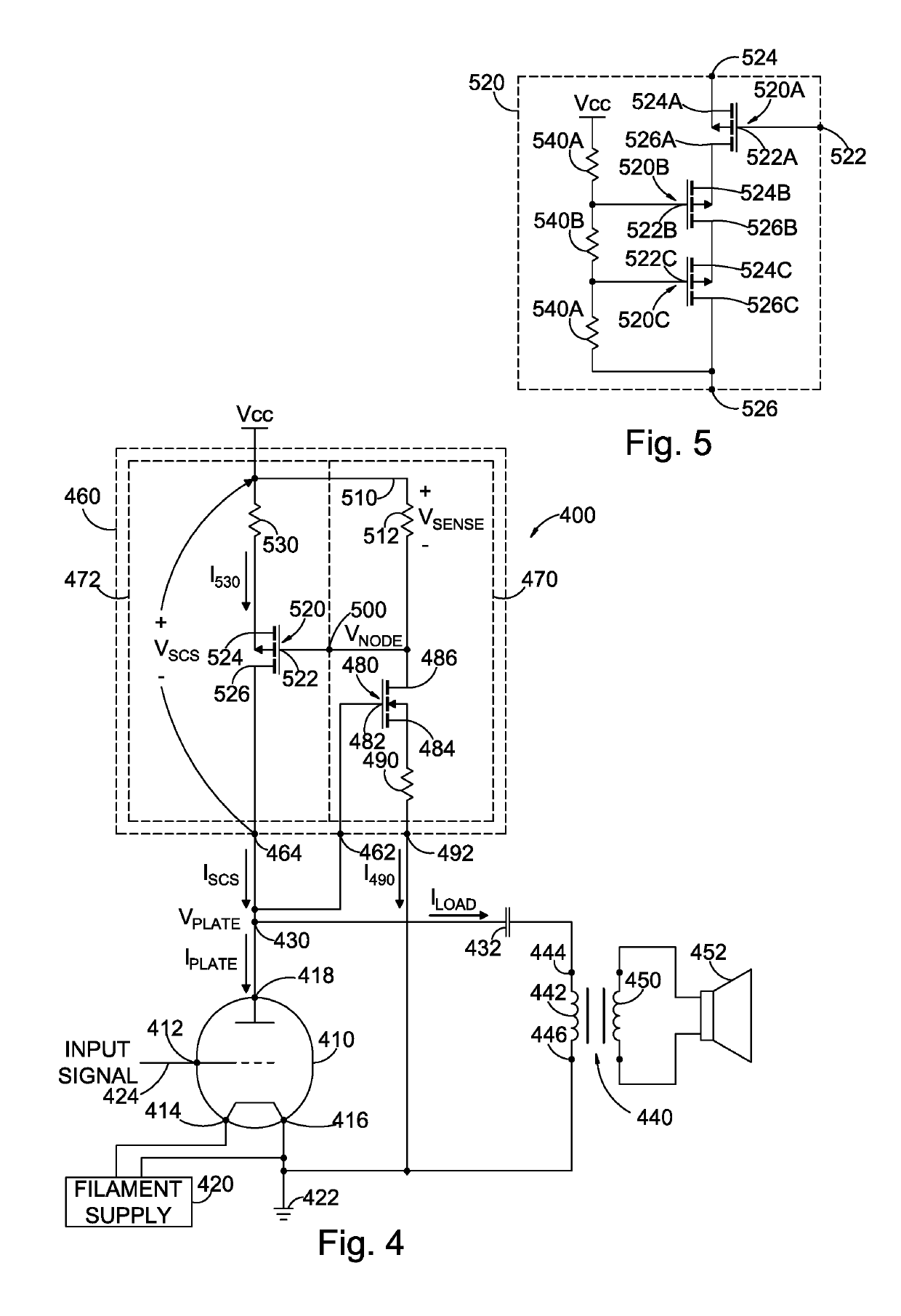
Figure 3
Abstract
Description
FIELD OF THE INVENTION
[0001] The present disclosure relates generally to audio amplifiers, and, more particularly, relates to Class A audio amplifiers having a single amplifying element to drive a load.BACKGROUND
[0002] For decades, vacuum tubes were incorporated into almost every aspect of electronic equipment, including audio amplifiers. With the advent of transistors followed by integrated circuits, vacuum tubes fell into disuse such that few, if any, modern televisions, radios, and similar electronic devices use vacuum tubes. However, a substantial group of “true” audiophiles consider the sound quality and performance of transistors and integrated circuits in audio equipment (e.g., stereo amplifiers) to be unsatisfactory because the sound from such modern amplifies tends to be cold and sterile. An increasing niche market exists for audio amplifiers having vacuum tubes in the power output stages.
[0003] Two major methods of power stage operation are used to implement vacuum tube ampli...
Examples
Embodiment Construction
[0055]Reference will now be made in detail to embodiments of the present disclosure, one or more drawings of which are set forth herein. Each drawing is provided by way of explanation of the present disclosure and is not a limitation. It will be apparent to those skilled in the art that various modifications and variations can be made to the teachings of the present disclosure without departing from the scope of the disclosure. For instance, features illustrated or described as part of one embodiment can be used with another embodiment to yield a still further embodiment.
[0056]It is intended that the present disclosure covers such modifications and variations as come within the scope of the appended claims and their equivalents. Other objects, features, and aspects of the present disclosure are disclosed in the following detailed description. It is to be understood by one of ordinary skill in the art that the present discussion is a description of exemplary embodiments only and is n...