
Enzyme coupled assay for quantification of protein and peptide binding by SAMDI mass spectrometry
a mass spectrometry and enzyme-coupled technology, applied in mass spectrometry analysis, instruments, biological material analysis, etc., can solve the problems of inability to detect labels, limited quantitative comparisons of available assays with high throughput, and lack of quantitative options. , to achieve the effect of accelerating the rate of enzyme-catalyzed reaction and reducing the rate of deacetylation
Patent Information
- Authority / Receiving Office
- US · United States
- Patent Type
- Patents(United States)
- Current Assignee / Owner
- Publication Date
- 2020-09-22
Smart Images
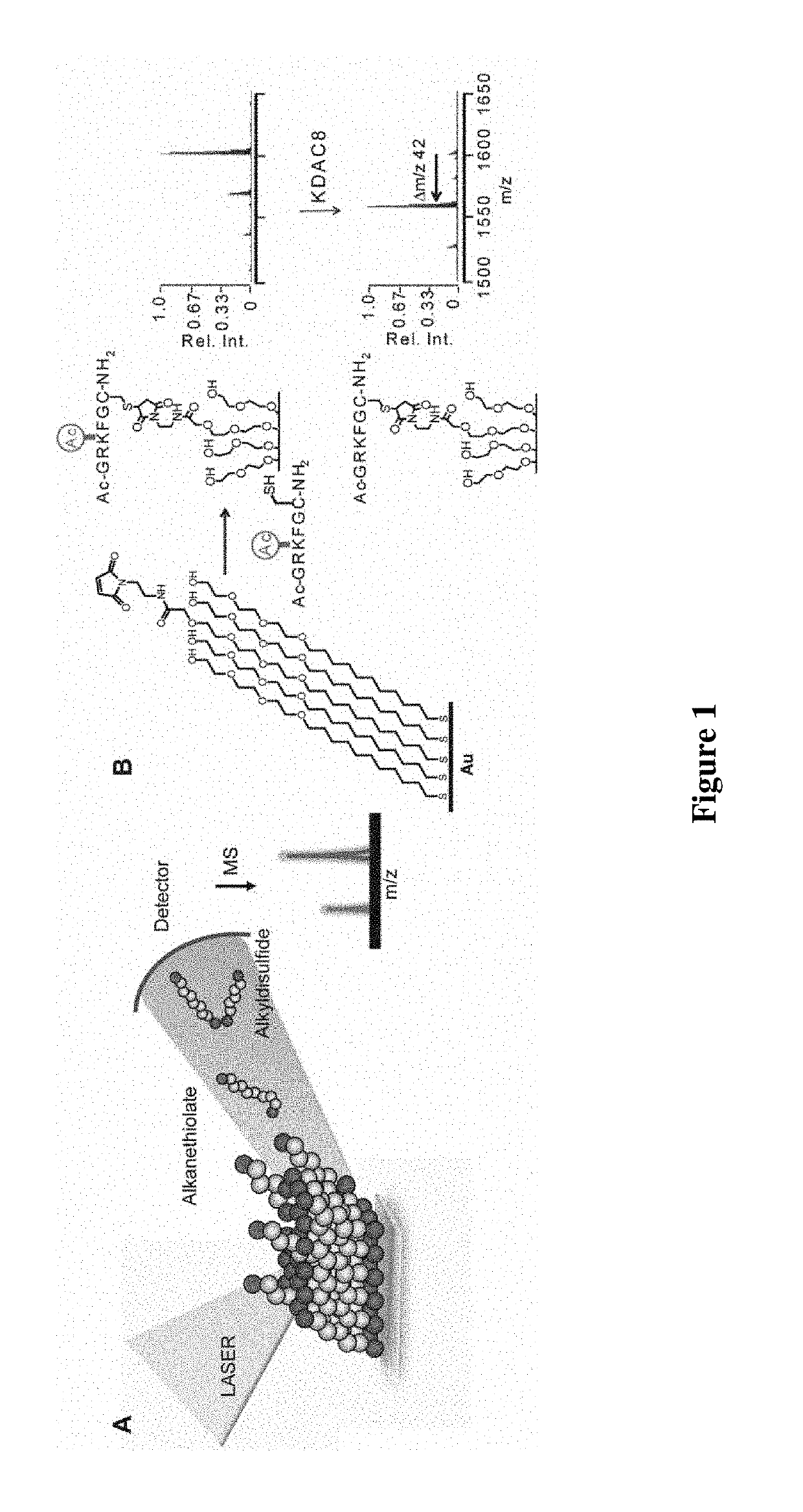
Figure 1 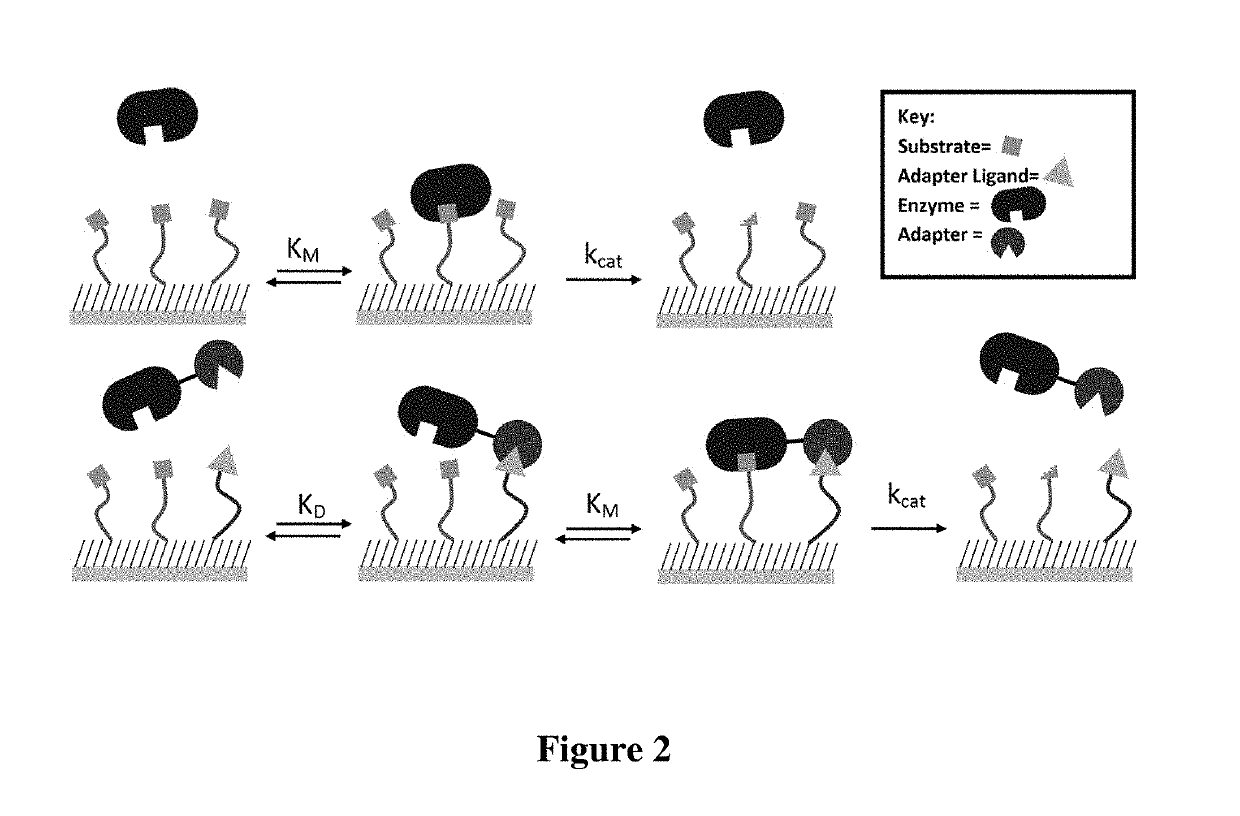
Figure 2 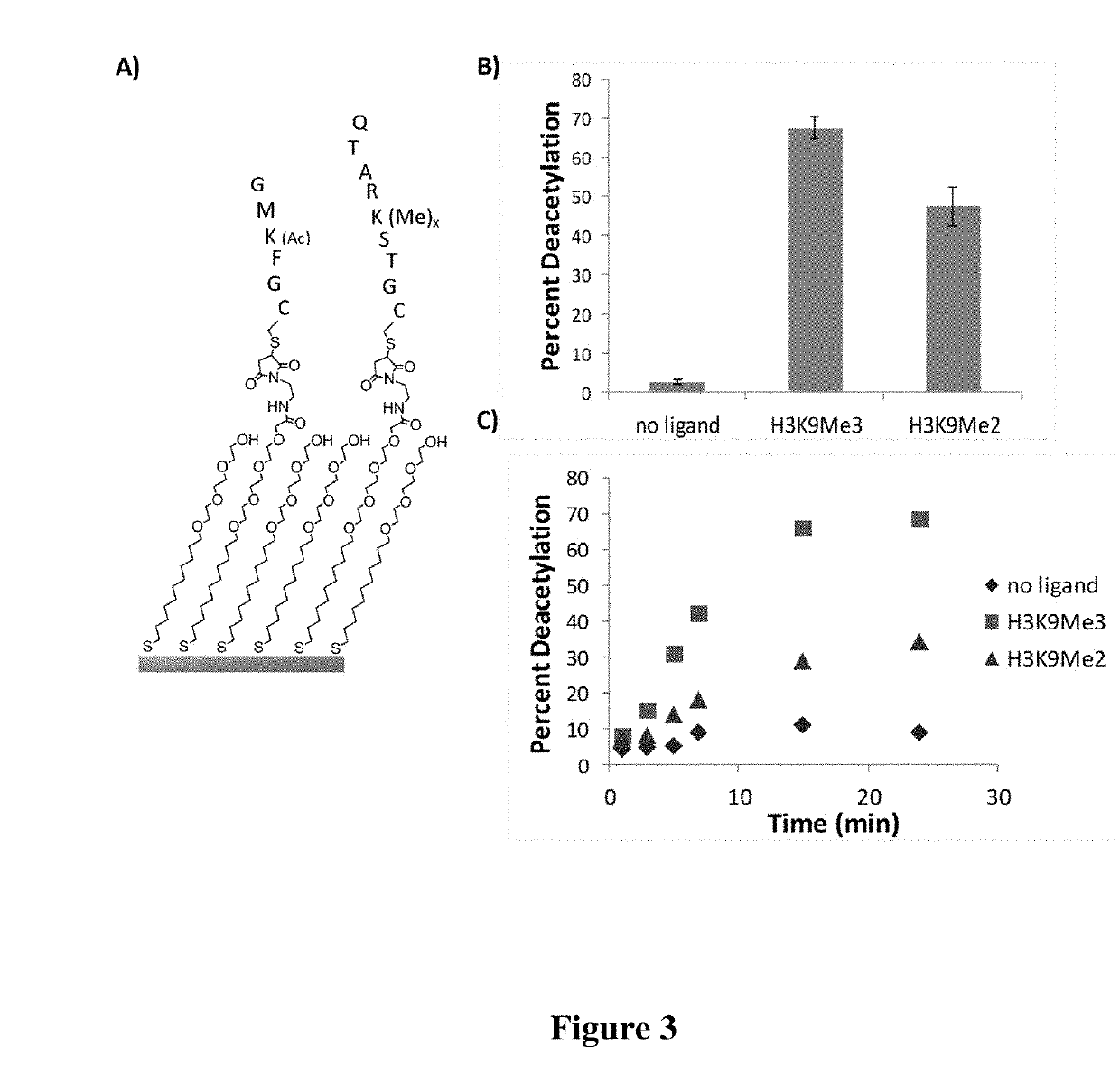
Figure 3
Abstract
Description
CROSS-REFERENCE TO RELATED APPLICATIONS
[0001] This application claims the priority benefit under 35 U.S.C. § 119(e) of U.S. Provisional Application No. 62 / 119,409, filed Feb. 23, 2015, the disclosure of which is incorporated herein by reference in its entirety.STATEMENT OF GOVERNMENT INTEREST
[0002] This invention was made with government support under grant number N66001-11-1-4179 awarded by the Defense Advanced Research Projects Agency (DARPA). The government has certain rights in the invention.INCORPORATION BY REFERENCE OF MATERIAL SUBMITTED ELECTRONICALLY
[0003] This application contains, as a separate part of the disclosure, a Sequence Listing in computer-readable form which is incorporated by reference in its entirety and identified as follows: Filename: 2013-090_Seqlisting.txt; Size: 1,488 bytes, created: Feb. 23, 2016.FIELD OF THE INVENTION
[0004] The present disclosure is directed to high throughput, label-free methods of profiling binding interactions.BACKGROUND OF THE INVENTION[...
Examples
example 1
Design and Construction of a Method to Monitor and Measure Weak Interactions
[0081]In this example, two peptides—a methylated peptide that binds the chromodomain and an acetylated peptide that is a substrate for the deacetylase—are immobilized to a monolayer presenting maleimide groups against a background of tri(ethylene glycol) groups. The density of the maleimide group is controlled precisely (Houseman et al., Langmuir 19: 1522-1531 (2003)) and the relative densities of the two peptides are controlled either by immobilizing them as a mixture at defined concentrations or by immobilizing the first for a time that gives incomplete immobilization followed by addition of the second peptide. Fusion proteins are prepared by first constructing E. coli-based vectors containing chromodomains and KDAC8 separated by a short linker. The vector is designed to contain a restriction site allowing for the insertion of any chromodomain of interest containing the complementary restriction sites. In ...
example 2
Screening for Protein Binding Inhibition
[0089]This example describes a screen of the chromodomain Cbx1 binding to the ligand H3K9(Me)3. The screen uses a commercial library of 130,000 compounds. This example will determine the Z-factor for the screen and has the dual goal of validating the approach for screening low affinity ligand-receptor interactions and also in identifying first generation compounds that can inhibit the chromodomain.
[0090]These experiments apply the assay discussed in Example 1 to a high throughput screen of 130,000 small molecules to identify inhibitors of the chromodomains. One paper to date has disclosed inhibitors of chromodomains and those inhibitors are based on methyllysine analogues (Herold et al., J Med Chem 54: 2504-2511 (2011)). A related report recently disclosed an inhibitor of a bromodomain that may have anti-inflammatory properties (Chung et al., J Med Chem 54, 3827-3838 (2011)).
[0091]High-Throughput Inhibitor Screening.
[0092]The screen is perform...