
Temporal Interpolation Of Adjacent Spectra
a technology of adjacent spectra and interpolation, applied in the field ofsignal processing, can solve the problems of limiting the performance of echo cancellation filters, hindering the adaptation of filters, and high computational load caused by pure time domain processing, so as to increase computational requirements, increase the number of spectra available, and avoid significant delay
Patent Information
- Authority / Receiving Office
- US · United States
- Patent Type
- Applications(United States)
- Current Assignee / Owner
- Publication Date
- 2013-08-15
Smart Images
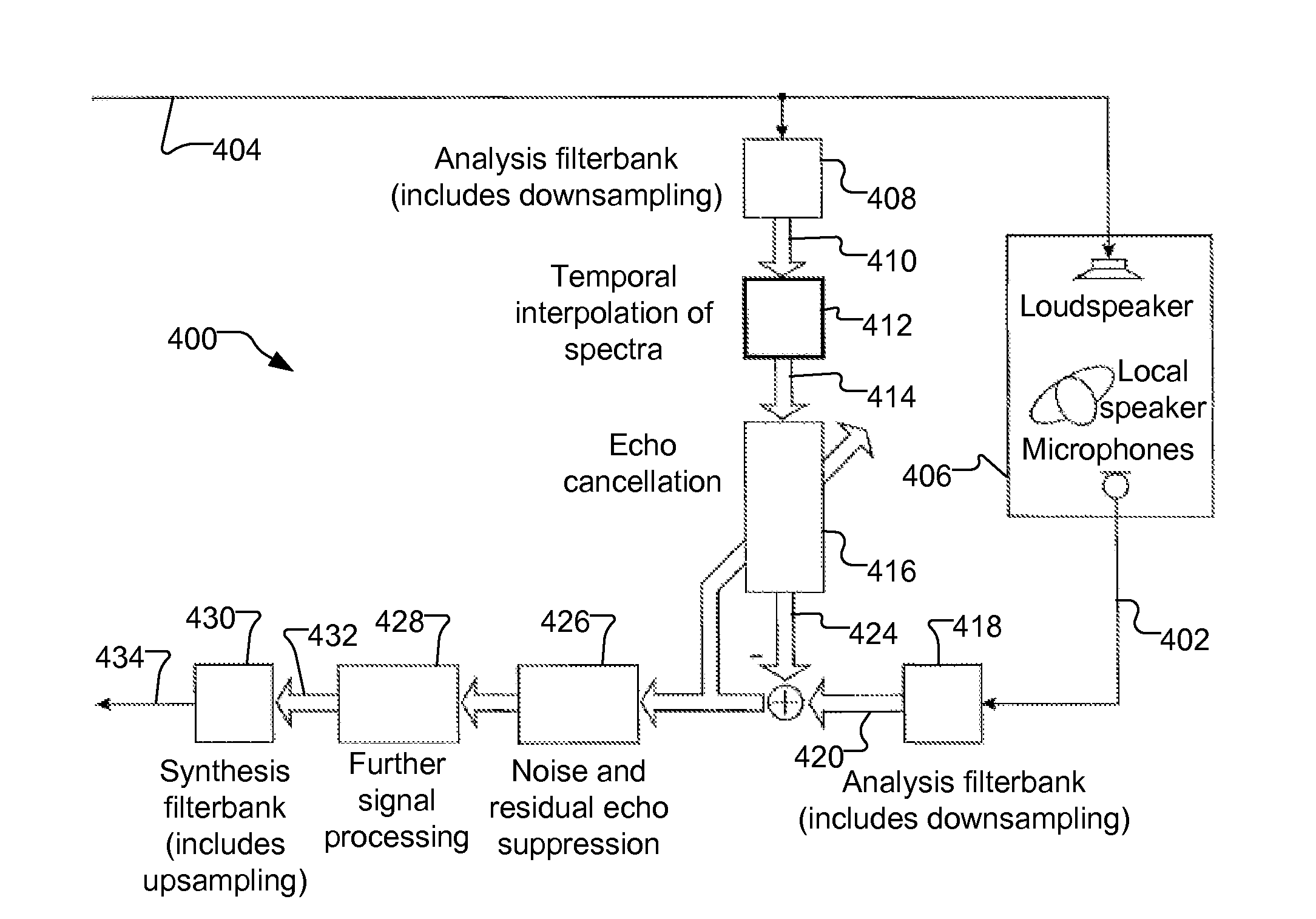
Figure 1 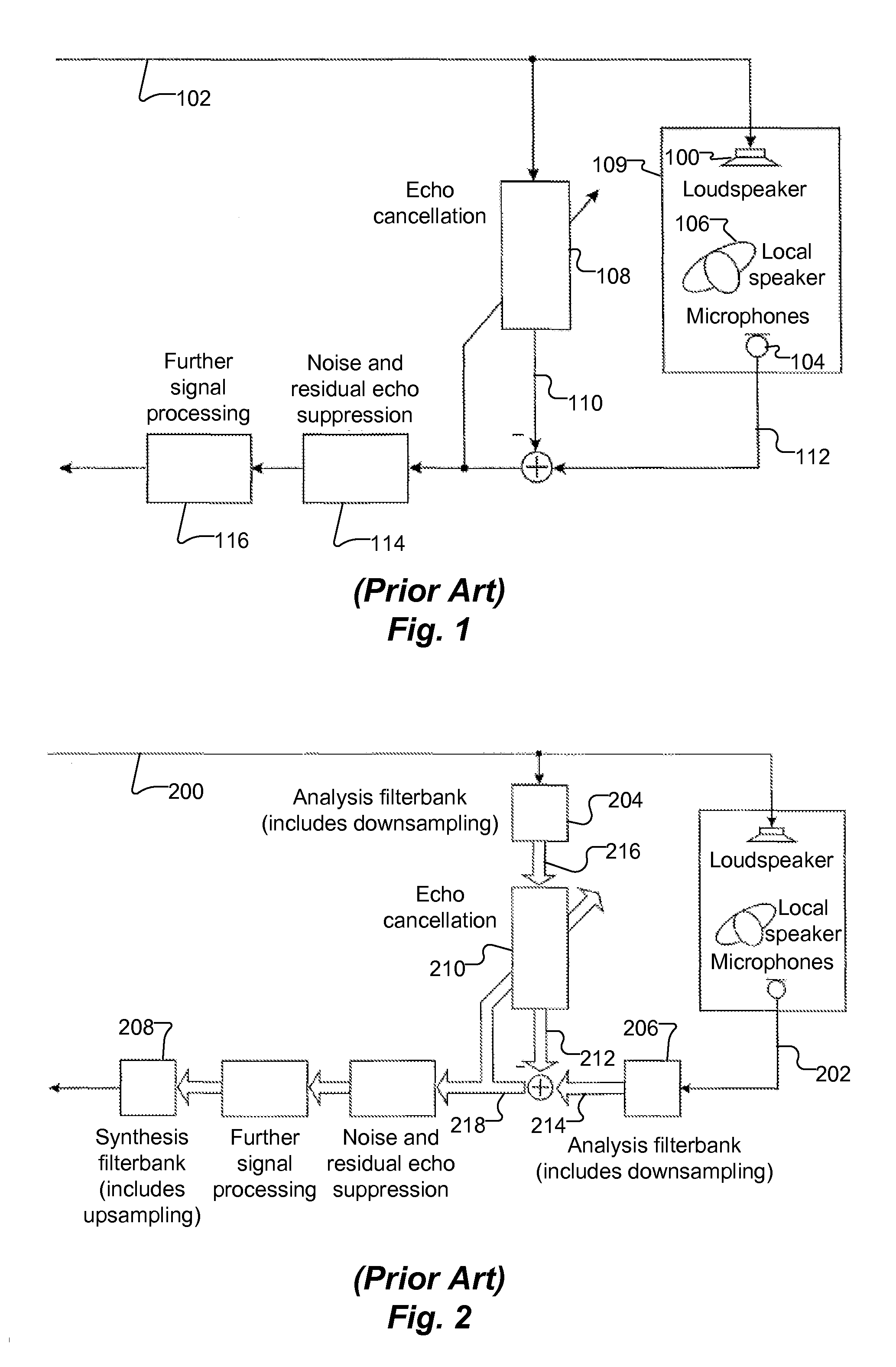
Figure 2 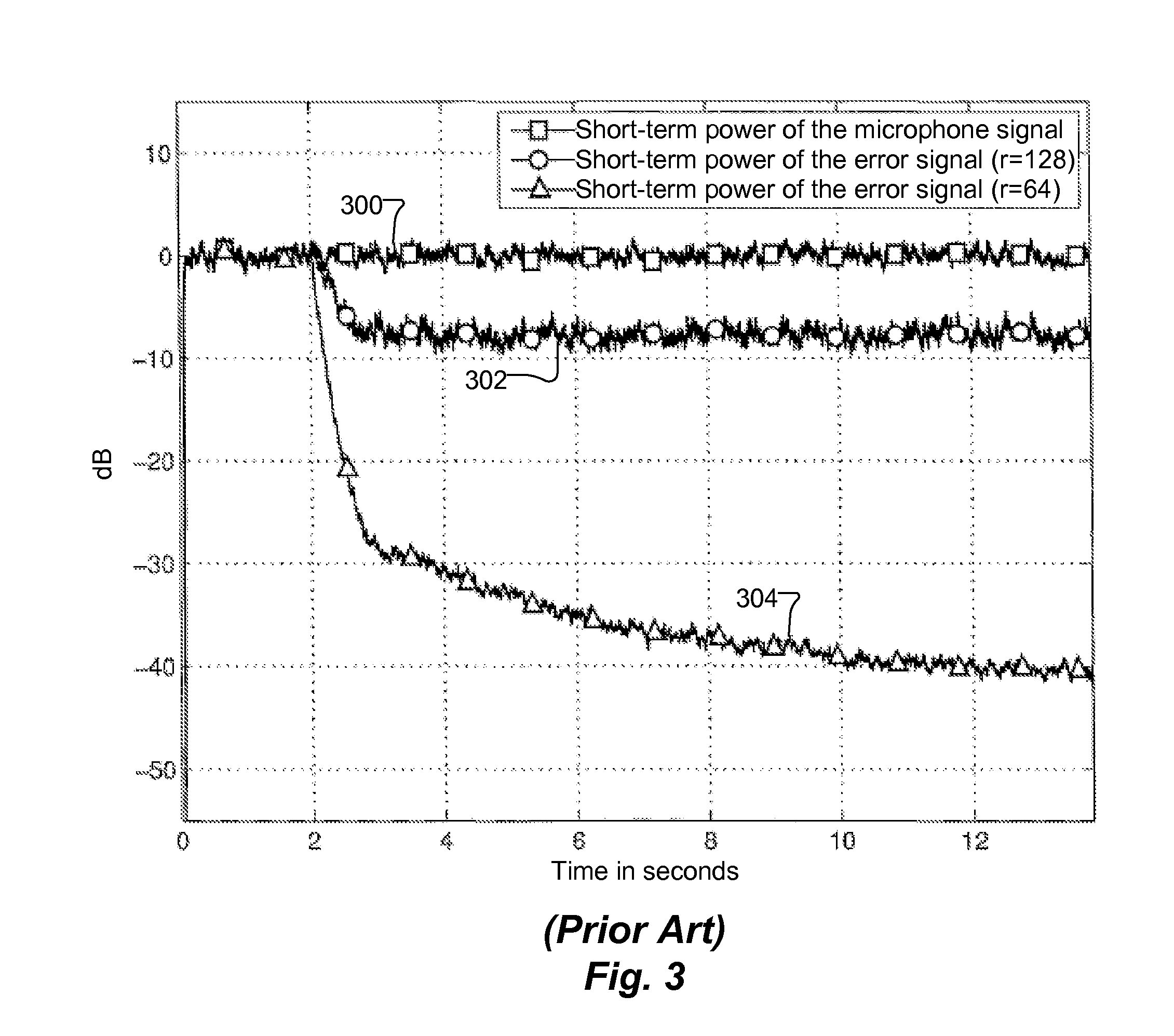
Figure 3
Abstract
Description
CROSS REFERENCE TO RELATED APPLICATIONS
[0001] This application claims the benefit of European Patent Application No. EP 11178320.5, filed Aug. 22, 2011, titled “Temporal Interpolation of Adjacent Spectra,” the entire contents of which are hereby incorporated by reference herein, for all purposes.TECHNICAL FIELD
[0002] The present invention relates to signal processing, such as for speech enhancement, and, more particularly, to temporal interpolation of spectra in adaptive filtering algorithms for echo cancellation.BACKGROUND ART
[0003] Speech is an acoustic signal produced by human vocal apparatus. Physically, speech is a longitudinal sound pressure wave. A microphone converts the sound pressure wave into an electrical signal. The electrical signal can be sampled and stored in a digital format.
[0004] Currently, sample rates used for speech applications are increasing due to the transition from “conventional” transmission systems, such as ISDN or GSM, to so-called “wideband” or even “super...
Examples
Embodiment Construction
[0022]Embodiments of the present invention exploit redundancy of succeeding FFT spectra and use this redundancy for computing interpolated temporal supporting points. Instead of calculating additional short-term spectra, embodiments of the present invention estimate additional short-term spectra between calculated short-term spectra. That is, a short-term spectrum is estimated for each pair of temporally adjacent calculated short-term spectra. The estimated short-term spectra effectively double the number of spectra available for echo cancellation or other signal processing purposes, without significantly increasing computational requirements and without introducing significant delay.
[0023]Due to simple temporal interpolation, there is no need for increased overlapping, no need for lower sub-sampling rates and, therefore, no need for calculating an increased number of short-term spectra. By using these temporally interpolated spectra in the adaptive filtering algorithm, aliasing eff...