
Accurate microstepping motor
a micro-stepping motor and accurate technology, applied in the field of accurate micro-stepping motors, can solve the problems of increasing the load of the motor, unable to improve the step accuracy, and the micro-steps are not guaranteed to be equal in size, so as to reduce the detent torque, increase the detent position, and pass easily
Patent Information
- Authority / Receiving Office
- US · United States
- Patent Type
- Applications(United States)
- Current Assignee / Owner
- Publication Date
- 2007-01-18
Smart Images
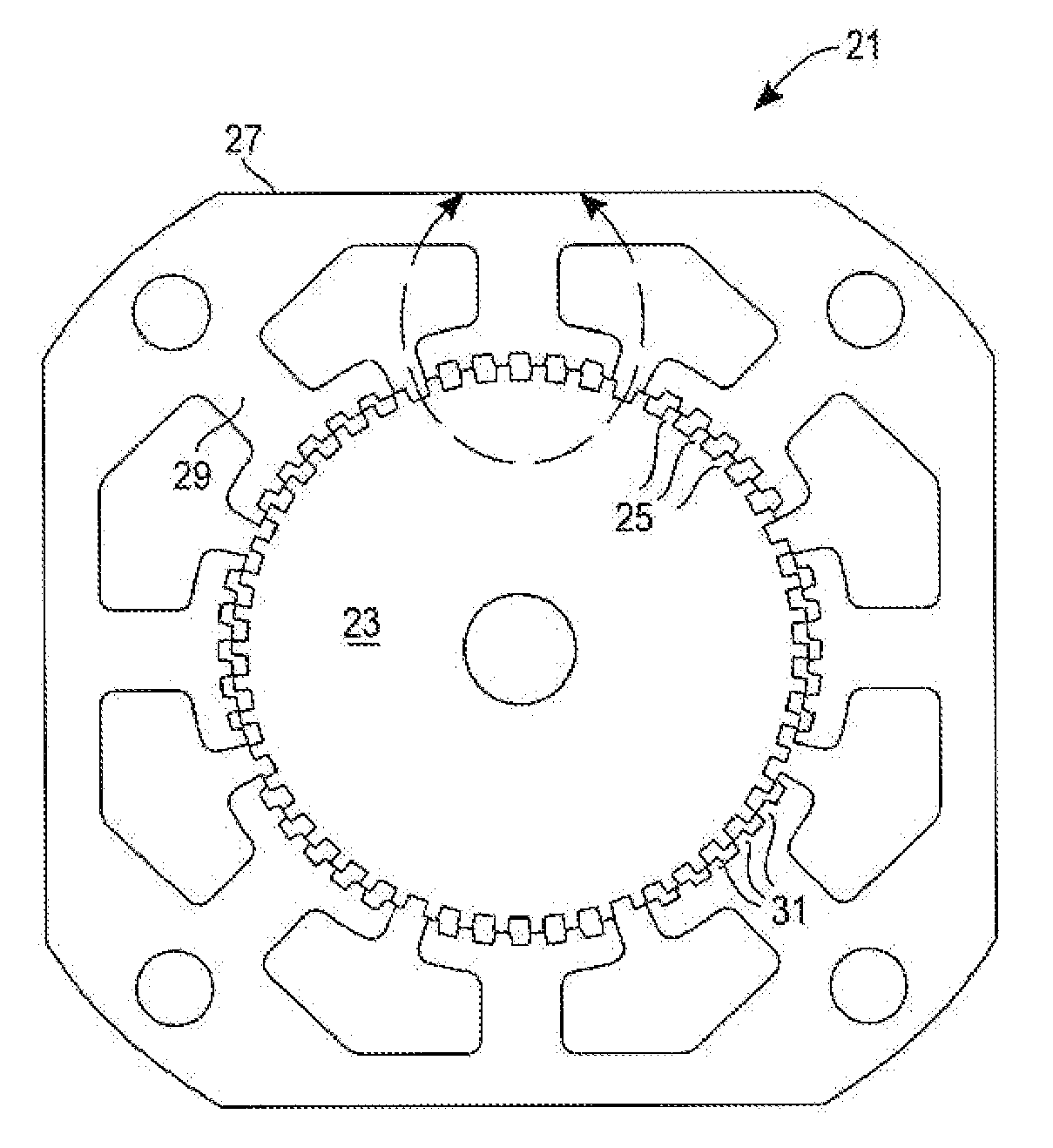
Figure 1 
Figure 2 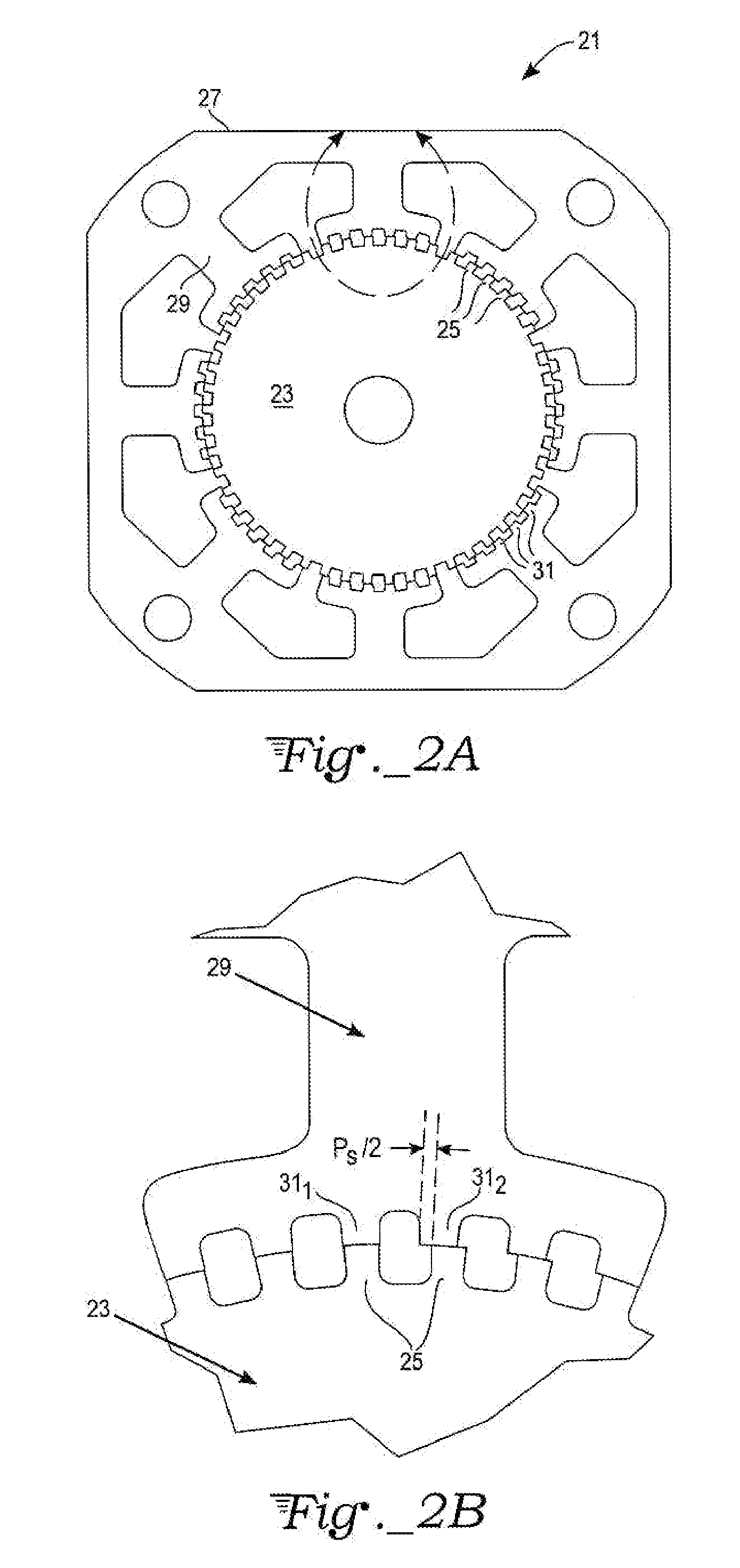
Figure 3
Abstract
Description
CROSS-REFERENCE TO RELATED APPLICATION
[0001] The present application claims priority under 35 U.S.C. 119(e) from U.S. provisional application no. 60 / 699,5360, filed Jul. 15, 2005.TECHNICAL FIELD
[0002] The invention relates generally to electric motor structures designed to rotate step by step, i.e., stepper motors, and in particular to arrangements, including microstepping, for smoothing out the motion, as well as arrangements for improving step accuracy. BACKGROUND ART
[0003] Stepper motors are used in a wide variety of applications that require precise motion control, such as in printers, scanners, x-y tables, turntables, tape and disk drive systems, security cameras and other optical equipment robotics, CNC (computer-numeric-control) machine tools, dispensers, and injector pumps. Unlike “conventional” AC or DC motors, which produce continuous rotary motion from a continuously applied input voltage, stepper motors will stay indefinitely at a particular stable “detent” position a...
Examples
example 1
[0027] A 7.2° standard stator tooth pitch angle corresponds to a 1.8° 2-phase bi-polar (or 4-phase unipolar) motor, a 1.2° 3-phase bipolar (or 6-phase unipolar) motor, a 0.72° 5-phase bipolar (or 10-phase unipolar) motor, where 1.8°, 1.2°, and 0.72° refer to the full step angle θ of the respective motors. For a 1.8° 2-phase bipolar (or 4-phase unipolar) motor, the stator teeth have tooth separations Pe between the two groups of stator teeth of 7.2°±1.8° / 2=7.2°±0.9°; i.e., alternately 6.3° and 8.1°. For a 1.2° 3-phase bipolar (or 6-phase unipolar) motor, the stator teeth have tooth separations Pe between the two groups of stator teeth of 7.2°±1.2° / 2=7.2°±0.6°; i.e., alternately 6.6° and 7.8°. And for a 0.72° 5-phase bipsolar (or 10-phase unipolar) motor, the stator teeth have tooth separations Pe between the two groups of stator teeth of 7:2°±0.72° / 2=7.2°±0.36°; i.e., alternately 6.84° and 7.56°.
[0028] With reference to FIGS. 4A and 4B, another exemplary stepper motor 41 in accordan...
example 2
[0029] As before, a 7.2° standard stator tooth pitch angle corresponds to a 1.8° 2-phase bipolar (or 4-phase unipolar) motor, a 1.2° 3-phase bipolar (or 6-phase unipolar) motor, a 0.72° 5-phase bipolar (or 10-phase unipolar) motor, where 1.8°, 1.2°, and 0.72° refer to the full step angle θ of the respective motors. For a 1.8° 2-phase bipolar (or 4-phase unipolar) motor, the stator teeth have tooth separations Po for the three groups of stator teeth of 7.2°±0.9° / 2 7.2°±0.45°=6.75° or 7.65°. For a 1.2° 3-phase bipolar (or 6-phase unipolar) motor, the stator teeth have tooth separations Po between the two groups of stator teeth of 7.2°±0.6° / 2=7.2°±0.3°=6.9° or 7.5°. And for a 0.72° 5-phase bipolar (or 10-phase unipolar) motor, the stator teeth have tooth separations Po between the two groups of stator teeth of 7.2°±0.36° / 2=7.2°±0.18°=7.02° or 7.38°.
[0030] With reference to FIG. 5, the effect of the tooth offsets is to double the number of detent positions while reducing the amount of ...