
Protein with anti-inflammatory properties
a protein and anti-inflammatory technology, applied in the field of proteins with anti-inflammatory properties, can solve the problems of not being suitable as clinical products for human administration, difficult to translate from these models, and difficult to achieve the effect of reducing the level of crp
Patent Information
- Authority / Receiving Office
- US · United States
- Patent Type
- Patents(United States)
- Current Assignee / Owner
- Publication Date
- 2020-12-08
Smart Images
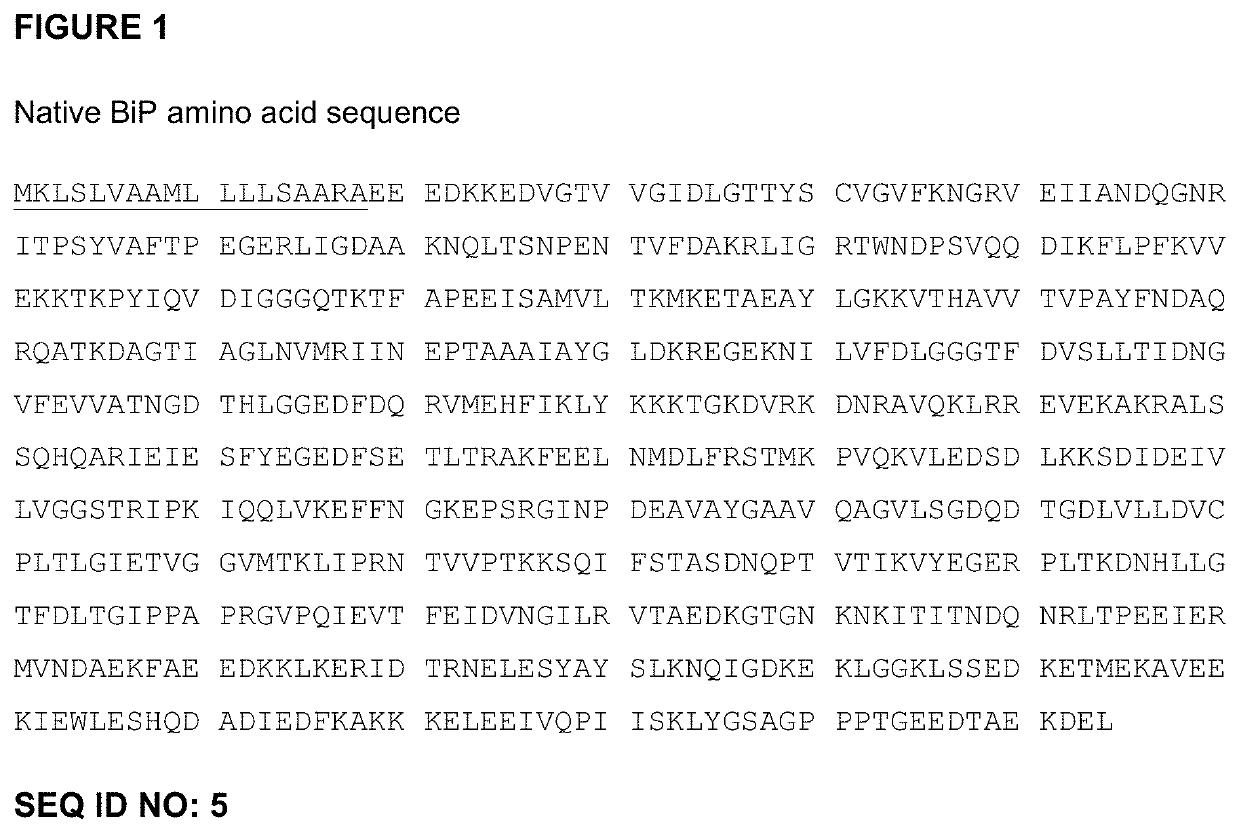
Figure 1 
Figure 2 
Figure 3
Abstract
Description
FIELD OF THE INVENTION
[0001] The present invention relates to a novel protein, its use in medicine, in particular its use in the prevention or treatment of inflammatory conditions, and processes for preparing the protein.BACKGROUND
[0002] The anti-inflammatory properties of a human molecular chaperone known variously as binding immunoglobulin protein (BiP) or glucose-regulated protein 78 (Grp78) have been reported (Corrigall V M, Bodman-Smith M D, Brunst M, Cornell H, Panayi G S. The stress protein, BiP, stimulates human peripheral blood mononuclear cells to express an anti-inflammatory cytokine profile and to inhibit antigen presenting cell function: relevance to the treatment of inflammatory arthritis. Arthritis Rheum 2004; 50:1167-1171). The amino acid sequence of the bacterially expressed recombinant human protein differs from the known sequence of the naturally occurring protein (SEQ ID NO: 5).
[0003] BiP is a ubiquitous, endogenously expressed protein resident in the endoplasmic re...
Examples
example 2
[0112]A comparison of TNFα production induced by proteins of SEQ ID NO: 3 and SEQ ID NO: 1 is provided in FIGS. 10A-10F. Peripheral blood mononuclear cells (PBMC) from 4 healthy controls (solid symbols) and 1 rheumatoid arthritis patient (open symbol) were cultured for 24 h in the presence of SEQ ID NO: 1 or SEQ ID NO: 3. Cytokines produced in the supernatant were detected and quantified by ELISA.
[0113]TNFα production by PBMC is greatly reduced in the presence of SEQ ID NO: 3 as compared to SEQ ID NO: 1. Furthermore, the protein of the invention does not increase the production of TNFα by rheumatoid arthritis PBMC differently to healthy controls, whereas the protein of SEQ ID NO: 1 appears to induce greater production of TNFα by the RA PBMC than the healthy PBMC.
[0114]The clinical significance of TNFα in the pathogenesis of rheumatoid arthritis (RA) is well established (see Role of cytokines in rheumatoid arthritis: an education in pathophysiology and therapeutics, Feldmann M, Maini...
example 3
[0115]The interaction between the molecules that regulate T cell activation is complex but since rheumatoid arthritis is a disease of chronic inflammation these molecules and their relative expression are important. Human Leukocyte Antigen-antigen D Related (HLA-DR) is a molecule constitutively expressed by monocytes, macrophages and dendritic cells, generally known as antigen presenting cells, each of which holds an antigenic peptide ready to be presented to the CD4+ T cell receptor. However for full T cell activation two signals are required one through HLA-DR-T cell receptor ligation and a simultaneous second signal through CD28 via CD86 or CD80 ligation. The second signal is provided by costimulatory molecules CD86 and / or CD80, also expressed by the antigen presenting cells, initially binding to CD28, expressed by the CD4 T cell which is later downregulated while CTLA-4 is upregulated. The activation of the T cell is regulated by the expression of these molecules. CD28 gives a p...
example 4
Data
[0119]The results from a randomised placebo-controlled, dose ascending double blind phase I / II clinical trial, in patients with active RA who had failed accepted therapies, showed that the protein of the invention is safe. Furthermore, biomarker analysis showed considerable anti-inflammatory activity with clinical benefit (see Kirkham B, Chaabo K, Hall C, Garrood T, Mant T, Allen E, et al. Safety and patient response as indicated by biomarker changes to binding immunoglobulin protein in the phase I / IIA RAGULA clinical trial in rheumatoid arthritis, Rheumatology 2016; 55:1993-2000.)
[0120]Twenty-four patients with active RA who were not responsive to treatment with one or more disease-modifying anti-rheumatic drugs (DMARDs) were sequentially assigned to three groups each of eight patients randomly allocated to receive placebo (two patients) or the protein of SEQ ID NO: 3 in accordance with the invention (six patients), in doses of 1, 5 or 15 mg. Patients received a single i.v. inf...