
Method for the manufacture of highly loadable components by precision forging
Patent Information
- Authority / Receiving Office
- US · United States
- Current Assignee / Owner
- Publication Date
- 2006-06-22
Smart Images
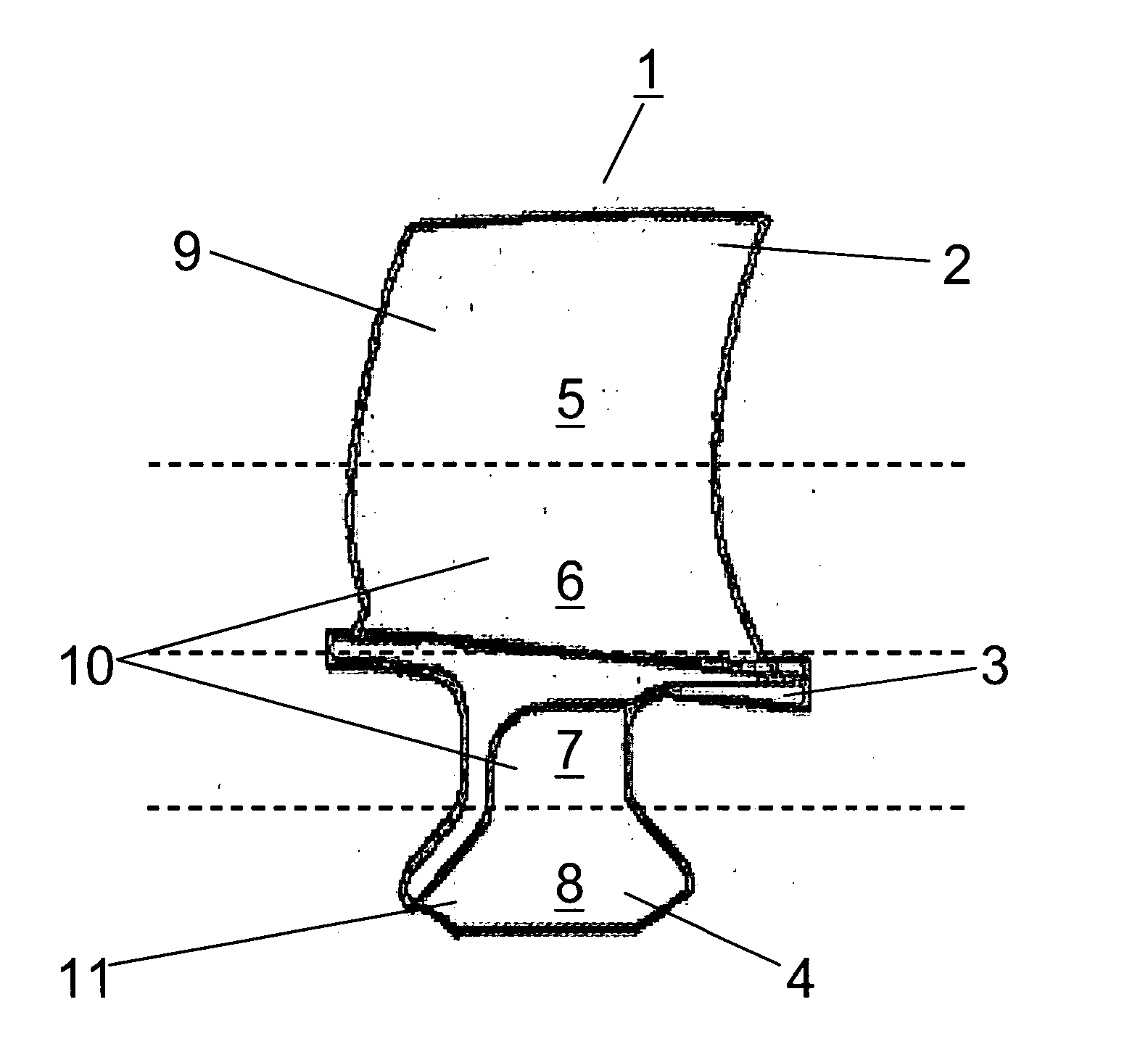
Figure 1 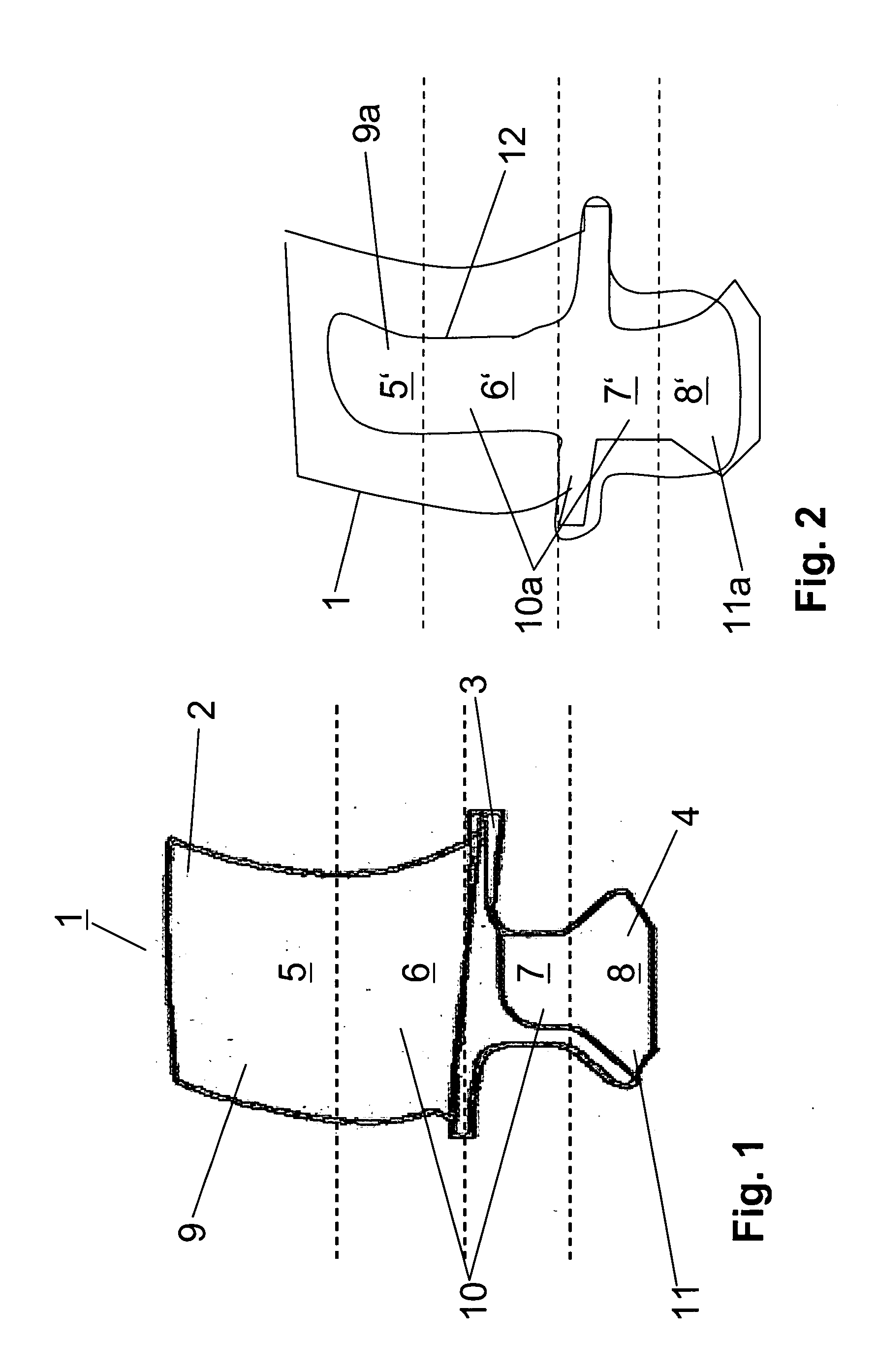
Figure 2
Abstract
Description
[0001] This application claims priority to German Patent Application DE 10 2004 062 174.8 filed Dec. 17, 2004, the entirety of which is incorporated by reference herein. BACKGROUND OF THE INVENTION
[0002] This invention relates to a method for the manufacture of highly loadable components by precision forging, preferably compressor or turbine blades or similar components with different stress and volume zones.
[0003] Turbine or compressor blades for aircraft engines are, as is generally known, manufactured by hot forging a blank made of usually cylindrical starting material to a near-net-shape preform in a multitude of subsequent forming operations, if applicable with intermediate deburring and surface treatment, as well as heat treatment to re-crystallization. From the preform, which in this case already comprises an airfoil, a platform and a blade root, the final form of the blade is then produced in further processing operations, for example deburring, cleaning, cold forging or s...
Examples
Embodiment Construction
[0015] The finished compressor blade 1 shown in FIG. 1 comprises an airfoil 2, a platform 3 and a root 4. In operation, the compressor blade 1 is partially, i.e., in the various blade zones, subject to different loads. A first stress zone 5 with small volume, which covers approximately the upper airfoil half extending from the blade tip, is subject to a dynamic high-frequency load and a low static load. A second stress zone 6, which covers approximately the bottom airfoil half, has a large volume and is subject to a medium static load and a low-frequency dynamic load. A third stress zone 7, which covers the platform 3 and the adjacent upper part of the root 4, again has a large volume and is subject to a high static and a low dynamic load. A fourth stress zone 8, which covers the bottom part of the root 4, has a medium volume and is subject to low load. The compressor blade 1 accordingly comprises three volume zones 9 to 11 of which each has a different volume, namely a first volume...