
Interleaving/de-interleaving using compressed bit-mapping sequences
Patent Information
- Authority / Receiving Office
- US · United States
- Current Assignee / Owner
- Publication Date
- 2006-07-13
- Estimated Expiration
- Not applicable · inactive patent
Smart Images
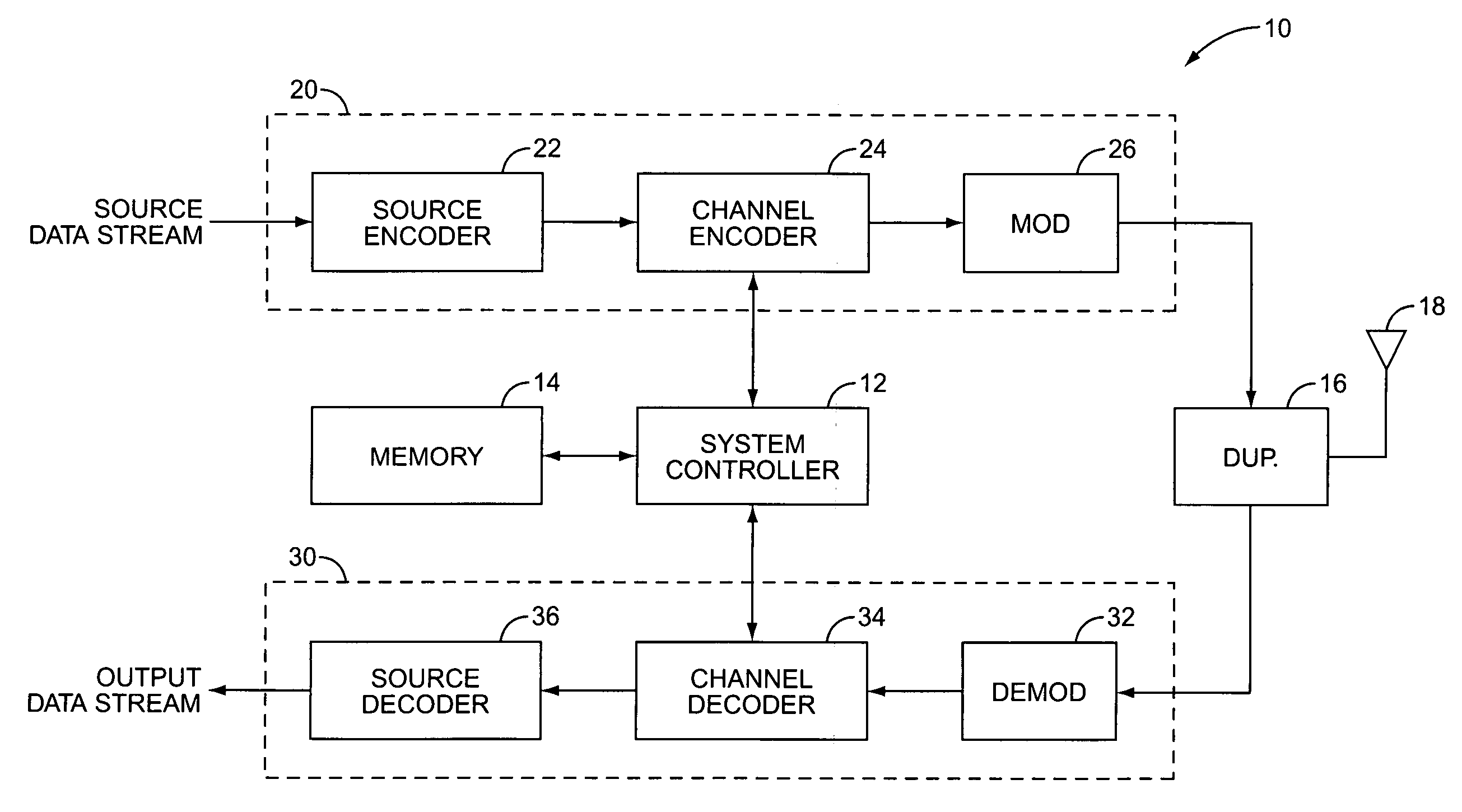
Figure 1 
Figure 2 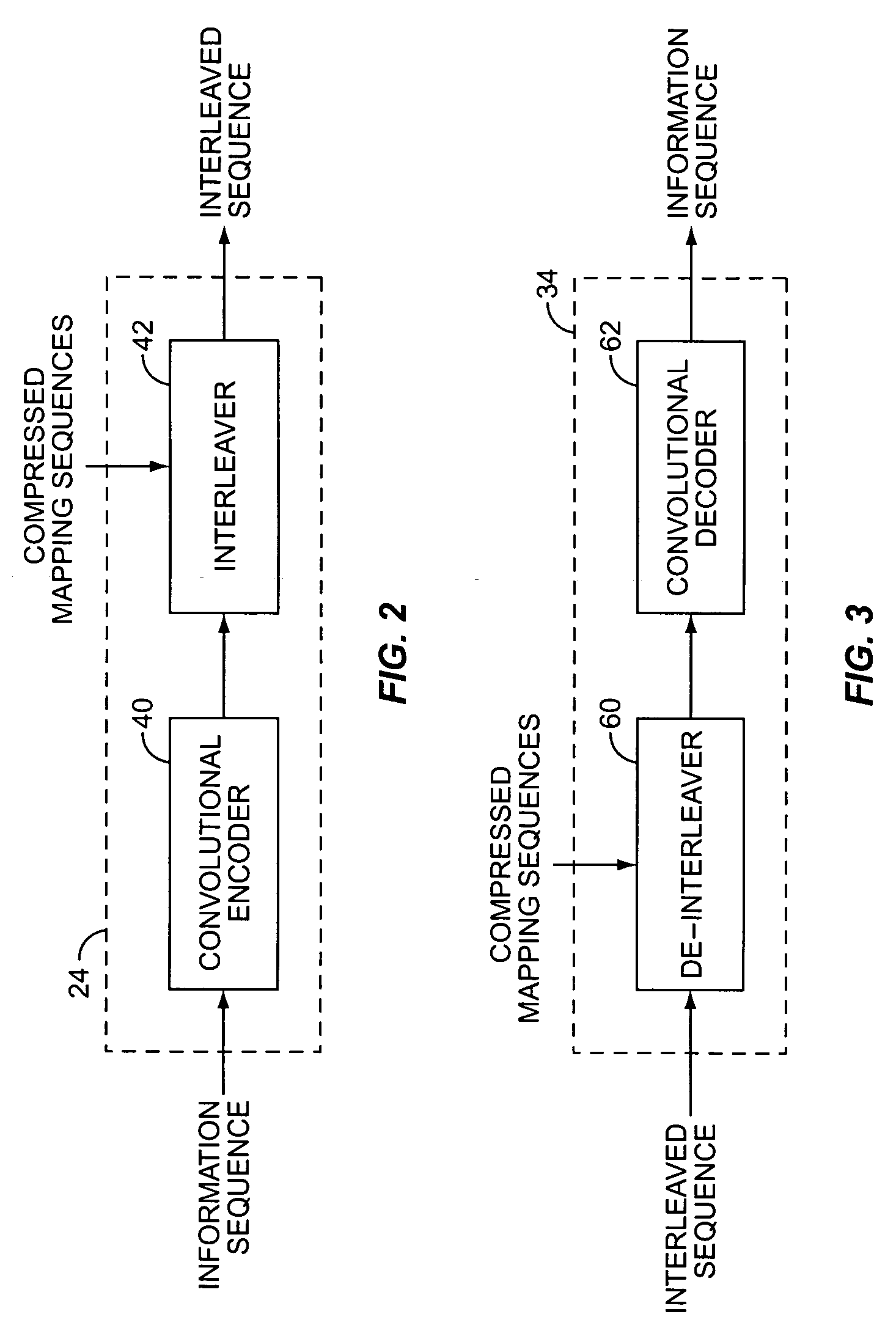
Figure 3
Abstract
Description
BACKGROUND OF THE INVENTION
[0001] The present invention relates generally to bit-mapping, and more particularly, to methods of interleaving / de-interleaving with compressed mapping sequences.
[0002] In many types of communication channels, such as radio channels, the inherent noise causes bit errors to occur during transmission. In order to reduce bit errors, digital communication systems typically use error control codes to enable detection and / or correction of the bit errors at the receiver. These error control codes introduce controlled redundancy into the information transmitted over the communication channel, which can be used at the receiver to detect and / or correct errors in the received signal. Error detecting codes enable the receiver to detect bit errors. The receiver may then request retransmission of the information that was received in error. Error correcting codes enable the receiver to detect and correct bit errors without retransmission.
[0003] Convolutional codes ar...
Examples
Embodiment Construction
[0018]FIG. 1 illustrates a mobile communication device generally indicated by the numeral 10. The mobile communication device 10 comprises a system controller 12 to control the overall operation of the mobile communication device 10, a memory 14 to store programs and data needed for operation, a transmitter 20 to transmit signals, and a receiver 30 to receive signals. The transmitter 20 and receiver 30 are coupled to a common antenna 18 by a duplexer or switch 16 that permits full duplex operation.
[0019] The transmitter 20 receives a source data stream from an information source, processes the source data stream to generate a transmit signal suitable for transmission over a radio channel, and modulates the transmit signal onto an RF carrier. The transmitter 20 includes a source encoder 22, a channel encoder 24 and a modulator 26. The source encoder 22 removes redundancy or randomizes the source data stream to produce an information sequence that has been optimized for maximum infor...