
Composites Made of Thermoplastic Polymers, Residual Oil, and Cellulosic Fibers
a technology of thermoplastic polymers and residual oil, applied in plastic recycling, recycling and recovery technologies, climate sustainability, etc., can solve the problems of contaminated containers becoming waste, re-using polymer containers for other purposes, and most plastic recycling programs will not accept empty motor oil containers, etc., to reduce incompatibilities
Patent Information
- Authority / Receiving Office
- US · United States
- Patent Type
- Applications(United States)
- Current Assignee / Owner
- Publication Date
- 2011-10-27
- Estimated Expiration
- Not applicable · inactive patent
Smart Images
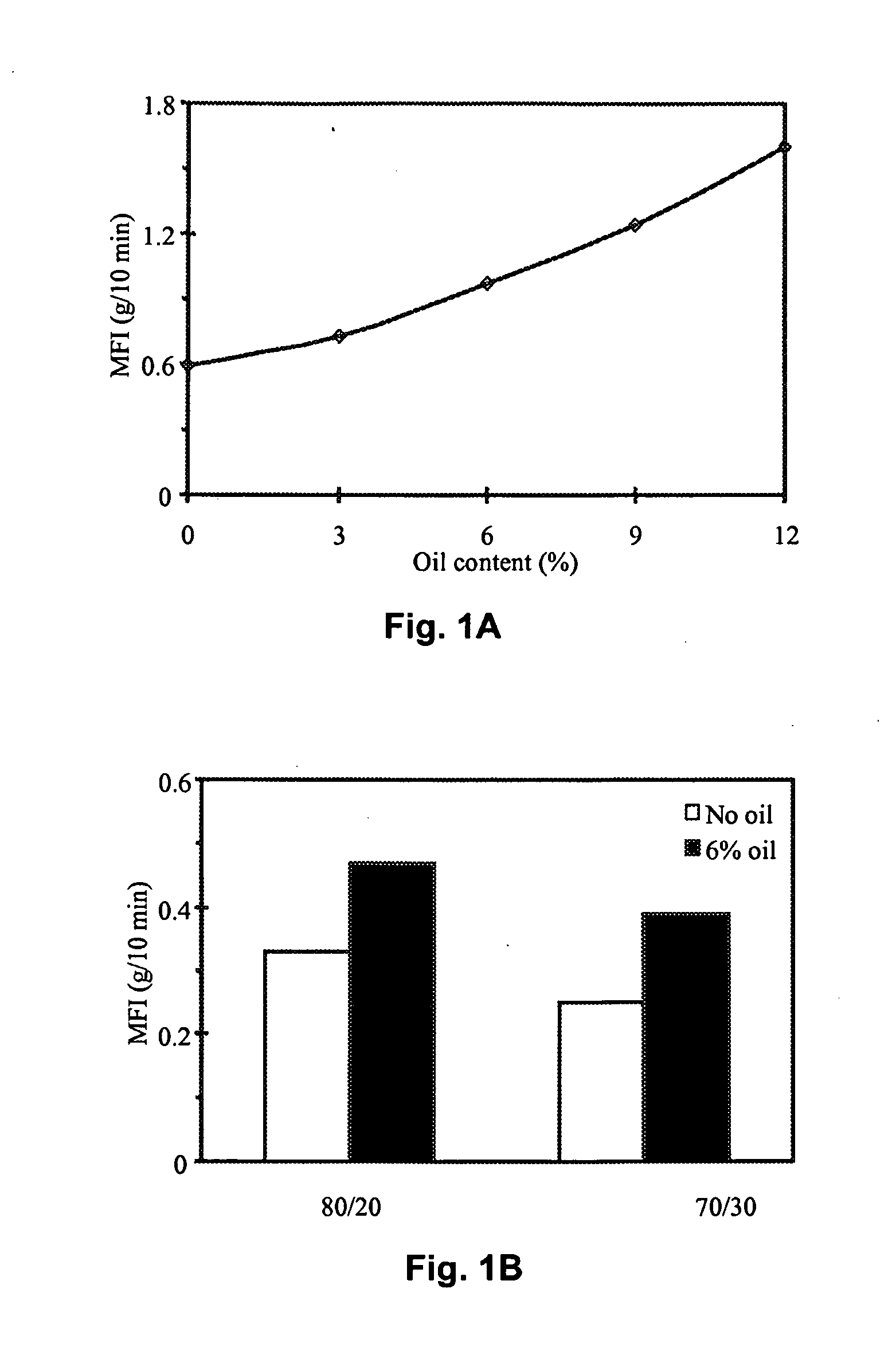
Figure 1 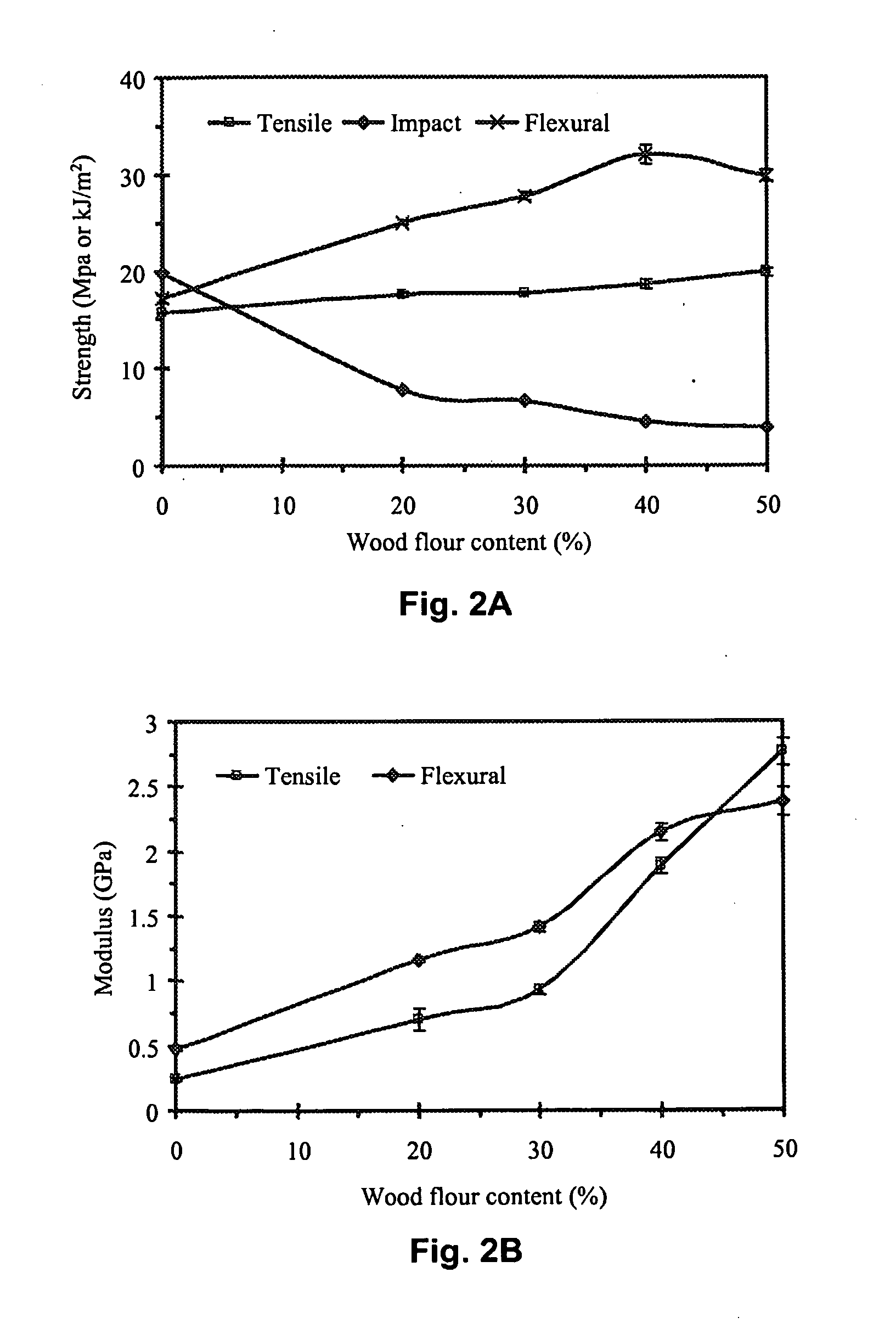
Figure 2 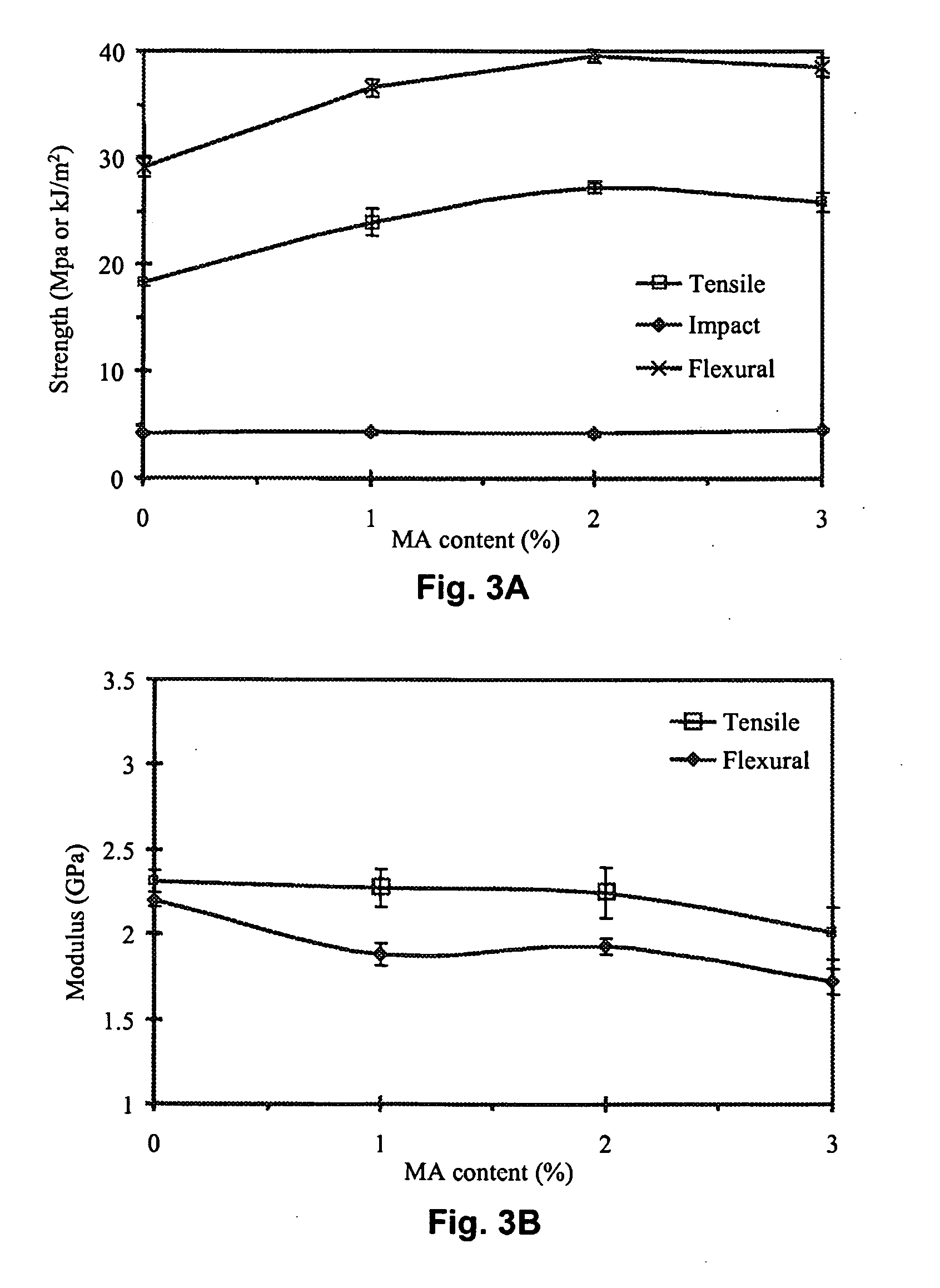
Figure 3
Abstract
Description
[0001] (In countries other than the United States:) The benefit of the 17 Dec. 2007 filing date of U.S. provisional patent application 61 / 014,098 is claimed under applicable treaties and conventions. (In the United States:) The benefit of the 17 Dec. 2007 filing date of U.S. provisional patent application 61 / 014,098 is claimed under 35 U.S.C. §119(e).
[0002] The development of this invention was partially funded by the United States Government under grant number 68-3A75-6-508 awarded by the Department of Agriculture. The United States Government has certain rights in this inventionTECHNICAL FIELD
[0003] This invention pertains to recycling of polymers contaminated with oil, such as used motor oil containers, into composite materials.BACKGROUND
[0004] Over 3 billion quart-size (−0.95 liter) high-density polyethylene (HDPE) motor oil containers are used each year in the United States alone, representing about 150,000 tons of HDPE waste containers annually; and many more are produced in other...
Examples
example 1
Polymer / Wood / Oil Composites
[0037]Quart-size HDPE motor oil containers were obtained from an oil change station in Baton Rouge, La. The sample primarily comprised automobile engine oil containers from a single manufacturer (Castol®). The containers were separated by color (silver, black, white) to investigate the possible significance, if any, of container color. Free-flowing oil in each bottle was drained into a glass beaker at room temperature. The bottles were then washed with xylenes (Mallinckrodt Chemicals) to determine initial residual oil loading, and also to obtain clean containers for comparisons. The washed containers were oven-dried at 80° C. for 8 hours, and then granulated to produce flakes 2-10 mm in diameter, with varying thicknesses. The flakes were then combined with wood fiber, motor oil, and additives as described below. The size of the flakes depends on the process apparatus and process parameters used, and in general will be ˜2 cm or smaller in diameter. (“Diamet...
example 2
WPC Composite Melt Flow Index Characterization
[0039]The melt flow indices (MFI) of the blends were measured (ASTM D1238) using an extrusion plastometer MP600 (Tinius Olsen Inc., Horsham, Pa.) at 190° C. with a 2.16 kg load. MFIs at 190° C. for the silver oil container HDPE and its composites are shown in FIG. 1. The MFI of the polymer increased linearly with increased oil loading (FIG. 1a). The MFI of the polymer / wood flour composites also increased with increased oil loading (FIG. 1b). The residual oil thus acted as a plasticizer, increasing polymer melt flowability and processability. Adding oil in an amount equal to 6% of the polymer by weight increased the MFI of the composites by 42.4% for the HDPE:wood flour 80 / 20 system, and by 56% for the HDPE:wood flour 70 / 30 system.
example 3
Characterization of Composite Flexural and Tensile Properties
[0040]Flexural and tensile properties were measured according to ASTM D790-03 and D638-03, respectively, using an INSTRON machine (Model 1125, Boston, Mass.). For each blend, five replicates were tested. A TINIUS 92T impact tester (Testing Machine Company, Horsham, Pa.) was used for the Izod impact test. All samples were notched at the center point of one longitudinal side according to the ASTM D256. Five replicates were tested for each treatment level. The influence of wood flour percentage on composite mechanical properties is shown in FIG. 2. Increasing the wood flour loading increased the flexural strength up to a maximum at about 40% wood flour. Tensile strength did not depend strongly on wood flour loading. Impact strength first dropped quickly, and then decreased more slowly when at wood flour levels over 20%. The flexural and tensile strengths of the composites increased by 87.4% and 18.6%, respectively, with 40% w...