
Novel antibody-albumin-drug conjugates (AADC) and methods for using them
a technology of antibody and albumin, which is applied in the direction of peptides, peptide/protein ingredients, fusions for specific cell targeting, etc., can solve the problems of few antibodies reaching commercialization, already failed clinical trials, and global crisis
Patent Information
- Authority / Receiving Office
- US · United States
- Patent Type
- Applications(United States)
- Current Assignee / Owner
- Publication Date
- 2018-03-01
- Estimated Expiration
- Not applicable · inactive patent
Smart Images
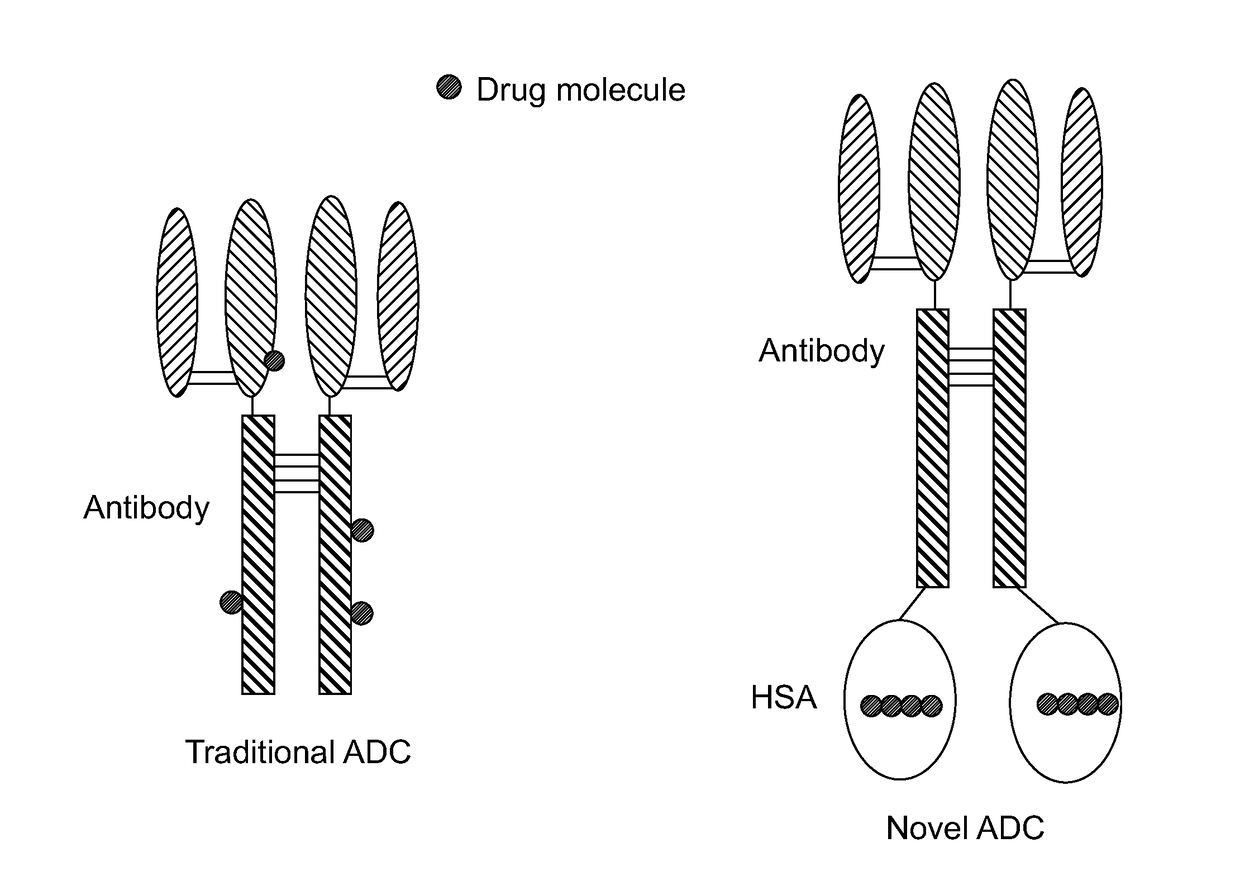
Figure 1 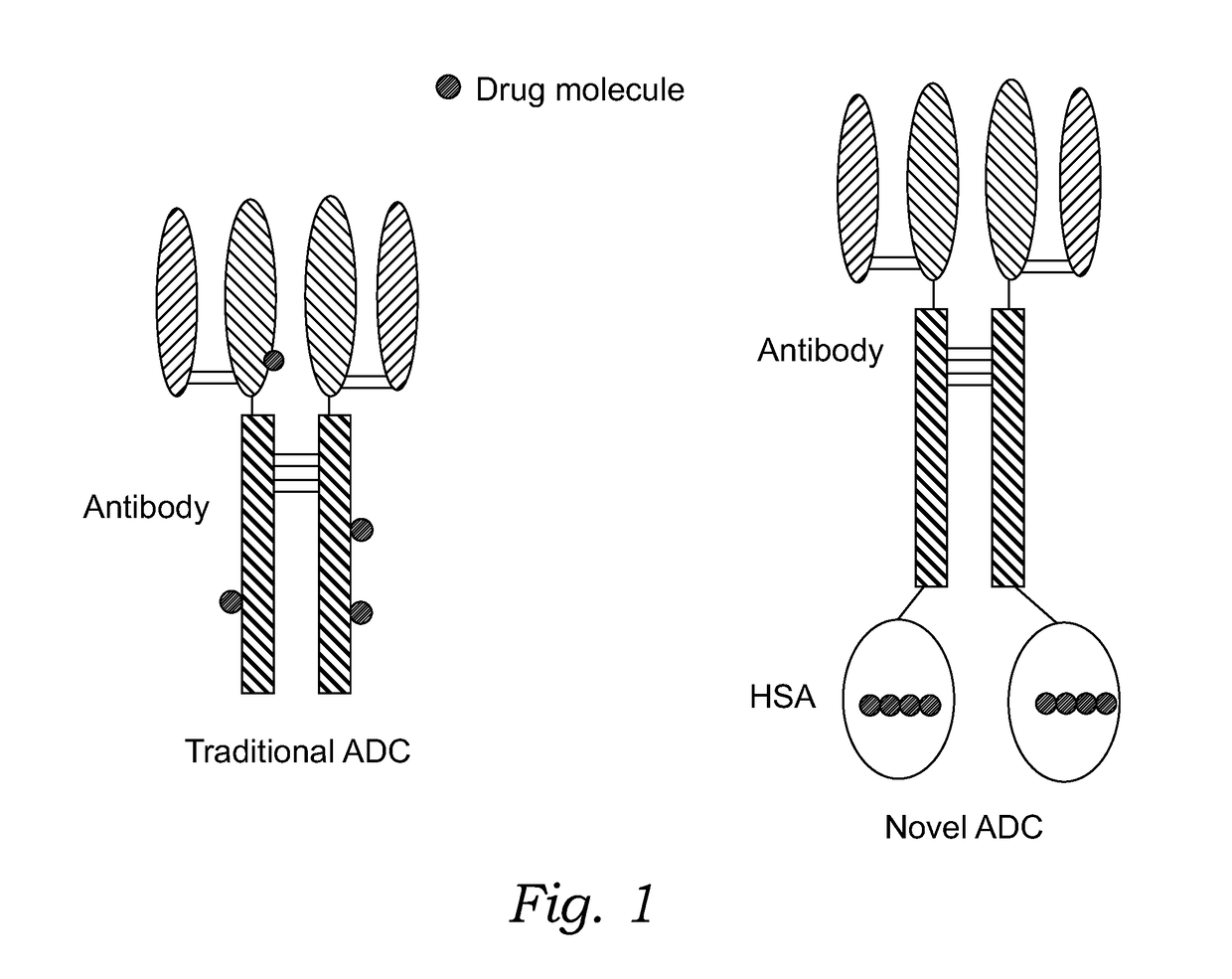
Figure 2 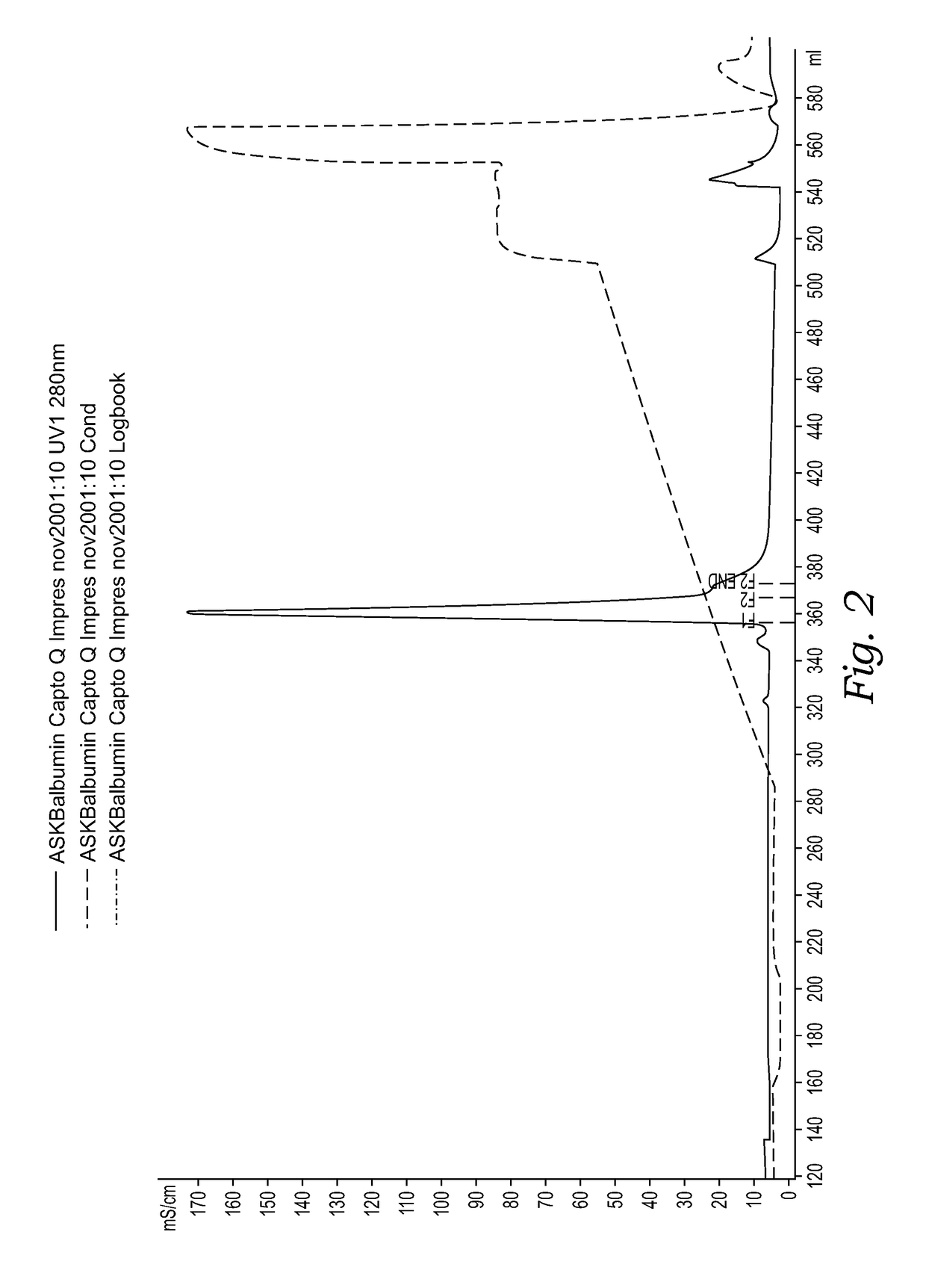
Figure 3
Abstract
Description
CROSS REFERENCE TO RELATED APPLICATIONS
[0001] The present application claims priority to U.S. provisional patent application 62 / 369,649, filed Aug. 1, 2016, U.S. provisional patent application 62 / 463,500, filed Feb. 24, 2017, and PCT / US2017 / 044771, filed Jul. 31, 2017, each herein incorporated by reference in their entirety.INTRODUCTION
[0002] Human Serum Albumin (HSA, HA): Albumin a protein of 585 amino acids in its mature form, is responsible for a significant proportion of the osmotic pressure of serum and also functions as a carrier of endogenous and exogenous ligands. It is the principal transport protein in human plasma. It is highly soluble and is the most abundant plasma protein in the blood, at 35-50 g / L (Kratz F. Albumin as a drug carrier: Design of prodrugs, drug conjugates and nanoparticles. J Control Release. 2008; 132(3):171-83). It binds a broad spectrum of compounds and metabolites, for example, steroids, bile acids, fatty acids and amino acids, heavy metals and pharmac...
Examples
example 1
n of GPC3 Antibody, the Chimeric Molecules Comprising GPC3 Antibody and Albumin
[0257]GPC3 antibody and GPC3 Antibody-Albumin Chimeric molecules were expressed through transient expression by HEK-293 cells. Briefly, DNAs were synthesized by DND 2.0 for expressing the light chain (with amino acid sequence as shown in SEQ ID NO:10), the heavy chain (with amino acid sequence as shown in SEQ ID NO:11), the heavy chain-albumin fusion protein (with amino acid sequence as shown in SEQ ID NO:41), and the heavy chain-albumin fusion protein with two point mutations in the albumin domain (with amino acid sequence as shown in SEQ ID NO:42). The antibody-albumin chimeric molecule with the light chain of SEQ ID NO:10 and the heavy chain-albumin fusion protein of SEQ ID NO:41 was named Anti-GPC3-AB#1. The antibody-albumin chimeric molecule with the light chain of SEQ ID NO:10 and the heavy chain-albumin fusion protein of SEQ ID NO:42 was named Anti-GPC3-AB#2. The complete expression constructs with...
example 2
l Measurement
[0259]In order to confirm that the cysteine residues introduced into the albumin domain of the chimeric molecule Anti-GPC3-AB#2 remained free after purification and storage, the free thiol content was measured for the purified Anti-GPC3-AB#2 sample, Lot# LL12-10, which had been stored at 2-8° C. for over 10 weeks. The free thiol measurement was carried out using the following procedure:[0260]a. Prepare free thiol working standard (110 microM) by diluting the 110 mM free thiol standard (Thermo Fisher Scientific, Cat# M30505) 1000 times with water.[0261]b. Further dilute the working standard to desired thiol concentrations ranged from 0-44 microM to serve as the calibration curve.[0262]c. Obtain 10 microL of the Anti-GPC3-AB#2 sample at 0.22 mg / ml and 10 microL of a BSA solution at 2.0 mg / ml. The BSA sample is served as a positive control for this experiment. Add 40 microL of the denaturing solution (6 M Guanidine HCl) to each of the samples, and heat at 85° C. for 10 min...
example 3
on of Fluorescent Dye
[0267]In order to test conjugations of the antibody-albumin chimeric molecules as well as the potential impact of albumin on the internalization process, pHAb dyes from Promega, Madison, Wis. were used. A key feature of pHAb Dyes is that they have two sulfonate groups per dye, which improve solubility in water and reduce the aggregation often seen with other non-sulfonated dyes. pHAb dye is a pH sensor florescence dye that has very low florescence at pH>7 but as pH become acidic, even after the dye conjugated to antibody. Any protein containing primary amines on lysine amino acids or thiols on the cysteine amino acids can be conjugated with pHAb Dyes. Conjugating pHAb Reactive Dyes to Antibodies is easy to detect after internalization because of the low pH environment inside the cells. The dye florescence cannot be detected when on cell surface
[0268]Conjugations to the primary amines of the GPC3 antibodies as well as the chimeric molecules Anti-GPC3-AB#1 and Ant...