
Attribute mapping to encode and decode 3D models
a technology of attribute mapping and 3d model, applied in the field of attribute mapping to encode and decode 3d models, can solve the problem that known techniques do not take advantage of correlations between points or vertices in sufficient degr
Patent Information
- Authority / Receiving Office
- US · United States
- Patent Type
- Applications(United States)
- Current Assignee / Owner
- Publication Date
- 2018-07-05
Smart Images
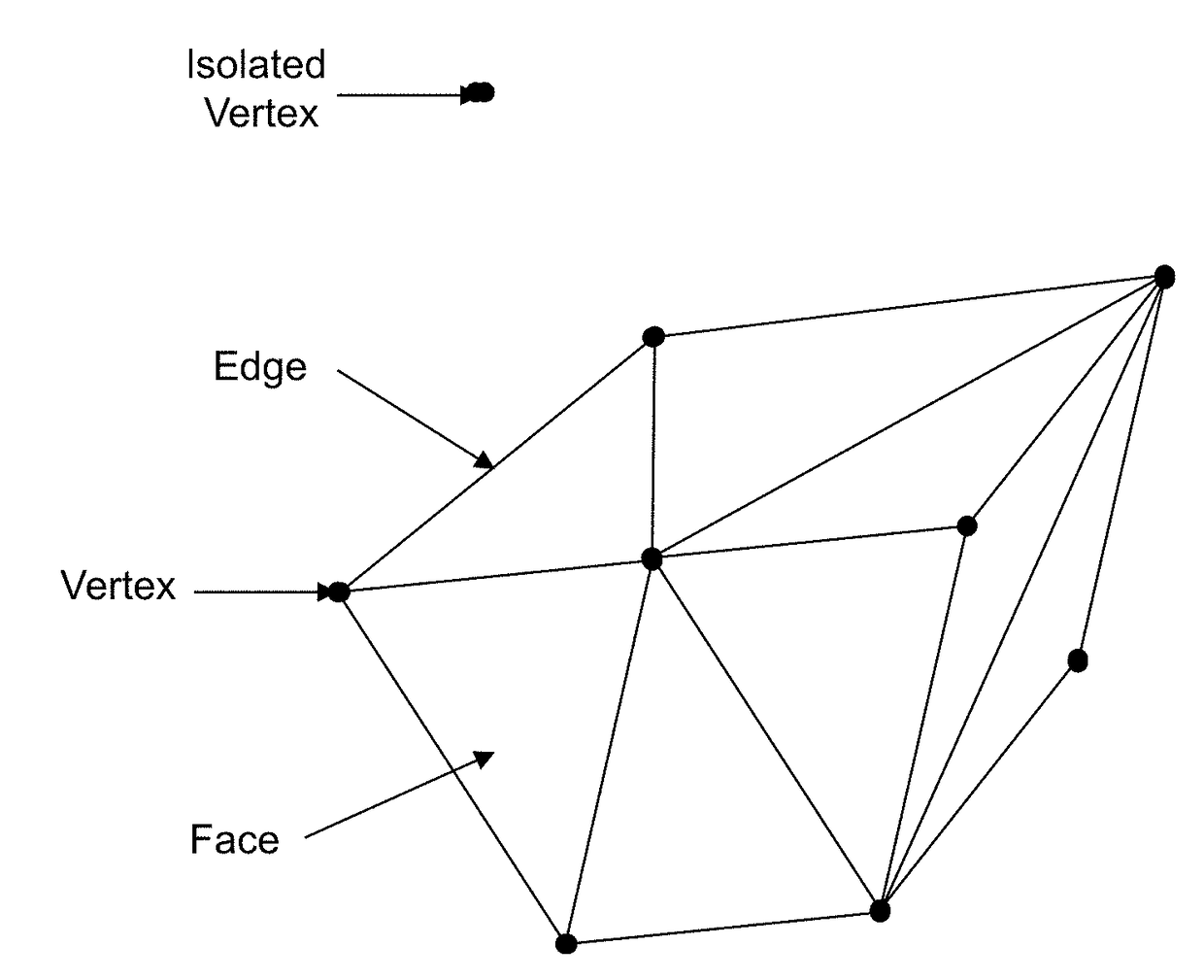
Figure 1 
Figure 2 
Figure 3
Abstract
Description
[0001] This application claims the benefit under 35 U.S.C. § 119(a)-(d) of United Kingdom Patent Application No. 1700025.8, filed on 2 Jan. 2017 and entitled “IMPROVED ATTRIBUTE MAPPING TO ENCODE AND DECODE 3D MODELS”. The above cited patent application is incorporated herein by reference in its entirety.”FIELD OF THE INVENTION
[0002] The present invention relates generally to the encoding of three-dimensional (3D) objects, and more specifically to methods and devices for encoding, into a bitstream, 3D models made of a plurality of points, for instance connected vertices forming triangles, and for decoding such bitstream. The present invention focuses on the encoding of property data, such as colour attributes.BACKGROUND OF THE INVENTION
[0003] 3D models are made of geometrical entities. 3D models may be made of a cloud of points. However, more common 3D models are 3D mesh models composed of polygons, e.g. triangles, between connected points, also denoted vertices.
[0004] Typically, 3D mes...
Examples
Embodiment Construction
[0197]The invention will now be described by means of specific non-limiting exemplary embodiments and by reference to the figures.
[0198]The present invention relates generally to the encoding of three-dimensional (3D) objects into a bitstream, usually 3D models made of a plurality of points, for instance a cloud of points or connected vertices forming polygons such as triangles. The invention particularly provides improvements to the coding of property data, which are additional to geometry data and possible connectivity data used to respectively describe the locations or positions of the vertices within the space and the connectivity between the vertices in case of a 3D mesh model.
[0199]A 3D mesh model is a representation of a tri-dimensional object or scene. As shown in FIG. 1, it comprises vertices, edges connecting vertices and faces defined by edges. Isolated vertices, one of which is shown in the Figure, does not belong to any edge or face. Two isolated vertices may be connect...