
Novel octahydroindenyl propanal compounds
a technology of octahydroindenyl propanal and compound, applied in the field of new chemical entities, can solve the problems of difficult identification of desirable fragrance chemicals, difficult for those with skill in the art to predict the effectiveness of a given structure, etc., and achieve the effect of enhancing, improving or modifying the fragrance of perfumes, colognes, toilet water
Patent Information
- Authority / Receiving Office
- US · United States
- Patent Type
- Applications(United States)
- Current Assignee / Owner
- Publication Date
- 2018-10-18
- Estimated Expiration
- Not applicable · inactive patent
Smart Images

Figure 1 
Figure 2 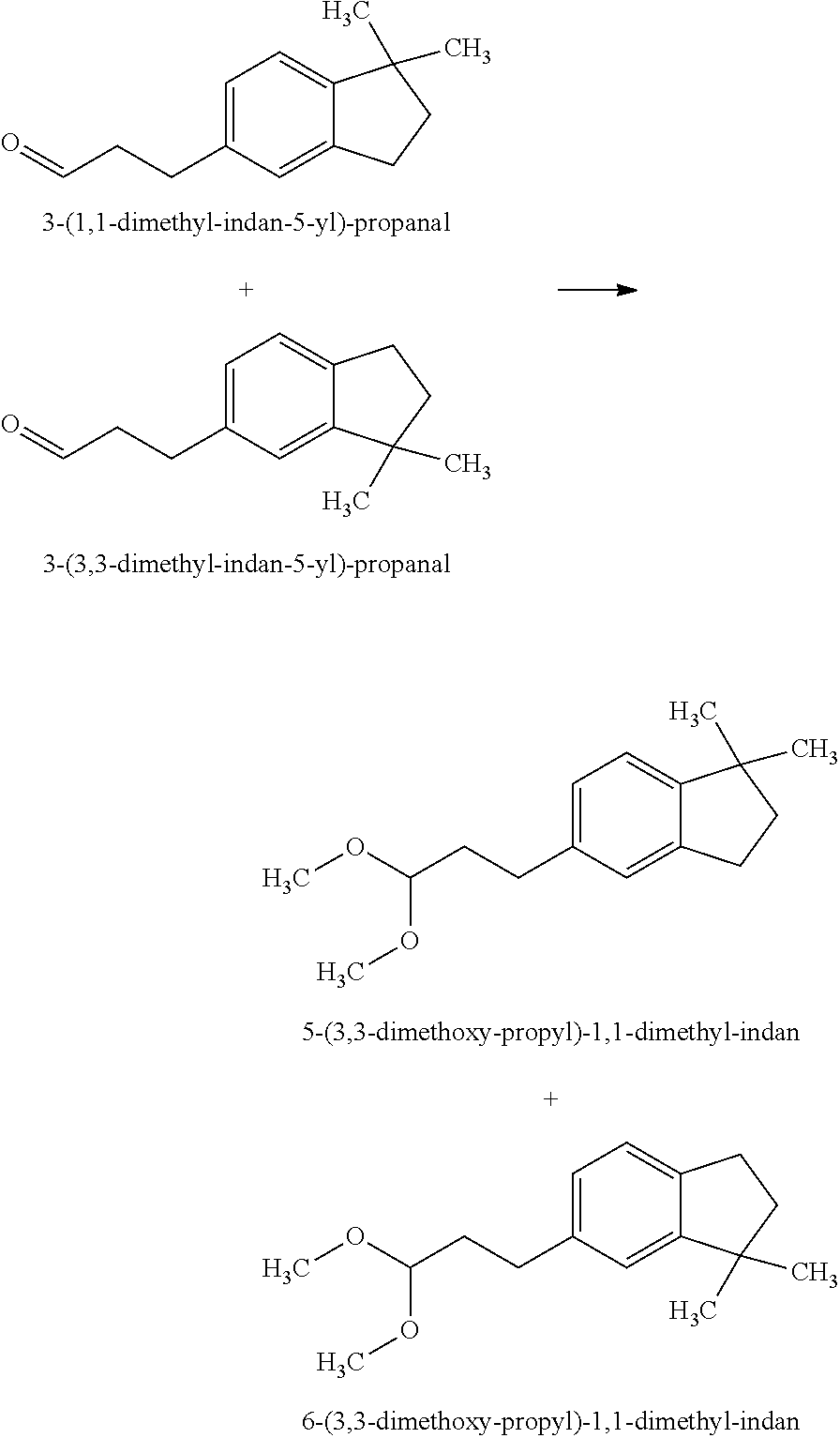
Figure 3
Abstract
Description
STATUS OF RELATED APPLICATIONS
[0001] This application claims priority to U.S. provisional application 62 / 240,238 filed Oct. 12, 2015, the content hereby incorporated by reference as if set forth in its entirety.FIELD OF THE INVENTION
[0002] The present invention relates to novel chemical entities and a method of using the same as fragrance materials.BACKGROUND OF THE INVENTION
[0003] There is an ongoing need in the fragrance industry to provide new chemicals to give perfumers and other persons the ability to create new fragrances for perfumes, colognes and personal care products. Those with skill in the art appreciate how small differences in chemical structures can result in unexpected and significant differences in odor, notes and characteristics of molecules. These variations allow perfumers and other persons to apply new compounds in creating new fragrances. For example, benzene compounds that differ slightly in substituents possess completely different odor profiles [Ishikawa, et al...
Examples
example i
[0065]
Preparation of 5-(3,3-Dimethoxy-propyl)-1,1-dimethyl-indan and 6-(3,3-Dimethoxy-propyl)-1,1-dimethyl-indan
[0066]The mixture of 3-(1,1-dimethyl-indan-5-yl)-propanal and 3-(3,3-dimethyl-indan-5-yl)-propanal in a weight ratio of 40:60 (See, U.S. Pat. No. 5,552,379) (150 g, 0.74 mol) was dissolved in trimethyl orthoformate (HC(OCH3)3) (250 g) and methanol (50 g) and cooled to −10° C. Hydrochloric acid (HCl) (12 M, 1 mL) was added and the reaction rapidly exothermed to 40° C. Sodium acetate (CH3COONa) (20 g) was added. The resulting reaction mixture was distilled to provide the mixture of 5-(3,3-dimethoxy-propyl)-1,1-dimethyl-indan and 6-(3,3-dimethoxy-propyl)-1,1-dimethyl-indan in a weight ratio of 40:60 (170 g).
[0067]The mixture of 5-(3,3-dimethoxy-propyl)-1,1-dimethyl-indan and 6-(3,3-dimethoxy-propyl)-1,1-dimethyl-indan was described as having chemical, kerosene-like, muguet and spicy notes.
[0068]The mixture of 5-(3,3-dimethoxy-propyl)-1,1-dimethyl-indan and 6-(3,3-dimethoxy-pr...
example ii
[0070]
Preparation of 3-(1,1-Dimethyl-octahydro-inden-5-yl)-propanal (Formula Ia) and 3-(3,3-Dimethyl-octahydro-inden-5-yl)-propanal (Formula Ib)
[0071]The mixture of 5-(3,3-dimethoxy-propyl)-1,1-dimethyl-indan and 6-(3,3-dimethoxy-propyl)-1,1-dimethyl-indan (obtained as above in EXAMPLE I) (108 g, 435 mmol) in isopropanol (CH3CHOHCH3) (200 mL) was hydrogenated over ruthenium (IV) oxide (RuO2) at 60° C. under 400 psi hydrogen (H2) for 8 hours. The reaction was cooled and vented to atmospheric pressure. The resulting mixture was filtered through Celite® and evaporated to dryness. The crude was dissolved in methyl ethyl ketone (MEK) (CH3C(O)CH2CH3) (200 mL). To the crude solution was added water (50 mL) and HCl (12 M, 1 mL) and the resulting mixture was heated to reflux for 1 hour. The reaction was then cooled and toluene (20 mL) was added. The organic layer was separated and evaporated to dryness. Further distillation provided the mixture of 3-(1,1-dimethyl-octahydro-inden-5-yl)-propan...
example iii
[0075]
Preparation of 1-(1,1-Dimethyl-indan-5-yl)-ethanone and 1-(3,3-Dimethyl-indan-5-yl)-ethanone
[0076]Aluminum chloride (AlCl3) (408 g, 3.1 mol) was dissolved in dichloromethane (CH2Cl2) (1 L) and cooled to 0° C. Acetyl chloride (CH3COCl) (240 g, 3.1 mol) was fed in over 30 minutes. While the temperature was maintained at 0° C., 1,1-dimethyl-indan (448 g, 3.1 mol) was added and the mixture was stirred for 2 hours. The resulting mixture was poured into ice (5 Kg). The organic layer was then separated and distilled to provide a clear oil comprising the mixture of 1-(1,1-dimethyl-indan-5-yl)-ethanone and 1-(3,3-dimethyl-indan-5-yl)-ethanone in a weight ratio of 40:60 (420 g).
[0077]The mixture of 1-(1,1-dimethyl-indan-5-yl)-ethanone and 1-(3,3-dimethyl-indan-5-yl)-ethanone was described as having chemical, kerosene, gassy and spicy notes.
1-(1,1-Dimethyl-indan-5-yl)-ethanone
[0078]1H NMR (CDCl3, 500 MHz): 7.77-7.81 (m, 1H), 7.73-7.76 (m, 1H), 7.24 (d, J=8.5 Hz, 1H), 2.92 (t, J=7.3 Hz, 2...