
Modifier, Method For Preparing The Same, And Modified Conjugated Diene-Based Polymer Including The Same
a conjugated diene-based polymer and modified technology, applied in the field of modified conjugated diene-based polymers including the same, can solve the problems of low wet skid resistance of rubbers and insufficient effect, and achieve excellent affinity with fillers, high anion reactivity, and easy action with active parts of polymers.
Patent Information
- Authority / Receiving Office
- US · United States
- Patent Type
- Applications(United States)
- Current Assignee / Owner
- Publication Date
- 2019-06-13
Smart Images
Figure 1 
Figure 2 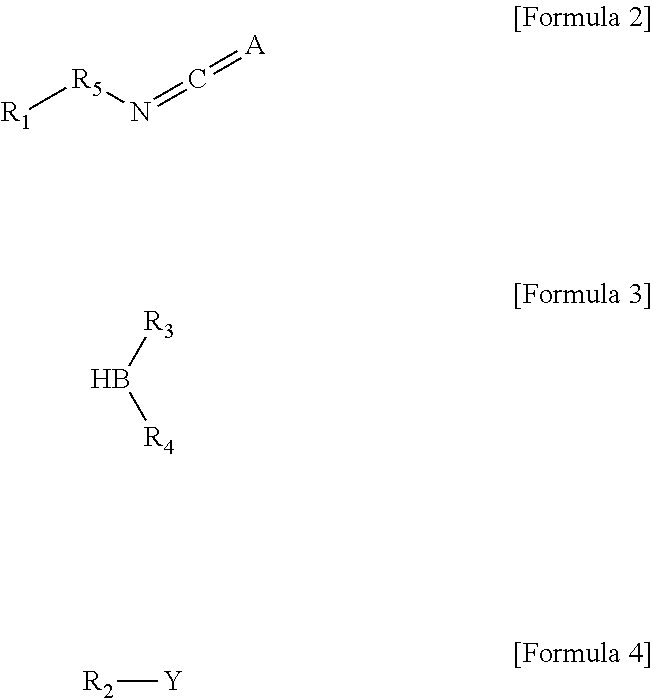
Figure 3
Abstract
Description
CROSS-REFERENCE TO RELATED APPLICATIONS
[0001] The present application claims the benefit of priority based on Korean Patent Application No. 10-2017-0097188, filed on Jul. 31, 2017, the entire contents of which are incorporated herein by reference.TECHNICAL FIELDTechnical Field
[0002] The present invention relates to a modifier useful for the modification of a conjugated diene-based polymer, having excellent affinity with a filler, and capable of improving the compounding properties of a conjugated diene-based polymer, a method for preparing the same, a modified conjugated diene-based polymer including the modifier, and a method for preparing the polymer.Background Art
[0003] According to the recent demand for cars having a low fuel consumption ratio, a modified conjugated diene-based polymer having modulational stability represented by wet skid resistance as well as low rolling resistance, and excellent abrasion resistance and tensile properties is required as a rubber material for tires...
Examples
preparation examples
Preparation Example 1: Preparation of Modifier Represented by Formula i
[0131]To a 1 L round bottom-flask connected with a schlenk line, 0.1 mol (13.92 g) of a compound represented by Formula 2-1 was added, the pressure was decreased and moisture was completely removed. Then, under an argon atmosphere, 500 ml of dichloromethane was added and 0.095 mol (40.44 g) of a compound represented by Formula 3-1 was injected, followed by stirring and reacting at room temperature for 4 hours. Then, 0.12 mol (13.04 g) of a compound represented by Formula 4-1 and 0.15 mol (15.18 g) of triethylamine were added thereto at a low temperature and stirred at room temperature for 24 hours to prepare a modifier represented by Formula i. After that, low boiling point by-products and unreacted materials were removed using a rotary evaporator, and extraction with hexane / acetonitrile was carried out to obtain a separated modifier represented by Formula i. 1H and 13C nuclear magnetic resonance spectroscopic sp...
preparation example 2
er Represented by Formula (ii)
[0134]To a 1 L round bottom-flask connected with a schlenk line, 0.1 mol (12.30 g) of a compound represented by Formula 2-2 was added, the pressure was decreased and moisture was completely removed. Then, under an argon atmosphere, 500 ml of dichloromethane was added, and 0.095 mol (40.44 g) of a compound represented by Formula 3-1 was injected, followed by stirring and reacting at room temperature for 4 hours. Then, 0.12 mol (13.04 g) of a compound represented by Formula 4-1 and 0.15 mol (15.18 g) of triethylamine were added thereto at a low temperature and stirred at room temperature for 24 hours to prepare a modifier represented by Formula (ii). After that, low boiling point by-products and unreacted materials were removed using a rotary evaporator, and extraction with hexane / acetonitrile was carried out to obtain a separated modifier represented by Formula (ii). 1H and 13C nuclear magnetic resonance spectroscopic spectrums were observed.
[0135]1H NMR...
preparation example 3
er Represented by Formula iii
[0137]To a 1 L round bottom-flask connected with a schlenk line, 0.1 mol (13.92 g) of a compound represented by Formula 2-1 was added, the pressure was decreased and moisture was completely removed. Then, under an argon atmosphere, 500 ml of dichloromethane was added, and 0.095 mol (22.65 g) of a compound represented by Formula 3-4 was injected, followed by stirring and reacting at room temperature for 4 hours. Then, 0.12 mol (13.04 g) of a compound represented by Formula 4-1 and 0.15 mol (15.18 g) of triethylamine were added thereto at a low temperature and stirred at room temperature for 24 hours to prepare a modifier represented by Formula (iii). After that, low boiling point by-products and unreacted materials were removed using a rotary evaporator, and extraction with hexane / acetonitrile was carried out to obtain a separated modifier represented by Formula (iii). 1H and 13C nuclear magnetic resonance spectroscopic spectrums were observed.
[0138]1H NM...