
Cationically curable composition and method for the joining, casting and coating of substrates using the composition
Patent Information
- Authority / Receiving Office
- US · United States
- Current Assignee / Owner
- Publication Date
- 2022-03-03
Smart Images
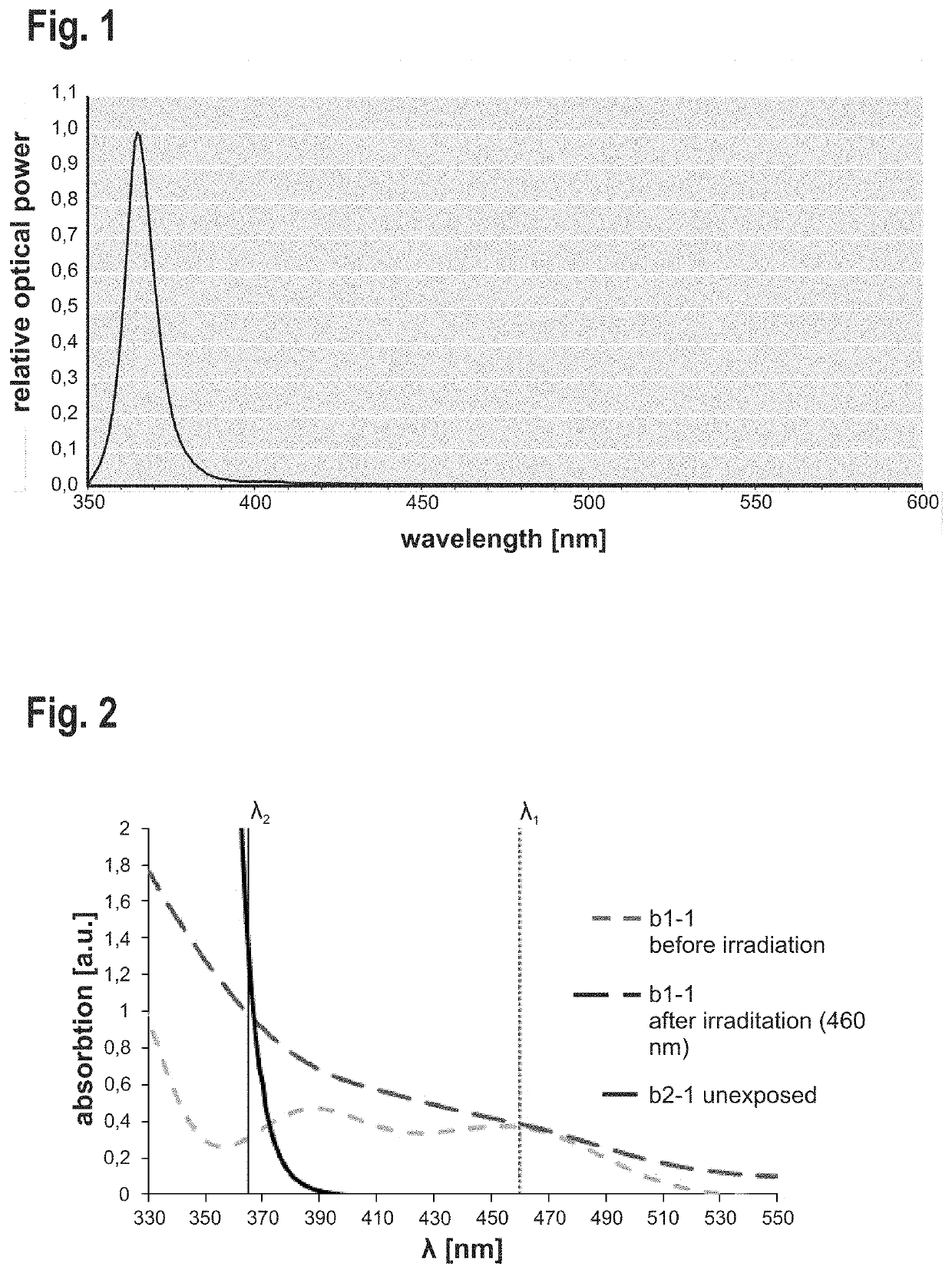
Figure 1 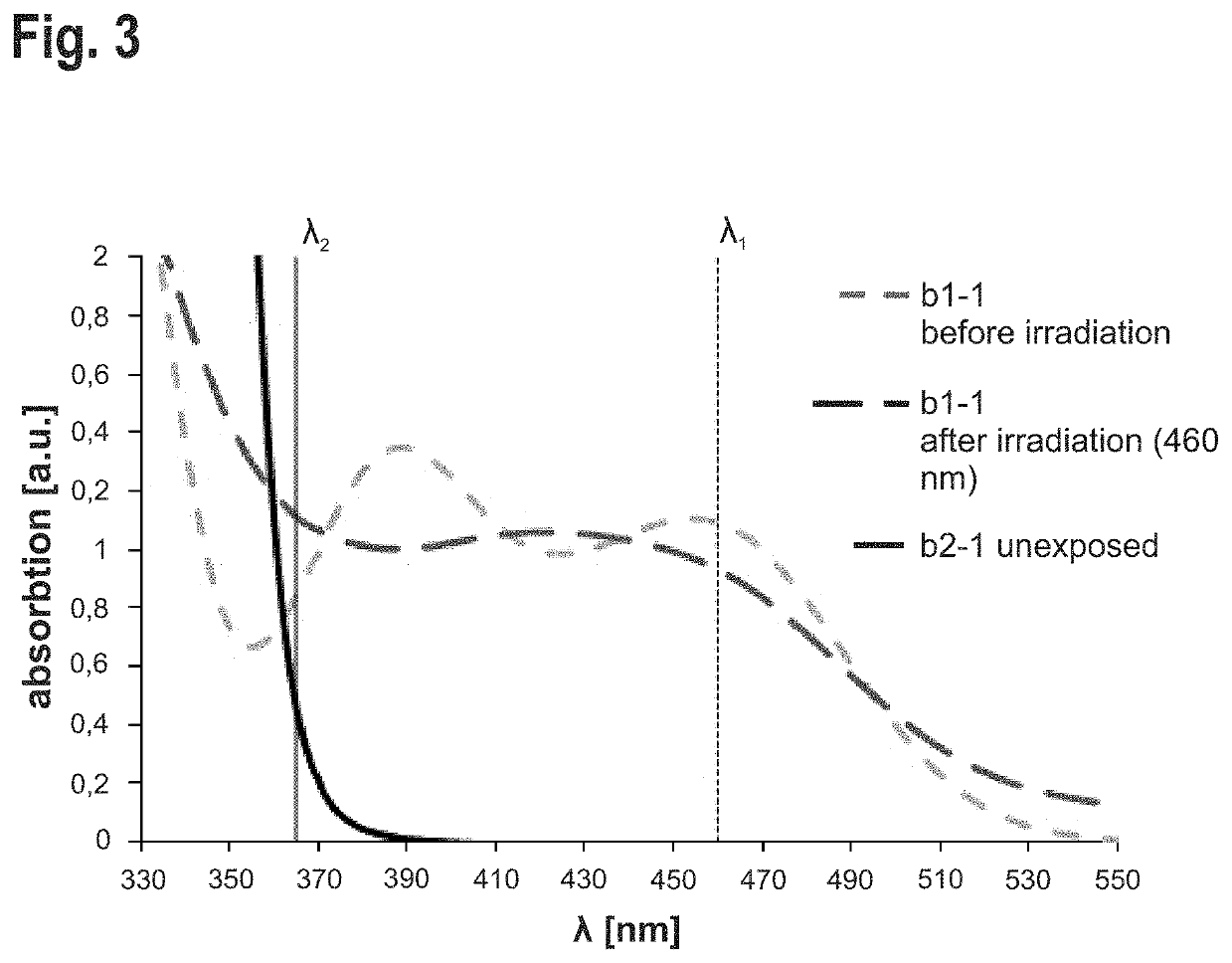
Figure 2
Abstract
Description
FIELD OF THE INVENTION
[0001] The invention relates to a cationically curable composition that can be activated by irradiation with actinic radiation, and a method for the joining, casting and coating of substrates using the composition.TECHNICAL BACKGROUND
[0002] Cationically polymerizable compositions with photoinitiators based on sulfonium and iodonium salts have been part of the state of the art for years. An overview of suitable photoinitiators can be found in the publications of J. V. Crivello and K. Dietliker in “Photoinitiators for Free Radical, Cationic & Anionic Photopolymerisation”, Vol. III of “Chemistry & Technology of UV & EB Formulation for Coatings, Inks & Paints”, 2nd ed., J. Wiley and Sons / SITA Technology (London), 1998.
[0003] HSO4−, PF6−, SbF6−, AsF6−, Cl−, Br−, I−, ClO4−, PO4−, SO3CF3−, tosylate or a borate anion such as BF4− and B(C6F6)4− can be used as anions for the sulfonium or iodonium salts. Aluminate anions as disclosed in EP 3 184 569 A1 or WO 2017 035 551 A1 ...
Examples
embodiments
[0215]To perform the method according to the present invention, first the curable cationic compositions described in the following examples were formulated with the proportions of components (A) to (E) as shown in the table below.
[0216]To evaluate the properties, 50 mg of each composition from the examples was used.
[0217]In the following examples, λ1 corresponds to 460 nm and λ2 to 365 nm.
[0218]If not stated otherwise, irradiation was performed at the different wavelengths with an intensity of 200 mW / cm2 for 30 s.
[0219]Final curing of the compositions was evaluated after 7-day storage at room temperature.
Recording of UVNIS Spectra for Photoinitiator Selection
[0220]Suitability of the blend of photoinitiators for use in the method according to the present invention was determined by measuring the UVNIS transmission of the blend in propylene carbonate (50 wt-%) as a solvent before and after irradiation of the blend of photoinitiators at the wavelength λ1 of 460 nm. The compounds b1-1 a...