
Water-soluble porphyrin derivatives for photodynamic therapy, their use and manufacture
Patent Information
- Authority / Receiving Office
- US · United States
- Current Assignee / Owner
- Publication Date
- 2003-01-30
- Estimated Expiration
- Not applicable · inactive patent
Smart Images
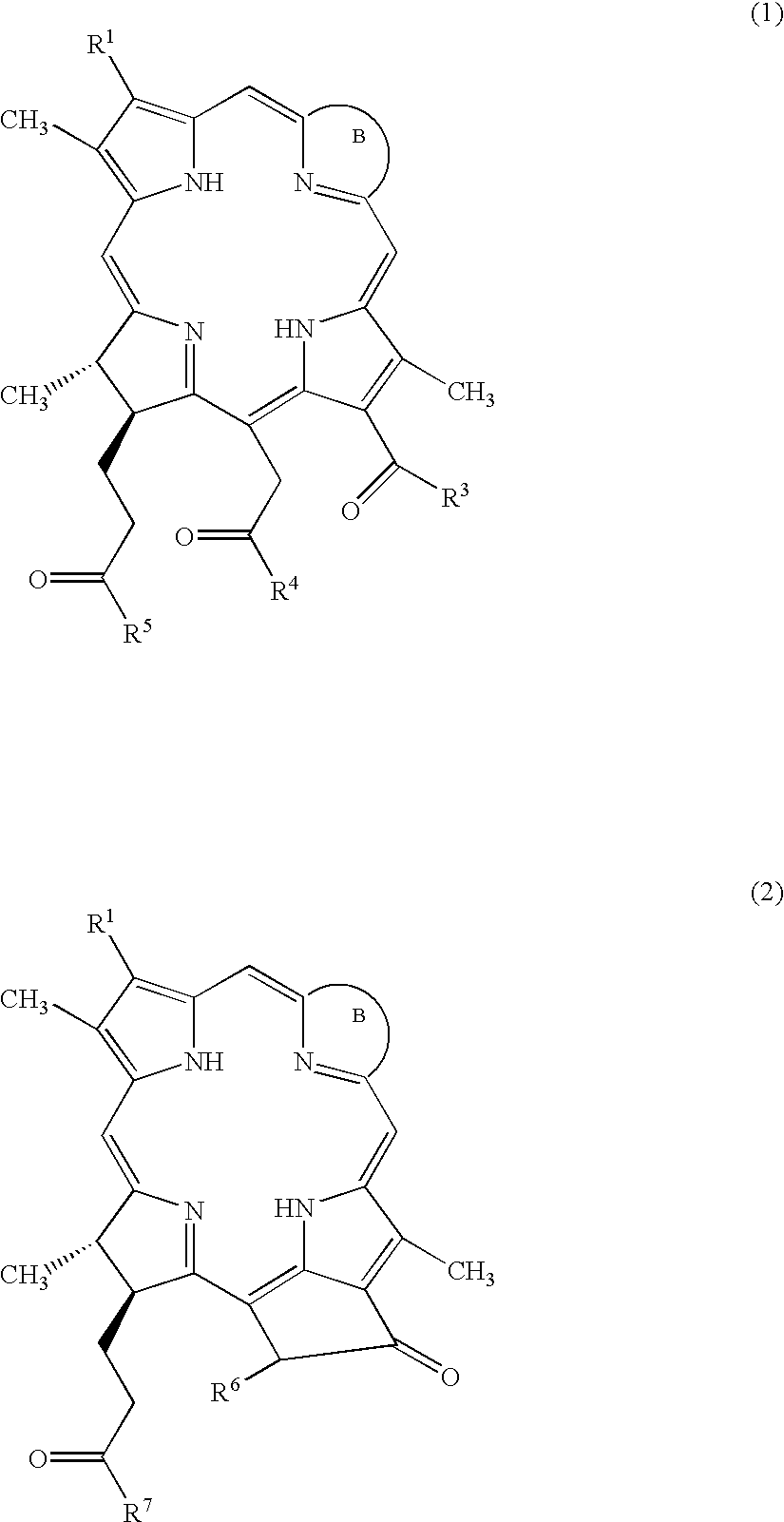
Figure 1 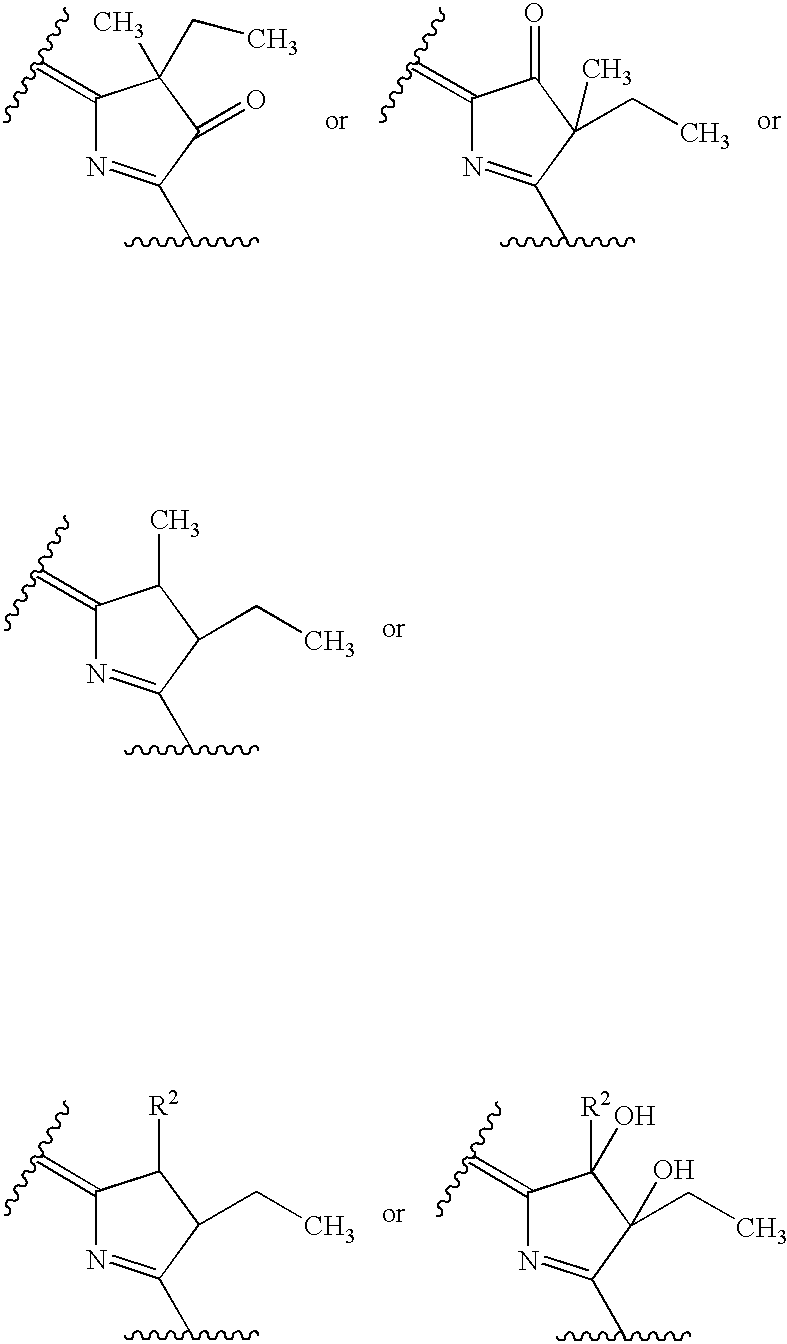
Figure 2 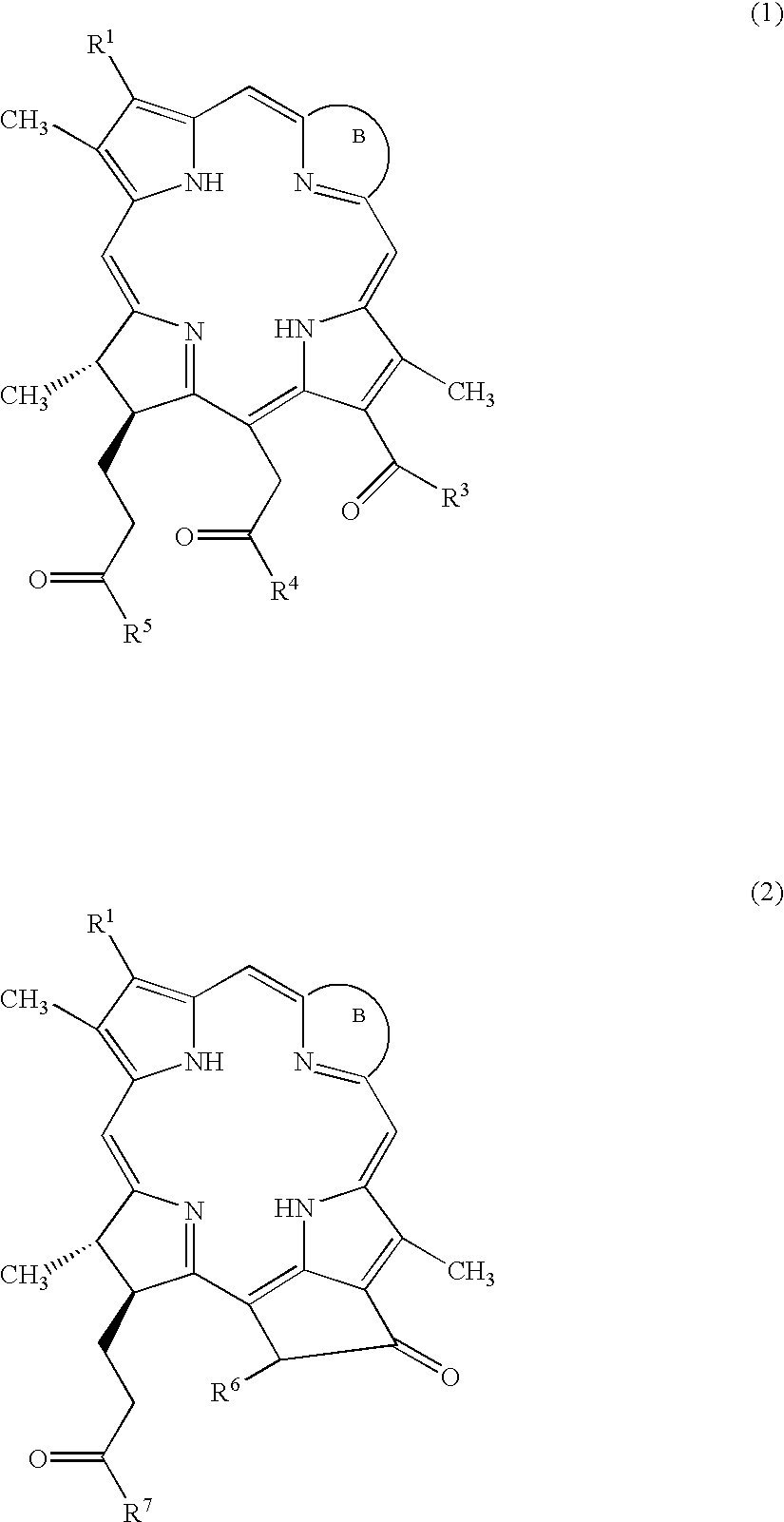
Figure 3
Abstract
Description
REFERENCE TO RELATED CASE
[0001] This application is a continuation-in-part of co-pending U.S. patent application Ser. No. 09 / 871,772 filed on Jun. 1, 2001 by Nikolay E. Nifantiev, inventor, entitled "WATER SOLUBLE PORPHYRIN DERIVATIVES AND METHODS OF THEIR PREPARATION", and incorporated by reference herein.
[0002] The invention relates to the chemistry of biologically active compounds, namely, to a new method to prepare water-soluble porphyrin derivatives, particularly chlorin, bacteriochlorin, pheophorbide and bacteriopheophorbide derivatives of types 1 and 2. The compounds of the present invention can be used as photosensitizers for the photodynamic therapy of cancer, infections and other diseases as well as for light irradiation treatments in other cases. 3
[0003] Wherein B is a ring having the structure: 4
[0004] Wherein:
[0005] R.sup.1.dbd.--CH.dbd.CH.sub.2, --CH(OAlk)CH.sub.3, --CHO, --C(O)CH.sub.3, --CH.sub.2CH.sub.3, --CH(Alk)CH(COAlk).sub.2, --CH.sub.2CH(COAlk).sub.2, --CH(Alk)...
Examples
examples
[0073] The following examples are presented to provide those of ordinary skill in the art with a full and illustrative disclosure and description of how to make water-soluble porphyrin derivatives of the invention to be used in preparation of pharmaceutical compositions and are not intended to limit the scope of what the inventor regards as the invention. Efforts have been made to ensure accuracy with respect to numbers used (e.g. amounts, temperature etc.), but some experimental errors and deviations should be accounted for.
examples 1
Obtaining Methyl Pheophorbide (5) from Spirulina platensis
[0074] (A) A mixture of 20 g of Spirulina platensis, 60 mL of methanol and 10 mL of concentrated sulfuric acid was stirred at room temperature for 3 hours, diluted with 30 mL of methanol and filtered through a pad of Celite. The content of the filtrating funnel was washed with methanol (70 mL). The above solution was extracted with hexane (2.times.30 mL), diluted with chloroform (100 mL) and poured into a saturated aqueous solution of potassium chloride (300 mL). The resulting mixture was filtered through a pad of Celite, aqueous phase was extracted with chloroform (2.times.50 mL). The combined extracts were washed with water, filtered through cotton and concentrated. The residue was dissolved in the mixture of chloroform-hexane (1:1, 30 mL) and filtrated through a pad of aluminum oxide to wash a first time with hexane (to remove non-polar non-chlorin components) and then with methylene chloride (to get methyl pheophorbide). ...
example 2
Obtaining Ethyl Pheophorbide (6) from Spirulina platensis
[0077] Ethanolysis of 20 g of Spirulina platensis in 60 mL of 96% aqueous ethanol and 10 mL concentrated sulfuric acid and subsequent workup as described in the Example 1A for the preparation of methyl pheophorbide a (5) but with the use of ethanol instead of methanol in all steps, gave 110 mg of crystalline ethyl pheophorbide a (6). .sup.1H--NMR spectrum: 9.57, 9.42, 8.61 (3H, all s, meso-H); 7.99 (1H, q, --CH.dbd.CH.sub.2), 6.32, 6.26 (2H, dd, --CH.dbd.CH.sub.2), 6.27 (1H, s, cyclopentanone-H), 4.51, 4.28 (2H, m, 7-H, 8-H); 4.07 (2H, q, --COOCH.sub.2CH.sub.3); 3.71 (2H, q, 4-CH.sub.2CH.sub.3); 3.89, 3.72, 3.41, 3.27 (12H, all s, 4 .upsilon. --CH.sub.3); 2.69, 2.47, 2.37, 2.22 (4H, m, --CH.sub.2CH.sub.2COOCH.sub.2CH.sub.3); 1.83 (3H, d, 8-CH.sub.3); 1.73 (3H, t, 4-CH.sub.2CH.sub.3); 1.12 (3H, t, --COOCH.sub.2CH.sub.3); 0.57, -1.46 ppm (2H, 2 broad s, 2 .upsilon. --NH--).