
Method and apparatus for performing packet loss or frame erasure concealment
a technology of frame erasure and concealment, which is applied in the field of techniques for performing packet loss or frame erasure concealment (fec), can solve the problems of unsatisfactory “beeping” artifacts for listeners, and the erasure may be inaudible after concealmen
Patent Information
- Authority / Receiving Office
- US · United States
- Patent Type
- Patents(United States)
- Current Assignee / Owner
- Publication Date
- 2005-11-01
- Estimated Expiration
- Not applicable · inactive patent
Smart Images
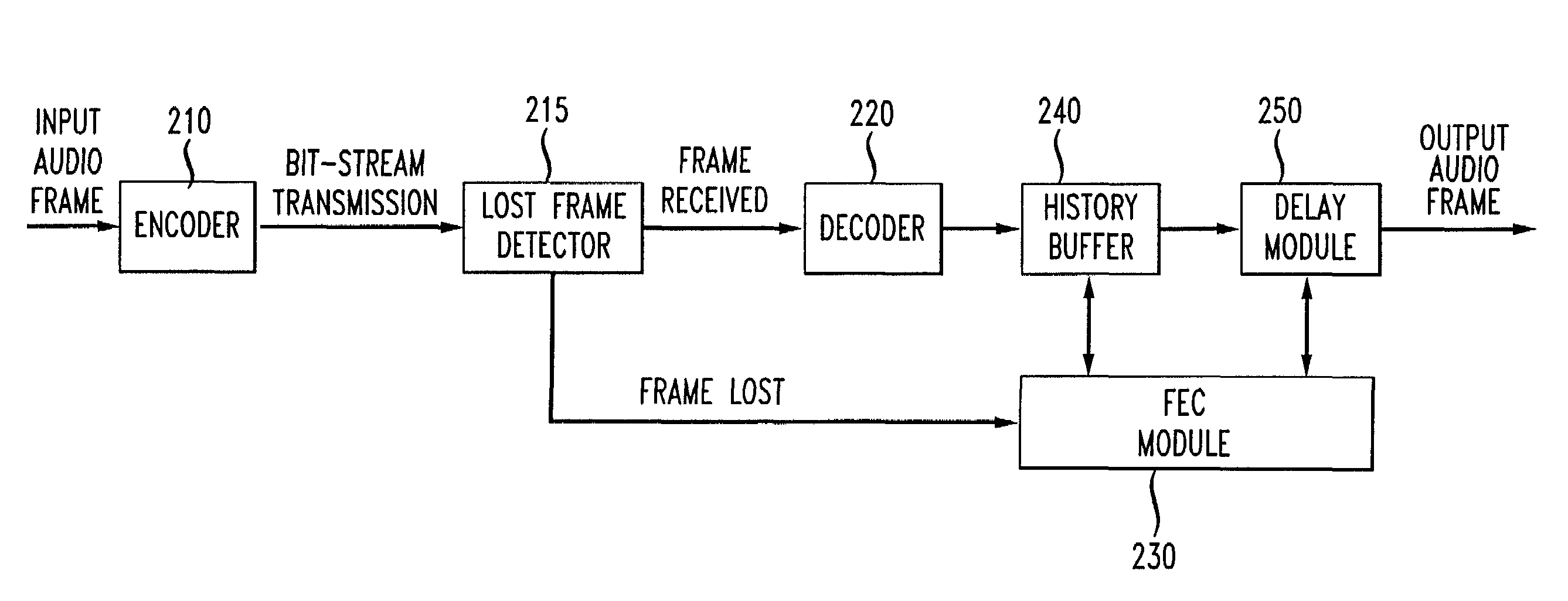
Figure 1 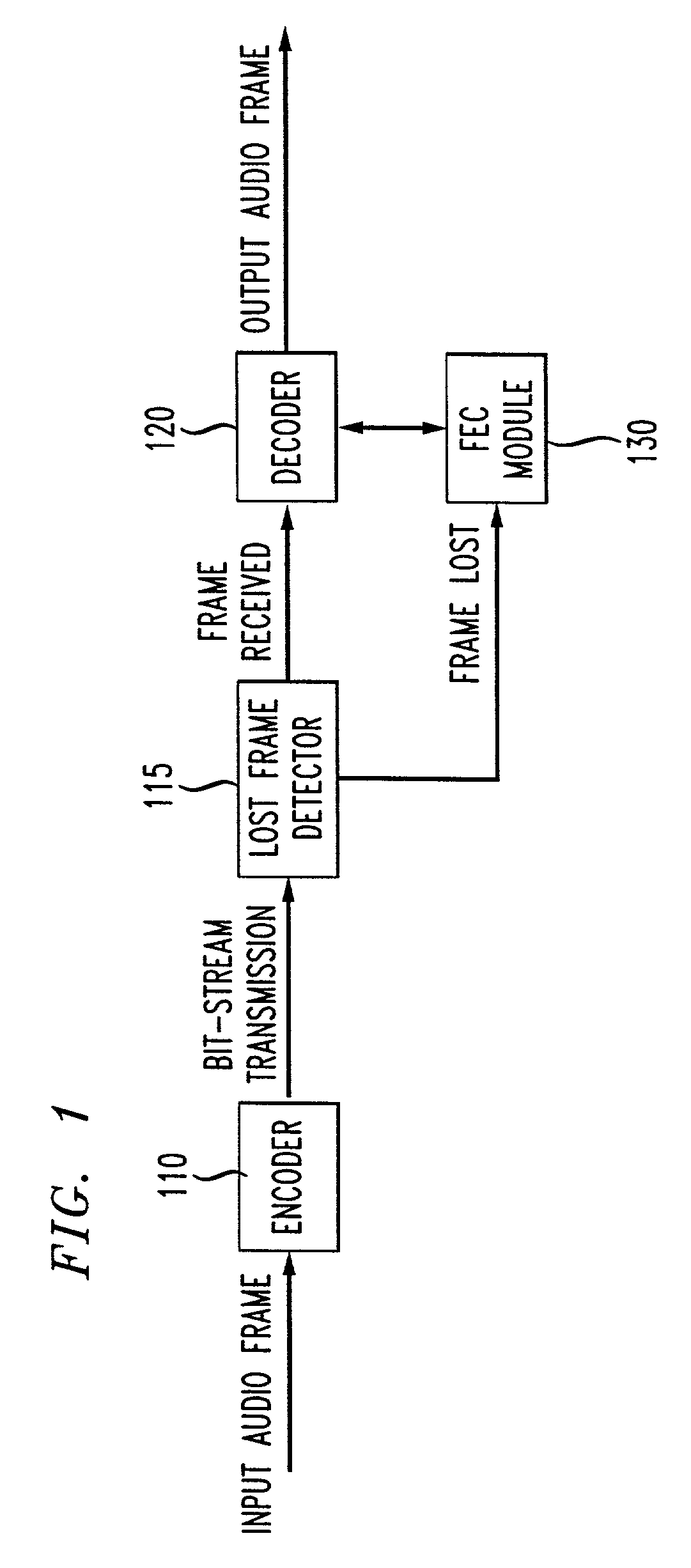
Figure 2 
Figure 3
Abstract
Description
CROSS REFERENCE TO RELATED APPLICATIONS
[0001] This application is filed under 35 USC 371, based on an International Application No. PCT / US00 / 10637, which has a filing date of Apr. 19, 2000, which International Application was filed claiming the benefit of a U.S. Provisional Application No. 60 / 130,016, which was filed on Apr. 19, 1999, and is now abandoned.BACKGROUND OF THE INVENTION
[0002] This non-provisional application incorporates by reference U.S. Provisional Application 60 / 130,016, filed Apr. 19, 1999. The following documents are also incorporated by reference herein: ITU-T Recommendation G.711-Appendix I, “A high quality low complexity algorithm for packet loss concealment with G.711” (September 1999) and American National Standard for Telecommunications—Packet Loss Concealment for Use with ITU-T Recommendation G.711 (T1.521-1999).
[0003] 1. Field of Invention
[0004] This invention relates techniques for performing packet loss or Frame Erasure Concealment (FEC).
[0005] 2. Description ...
Examples
Embodiment Construction
[0030]Recently there has been much interest in using G.711 on packet networks without guaranteed quality of service to support Plain-Old-Telephony Service (POTS). When frame erasures (or packet losses) occur on these networks, concealment techniques are needed or the quality of the call is seriously degraded. A high-quality, low complexity Frame Erasure Concealment (FEC) technique has been developed and is described in detail below.
[0031]An exemplary block diagram of an audio system with FEC is shown in FIG. 1. In FIG. 1, an encoder 110 receives an input audio frame and outputs a coded bit-stream. The bit-stream is received by the lost frame detector 115 which determines whether any frames have been lost. If the lost frame detector 115 determines that frames have been lost, the lost frame detector 115 signals the FEC module 130 to apply an FEC algorithm or process to reconstruct the missing frames.
[0032]Thus, the FEC process hides transmission losses in an audio system where the inp...