
Method for manufacturing high viscosity polyalphaolefins using ionic liquid catalysts
a technology of ionic liquid and polyalphaolefin, which is applied in the direction of hydrocarbon preparation catalysts, organic chemistry, lubricant compositions, etc., can solve the problems of physical properties and high cost of manufactur
Patent Information
- Authority / Receiving Office
- US · United States
- Patent Type
- Patents(United States)
- Current Assignee / Owner
- Publication Date
- 2008-04-01
- Estimated Expiration
- Not applicable · inactive patent
Smart Images
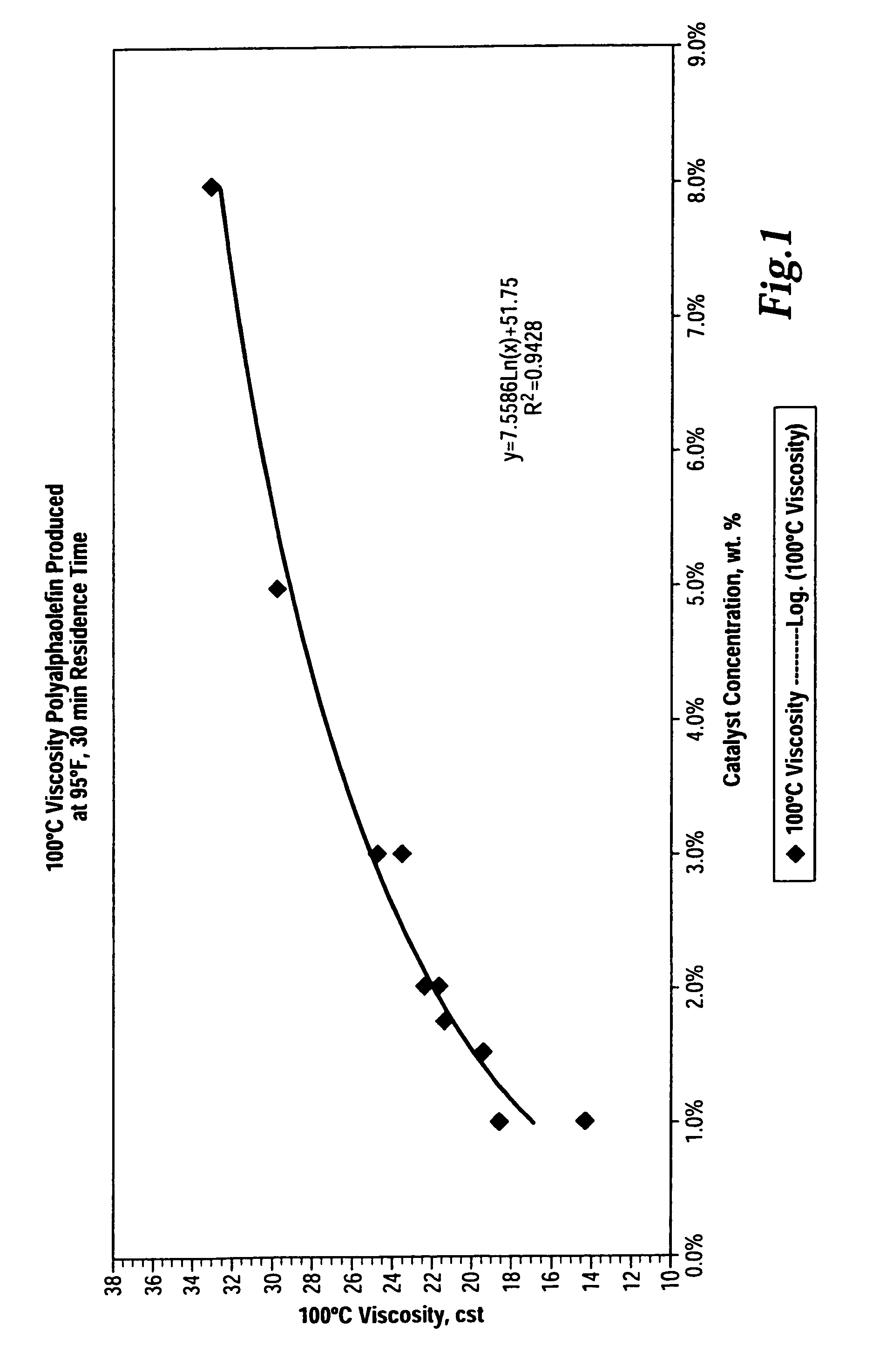
Figure 1 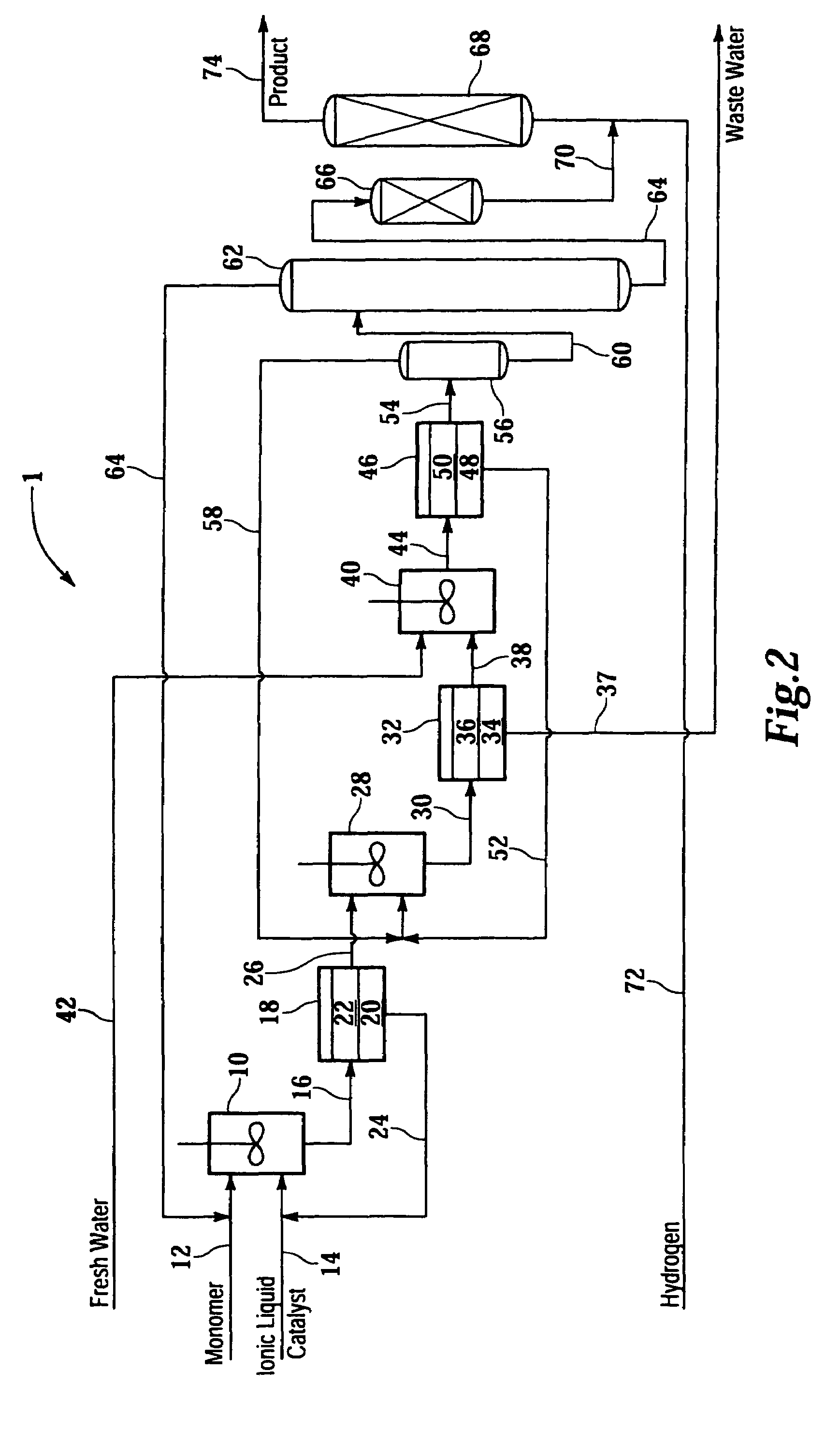
Figure 2
Abstract
Description
CROSS-REFERENCE TO RELATED APPLICATIONS
[0001] This application claims the benefit of and priority to provisional U.S. patent application No. 60 / 374,528, filed Apr. 22, 2002 and entitled “Method for Manufacturing High Viscosity Polyalphaoleflns Using Ionic Liquid Catalysts”. This application is related to U.S. patent application Ser. No. 10 / 420,182 filed on Apr. 22, 2003, U.S. Pat. No. 6,984,605, and entitled “Method for Manufacturing Ionic Liquid Catalysts.” Each of the above-listed applications is hereby incorporated herein by reference in its entirety for all purposes.FIELD OF THE INVENTION
[0002] The present invention relates to a continuous process for the manufacture of high viscosity polyalphaolefin products from an alphaolefin feedstock using an ionic liquid catalyst where the polyalphaolefin products have unique physical properties that make them useful as lubricants or lubricant additives.BACKGROUND
[0003] It is known that alpha olefins may be oligomerized to prepare synthetic o...
Examples
examples 1-3
Batch Oligomerization of 1-Dodecene
[0051]The following Examples 1-3 illustrate the effect of the ionic liquid catalyst concentration on certain of the physical properties of the oligomer reaction product resulting from the batch oligomerization of 1-dodecene.
example 1
[0052]400 g of molecular sieve-dried 1-dodecene was added to a three-necked round-bottom flask under a nitrogen purge and heated to 50° C. An addition funnel containing 4.1 g of catalyst (2:1 molar ratio AlCl3:TMA·HCl) was attached to the round-bottom flask. The system was purged with nitrogen and the catalyst was slowly added to the 1-dodecene. The nitrogen purge was continued through the entire reaction. The temperature was controlled with an ice bath and an exotherm (maximum temperature 129° C.) was observed. Samples were pulled every 15 minutes for one hour, neutralized with dilute KOH to quench the catalyst, and filtered through alumina to remove water. Table 1 summarizes the gel permeation chromatography (GPC) results, including the oligomer distribution, weight average molecular weight (Mw) and polydispersity index (D) of the sampled product.
[0053]
TABLE 1Exam-Exam-Example 1aExample 1bple 1cple 1d15 Min.30 Min.45 Min.60 Min.ProductUnitsSampleSampleSampleSampleMonomerWeight %35...
example 2
[0055]The conditions of Example 1 were repeated except that 22.1 g of catalyst were used and the initial reaction temperature was 35° C. The analyses of the samples taken during the reaction are presented in Table 2.
[0056]
TABLE 2Exam-Exam-Exam-ple 2aple 2bple 2c15 Min.30 Min.45 Min.Example 2dProductUnitsSampleSampleSample60 Min. SampleMonomerWeight %50.347.546.241.0DimerWeight %1.81.91.92.0TrimerWeight %5.96.16.16.2TetramerWeight %5.15.55.45.6Pentamer+Weight %37.039.140.445.3Mw625648676744D2.212.202.252.28
[0057]After one hour, the catalyst was removed from the reaction vessel with a syringe. Dilute KOH was then added to the reaction vessel, the contents were stirred and then allowed to phase separate. The hydrocarbon phase was subsequently hydrogenated and finally distilled until the monomer content was less than 1%. The hydrogenated and distilled product had a kinematic viscosity at 100° C. of 17.7 cSt, a viscosity index of 154, and a pour point of −36° C.