
Technique for efficiently routing IP traffic on CE-CE paths across a provider network
a technology of ip traffic and provider network, applied in the field of computer networks, can solve the problems of not providing te information of the pe-ce link, the current inability of the node to communicate with one of its neighboring nodes, and the inability to efficiently route ip traffic. the effect of efficient routing of internet protocol (ip) traffi
Patent Information
- Authority / Receiving Office
- US · United States
- Patent Type
- Patents(United States)
- Current Assignee / Owner
- Publication Date
- 2009-04-21
- Estimated Expiration
- Not applicable · inactive patent
Smart Images
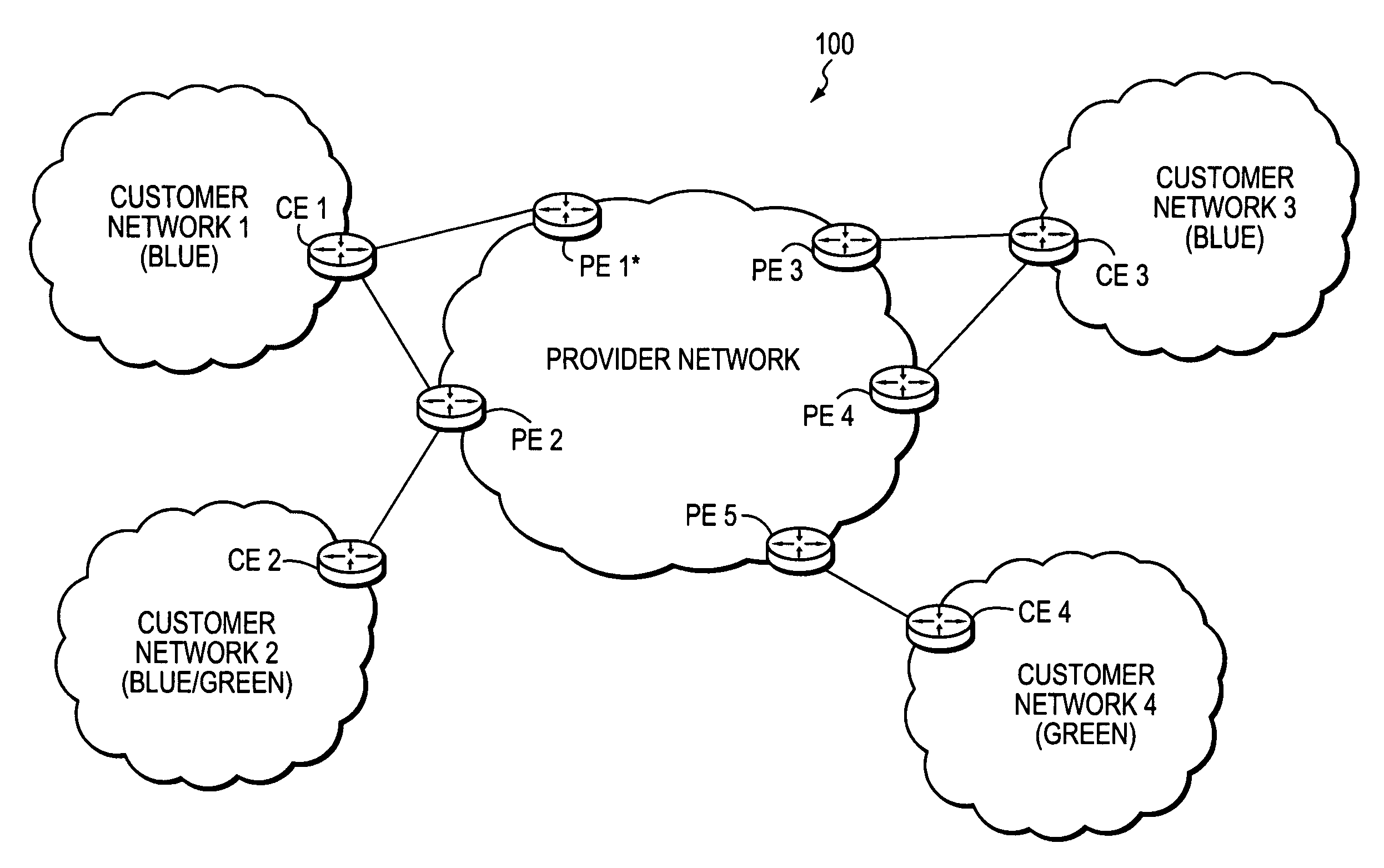
Figure 1 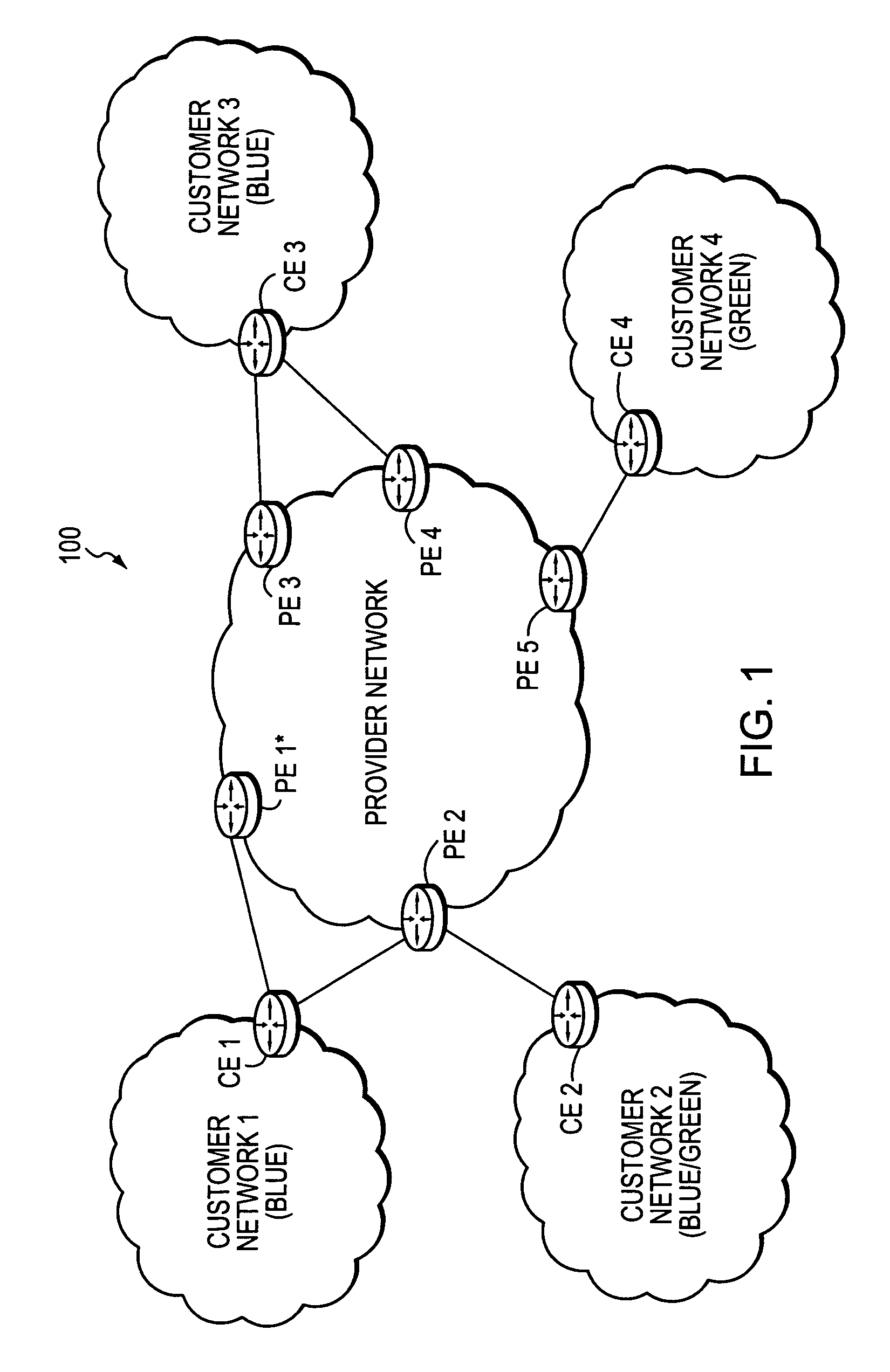
Figure 2 
Figure 3
Abstract
Description
RELATED APPLICATION
[0001] This application is related to U.S. application Ser. No. 11 / 302,595, entitled TECHNIQUE FOR ENABLING TRAFFIC ENGINEERING ON CE-CE PATHS ACROSS A PROVIDER NETWORK, filed by Vasseur on Dec. 14, 2005, the contents of which are hereby incorporated in its entirety.BACKGROUND OF THE INVENTION
[0002] 1. Field of the Invention
[0003] The present invention relates to computer networks and more particularly to Internet Protocol (IP) traffic routing between customer edge devices (CEs) across a provider network in a computer network.
[0004] 2. Background Information
[0005] A computer network is a geographically distributed collection of interconnected subnetworks, such as local area networks (LAN) that transport data between network nodes. As used herein, a network node is any device adapted to send and / or receive data in the computer network. Thus, in this context, “node” and “device” may be used interchangeably. The network topology is defined by an arrangement of network nod...
Examples
Embodiment Construction
[0035]FIG. 1 is a schematic block diagram of an exemplary computer network 100 comprising a provider network, (e.g., a service provider network) interconnected to one or more customer networks (customer networks 1-4). Although the provider and customer networks are described illustratively herein as autonomous systems, those skilled in the art will appreciate that they may be configured as one or more routing domains or other networks or subnetworks. The provider network comprises one or more network nodes, including a set of communicating border nodes or routers (illustratively, provider edge devices, or “PEs”) PE1-PE5, through which client communications, such as data packet traffic, can pass into and out of the provider network. The network comprises provider devices (Ps) (not shown) configured to communicate traffic and information internally within the provider network.
[0036]The customer networks 1-4 also comprise one or more network nodes, including a set of communicating bord...