
Process for laying a strip continuously on a toroidal surface
a technology of toroidal surface and continuous laying, which is applied in the direction of process and machine control, mechanical control devices, instruments, etc., can solve the problems of pressure in the organisation of the manufacturing process, too cumbersome devices to use, and unsuitability
Patent Information
- Authority / Receiving Office
- US · United States
- Patent Type
- Patents(United States)
- Current Assignee / Owner
- Publication Date
- 2010-01-05
- Estimated Expiration
- Not applicable · inactive patent
Smart Images
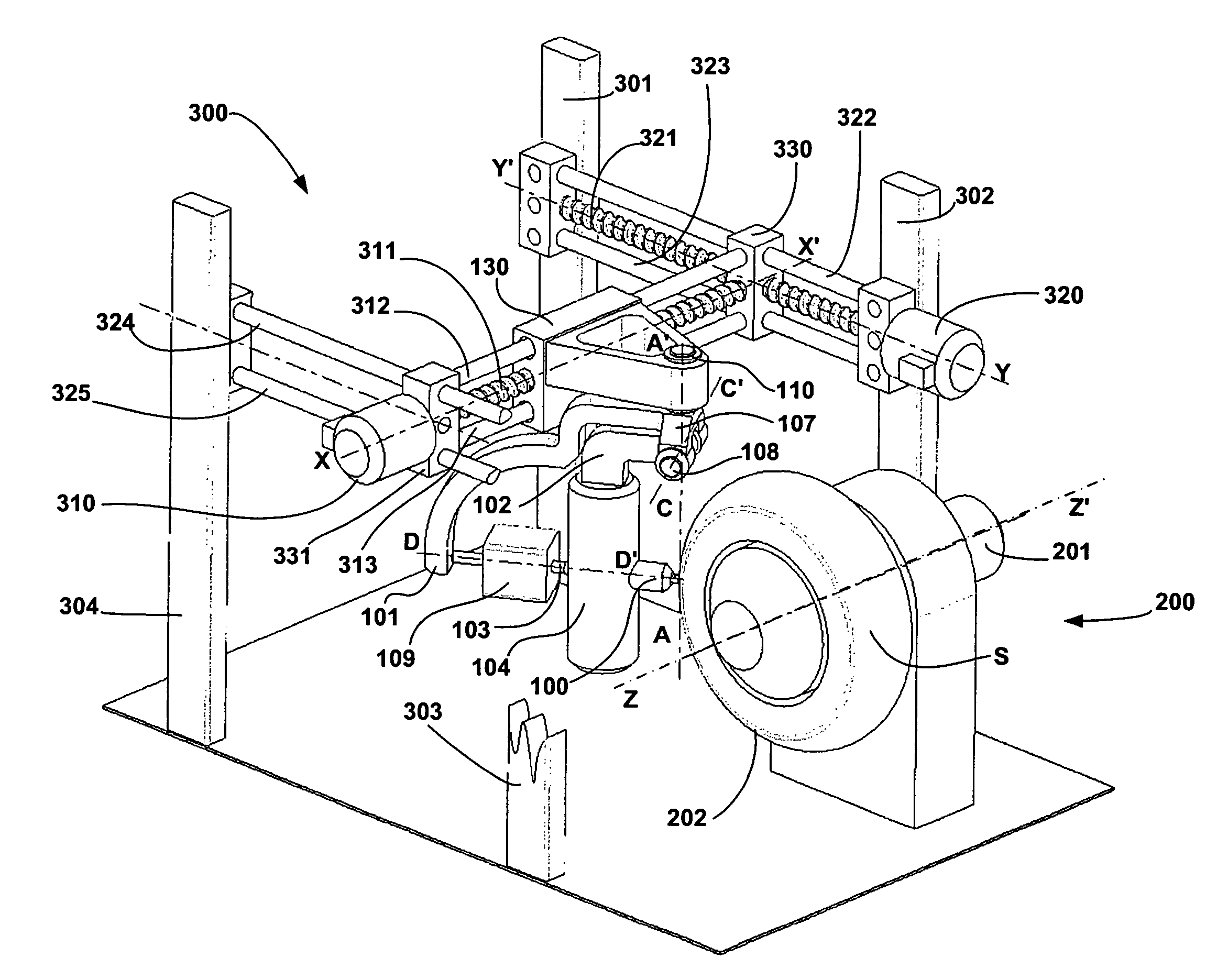
Figure 1 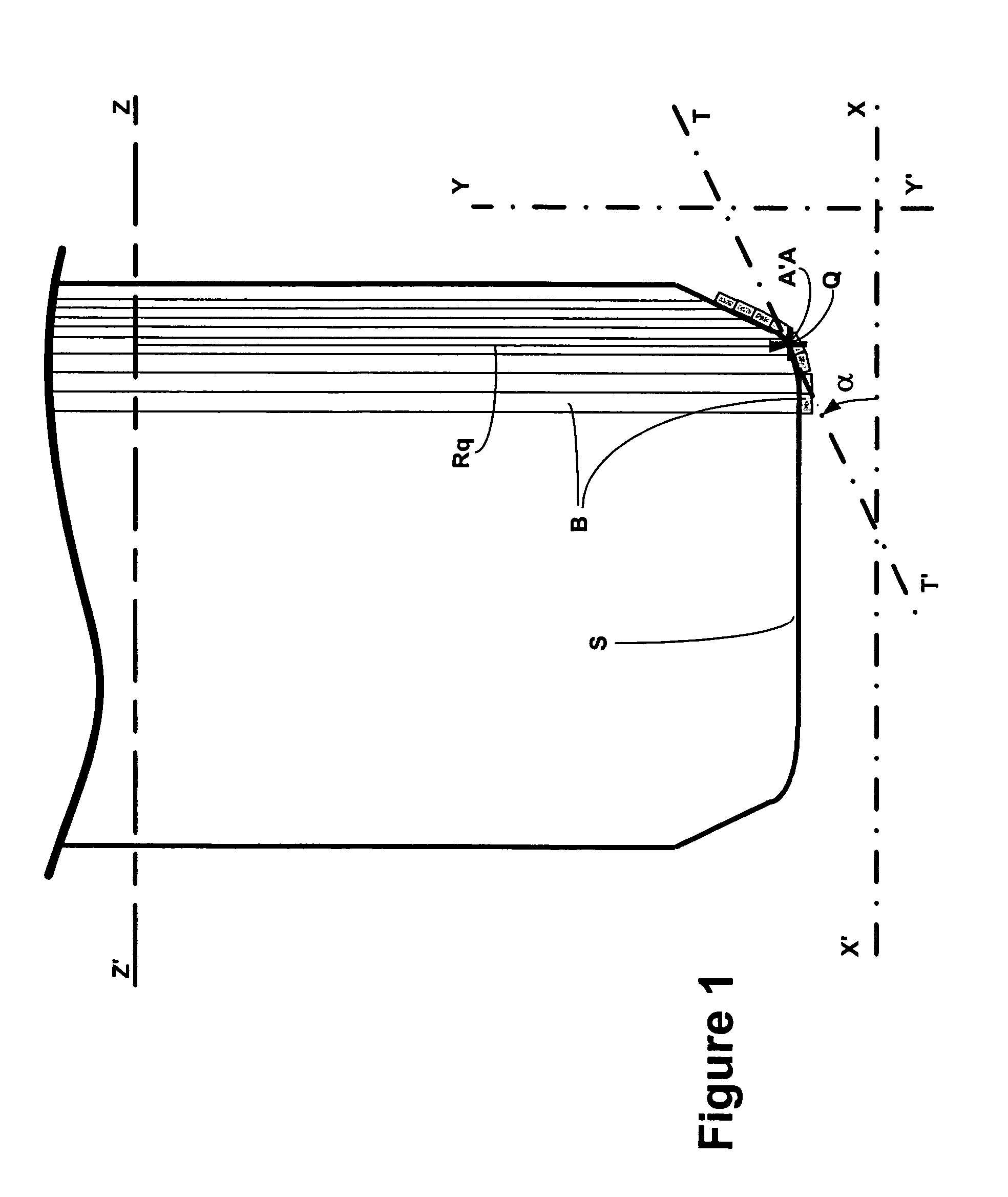
Figure 2 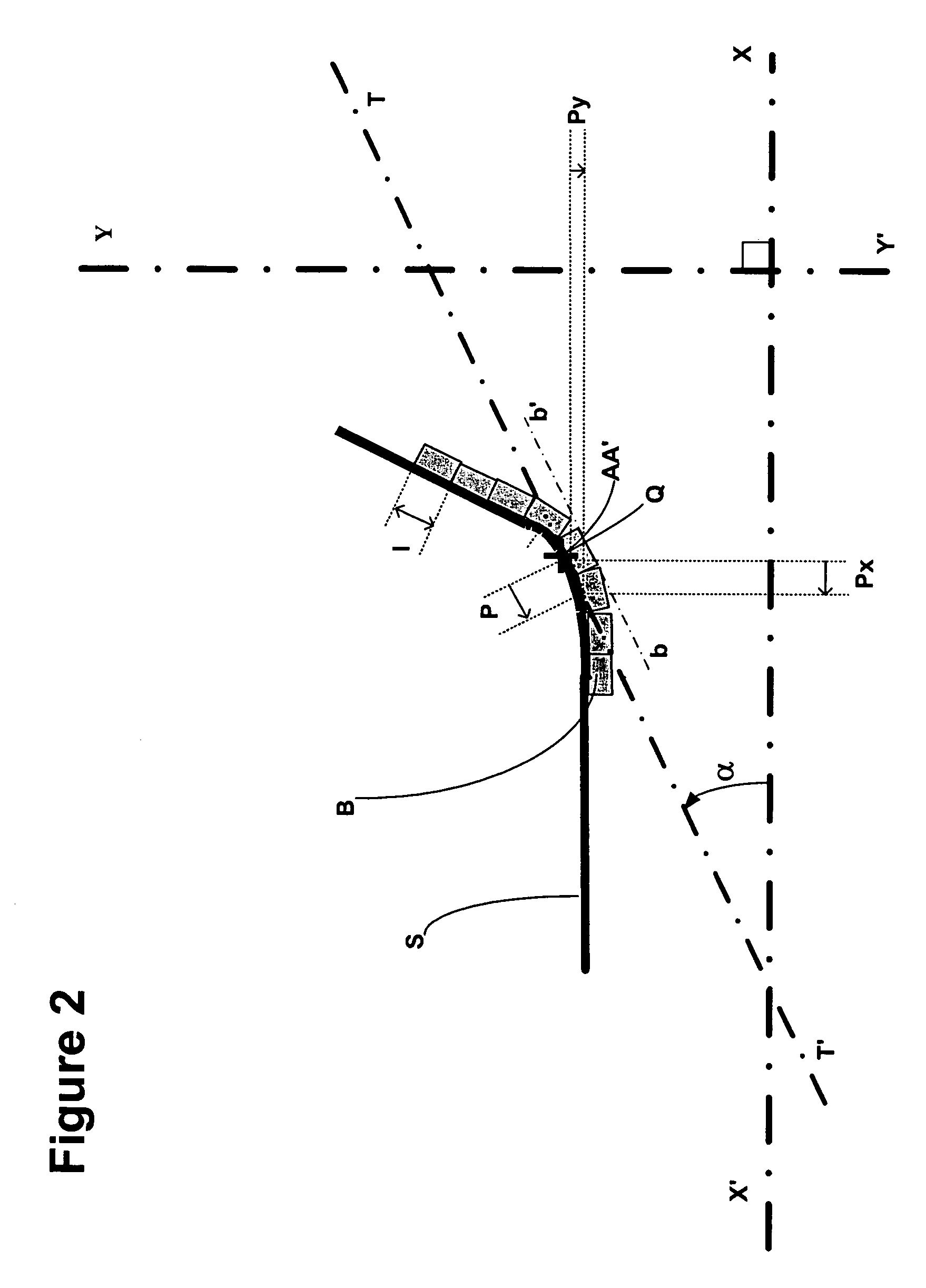
Figure 3
Abstract
Description
[0001] The present application claims priority under 35 U.S.C. §119 to patent application Ser. No. 03 / 13763 filed in France on Nov. 21, 2003.BACKGROUND
[0002] The present invention relates to a process for laying a strip continuously on a profile which is generally toroidal in shape.
[0003] These days, continuous strip laying is widespread in the tyre industry and various processes have been described for depositing rubber strips or cord plies in the radial or circumferential direction.
[0004] More particularly, the field of the invention relates to laying a strip continuously in the circumferential direction on the toroidal surface of a tyre casing, where the width of the strip is very much less than the width of the receiving surface and where, moreover, the thickness of the strip is very much less than its width.
[0005] The processes suitable for performing these functions have been known for a long time and are described, by way of example, in patent nos. U.S. Pat. Nos. 3,251,722, 4,240,...
Examples
Embodiment Construction
[0039]Hereinafter, the same reference numerals will be used to denote elements of the apparatus having identical functions, such as represented in FIGS. 1 to 9.
[0040]FIG. 1 illustrates the respective positions of the locating axes useful in describing an apparatus according to the invention.
[0041]With reference to the axis of rotation ZZ′ of the receiving surface S, the axes XX′ and YY′ are respectively successively positioned parallel to the axis ZZ′ and parallel to a radial direction passing through the point Q corresponding substantially to the centre of contact between the application means 112 for the strip B and the receiving surface S. The direction YY′ is thus perpendicular to the axes XX′ and ZZ′, and the plane formed by the directions XX′ and YY′ passing through the point Q is an equatorial plane passing through the axis ZZ′, whose intersection with the surface S delimits the transverse profile of the latter.
[0042]The tangent TT′ to the transverse profile of the receiving ...