
Laser noise detection and mitigation in particle counting instruments
a particle counting and laser noise technology, applied in the field of optical particle analyzers, can solve the problems of limiting the sensitivity and particle sizing capability, the state of the art optical particle counter is currently susceptible to problems, and the count adversely affecting the accuracy and sensitivity of the system, so as to reduce false positives and effectively distinguish signals
Patent Information
- Authority / Receiving Office
- US · United States
- Patent Type
- Patents(United States)
- Current Assignee / Owner
- Publication Date
- 2018-06-05
Smart Images
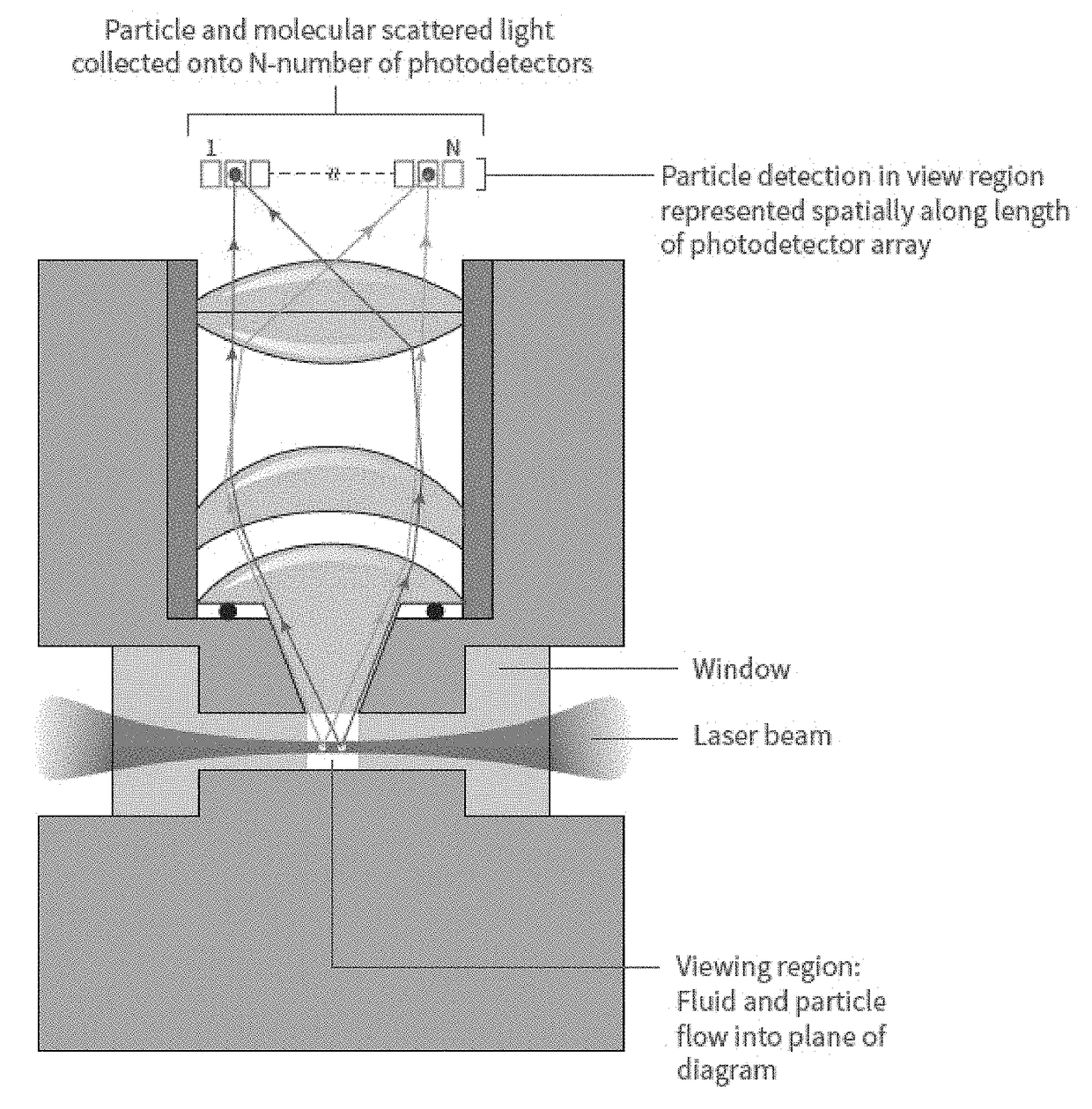
Figure 1 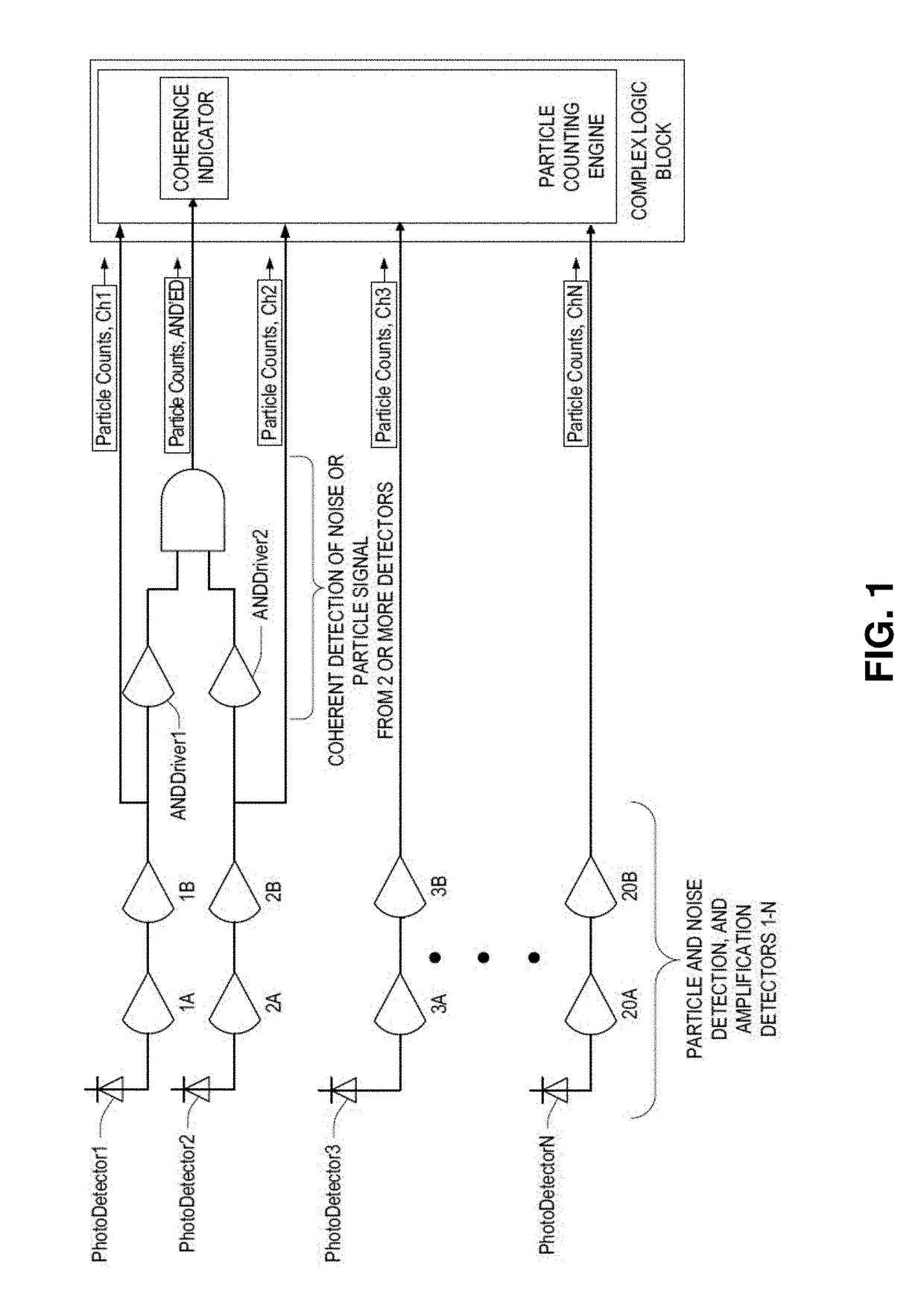
Figure 2 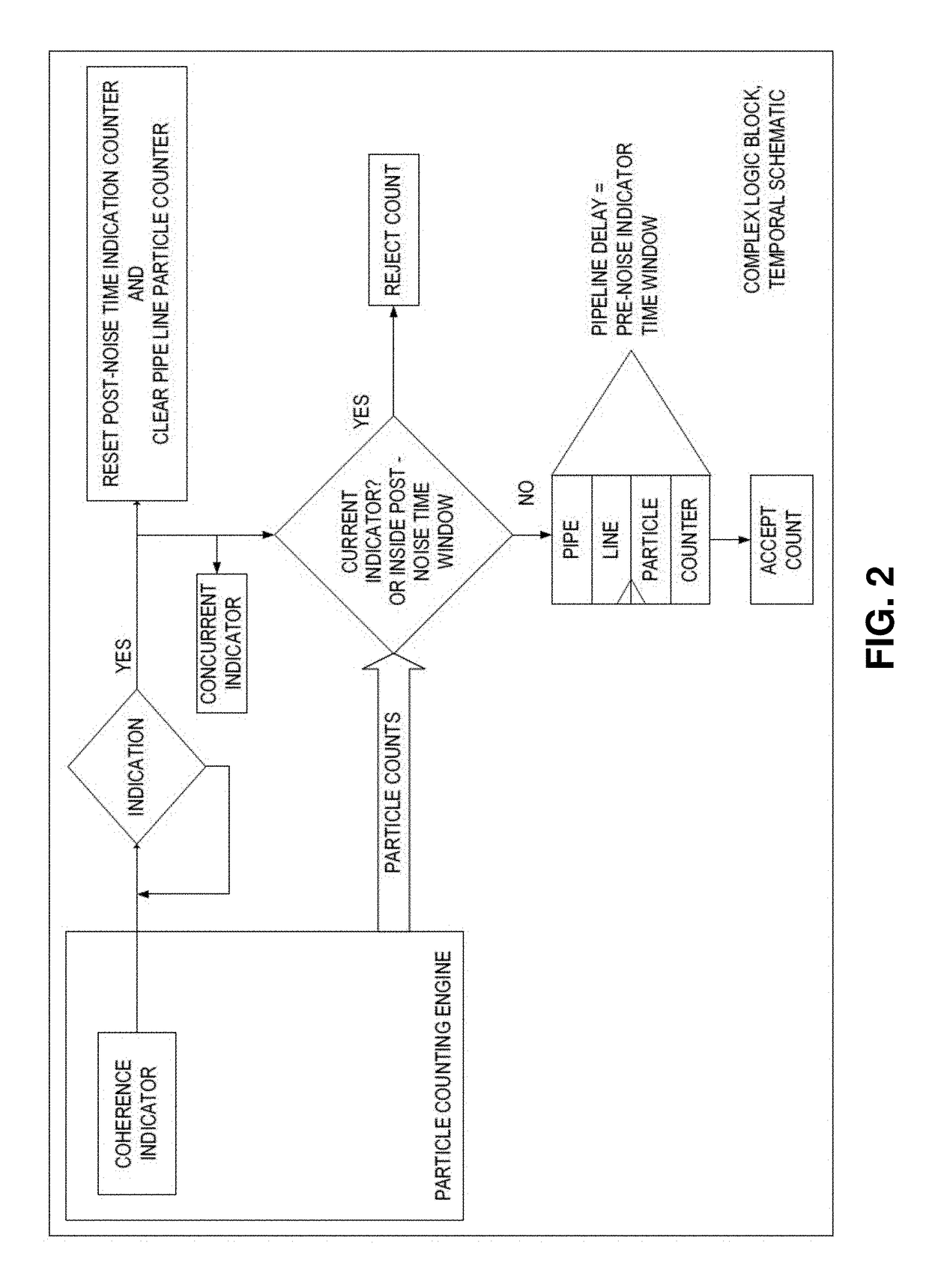
Figure 3
Abstract
Description
CROSS-REFERENCE TO RELATED APPLICATIONS
[0001] This application claims the benefit of and priority to U.S. Provisional Application No. 62 / 142,141, filed Apr. 2, 2015, and U.S. Provisional Application No. 62 / 205,239, filed Aug. 14, 2015, both of which are hereby incorporated by reference in their entirety to the extent non inconsistent with the disclosure herein.BACKGROUND OF INVENTION
[0002] This invention is in the field of optical particle analyzers. In an embodiment, his invention relates generally to two-dimensional optical imaging-based methods and systems for detecting and characterizing particles in fluid samples. In an embodiment, this invention also relates generally to methods and systems for improving the sensitivity and versatility of optical particle analyzers and for extending device performance of these systems so as to accurately detect and characterize particles having small physical dimensions (e.g., less than 0.1 microns).
[0003] A large portion of the micro-contaminati...
Examples
example 1
Identification and Discrimination of Laser Noise Events Using a Multi-element Detector Configuration.
[0041]In embodiments of the present invention, when using multi-element photonic detectors for detection of submicron particles in fluids; liquid or aerosol, it is beneficial to utilize one or more of detector elements to distinguish between the very low signal level that is generated when a nano-size particle passes through the sampling region, and the increase in light level when the light source undergoes brief periods of positive light intensity fluctuations. In light scattering particle counters, as a particle passes thru the sampling region it generates an increase in light scattered signal above the background molecular scatter of the sample fluid. When the light source, which is typically a laser in state of the art particle counters, experiences a momentary unstable state, its light output can “burst” in output intensity. These bursts periods are typically referred to as las...
example 2
Experimental Performance Evaluation
[0050]Laser light noise variation in available state-of-the-art diode-pumped solid-state (DPSS) lasers becomes a greater proportion of the SNR (Signal to Noise Ratio) in light scattering based Particle Counters as the push for detection of smaller and smaller particles in the fluid samples continue. As described above, changes in temperature of a laser cause a laser's cavity length to change, which in turn causes mode-hopping and unstable noise bursting in the laser's light intensity. In the following tests, laser noise was approximated by intentionally changing the temperature of the laser. To produce a changing temperature surrounding the instrument and its laser, a temperature controlled cabinet that uses a TEC (Thermal Electric Cooler) was used. The specific use of a cabinet that utilizes a TEC was important because unlike temperature controlled chambers that use refrigeration, the TEC does not generate Line Conducted electrical noise that migh...
example 3
Array Detector Embodiments for Laser Noise Detection and Mitigation
[0082]A range of array detector geometries and related signal processing methods are useful in the present methods and systems.
Detector Spacing
[0083]In methods and systems of embodiments of the present design, multiple detector elements are used to detect individual real particles as these particles pass through spatially separated viewing regions being witnessed by each of the separate elements.
[0084]For very small of particle sizes; e.g., having cross sectional dimensions of approximately 20 nm, the collected partial scattering of light from these particles and the amount of photon energy in each of these scattering events is enough to generate sufficient photon-generated current above the molecular background scattering and be recorded as a particle event when a high percentage of the imaged spot falls inside a single element without some of the photon energy falling into a separating region between elements, or w...