Analysis of Biomass-Derived Solvents in Environmental Contexts
OCT 23, 202510 MIN READ
Generate Your Research Report Instantly with AI Agent
Patsnap Eureka helps you evaluate technical feasibility & market potential.
Biomass Solvent Development Background and Objectives
The development of biomass-derived solvents represents a significant paradigm shift in the chemical industry's approach to sustainability. Historically, conventional solvents derived from petroleum have dominated industrial applications since the early 20th century, with limited consideration for environmental impacts. The emergence of green chemistry principles in the 1990s marked a turning point, highlighting the need for environmentally benign alternatives to traditional solvents that often contribute to air pollution, water contamination, and human health concerns.
Biomass-derived solvents have evolved from simple alcohols like bioethanol to more complex structures including esters, ethers, and terpenes extracted from renewable biological materials. This evolution has been driven by increasing environmental regulations, corporate sustainability initiatives, and consumer demand for eco-friendly products. The technical trajectory shows a clear progression from first-generation biofuels toward sophisticated, functionally-designed green solvents with specific performance characteristics.
The primary objective of biomass solvent development is to create viable alternatives that maintain or enhance the performance attributes of conventional solvents while significantly reducing environmental footprint. This includes minimizing toxicity, improving biodegradability, reducing volatile organic compound (VOC) emissions, and ensuring compatibility with existing industrial processes and equipment. Additionally, these solvents aim to contribute to circular economy principles by utilizing waste biomass streams as feedstock.
Current research focuses on optimizing extraction methods, improving yield efficiency, and enhancing solvent stability across various applications. Particular attention is being paid to developing solvents with tunable properties that can be customized for specific industrial requirements, from pharmaceutical manufacturing to advanced materials processing. The technical goals include achieving cost parity with petroleum-based alternatives while delivering superior environmental performance metrics.
The environmental context of biomass-derived solvents extends beyond their direct application properties to encompass their entire lifecycle. This includes considerations of land use for biomass cultivation, energy requirements for processing, and end-of-life degradation pathways. Comprehensive life cycle assessment (LCA) methodologies are increasingly being applied to evaluate the true environmental impact of these alternative solvents, ensuring that solutions address the full spectrum of sustainability challenges rather than simply shifting environmental burdens.
Looking forward, the technical roadmap for biomass-derived solvents includes developing advanced catalytic processes for more efficient conversion, exploring novel biomass feedstocks beyond traditional agricultural sources, and creating integrated biorefinery concepts that maximize resource utilization while minimizing waste generation. These developments align with broader societal goals of transitioning toward a bio-based economy with reduced dependence on fossil resources.
Biomass-derived solvents have evolved from simple alcohols like bioethanol to more complex structures including esters, ethers, and terpenes extracted from renewable biological materials. This evolution has been driven by increasing environmental regulations, corporate sustainability initiatives, and consumer demand for eco-friendly products. The technical trajectory shows a clear progression from first-generation biofuels toward sophisticated, functionally-designed green solvents with specific performance characteristics.
The primary objective of biomass solvent development is to create viable alternatives that maintain or enhance the performance attributes of conventional solvents while significantly reducing environmental footprint. This includes minimizing toxicity, improving biodegradability, reducing volatile organic compound (VOC) emissions, and ensuring compatibility with existing industrial processes and equipment. Additionally, these solvents aim to contribute to circular economy principles by utilizing waste biomass streams as feedstock.
Current research focuses on optimizing extraction methods, improving yield efficiency, and enhancing solvent stability across various applications. Particular attention is being paid to developing solvents with tunable properties that can be customized for specific industrial requirements, from pharmaceutical manufacturing to advanced materials processing. The technical goals include achieving cost parity with petroleum-based alternatives while delivering superior environmental performance metrics.
The environmental context of biomass-derived solvents extends beyond their direct application properties to encompass their entire lifecycle. This includes considerations of land use for biomass cultivation, energy requirements for processing, and end-of-life degradation pathways. Comprehensive life cycle assessment (LCA) methodologies are increasingly being applied to evaluate the true environmental impact of these alternative solvents, ensuring that solutions address the full spectrum of sustainability challenges rather than simply shifting environmental burdens.
Looking forward, the technical roadmap for biomass-derived solvents includes developing advanced catalytic processes for more efficient conversion, exploring novel biomass feedstocks beyond traditional agricultural sources, and creating integrated biorefinery concepts that maximize resource utilization while minimizing waste generation. These developments align with broader societal goals of transitioning toward a bio-based economy with reduced dependence on fossil resources.
Environmental Market Demand Analysis for Bio-based Solvents
The global market for bio-based solvents has witnessed significant growth in recent years, driven primarily by increasing environmental concerns and stringent regulations on volatile organic compounds (VOCs) emissions. The market value reached approximately $6.5 billion in 2022 and is projected to grow at a compound annual growth rate of 7.8% through 2030, potentially reaching $11.2 billion by the end of the forecast period.
Environmental regulations have emerged as the primary market driver for bio-based solvents. The European Union's VOC Solvents Emissions Directive and similar regulations in North America have created substantial demand for environmentally friendly alternatives to petroleum-based solvents. Additionally, the U.S. Environmental Protection Agency's Significant New Alternatives Policy (SNAP) program has further accelerated the transition toward greener solvent options.
Consumer preferences are increasingly shifting toward eco-friendly products, creating pull-through demand for bio-based solvents in consumer goods. Market research indicates that 68% of consumers are willing to pay a premium for products with environmentally sustainable ingredients, including those formulated with bio-based solvents. This trend is particularly pronounced in personal care, household cleaning, and premium consumer products segments.
Industrial applications represent the largest market segment for bio-based solvents, accounting for approximately 42% of total consumption. Paints and coatings manufacturers have been early adopters, with bio-based solvents now comprising nearly 25% of solvents used in this sector. The automotive and construction industries have also shown increasing interest in bio-based solvent technologies to meet their sustainability targets.
Regionally, Europe leads the market with a 38% share, followed by North America at 32% and Asia-Pacific at 24%. However, the highest growth rates are expected in emerging economies, particularly in the Asia-Pacific region, where industrial expansion coincides with increasing environmental awareness and regulatory development.
Despite positive growth indicators, several market challenges persist. Price volatility of agricultural feedstocks creates uncertainty in production costs, while performance limitations in certain applications restrict market penetration. The average price premium for bio-based solvents remains 15-30% above conventional alternatives, though this gap has narrowed significantly over the past five years due to economies of scale and process improvements.
Market forecasts suggest that bio-based solvents derived from lignocellulosic biomass will experience the fastest growth due to their non-competition with food resources and favorable carbon footprint. Specifically, solvents produced from agricultural residues and forestry byproducts are projected to grow at 9.3% annually, outpacing the overall market growth rate.
Environmental regulations have emerged as the primary market driver for bio-based solvents. The European Union's VOC Solvents Emissions Directive and similar regulations in North America have created substantial demand for environmentally friendly alternatives to petroleum-based solvents. Additionally, the U.S. Environmental Protection Agency's Significant New Alternatives Policy (SNAP) program has further accelerated the transition toward greener solvent options.
Consumer preferences are increasingly shifting toward eco-friendly products, creating pull-through demand for bio-based solvents in consumer goods. Market research indicates that 68% of consumers are willing to pay a premium for products with environmentally sustainable ingredients, including those formulated with bio-based solvents. This trend is particularly pronounced in personal care, household cleaning, and premium consumer products segments.
Industrial applications represent the largest market segment for bio-based solvents, accounting for approximately 42% of total consumption. Paints and coatings manufacturers have been early adopters, with bio-based solvents now comprising nearly 25% of solvents used in this sector. The automotive and construction industries have also shown increasing interest in bio-based solvent technologies to meet their sustainability targets.
Regionally, Europe leads the market with a 38% share, followed by North America at 32% and Asia-Pacific at 24%. However, the highest growth rates are expected in emerging economies, particularly in the Asia-Pacific region, where industrial expansion coincides with increasing environmental awareness and regulatory development.
Despite positive growth indicators, several market challenges persist. Price volatility of agricultural feedstocks creates uncertainty in production costs, while performance limitations in certain applications restrict market penetration. The average price premium for bio-based solvents remains 15-30% above conventional alternatives, though this gap has narrowed significantly over the past five years due to economies of scale and process improvements.
Market forecasts suggest that bio-based solvents derived from lignocellulosic biomass will experience the fastest growth due to their non-competition with food resources and favorable carbon footprint. Specifically, solvents produced from agricultural residues and forestry byproducts are projected to grow at 9.3% annually, outpacing the overall market growth rate.
Current Status and Challenges in Biomass Solvent Technology
The global landscape of biomass-derived solvents has witnessed significant advancements in recent years, with research institutions and industrial players across North America, Europe, and Asia making substantial contributions. Currently, the technology readiness level (TRL) varies considerably across different biomass solvent categories, with bio-alcohols like bioethanol reaching commercial scale (TRL 8-9), while more complex solvents such as cyrene and gamma-valerolactone remain at pilot or demonstration scales (TRL 5-7).
Despite promising developments, several critical challenges impede the widespread adoption of biomass-derived solvents. Technical barriers include inconsistent feedstock quality, which affects solvent purity and performance characteristics. The heterogeneous nature of biomass resources leads to batch-to-batch variations that complicate standardization efforts and quality control protocols. Additionally, current conversion processes often suffer from low yields and selectivity, resulting in higher production costs compared to conventional petroleum-based alternatives.
Economic constraints represent another significant hurdle, with production costs typically 1.5-3 times higher than fossil-based counterparts. This cost differential stems from complex processing requirements, energy-intensive separation techniques, and the need for specialized catalysts. The absence of economies of scale further exacerbates the economic viability gap, as most bio-solvent production facilities operate at smaller capacities than established petrochemical plants.
Regulatory frameworks present a mixed landscape of both challenges and opportunities. While environmental regulations increasingly favor greener alternatives, the approval processes for new solvents remain lengthy and costly. The Registration, Evaluation, Authorization and Restriction of Chemicals (REACH) in Europe and similar regulations worldwide require extensive toxicological and environmental impact data, creating significant barriers to market entry for novel biomass-derived solvents.
From a geographical perspective, the development of biomass solvent technology shows distinct regional characteristics. European countries lead in regulatory frameworks and sustainability metrics, with particular strength in developing bio-based esters and ethers. North American research focuses heavily on lignocellulosic conversion technologies and corn-based derivatives, while Asian contributions center on agricultural waste valorization and fermentation-based approaches.
The technological landscape is further complicated by intellectual property considerations, with patent thickets forming around key conversion processes and catalyst technologies. This fragmentation of intellectual property rights creates additional barriers for new entrants and sometimes slows collaborative innovation efforts that could address fundamental challenges in the field.
Despite promising developments, several critical challenges impede the widespread adoption of biomass-derived solvents. Technical barriers include inconsistent feedstock quality, which affects solvent purity and performance characteristics. The heterogeneous nature of biomass resources leads to batch-to-batch variations that complicate standardization efforts and quality control protocols. Additionally, current conversion processes often suffer from low yields and selectivity, resulting in higher production costs compared to conventional petroleum-based alternatives.
Economic constraints represent another significant hurdle, with production costs typically 1.5-3 times higher than fossil-based counterparts. This cost differential stems from complex processing requirements, energy-intensive separation techniques, and the need for specialized catalysts. The absence of economies of scale further exacerbates the economic viability gap, as most bio-solvent production facilities operate at smaller capacities than established petrochemical plants.
Regulatory frameworks present a mixed landscape of both challenges and opportunities. While environmental regulations increasingly favor greener alternatives, the approval processes for new solvents remain lengthy and costly. The Registration, Evaluation, Authorization and Restriction of Chemicals (REACH) in Europe and similar regulations worldwide require extensive toxicological and environmental impact data, creating significant barriers to market entry for novel biomass-derived solvents.
From a geographical perspective, the development of biomass solvent technology shows distinct regional characteristics. European countries lead in regulatory frameworks and sustainability metrics, with particular strength in developing bio-based esters and ethers. North American research focuses heavily on lignocellulosic conversion technologies and corn-based derivatives, while Asian contributions center on agricultural waste valorization and fermentation-based approaches.
The technological landscape is further complicated by intellectual property considerations, with patent thickets forming around key conversion processes and catalyst technologies. This fragmentation of intellectual property rights creates additional barriers for new entrants and sometimes slows collaborative innovation efforts that could address fundamental challenges in the field.
Current Biomass Solvent Formulations and Applications
01 Production of biomass-derived solvents from lignocellulosic materials
Lignocellulosic materials can be processed to produce various biomass-derived solvents through methods such as hydrolysis, fermentation, and chemical conversion. These processes typically involve breaking down cellulose and hemicellulose components into sugars, which are then further converted into solvents like ethanol, butanol, and other alcohols. These renewable solvents offer environmentally friendly alternatives to petroleum-based products with comparable performance characteristics.- Production of biomass-derived solvents from lignocellulosic materials: Lignocellulosic materials such as agricultural residues, forestry waste, and dedicated energy crops can be processed to produce various green solvents. These processes typically involve pretreatment, hydrolysis, and fermentation steps to convert cellulose and hemicellulose components into valuable solvents. The resulting bio-based solvents offer environmentally friendly alternatives to petroleum-derived products with comparable performance characteristics while reducing carbon footprint.
- Biomass-derived solvents for pulp and paper applications: Biomass-derived solvents can be effectively utilized in pulp and paper manufacturing processes as alternatives to conventional chemical solvents. These bio-based solvents facilitate the separation of lignin from cellulose fibers, improving pulping efficiency while reducing environmental impact. The integration of these green solvents into existing industrial processes helps decrease dependence on fossil-based chemicals and supports circular economy principles in the pulp and paper industry.
- Synthesis of biomass-derived solvents through catalytic processes: Advanced catalytic processes enable the efficient conversion of biomass feedstocks into high-quality solvents. These processes typically employ heterogeneous catalysts to facilitate selective transformations under moderate conditions. The catalytic pathways allow for the production of various solvent types including esters, ethers, alcohols, and ketones from renewable resources. These methods improve yield, selectivity, and energy efficiency compared to traditional conversion techniques.
- Applications of biomass-derived solvents in coatings and adhesives: Biomass-derived solvents offer sustainable alternatives for formulating coatings, adhesives, sealants, and elastomers. These bio-based solvents provide excellent solvency for various resins and polymers while offering improved safety profiles compared to conventional petroleum-based solvents. They contribute to reduced VOC emissions and can enhance certain performance properties of the final products. The incorporation of these green solvents supports manufacturers in meeting increasingly stringent environmental regulations.
- Biomass-derived solvents for biofuel production and biorefineries: Biomass-derived solvents play a crucial role in modern biorefinery operations and biofuel production processes. These solvents facilitate efficient extraction, separation, and purification of valuable compounds from biomass feedstocks. They can be used in pretreatment steps to enhance the accessibility of cellulose and hemicellulose for enzymatic hydrolysis, improving overall process efficiency. Additionally, some biomass-derived solvents can themselves be used as fuel additives or blending components, creating integrated biorefinery systems.
02 Biomass-derived solvents for polymer applications
Biomass-derived solvents are increasingly being utilized in polymer applications, including as processing aids, reaction media, and components in polymer formulations. These bio-based solvents can improve the sustainability profile of polymer products while maintaining or enhancing performance properties. Applications include use in adhesives, coatings, and composite materials, where they can replace traditional petroleum-derived solvents while providing comparable or superior functionality.Expand Specific Solutions03 Green solvents from agricultural and forestry residues
Agricultural and forestry residues serve as abundant and sustainable feedstocks for producing green solvents. These waste materials can be converted through various processes including extraction, distillation, and chemical modification to yield solvents with properties suitable for industrial applications. The resulting bio-based solvents offer reduced environmental impact compared to conventional solvents while providing economic value to what would otherwise be waste materials.Expand Specific Solutions04 Novel biomass-derived solvent systems and formulations
Innovative solvent systems and formulations derived from biomass are being developed with tailored properties for specific applications. These include solvent blends, deep eutectic solvents, and functionalized bio-based solvents with enhanced performance characteristics. Such formulations can be designed to have specific polarities, volatilities, and solvation properties while maintaining their renewable and environmentally friendly nature, making them suitable for applications ranging from extraction processes to cleaning products.Expand Specific Solutions05 Catalytic processes for biomass-derived solvent production
Advanced catalytic processes are being employed to efficiently convert biomass into high-value solvents. These processes utilize various catalysts to facilitate selective transformations of biomass components into desired solvent molecules under milder conditions with improved yields. Catalytic approaches can reduce energy requirements and waste generation while enabling the production of solvents with specific properties and functionalities that are difficult to achieve through conventional methods.Expand Specific Solutions
Key Industry Players in Biomass Solvent Development
The biomass-derived solvents market is in a growth phase, driven by increasing environmental regulations and sustainability demands. Market size is expanding rapidly, with projections indicating significant growth as industries seek greener alternatives to petroleum-based solvents. Technologically, the field shows varying maturity levels across applications. Leading players like DuPont, Neste, and SK Chemicals have established commercial-scale production capabilities, while research institutions such as MIT, Tongji University, and EPFL are advancing fundamental innovations. UOP LLC and Saudi Aramco are leveraging their petrochemical expertise to develop bio-solvent technologies. Emerging companies like SixRing and GTI Energy are introducing novel conversion processes, while established chemical manufacturers including Sulzer and Rhodia Brasil are integrating biomass-derived solvents into their sustainability portfolios, creating a competitive landscape balancing innovation with commercialization capabilities.
UOP LLC
Technical Solution: UOP LLC has developed advanced catalytic conversion technologies for biomass-derived solvents, focusing on their GreenFuel platform. Their approach involves selective hydrogenation and deoxygenation of biomass feedstocks to produce high-quality bio-solvents with reduced environmental impact. The company employs proprietary molecular sieve catalysts and process technologies that enable efficient conversion of various biomass sources including agricultural residues and forestry waste into renewable solvents. Their integrated biorefinery concept incorporates comprehensive lifecycle analysis to ensure environmental sustainability across the production chain. UOP's technology platform allows for the production of drop-in replacement solvents that maintain performance characteristics while reducing carbon footprint by up to 70% compared to petroleum-derived alternatives.
Strengths: Extensive experience in refining and petrochemical processes provides strong foundation for biomass conversion; proprietary catalyst technology enables high selectivity and yield. Weaknesses: Higher capital costs compared to conventional solvent production; technology primarily optimized for large-scale operations, limiting accessibility for smaller producers.
DuPont de Nemours, Inc.
Technical Solution: DuPont has pioneered bio-based solvent technologies through their Bio-PDO™ platform, which utilizes renewable resources to produce bio-based 1,3-propanediol. Their proprietary fermentation process converts glucose derived from corn to create solvents with applications across multiple industries. DuPont's environmental analysis framework incorporates comprehensive lifecycle assessment methodologies that evaluate water consumption, greenhouse gas emissions, and land use impacts. Their Sorona® polymer technology, which incorporates bio-based PDO, demonstrates the company's integrated approach to developing sustainable solvent applications. DuPont's research has shown that their bio-based solvents reduce greenhouse gas emissions by up to 40% compared to petroleum-based alternatives while maintaining equivalent or superior performance characteristics in formulations.
Strengths: Established fermentation technology with proven commercial scale; extensive application development expertise across multiple industries. Weaknesses: Reliance on food-crop feedstocks raises sustainability concerns; limited portfolio diversity compared to petroleum-based solvent offerings.
Critical Patents and Research in Biomass Solvent Chemistry
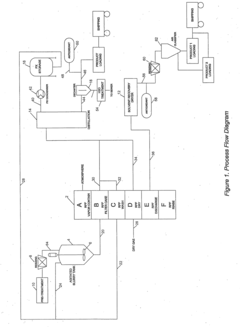
Continuous System and Process for Treating a Low-Water Biomass Stream with Liquefied-Gas Solvent to Separate and Recover Organic Products
PatentActiveUS20170183377A1
Innovation
- A method utilizing a rotary pressure filter with a liquefied gas solvent to extract bio-molecules like lipids and proteins from partially dewatered biomass, where the biomass is mixed with the solvent in an agitator vessel and then filtered, allowing for continuous separation and subsequent solvent recovery and reuse, reducing residual solvent content.
Lifecycle Assessment of Biomass-Derived Solvents
Lifecycle Assessment of Biomass-Derived Solvents
The comprehensive lifecycle assessment (LCA) of biomass-derived solvents reveals significant environmental advantages compared to conventional petroleum-based alternatives. These bio-solvents demonstrate reduced carbon footprints, with studies indicating 30-70% lower greenhouse gas emissions depending on feedstock selection and processing methods. Corn-based solvents typically show moderate reductions, while those derived from agricultural waste streams and forestry residues achieve the highest environmental benefits.
Water consumption patterns vary considerably across different biomass solvent production pathways. While some require substantial irrigation during biomass cultivation, others utilizing waste biomass demonstrate water efficiency advantages. Advanced water recycling technologies implemented in newer production facilities have reduced freshwater requirements by approximately 40% compared to first-generation bio-solvent manufacturing processes.
Land use considerations remain a critical factor in biomass solvent sustainability. Direct and indirect land use changes associated with dedicated biomass cultivation can potentially offset carbon benefits. Recent analyses indicate that second-generation biomass solvents derived from agricultural residues and waste materials minimize these concerns by avoiding competition with food production and preventing additional land conversion.
Energy return on investment (EROI) metrics for biomass-derived solvents have improved significantly over the past decade. Current production pathways achieve EROI ratios between 2.5:1 and 4.8:1, representing substantial improvement from earlier generations but still below some conventional solvent production methods. Technological innovations in enzymatic processing and catalytic conversion continue to enhance these efficiency metrics.
Toxicity profiles of biomass-derived solvents demonstrate notable advantages in environmental persistence, bioaccumulation potential, and aquatic toxicity. Biodegradability rates typically exceed 90% within 28 days for most bio-based solvents, compared to significantly longer persistence for many petroleum-derived counterparts. This characteristic substantially reduces environmental risk in case of accidental release or disposal.
End-of-life considerations further enhance the environmental profile of biomass-derived solvents. Their biodegradable nature facilitates integration into existing waste treatment systems with minimal modification requirements. Several bio-solvents can be effectively recovered and recycled through distillation processes, with recovery rates exceeding 85% while maintaining performance characteristics.
Sensitivity analyses across multiple LCA studies highlight the importance of regional factors in determining overall environmental performance. Biomass availability, transportation distances, electricity grid composition, and waste management infrastructure significantly influence lifecycle impacts. This regional variability necessitates location-specific assessments when evaluating implementation strategies for biomass-derived solvent technologies.
The comprehensive lifecycle assessment (LCA) of biomass-derived solvents reveals significant environmental advantages compared to conventional petroleum-based alternatives. These bio-solvents demonstrate reduced carbon footprints, with studies indicating 30-70% lower greenhouse gas emissions depending on feedstock selection and processing methods. Corn-based solvents typically show moderate reductions, while those derived from agricultural waste streams and forestry residues achieve the highest environmental benefits.
Water consumption patterns vary considerably across different biomass solvent production pathways. While some require substantial irrigation during biomass cultivation, others utilizing waste biomass demonstrate water efficiency advantages. Advanced water recycling technologies implemented in newer production facilities have reduced freshwater requirements by approximately 40% compared to first-generation bio-solvent manufacturing processes.
Land use considerations remain a critical factor in biomass solvent sustainability. Direct and indirect land use changes associated with dedicated biomass cultivation can potentially offset carbon benefits. Recent analyses indicate that second-generation biomass solvents derived from agricultural residues and waste materials minimize these concerns by avoiding competition with food production and preventing additional land conversion.
Energy return on investment (EROI) metrics for biomass-derived solvents have improved significantly over the past decade. Current production pathways achieve EROI ratios between 2.5:1 and 4.8:1, representing substantial improvement from earlier generations but still below some conventional solvent production methods. Technological innovations in enzymatic processing and catalytic conversion continue to enhance these efficiency metrics.
Toxicity profiles of biomass-derived solvents demonstrate notable advantages in environmental persistence, bioaccumulation potential, and aquatic toxicity. Biodegradability rates typically exceed 90% within 28 days for most bio-based solvents, compared to significantly longer persistence for many petroleum-derived counterparts. This characteristic substantially reduces environmental risk in case of accidental release or disposal.
End-of-life considerations further enhance the environmental profile of biomass-derived solvents. Their biodegradable nature facilitates integration into existing waste treatment systems with minimal modification requirements. Several bio-solvents can be effectively recovered and recycled through distillation processes, with recovery rates exceeding 85% while maintaining performance characteristics.
Sensitivity analyses across multiple LCA studies highlight the importance of regional factors in determining overall environmental performance. Biomass availability, transportation distances, electricity grid composition, and waste management infrastructure significantly influence lifecycle impacts. This regional variability necessitates location-specific assessments when evaluating implementation strategies for biomass-derived solvent technologies.
Regulatory Framework for Green Solvent Implementation
The regulatory landscape for biomass-derived solvents is rapidly evolving as governments worldwide recognize the importance of transitioning to more sustainable chemical practices. At the international level, frameworks such as the United Nations Framework Convention on Climate Change (UNFCCC) and the Paris Agreement provide overarching guidance for reducing carbon emissions, indirectly influencing the adoption of bio-based solvents as alternatives to petrochemical products.
In the European Union, the REACH (Registration, Evaluation, Authorization and Restriction of Chemicals) regulation serves as a cornerstone for chemical management, with specific provisions that increasingly favor green solvents. The EU's Circular Economy Action Plan and Bioeconomy Strategy further strengthen the regulatory foundation for biomass-derived solvents by promoting bio-based products and establishing sustainability criteria for their production and use.
The United States has implemented a patchwork of regulations affecting green solvent implementation, including the Toxic Substances Control Act (TSCA) and the BioPreferred Program, which mandates federal agencies to purchase bio-based products when available. Additionally, California's Green Chemistry Initiative has pioneered state-level regulations that encourage the substitution of hazardous chemicals with safer alternatives, including biomass-derived solvents.
Compliance challenges remain significant for manufacturers and users of biomass-derived solvents. These include navigating complex certification processes, addressing varying regional standards, and managing the costs associated with regulatory testing and documentation. Small and medium enterprises particularly struggle with these burdens, potentially limiting innovation in the sector.
Standardization efforts are underway through organizations such as the International Organization for Standardization (ISO) and ASTM International, which are developing specific standards for bio-based products. These standards aim to harmonize testing methods, labeling requirements, and sustainability criteria, facilitating international trade and consumer confidence in biomass-derived solvents.
Looking forward, regulatory trends indicate a move toward more stringent environmental criteria and expanded lifecycle assessment requirements for chemical products. The concept of "extended producer responsibility" is gaining traction, potentially shifting more environmental management costs to producers and encouraging the development of more sustainable solvent options.
Incentive mechanisms, including tax benefits, subsidies, and preferential procurement policies, are increasingly being deployed to accelerate the adoption of green solvents. These economic instruments complement traditional command-and-control regulations and can significantly influence market dynamics in favor of biomass-derived alternatives.
In the European Union, the REACH (Registration, Evaluation, Authorization and Restriction of Chemicals) regulation serves as a cornerstone for chemical management, with specific provisions that increasingly favor green solvents. The EU's Circular Economy Action Plan and Bioeconomy Strategy further strengthen the regulatory foundation for biomass-derived solvents by promoting bio-based products and establishing sustainability criteria for their production and use.
The United States has implemented a patchwork of regulations affecting green solvent implementation, including the Toxic Substances Control Act (TSCA) and the BioPreferred Program, which mandates federal agencies to purchase bio-based products when available. Additionally, California's Green Chemistry Initiative has pioneered state-level regulations that encourage the substitution of hazardous chemicals with safer alternatives, including biomass-derived solvents.
Compliance challenges remain significant for manufacturers and users of biomass-derived solvents. These include navigating complex certification processes, addressing varying regional standards, and managing the costs associated with regulatory testing and documentation. Small and medium enterprises particularly struggle with these burdens, potentially limiting innovation in the sector.
Standardization efforts are underway through organizations such as the International Organization for Standardization (ISO) and ASTM International, which are developing specific standards for bio-based products. These standards aim to harmonize testing methods, labeling requirements, and sustainability criteria, facilitating international trade and consumer confidence in biomass-derived solvents.
Looking forward, regulatory trends indicate a move toward more stringent environmental criteria and expanded lifecycle assessment requirements for chemical products. The concept of "extended producer responsibility" is gaining traction, potentially shifting more environmental management costs to producers and encouraging the development of more sustainable solvent options.
Incentive mechanisms, including tax benefits, subsidies, and preferential procurement policies, are increasingly being deployed to accelerate the adoption of green solvents. These economic instruments complement traditional command-and-control regulations and can significantly influence market dynamics in favor of biomass-derived alternatives.
Unlock deeper insights with Patsnap Eureka Quick Research — get a full tech report to explore trends and direct your research. Try now!
Generate Your Research Report Instantly with AI Agent
Supercharge your innovation with Patsnap Eureka AI Agent Platform!