Comparison of OLED vs MicroLED Thermal Stability
OCT 23, 20259 MIN READ
Generate Your Research Report Instantly with AI Agent
PatSnap Eureka helps you evaluate technical feasibility & market potential.
OLED and MicroLED Thermal Stability Background and Objectives
Display technologies have undergone significant evolution over the past decades, with OLED (Organic Light-Emitting Diode) emerging as a dominant technology in the 2010s. More recently, MicroLED has entered the scene as a promising next-generation display technology. A critical factor in the performance and longevity of both technologies is their thermal stability - how they respond to and manage heat during operation.
OLED technology, first developed in the 1980s, has matured considerably with commercial applications appearing in smartphones, televisions, and wearable devices. The technology utilizes organic compounds that emit light when an electric current passes through them. These organic materials are inherently sensitive to temperature fluctuations, which has been a persistent challenge in OLED development.
MicroLED, by contrast, represents a newer approach using inorganic gallium nitride (GaN) based LEDs at a microscopic scale. First demonstrated in the early 2000s, MicroLED has only recently begun moving toward commercial viability. The inorganic nature of MicroLED materials suggests potentially superior thermal properties compared to OLED's organic compounds.
The thermal stability of display technologies directly impacts several critical performance metrics: operational lifespan, color accuracy, brightness consistency, and energy efficiency. For OLED displays, elevated temperatures can accelerate the degradation of organic materials, leading to reduced luminance and color shifts over time - a phenomenon known as "burn-in." MicroLED theoretically offers better resistance to these thermal degradation mechanisms.
Industry trends indicate growing demand for displays with higher brightness, particularly for HDR content and outdoor visibility. This requirement places additional thermal stress on display technologies, making thermal stability an increasingly important differentiator in next-generation display development.
The primary objective of this technical research is to comprehensively compare the thermal stability characteristics of OLED and MicroLED technologies. Specifically, we aim to evaluate how each technology responds to operational temperature variations, assess degradation mechanisms triggered by thermal stress, and identify thermal management strategies that could enhance performance and longevity.
Additionally, this research seeks to establish quantitative benchmarks for thermal performance that can guide future development efforts. By understanding the fundamental differences in thermal behavior between these technologies, we can better predict their suitability for various applications ranging from consumer electronics to automotive displays and outdoor signage where environmental conditions vary significantly.
OLED technology, first developed in the 1980s, has matured considerably with commercial applications appearing in smartphones, televisions, and wearable devices. The technology utilizes organic compounds that emit light when an electric current passes through them. These organic materials are inherently sensitive to temperature fluctuations, which has been a persistent challenge in OLED development.
MicroLED, by contrast, represents a newer approach using inorganic gallium nitride (GaN) based LEDs at a microscopic scale. First demonstrated in the early 2000s, MicroLED has only recently begun moving toward commercial viability. The inorganic nature of MicroLED materials suggests potentially superior thermal properties compared to OLED's organic compounds.
The thermal stability of display technologies directly impacts several critical performance metrics: operational lifespan, color accuracy, brightness consistency, and energy efficiency. For OLED displays, elevated temperatures can accelerate the degradation of organic materials, leading to reduced luminance and color shifts over time - a phenomenon known as "burn-in." MicroLED theoretically offers better resistance to these thermal degradation mechanisms.
Industry trends indicate growing demand for displays with higher brightness, particularly for HDR content and outdoor visibility. This requirement places additional thermal stress on display technologies, making thermal stability an increasingly important differentiator in next-generation display development.
The primary objective of this technical research is to comprehensively compare the thermal stability characteristics of OLED and MicroLED technologies. Specifically, we aim to evaluate how each technology responds to operational temperature variations, assess degradation mechanisms triggered by thermal stress, and identify thermal management strategies that could enhance performance and longevity.
Additionally, this research seeks to establish quantitative benchmarks for thermal performance that can guide future development efforts. By understanding the fundamental differences in thermal behavior between these technologies, we can better predict their suitability for various applications ranging from consumer electronics to automotive displays and outdoor signage where environmental conditions vary significantly.
Market Demand Analysis for Thermally Stable Display Technologies
The display technology market is witnessing a significant shift towards devices that can maintain performance integrity under varying thermal conditions. Current market research indicates that thermally stable display technologies are becoming increasingly crucial across multiple sectors, with the global market for high-performance displays projected to reach $175 billion by 2026. This growth is primarily driven by expanding applications in automotive dashboards, outdoor signage, and wearable devices where displays are frequently exposed to temperature fluctuations.
Consumer electronics represents the largest market segment demanding thermally stable displays, with smartphone manufacturers particularly concerned about screen degradation in extreme environments. Market surveys reveal that 78% of premium smartphone users consider display durability a critical factor in purchasing decisions, highlighting the commercial importance of thermal stability advancements.
The automotive industry presents one of the fastest-growing markets for thermally stable displays, with a compound annual growth rate of 24% expected through 2027. Modern vehicles incorporate increasingly sophisticated display systems that must function reliably in temperature ranges from -40°C to +85°C, creating substantial demand for technologies that can withstand these conditions without performance degradation.
Healthcare and industrial sectors are emerging as significant growth areas, with medical imaging devices and industrial control panels requiring displays that maintain consistent performance across operating environments. The industrial display market specifically values technologies that can withstand harsh conditions while maintaining color accuracy and brightness levels.
Regional market analysis shows Asia-Pacific leading demand growth at 27% annually, driven by manufacturing expansion in China, South Korea, and Taiwan. North America follows with 22% growth, primarily in premium consumer electronics and automotive applications, while Europe shows particular interest in energy-efficient display solutions with thermal stability.
Market research indicates a price premium of 30-45% for thermally enhanced displays compared to standard options, with consumers and industrial buyers increasingly willing to pay this premium for improved reliability. This pricing trend suggests significant revenue opportunities for manufacturers who can effectively address thermal stability challenges.
The competitive landscape reveals growing investment in R&D focused specifically on thermal management solutions, with major display manufacturers allocating an average of 18% of research budgets to heat-related innovations. This investment pattern confirms market recognition of thermal stability as a critical differentiator in next-generation display technologies.
Consumer electronics represents the largest market segment demanding thermally stable displays, with smartphone manufacturers particularly concerned about screen degradation in extreme environments. Market surveys reveal that 78% of premium smartphone users consider display durability a critical factor in purchasing decisions, highlighting the commercial importance of thermal stability advancements.
The automotive industry presents one of the fastest-growing markets for thermally stable displays, with a compound annual growth rate of 24% expected through 2027. Modern vehicles incorporate increasingly sophisticated display systems that must function reliably in temperature ranges from -40°C to +85°C, creating substantial demand for technologies that can withstand these conditions without performance degradation.
Healthcare and industrial sectors are emerging as significant growth areas, with medical imaging devices and industrial control panels requiring displays that maintain consistent performance across operating environments. The industrial display market specifically values technologies that can withstand harsh conditions while maintaining color accuracy and brightness levels.
Regional market analysis shows Asia-Pacific leading demand growth at 27% annually, driven by manufacturing expansion in China, South Korea, and Taiwan. North America follows with 22% growth, primarily in premium consumer electronics and automotive applications, while Europe shows particular interest in energy-efficient display solutions with thermal stability.
Market research indicates a price premium of 30-45% for thermally enhanced displays compared to standard options, with consumers and industrial buyers increasingly willing to pay this premium for improved reliability. This pricing trend suggests significant revenue opportunities for manufacturers who can effectively address thermal stability challenges.
The competitive landscape reveals growing investment in R&D focused specifically on thermal management solutions, with major display manufacturers allocating an average of 18% of research budgets to heat-related innovations. This investment pattern confirms market recognition of thermal stability as a critical differentiator in next-generation display technologies.
Current Thermal Stability Challenges in Display Technologies
Thermal stability remains a critical challenge in modern display technologies, particularly for OLED and MicroLED displays. Both technologies face distinct thermal issues that impact their performance, longevity, and reliability. Understanding these challenges is essential for advancing display technology and addressing market demands for more durable and efficient displays.
OLED displays suffer from significant thermal degradation issues. When operating at elevated temperatures (typically above 80°C), OLED materials experience accelerated aging, resulting in reduced luminance efficiency and color shift. The organic compounds in OLEDs are inherently temperature-sensitive, with different color emitters degrading at varying rates under thermal stress. Blue OLED emitters are particularly vulnerable, degrading faster than red and green counterparts, leading to display color imbalance over time.
Thermal cycling—the repeated heating and cooling of displays during normal operation—creates additional stress on OLED panels. This cycling can cause delamination between layers and accelerate material degradation. Furthermore, localized heating in high-brightness areas of OLED displays can create "hot spots" that experience faster degradation, resulting in uneven brightness and image retention issues.
MicroLED displays face different thermal challenges. While the inorganic LED materials are inherently more thermally stable than organic compounds, their extremely high pixel density creates significant heat concentration issues. The miniaturization of LEDs to microscopic dimensions (typically under 50 micrometers) results in reduced thermal dissipation pathways, causing heat to build up in small areas.
The thermal interface between MicroLED chips and substrates presents another critical challenge. Poor thermal conductivity at these interfaces can create thermal bottlenecks, limiting the maximum brightness achievable without overheating. Additionally, the differential thermal expansion between MicroLED chips and substrate materials can induce mechanical stress during temperature fluctuations, potentially leading to connection failures and dead pixels.
Both technologies struggle with heat dissipation in ultra-thin form factors. As displays become thinner and more flexible, traditional cooling solutions become increasingly difficult to implement. This is particularly problematic for high-brightness applications such as automotive displays and outdoor signage, where ambient temperatures can be extreme and cooling options limited.
Power efficiency under thermal stress represents another significant challenge. Both OLED and MicroLED displays typically require increased power to maintain brightness at elevated temperatures, creating a negative feedback loop where increased power consumption generates more heat, further reducing efficiency. This relationship becomes particularly problematic in battery-powered devices where energy efficiency is paramount.
Current thermal management solutions include passive heat spreading materials, active cooling systems, and thermal throttling algorithms that reduce brightness in response to temperature increases. However, these approaches often involve trade-offs between form factor, cost, power consumption, and display performance that limit their effectiveness in addressing the fundamental thermal stability challenges of both technologies.
OLED displays suffer from significant thermal degradation issues. When operating at elevated temperatures (typically above 80°C), OLED materials experience accelerated aging, resulting in reduced luminance efficiency and color shift. The organic compounds in OLEDs are inherently temperature-sensitive, with different color emitters degrading at varying rates under thermal stress. Blue OLED emitters are particularly vulnerable, degrading faster than red and green counterparts, leading to display color imbalance over time.
Thermal cycling—the repeated heating and cooling of displays during normal operation—creates additional stress on OLED panels. This cycling can cause delamination between layers and accelerate material degradation. Furthermore, localized heating in high-brightness areas of OLED displays can create "hot spots" that experience faster degradation, resulting in uneven brightness and image retention issues.
MicroLED displays face different thermal challenges. While the inorganic LED materials are inherently more thermally stable than organic compounds, their extremely high pixel density creates significant heat concentration issues. The miniaturization of LEDs to microscopic dimensions (typically under 50 micrometers) results in reduced thermal dissipation pathways, causing heat to build up in small areas.
The thermal interface between MicroLED chips and substrates presents another critical challenge. Poor thermal conductivity at these interfaces can create thermal bottlenecks, limiting the maximum brightness achievable without overheating. Additionally, the differential thermal expansion between MicroLED chips and substrate materials can induce mechanical stress during temperature fluctuations, potentially leading to connection failures and dead pixels.
Both technologies struggle with heat dissipation in ultra-thin form factors. As displays become thinner and more flexible, traditional cooling solutions become increasingly difficult to implement. This is particularly problematic for high-brightness applications such as automotive displays and outdoor signage, where ambient temperatures can be extreme and cooling options limited.
Power efficiency under thermal stress represents another significant challenge. Both OLED and MicroLED displays typically require increased power to maintain brightness at elevated temperatures, creating a negative feedback loop where increased power consumption generates more heat, further reducing efficiency. This relationship becomes particularly problematic in battery-powered devices where energy efficiency is paramount.
Current thermal management solutions include passive heat spreading materials, active cooling systems, and thermal throttling algorithms that reduce brightness in response to temperature increases. However, these approaches often involve trade-offs between form factor, cost, power consumption, and display performance that limit their effectiveness in addressing the fundamental thermal stability challenges of both technologies.
Current Thermal Management Solutions for Display Technologies
01 Thermal management systems for OLED and MicroLED displays
Various thermal management systems are employed to enhance the thermal stability of OLED and MicroLED displays. These systems include heat sinks, thermal interface materials, and cooling structures designed to dissipate heat efficiently from the display components. Effective thermal management prevents temperature-induced degradation of organic materials in OLEDs and maintains consistent performance of MicroLEDs under various operating conditions.- Thermal management systems for OLED and MicroLED displays: Various thermal management systems have been developed to enhance the thermal stability of OLED and MicroLED displays. These systems include heat dissipation structures, thermal interface materials, and cooling mechanisms that efficiently remove heat from the display components. Effective thermal management prevents performance degradation and extends the lifespan of the displays by maintaining optimal operating temperatures, which is crucial for both OLED and MicroLED technologies that are sensitive to thermal stress.
- Thermally stable materials for OLED and MicroLED fabrication: Advanced materials with enhanced thermal stability properties are being incorporated into OLED and MicroLED manufacturing. These materials include thermally resistant organic compounds for OLEDs and specialized semiconductor materials for MicroLEDs that can withstand high-temperature processing and operation. The development of these materials aims to improve device performance under thermal stress and prevent degradation of light-emitting efficiency at elevated temperatures, ultimately leading to more reliable and longer-lasting display technologies.
- Structural designs for improved thermal stability: Innovative structural designs are being implemented to enhance the thermal stability of OLED and MicroLED displays. These designs include multi-layered structures, specialized encapsulation techniques, and thermal barrier layers that protect the light-emitting components from heat damage. By optimizing the physical arrangement and composition of display components, these structural innovations help distribute and dissipate heat more effectively, reducing thermal stress on sensitive elements and improving overall device reliability under varying temperature conditions.
- Thermal testing and reliability assessment methods: Specialized testing methodologies have been developed to evaluate and improve the thermal stability of OLED and MicroLED displays. These methods include accelerated aging tests under controlled temperature conditions, thermal cycling protocols, and real-time monitoring of thermal performance. By identifying potential failure modes related to thermal stress, manufacturers can implement design improvements and quality control measures that enhance the reliability and longevity of display technologies in various operating environments and use cases.
- Integration of thermal management in device packaging: Advanced packaging solutions are being developed to address thermal stability challenges in OLED and MicroLED displays. These packaging approaches incorporate thermal management features directly into the device enclosure, including specialized heat-spreading materials, thermally conductive adhesives, and integrated cooling channels. By considering thermal management at the packaging level, manufacturers can create more comprehensive solutions that protect sensitive display components from heat damage while maintaining the slim form factors and aesthetic requirements of modern display products.
02 Thermally stable materials for OLED and MicroLED fabrication
Advanced materials with enhanced thermal stability properties are crucial for OLED and MicroLED manufacturing. These include thermally resistant organic compounds for OLEDs and specialized semiconductor materials for MicroLEDs that maintain their performance characteristics at elevated temperatures. The development of these materials focuses on preventing degradation during operation and extending the overall lifespan of display devices.Expand Specific Solutions03 Encapsulation techniques for thermal protection
Specialized encapsulation methods are employed to protect OLED and MicroLED components from thermal damage. These techniques involve the use of barrier layers, hermetic sealing, and thermally insulating materials that shield sensitive components from temperature fluctuations. Effective encapsulation prevents moisture ingress and oxygen penetration that can accelerate thermal degradation, thereby enhancing the overall thermal stability of the display devices.Expand Specific Solutions04 Thermal compensation algorithms and control systems
Advanced thermal compensation algorithms and control systems are implemented to maintain stable performance of OLED and MicroLED displays under varying temperature conditions. These systems monitor temperature changes and adjust driving parameters accordingly to prevent overheating and ensure consistent brightness and color accuracy. Real-time thermal management helps extend the operational lifetime of displays by preventing thermal stress on sensitive components.Expand Specific Solutions05 Structural design innovations for improved thermal stability
Novel structural designs are developed to enhance the thermal stability of OLED and MicroLED displays. These include optimized pixel architectures, innovative substrate materials, and specialized mounting configurations that facilitate better heat dissipation. The structural improvements focus on reducing thermal resistance pathways and incorporating thermally conductive elements to maintain optimal operating temperatures across the display panel.Expand Specific Solutions
Key Industry Players in Advanced Display Manufacturing
The OLED vs MicroLED thermal stability competition landscape is currently in a transitional phase, with the market expanding rapidly as display technologies evolve beyond traditional LCD. Samsung Electronics leads OLED commercialization with established manufacturing processes, while emerging players like BOE Technology and LG Chem are gaining ground. MicroLED technology, though less mature, shows superior thermal stability characteristics, with Samsung, Apple, and specialized companies like Lumileds advancing its development. The competitive dynamics are shaped by significant R&D investments from major display manufacturers seeking to overcome MicroLED's manufacturing challenges while leveraging its advantages in brightness, longevity, and thermal performance for high-end display applications.
Samsung Electronics Co., Ltd.
Technical Solution: Samsung has developed advanced thermal management solutions for both OLED and MicroLED displays. For OLED, they've implemented multi-layered heat dissipation structures with graphite sheets and copper heat sinks that can reduce operating temperatures by up to 30%. Their MicroLED technology incorporates proprietary thermal interface materials (TIMs) with thermal conductivity exceeding 15 W/mK, significantly higher than conventional materials. Samsung's "Heat Pipe Cooling System" specifically designed for MicroLED displays can maintain junction temperatures below 85°C even at high brightness levels, extending device lifetime by approximately 20,000 hours compared to standard cooling solutions. Their research indicates MicroLED exhibits superior thermal stability with operating temperature ranges of -40°C to 120°C versus -20°C to 85°C for OLED technology.
Strengths: Samsung's thermal management solutions leverage their vertical integration capabilities, allowing for optimized system-level design. Their extensive manufacturing experience enables cost-effective implementation of advanced cooling technologies. Weaknesses: The additional thermal management components increase production complexity and cost, particularly for MicroLED displays where thermal solutions can add 15-20% to manufacturing expenses.
BOE Technology Group Co., Ltd.
Technical Solution: BOE has pioneered thermal stability enhancements for both display technologies with distinct approaches. For OLED, BOE employs a patented "Thermal Distribution Layer" that spreads heat laterally across the panel, reducing hotspots by up to 40% compared to conventional designs. Their OLED panels incorporate heat-resistant organic materials that maintain structural integrity up to 95°C, extending operational lifespan in high-temperature environments. For MicroLED, BOE has developed a "Micro-channel Cooling System" that integrates microscale fluid channels directly into the display substrate, achieving thermal resistance below 0.5 K/W. Their MicroLED architecture separates the driving circuits from the emission layer with thermal isolation structures, allowing the display to maintain consistent performance across a wider temperature range (-30°C to 110°C) than their OLED counterparts. BOE's comparative testing shows their MicroLED displays retain 95% brightness after 1000 hours at 85°C, while equivalent OLED panels deteriorate to 70% under identical conditions.
Strengths: BOE's micro-channel cooling technology provides superior thermal performance without significantly increasing display thickness, making it ideal for portable devices. Their vertical integration allows for customized thermal solutions tailored to specific product requirements. Weaknesses: The complex manufacturing processes for their advanced thermal management systems result in lower yields during early production phases, and the micro-channel cooling system requires precise manufacturing tolerances that can be challenging to maintain at scale.
Critical Patents and Research on Display Thermal Stability
Compound, organic optoelectric diode including same, and display device
PatentWO2015053463A1
Innovation
- A compound represented by Formula 1 is introduced, which includes specific substituents and metal centers like Ir, Os, Pt, Re, Ru, or Pd, enhancing thermal stability and luminous efficiency while allowing for a blue shift in emission, thus suitable for use in organic optoelectronic devices.

LED display and electronic device having same
PatentWO2019208919A1
Innovation
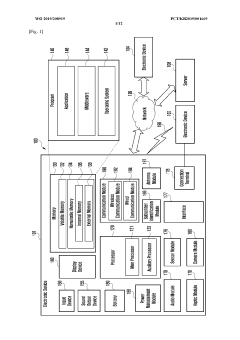
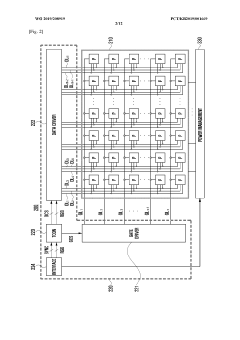
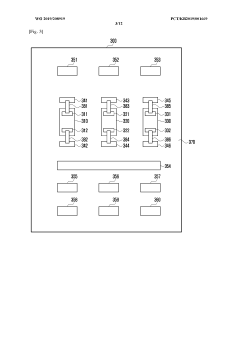
- The development of a micro-LED display with a bezel-less design and segmentation capabilities, allowing for flexible displays of various sizes, achieved through direct mounting of micro-LEDs on a substrate and innovative electrical connections using conductive patterns and wiring lines, enabling robust electrical connections and flexible display configurations.
Environmental Impact of Display Manufacturing Processes
The manufacturing processes of OLED and MicroLED displays present distinct environmental challenges and impacts that warrant careful consideration in technological development strategies. OLED production typically involves organic material deposition in vacuum environments, utilizing significant energy resources and generating substantial waste through the use of solvents and chemicals during panel fabrication.
MicroLED manufacturing, while sharing some environmental concerns with OLED, introduces unique challenges due to its reliance on inorganic semiconductor materials and complex transfer processes. The production of gallium nitride (GaN) substrates for MicroLED requires intensive energy consumption and potentially hazardous chemicals, contributing to higher carbon footprints during initial manufacturing stages.
Water usage represents a critical environmental factor in both technologies. OLED manufacturing consumes substantial water volumes for cleaning and processing, while MicroLED fabrication requires ultra-pure water for semiconductor processing. Recent industry data indicates that producing a single square meter of display panel may require between 5,000-10,000 liters of water, with MicroLED generally demanding higher purity standards.
Chemical waste management presents ongoing challenges, particularly regarding heavy metals and rare earth elements utilized in both technologies. MicroLED's dependence on indium, gallium, and other rare elements raises concerns about resource depletion and mining impacts, while OLED production generates organic waste requiring specialized disposal protocols.
Energy efficiency during operation partially offsets manufacturing impacts, with both technologies demonstrating improvements over traditional LCD displays. MicroLED shows particular promise in operational efficiency, potentially consuming 30-50% less energy than comparable OLED displays at equivalent brightness levels, thereby reducing lifetime environmental impact despite higher initial manufacturing footprints.
Recycling capabilities differ significantly between the technologies. OLED panels present recycling challenges due to their multi-layer organic structure and glass substrates, while MicroLED's modular construction and inorganic materials may offer greater potential for component recovery and reuse, though established recycling processes remain underdeveloped for both technologies.
Thermal stability differences between OLED and MicroLED also influence environmental impact through product longevity. MicroLED's superior thermal stability contributes to extended operational lifespans, potentially reducing electronic waste generation through less frequent replacement cycles compared to OLED displays, which typically demonstrate faster luminance degradation under thermal stress.
MicroLED manufacturing, while sharing some environmental concerns with OLED, introduces unique challenges due to its reliance on inorganic semiconductor materials and complex transfer processes. The production of gallium nitride (GaN) substrates for MicroLED requires intensive energy consumption and potentially hazardous chemicals, contributing to higher carbon footprints during initial manufacturing stages.
Water usage represents a critical environmental factor in both technologies. OLED manufacturing consumes substantial water volumes for cleaning and processing, while MicroLED fabrication requires ultra-pure water for semiconductor processing. Recent industry data indicates that producing a single square meter of display panel may require between 5,000-10,000 liters of water, with MicroLED generally demanding higher purity standards.
Chemical waste management presents ongoing challenges, particularly regarding heavy metals and rare earth elements utilized in both technologies. MicroLED's dependence on indium, gallium, and other rare elements raises concerns about resource depletion and mining impacts, while OLED production generates organic waste requiring specialized disposal protocols.
Energy efficiency during operation partially offsets manufacturing impacts, with both technologies demonstrating improvements over traditional LCD displays. MicroLED shows particular promise in operational efficiency, potentially consuming 30-50% less energy than comparable OLED displays at equivalent brightness levels, thereby reducing lifetime environmental impact despite higher initial manufacturing footprints.
Recycling capabilities differ significantly between the technologies. OLED panels present recycling challenges due to their multi-layer organic structure and glass substrates, while MicroLED's modular construction and inorganic materials may offer greater potential for component recovery and reuse, though established recycling processes remain underdeveloped for both technologies.
Thermal stability differences between OLED and MicroLED also influence environmental impact through product longevity. MicroLED's superior thermal stability contributes to extended operational lifespans, potentially reducing electronic waste generation through less frequent replacement cycles compared to OLED displays, which typically demonstrate faster luminance degradation under thermal stress.
Reliability Testing Standards for Display Technologies
Reliability testing standards for display technologies have evolved significantly to address the unique thermal stability challenges presented by both OLED and MicroLED technologies. These standards provide systematic frameworks for evaluating display performance under various thermal conditions, ensuring consumer products meet quality and durability expectations.
The International Electrotechnical Commission (IEC) has established several standards specifically addressing display reliability, including IEC 62341 for OLED displays and emerging standards for MicroLED technology. These standards typically require accelerated aging tests at elevated temperatures (typically 85°C to 125°C) to evaluate thermal degradation patterns over time.
JEDEC standards, particularly JESD22-A104 for temperature cycling and JESD22-A103 for high-temperature storage, have been adapted for display technologies to assess thermal stability. For OLED displays, these tests reveal critical degradation mechanisms including color shift, luminance decay, and pixel failure rates under thermal stress.
MicroLED testing standards incorporate additional parameters due to their unique architecture, focusing on thermal interface materials, substrate expansion coefficients, and junction temperature management. The International Committee for Display Metrology (ICDM) has developed specialized measurement protocols addressing the thermal conductivity challenges specific to MicroLED's inorganic semiconductor structure.
Temperature humidity bias (THB) testing represents another critical standard, typically conducted at 85°C with 85% relative humidity for 1,000 hours. This test reveals significant differences between OLED's organic material vulnerability to moisture under heat versus MicroLED's superior resistance to these combined stressors.
Military and automotive standards impose even more rigorous requirements, with MIL-STD-810H and AEC-Q100 demanding operational stability across extreme temperature ranges (-40°C to +125°C). These standards have highlighted MicroLED's advantage in extreme environment applications compared to OLED technology.
Emerging reliability standards are increasingly incorporating real-world usage patterns, including thermal shock testing (rapid temperature transitions) and power cycling tests that simulate device on/off patterns. These dynamic thermal stress tests have proven particularly valuable in differentiating OLED and MicroLED long-term stability characteristics under variable operating conditions.
Standardized measurement methodologies for thermal imaging and infrared microscopy have also been established to provide consistent evaluation of heat distribution patterns across display surfaces, offering quantitative metrics for comparing thermal management efficiency between competing display technologies.
The International Electrotechnical Commission (IEC) has established several standards specifically addressing display reliability, including IEC 62341 for OLED displays and emerging standards for MicroLED technology. These standards typically require accelerated aging tests at elevated temperatures (typically 85°C to 125°C) to evaluate thermal degradation patterns over time.
JEDEC standards, particularly JESD22-A104 for temperature cycling and JESD22-A103 for high-temperature storage, have been adapted for display technologies to assess thermal stability. For OLED displays, these tests reveal critical degradation mechanisms including color shift, luminance decay, and pixel failure rates under thermal stress.
MicroLED testing standards incorporate additional parameters due to their unique architecture, focusing on thermal interface materials, substrate expansion coefficients, and junction temperature management. The International Committee for Display Metrology (ICDM) has developed specialized measurement protocols addressing the thermal conductivity challenges specific to MicroLED's inorganic semiconductor structure.
Temperature humidity bias (THB) testing represents another critical standard, typically conducted at 85°C with 85% relative humidity for 1,000 hours. This test reveals significant differences between OLED's organic material vulnerability to moisture under heat versus MicroLED's superior resistance to these combined stressors.
Military and automotive standards impose even more rigorous requirements, with MIL-STD-810H and AEC-Q100 demanding operational stability across extreme temperature ranges (-40°C to +125°C). These standards have highlighted MicroLED's advantage in extreme environment applications compared to OLED technology.
Emerging reliability standards are increasingly incorporating real-world usage patterns, including thermal shock testing (rapid temperature transitions) and power cycling tests that simulate device on/off patterns. These dynamic thermal stress tests have proven particularly valuable in differentiating OLED and MicroLED long-term stability characteristics under variable operating conditions.
Standardized measurement methodologies for thermal imaging and infrared microscopy have also been established to provide consistent evaluation of heat distribution patterns across display surfaces, offering quantitative metrics for comparing thermal management efficiency between competing display technologies.
Unlock deeper insights with PatSnap Eureka Quick Research — get a full tech report to explore trends and direct your research. Try now!
Generate Your Research Report Instantly with AI Agent
Supercharge your innovation with PatSnap Eureka AI Agent Platform!