

What Are the Key Patents in OLED vs MicroLED Technology
OCT 23, 20259 MIN READ
Generate Your Research Report Instantly with AI Agent
PatSnap Eureka helps you evaluate technical feasibility & market potential.
OLED vs MicroLED Evolution and Development Goals
The evolution of display technologies has witnessed significant advancements over the past decades, with OLED (Organic Light-Emitting Diode) and MicroLED emerging as two pivotal technologies shaping the future of displays. OLED technology, first conceptualized in the 1950s, saw practical development in the 1980s with Eastman Kodak's pioneering work. Commercial OLED displays began appearing in the early 2000s, revolutionizing the industry with their self-emissive properties, eliminating the need for backlighting.
MicroLED technology represents a more recent innovation, with its conceptual foundations laid in the early 2000s. Unlike OLEDs that utilize organic compounds, MicroLEDs employ inorganic gallium nitride-based materials, offering potential advantages in brightness, efficiency, and longevity. The technology gained significant momentum after 2010, with major industry players investing heavily in research and development.
The evolutionary trajectory of these technologies reveals distinct development patterns. OLED technology has matured considerably, with manufacturers focusing on overcoming inherent challenges such as blue pixel degradation, manufacturing yield improvements, and cost reduction. The technology has evolved from passive-matrix to active-matrix configurations, with flexible and transparent OLED displays representing recent breakthroughs.
MicroLED development, while still in earlier stages compared to OLED, has progressed rapidly. Initial challenges in mass transfer techniques—moving millions of microscopic LEDs precisely onto substrates—have seen innovative solutions emerge. The technology has evolved from proof-of-concept prototypes to demonstration products, with mass production techniques continuously improving.
The development goals for both technologies reflect their respective market positions and technical challenges. For OLED, key objectives include extending operational lifespan, particularly for blue subpixels, improving energy efficiency, reducing production costs, and enhancing manufacturing yields for larger displays. Additionally, advancing flexible and transparent OLED capabilities remains a priority for enabling novel form factors.
MicroLED development goals center on perfecting mass transfer techniques to enable cost-effective production, reducing pixel size while maintaining brightness efficiency, developing viable color conversion methods, and establishing standardized manufacturing processes. The ultimate aim is to achieve production scalability that can compete with established display technologies on cost while delivering superior performance characteristics.
Both technologies are converging toward similar end-user benefits—thinner, lighter, more energy-efficient displays with superior image quality—but through fundamentally different technical approaches, each with distinct advantages and limitations that will shape their respective adoption across various market segments.
MicroLED technology represents a more recent innovation, with its conceptual foundations laid in the early 2000s. Unlike OLEDs that utilize organic compounds, MicroLEDs employ inorganic gallium nitride-based materials, offering potential advantages in brightness, efficiency, and longevity. The technology gained significant momentum after 2010, with major industry players investing heavily in research and development.
The evolutionary trajectory of these technologies reveals distinct development patterns. OLED technology has matured considerably, with manufacturers focusing on overcoming inherent challenges such as blue pixel degradation, manufacturing yield improvements, and cost reduction. The technology has evolved from passive-matrix to active-matrix configurations, with flexible and transparent OLED displays representing recent breakthroughs.
MicroLED development, while still in earlier stages compared to OLED, has progressed rapidly. Initial challenges in mass transfer techniques—moving millions of microscopic LEDs precisely onto substrates—have seen innovative solutions emerge. The technology has evolved from proof-of-concept prototypes to demonstration products, with mass production techniques continuously improving.
The development goals for both technologies reflect their respective market positions and technical challenges. For OLED, key objectives include extending operational lifespan, particularly for blue subpixels, improving energy efficiency, reducing production costs, and enhancing manufacturing yields for larger displays. Additionally, advancing flexible and transparent OLED capabilities remains a priority for enabling novel form factors.
MicroLED development goals center on perfecting mass transfer techniques to enable cost-effective production, reducing pixel size while maintaining brightness efficiency, developing viable color conversion methods, and establishing standardized manufacturing processes. The ultimate aim is to achieve production scalability that can compete with established display technologies on cost while delivering superior performance characteristics.
Both technologies are converging toward similar end-user benefits—thinner, lighter, more energy-efficient displays with superior image quality—but through fundamentally different technical approaches, each with distinct advantages and limitations that will shape their respective adoption across various market segments.
Display Market Demand Analysis and Trends
The display technology market has witnessed significant growth over the past decade, with OLED (Organic Light-Emitting Diode) establishing itself as the premium display solution across multiple device categories. However, MicroLED technology has emerged as a promising contender that could potentially reshape market dynamics in the coming years. Current market analysis indicates that the global display market is valued at approximately 150 billion USD, with projections suggesting growth to 200 billion USD by 2027.
Consumer electronics continues to drive display technology demand, with smartphones representing the largest segment. High-end smartphone manufacturers have widely adopted OLED technology, with over 70% of premium devices now featuring OLED displays. This adoption has been fueled by consumer preference for vibrant colors, true blacks, and energy efficiency in mobile devices. Meanwhile, television displays represent the second-largest market segment, where OLED has captured the premium tier while LCD technology maintains dominance in mid-range and budget categories.
Market research indicates emerging demand patterns that favor technologies offering higher energy efficiency, improved brightness, longer lifespan, and thinner form factors. MicroLED addresses many of these requirements, potentially disrupting OLED's current market position. Industry surveys reveal that 65% of consumers consider display quality a critical factor in purchasing decisions for electronic devices, highlighting the strategic importance of advanced display technologies.
Commercial applications represent a rapidly growing market segment, with digital signage, automotive displays, and augmented reality devices creating new demand vectors. These applications often require specialized display characteristics such as extreme brightness, durability, and unique form factors that neither traditional LCD nor current OLED implementations fully satisfy, creating market opportunities for MicroLED technology.
Regional analysis shows Asia-Pacific dominating display manufacturing, with South Korea and China leading OLED production. However, MicroLED patent activity indicates more distributed innovation centers across North America, Europe, and Asia, suggesting a potential shift in the geographic distribution of display technology leadership as MicroLED matures.
Market forecasts predict that while OLED will maintain its dominant position through 2025, MicroLED is expected to gain significant market share thereafter, particularly in premium television, automotive, and AR/VR segments. This transition is anticipated to accelerate as manufacturing costs decrease and yield rates improve, with industry analysts projecting MicroLED to capture 15% of the premium display market by 2030.
Consumer electronics continues to drive display technology demand, with smartphones representing the largest segment. High-end smartphone manufacturers have widely adopted OLED technology, with over 70% of premium devices now featuring OLED displays. This adoption has been fueled by consumer preference for vibrant colors, true blacks, and energy efficiency in mobile devices. Meanwhile, television displays represent the second-largest market segment, where OLED has captured the premium tier while LCD technology maintains dominance in mid-range and budget categories.
Market research indicates emerging demand patterns that favor technologies offering higher energy efficiency, improved brightness, longer lifespan, and thinner form factors. MicroLED addresses many of these requirements, potentially disrupting OLED's current market position. Industry surveys reveal that 65% of consumers consider display quality a critical factor in purchasing decisions for electronic devices, highlighting the strategic importance of advanced display technologies.
Commercial applications represent a rapidly growing market segment, with digital signage, automotive displays, and augmented reality devices creating new demand vectors. These applications often require specialized display characteristics such as extreme brightness, durability, and unique form factors that neither traditional LCD nor current OLED implementations fully satisfy, creating market opportunities for MicroLED technology.
Regional analysis shows Asia-Pacific dominating display manufacturing, with South Korea and China leading OLED production. However, MicroLED patent activity indicates more distributed innovation centers across North America, Europe, and Asia, suggesting a potential shift in the geographic distribution of display technology leadership as MicroLED matures.
Market forecasts predict that while OLED will maintain its dominant position through 2025, MicroLED is expected to gain significant market share thereafter, particularly in premium television, automotive, and AR/VR segments. This transition is anticipated to accelerate as manufacturing costs decrease and yield rates improve, with industry analysts projecting MicroLED to capture 15% of the premium display market by 2030.
Current Technical Challenges in OLED and MicroLED
Despite significant advancements in both OLED and MicroLED technologies, several critical technical challenges persist that impede their widespread adoption and performance optimization. For OLED technology, material degradation remains a fundamental issue, particularly the differential aging of organic compounds that leads to color shift and reduced brightness over time. Blue OLED materials specifically continue to exhibit shorter lifespans compared to their red and green counterparts, creating an imbalance in display longevity.
Manufacturing scalability presents another significant hurdle for OLED, especially for larger display formats. The precision required for vapor deposition processes becomes increasingly difficult to maintain as display sizes increase, resulting in yield rate challenges and cost inefficiencies. Additionally, OLED displays suffer from susceptibility to moisture and oxygen, necessitating complex encapsulation solutions that add to production complexity and cost.
MicroLED technology faces its own set of distinct challenges. Mass transfer remains perhaps the most significant technical barrier, as the process of precisely positioning millions of microscopic LED chips from a source wafer to a display substrate with near-perfect yield is extraordinarily complex. Current pick-and-place methods struggle with throughput limitations, while alternative approaches like fluidic assembly lack the necessary precision.
Miniaturization of LED chips presents another formidable challenge. As manufacturers push toward pixel sizes below 3 microns, quantum efficiency tends to decrease dramatically due to increased surface defects and sidewall recombination effects. This efficiency droop becomes particularly pronounced in blue MicroLEDs, creating color balance issues similar to those in OLED technology.
For both technologies, driving circuit complexity represents a significant challenge. OLED requires precise current control to maintain color accuracy and prevent premature aging, while MicroLED demands individual pixel addressability with extremely high precision. The integration of these driving circuits with the display elements introduces additional manufacturing complexities and potential points of failure.
Power efficiency optimization remains critical, particularly for mobile applications. While MicroLED theoretically offers superior efficiency, achieving this advantage in practical implementations requires overcoming significant engineering challenges related to light extraction efficiency and electrical-to-optical conversion rates. OLED technology continues to struggle with power consumption during the display of bright content, particularly white backgrounds.
Color management and quantum dot integration represent emerging challenges for both technologies as they strive to meet increasingly demanding color gamut standards. The precise control of color reproduction across millions of individual light-emitting elements requires sophisticated calibration techniques and compensation algorithms that add to system complexity.
Manufacturing scalability presents another significant hurdle for OLED, especially for larger display formats. The precision required for vapor deposition processes becomes increasingly difficult to maintain as display sizes increase, resulting in yield rate challenges and cost inefficiencies. Additionally, OLED displays suffer from susceptibility to moisture and oxygen, necessitating complex encapsulation solutions that add to production complexity and cost.
MicroLED technology faces its own set of distinct challenges. Mass transfer remains perhaps the most significant technical barrier, as the process of precisely positioning millions of microscopic LED chips from a source wafer to a display substrate with near-perfect yield is extraordinarily complex. Current pick-and-place methods struggle with throughput limitations, while alternative approaches like fluidic assembly lack the necessary precision.
Miniaturization of LED chips presents another formidable challenge. As manufacturers push toward pixel sizes below 3 microns, quantum efficiency tends to decrease dramatically due to increased surface defects and sidewall recombination effects. This efficiency droop becomes particularly pronounced in blue MicroLEDs, creating color balance issues similar to those in OLED technology.
For both technologies, driving circuit complexity represents a significant challenge. OLED requires precise current control to maintain color accuracy and prevent premature aging, while MicroLED demands individual pixel addressability with extremely high precision. The integration of these driving circuits with the display elements introduces additional manufacturing complexities and potential points of failure.
Power efficiency optimization remains critical, particularly for mobile applications. While MicroLED theoretically offers superior efficiency, achieving this advantage in practical implementations requires overcoming significant engineering challenges related to light extraction efficiency and electrical-to-optical conversion rates. OLED technology continues to struggle with power consumption during the display of bright content, particularly white backgrounds.
Color management and quantum dot integration represent emerging challenges for both technologies as they strive to meet increasingly demanding color gamut standards. The precise control of color reproduction across millions of individual light-emitting elements requires sophisticated calibration techniques and compensation algorithms that add to system complexity.
Comparative Analysis of OLED and MicroLED Solutions
01 Manufacturing processes for OLED and MicroLED displays
Various manufacturing techniques are employed to produce OLED and MicroLED displays, including specialized deposition methods, transfer processes, and integration approaches. These processes focus on improving yield rates, reducing production costs, and enabling mass production of high-resolution displays. Advanced manufacturing methods address challenges in pixel placement accuracy, substrate handling, and integration with driving circuits to create commercially viable display technologies.- Manufacturing processes for OLED and MicroLED displays: Various manufacturing techniques are employed to produce OLED and MicroLED displays, including specialized deposition methods, transfer processes, and integration approaches. These processes focus on improving yield rates, reducing production costs, and enabling mass production of high-resolution displays. Advanced manufacturing methods address challenges in pixel placement accuracy, substrate handling, and integration with driving circuits to achieve commercially viable display products.
- Device structures and materials for display technologies: Innovations in device architectures and materials are critical for both OLED and MicroLED technologies. These include novel electrode configurations, light-emitting materials, encapsulation layers, and substrate designs. Material developments focus on improving efficiency, color purity, lifetime, and environmental stability. Structural innovations address issues like light extraction efficiency, pixel density, and form factor flexibility while maintaining display performance.
- Driving and control systems for display technologies: Advanced driving and control systems are essential for operating OLED and MicroLED displays. These include thin-film transistor (TFT) backplanes, driving circuits, and control algorithms that manage pixel addressing, brightness control, and power management. Innovations in this area focus on reducing power consumption, improving refresh rates, enabling high dynamic range, and addressing specific challenges related to the different electrical characteristics of OLED and MicroLED pixels.
- Integration and application-specific display solutions: OLED and MicroLED technologies are being adapted for various applications beyond conventional displays, including wearable devices, automotive displays, transparent displays, and flexible/foldable screens. These applications require specialized integration approaches, form factors, and performance characteristics. Innovations focus on addressing application-specific requirements such as outdoor visibility, conformability to curved surfaces, transparency, and integration with other electronic components.
- Efficiency and performance enhancement techniques: Various techniques are employed to enhance the efficiency and performance of OLED and MicroLED displays. These include optical structures for improved light extraction, thermal management solutions, color conversion technologies, and quantum dot integration. Innovations in this area aim to increase brightness, reduce power consumption, improve color gamut, enhance contrast ratios, and extend the operational lifetime of displays while maintaining manufacturing feasibility.
02 Device structures and materials for improved display performance
Innovations in device architectures and materials enhance the performance of OLED and MicroLED displays. These include novel electrode configurations, light-emitting materials, and encapsulation techniques that improve efficiency, brightness, and color accuracy. Specialized materials and structures are designed to optimize electron transport, reduce power consumption, and extend device lifetime while maintaining high display quality across various operating conditions.Expand Specific Solutions03 Integration technologies for flexible and foldable displays
Advanced integration technologies enable the development of flexible, foldable, and stretchable OLED and MicroLED displays. These technologies include specialized substrate materials, bonding techniques, and stress management approaches that maintain display functionality during bending or folding operations. Innovations in this area focus on minimizing stress-induced defects, improving durability during repeated folding cycles, and ensuring consistent performance across the entire display surface.Expand Specific Solutions04 Driving and control systems for high-resolution displays
Sophisticated driving and control systems are developed to manage the operation of high-resolution OLED and MicroLED displays. These systems include advanced thin-film transistor (TFT) backplanes, driving circuits, and control algorithms that ensure uniform brightness, accurate color reproduction, and fast response times. Innovations in this area address challenges related to power efficiency, thermal management, and compensation for device aging or manufacturing variations.Expand Specific Solutions05 Pixel architecture and light extraction techniques
Novel pixel architectures and light extraction methods enhance the efficiency and visual quality of OLED and MicroLED displays. These include specialized pixel layouts, optical structures, and light management techniques that improve brightness, contrast, and viewing angles. Innovations focus on optimizing the emission and extraction of light from individual pixels, reducing optical losses, and enhancing color purity through advanced quantum dot integration and wavelength conversion technologies.Expand Specific Solutions
Leading Companies in Display Technology Innovation
The OLED vs MicroLED technology landscape is currently in a transitional phase, with OLED being more commercially mature while MicroLED represents an emerging disruptive technology. The global display market is projected to reach $200 billion by 2025, with OLED holding significant market share. Samsung Display, LG Display, and BOE Technology lead OLED commercialization with extensive patent portfolios, while companies like Apple, Samsung, and Google are heavily investing in MicroLED development. Universal Display Corporation maintains critical OLED IP, particularly in phosphorescent materials. The technical challenges for MicroLED include mass transfer techniques and yield management, areas where Applied Materials and Lumileds are making significant patent contributions. The competitive landscape suggests a gradual transition from OLED to MicroLED in premium display applications over the next decade.
BOE Technology Group Co., Ltd.
Technical Solution: BOE has rapidly expanded its patent portfolio in both OLED and MicroLED technologies, becoming one of the most prolific patent filers in the display industry. In OLED, BOE's key patents focus on oxide TFT backplane technology that enables higher electron mobility and stability for large-format displays. Their patent portfolio includes innovations in OLED encapsulation techniques using inorganic-organic composite layers that significantly extend display lifetime by preventing moisture and oxygen penetration. For MicroLED, BOE holds critical patents on "mass repair" technologies that allow for efficient identification and replacement of defective MicroLED pixels during manufacturing. Their patented "selective transfer" process enables precise placement of RGB MicroLEDs with different sizes onto a single substrate. BOE has also developed proprietary inspection systems covered by patents that can detect sub-micron defects in MicroLED arrays at production speeds. Their recent patents show increasing focus on flexible MicroLED displays, with novel substrate materials and interconnect designs that maintain performance under repeated bending stress.
Strengths: Rapidly growing patent portfolio with strong focus on manufacturing efficiency; significant innovations in inspection and repair technologies for both display types; competitive advantage in large-format OLED manufacturing techniques. Weaknesses: Less mature commercialization experience compared to Samsung; relatively newer entrant to MicroLED technology with fewer fundamental patents; higher dependency on licensed technologies for certain OLED materials.
Samsung Electronics Co., Ltd.
Technical Solution: Samsung has established a dominant position in both OLED and MicroLED patent landscapes. In OLED technology, Samsung holds key patents covering thin-film transistor (TFT) backplane designs, pixel circuit architectures, and manufacturing processes that enable mass production of flexible AMOLED displays. Their patents include critical innovations in OLED materials formulation, particularly blue OLED emitters with improved lifetime and efficiency. For MicroLED, Samsung's patent portfolio focuses on mass transfer techniques that allow precise placement of microscopic LED chips onto display substrates. Their "nozzle jet" transfer method patents enable parallel transfer of thousands of MicroLEDs simultaneously, addressing one of the major manufacturing challenges. Samsung also holds patents on redundancy correction methods that improve MicroLED yield rates by identifying and compensating for defective pixels during production. Their intellectual property covers the full manufacturing stack from epitaxial growth of LED materials to final display assembly processes.
Strengths: Comprehensive patent coverage across both technologies; strong vertical integration from materials to finished displays; pioneering commercialization of flexible OLED displays. Samsung's patents show particular strength in manufacturing scalability solutions. Weaknesses: Higher dependency on blue OLED material patents from Universal Display Corporation; MicroLED transfer yield rates still present challenges despite patented solutions.
Key Patent Landscape and IP Strategy Analysis
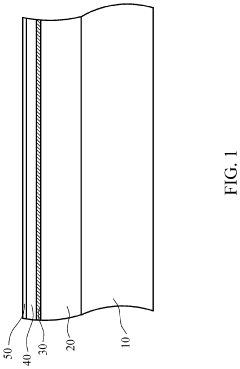
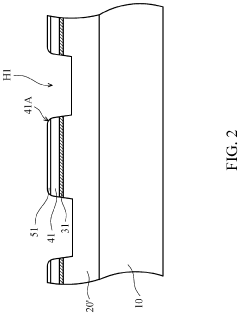
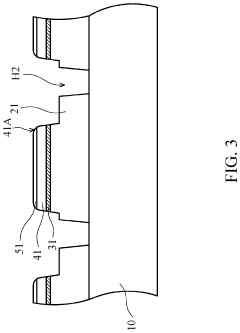
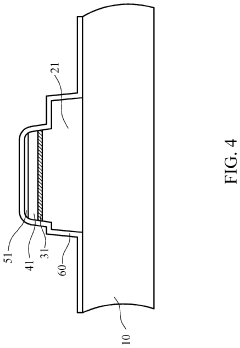
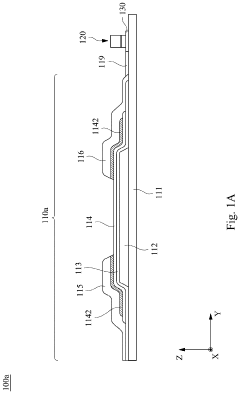
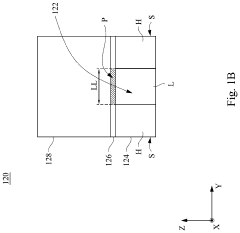
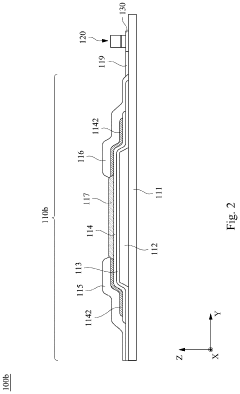
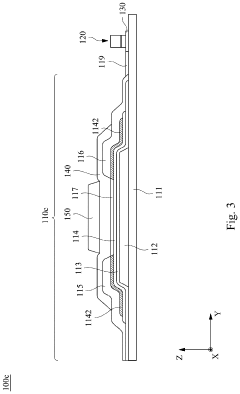
Micro light-emitting diode structure and micro light-emitting diode display device using the same
PatentInactiveUS20220173273A1
Innovation
- A flip-chip micro light-emitting diode structure is designed where the mesa region is smaller than the first-type semiconductor layer, exposing a portion of its top surface for electrode connection, eliminating the need for multiple aligned holes and simplifying the manufacturing process.
Micro light-emitting diode display device and micro light-emitting diode driving circuit
PatentActiveUS10680035B1
Innovation
- A micro light-emitting diode display device with a driving transistor featuring a gate insulator thickness of less than or equal to 500 angstroms and a micro light-emitting diode with a current injection channel and an active layer portion in contact with the channel, reducing the light-emitting area and avoiding surface recombination, thereby lowering the voltage required to activate the diode.
Manufacturing Process Comparison and Scalability
The manufacturing processes for OLED and MicroLED technologies represent fundamentally different approaches with significant implications for scalability and mass production. OLED manufacturing has matured considerably over the past decade, utilizing vacuum thermal evaporation for small molecule OLEDs and solution processing techniques for polymer-based variants. These established processes allow for relatively efficient large-panel production, though yield rates remain a persistent challenge particularly for higher resolution displays.
In contrast, MicroLED manufacturing faces more substantial hurdles in scaling to mass production. The process requires precise placement of millions of microscopic LED chips with positional accuracy measured in microns. Current manufacturing approaches include pick-and-place methods using specialized equipment from companies like Apple-acquired LuxVue and eLux, which can transfer thousands of microLEDs simultaneously but still face throughput limitations.
Mass transfer techniques represent the most promising path toward MicroLED scalability. Patents from Samsung Display and PlayNitride detail innovative approaches using elastomer stamps and fluidic assembly to transfer large quantities of microLEDs in parallel operations. However, these methods still struggle with consistent yield rates above 99.99% required for commercial viability in high-resolution displays.
Defect management presents another critical manufacturing distinction. OLED production benefits from established compensation schemes that can address pixel defects through redundant sub-pixels or algorithmic corrections. MicroLED manufacturing requires more sophisticated repair mechanisms, with Sony and LG holding key patents on laser-based repair techniques and redundant micro-driver architectures.
Cost structures differ significantly between technologies. OLED manufacturing has achieved economies of scale, particularly for smartphone-sized panels, though larger displays remain costly. MicroLED production costs remain prohibitively high for consumer applications, with estimates suggesting 5-10x higher manufacturing costs compared to equivalent OLED panels. Industry analysts project that MicroLED will require 3-5 more years of manufacturing innovation before reaching price parity with premium OLED displays.
Equipment infrastructure represents another key distinction. OLED manufacturing leverages modified semiconductor and LCD production equipment, while MicroLED requires specialized transfer and inspection systems. Companies like Applied Materials and Veeco Instruments hold strategic patents on critical MicroLED manufacturing equipment, potentially creating bottlenecks in the supply chain as production scales.
In contrast, MicroLED manufacturing faces more substantial hurdles in scaling to mass production. The process requires precise placement of millions of microscopic LED chips with positional accuracy measured in microns. Current manufacturing approaches include pick-and-place methods using specialized equipment from companies like Apple-acquired LuxVue and eLux, which can transfer thousands of microLEDs simultaneously but still face throughput limitations.
Mass transfer techniques represent the most promising path toward MicroLED scalability. Patents from Samsung Display and PlayNitride detail innovative approaches using elastomer stamps and fluidic assembly to transfer large quantities of microLEDs in parallel operations. However, these methods still struggle with consistent yield rates above 99.99% required for commercial viability in high-resolution displays.
Defect management presents another critical manufacturing distinction. OLED production benefits from established compensation schemes that can address pixel defects through redundant sub-pixels or algorithmic corrections. MicroLED manufacturing requires more sophisticated repair mechanisms, with Sony and LG holding key patents on laser-based repair techniques and redundant micro-driver architectures.
Cost structures differ significantly between technologies. OLED manufacturing has achieved economies of scale, particularly for smartphone-sized panels, though larger displays remain costly. MicroLED production costs remain prohibitively high for consumer applications, with estimates suggesting 5-10x higher manufacturing costs compared to equivalent OLED panels. Industry analysts project that MicroLED will require 3-5 more years of manufacturing innovation before reaching price parity with premium OLED displays.
Equipment infrastructure represents another key distinction. OLED manufacturing leverages modified semiconductor and LCD production equipment, while MicroLED requires specialized transfer and inspection systems. Companies like Applied Materials and Veeco Instruments hold strategic patents on critical MicroLED manufacturing equipment, potentially creating bottlenecks in the supply chain as production scales.
Energy Efficiency and Environmental Considerations
Energy efficiency represents a critical differentiator between OLED and MicroLED technologies, with significant implications for both consumer applications and environmental sustainability. OLED displays inherently consume less power when displaying darker content due to their emissive nature, where black pixels are simply turned off. This selective pixel activation creates substantial energy savings in real-world usage scenarios where content isn't consistently bright across the entire display.
MicroLED technology, while initially more power-intensive in manufacturing, demonstrates superior energy efficiency at higher brightness levels. Patent analysis reveals that companies like Samsung (US10847712B2) and Apple (US10847113B2) have developed innovative power management systems for MicroLED displays that significantly reduce operational energy consumption, particularly for high-brightness applications like outdoor-viewable displays.
The environmental footprint of both technologies extends beyond operational efficiency to manufacturing processes and materials. OLED production traditionally involves organic compounds that may include rare earth elements and potentially hazardous materials. Key patents from LG Display (US9929360B2) focus on reducing these environmental impacts through alternative material formulations and manufacturing techniques that minimize waste.
MicroLED manufacturing currently requires more energy-intensive processes, particularly in the mass transfer of microscopic LED elements. However, patents from companies like X-Celeprint (US9768345B2) and eLux (US9825202B2) demonstrate novel approaches to mass transfer that significantly reduce energy requirements and material waste during production.
Lifecycle assessment patents reveal that MicroLED displays potentially offer longer operational lifespans than OLEDs, which suffer from organic material degradation over time. This longevity factor represents an important environmental consideration, as extended product lifecycles reduce electronic waste generation. Sony's patent portfolio (US10665799B2) specifically addresses durability enhancements that extend display lifespan while maintaining energy efficiency.
Recycling capabilities differ significantly between technologies. Recent patents from Universal Display Corporation (US10854829B2) demonstrate novel approaches to OLED material recovery, while MicroLED patents from PlayNitride (US10665185B2) focus on inorganic material reclamation processes that potentially offer higher recovery rates of valuable materials at end-of-life.
MicroLED technology, while initially more power-intensive in manufacturing, demonstrates superior energy efficiency at higher brightness levels. Patent analysis reveals that companies like Samsung (US10847712B2) and Apple (US10847113B2) have developed innovative power management systems for MicroLED displays that significantly reduce operational energy consumption, particularly for high-brightness applications like outdoor-viewable displays.
The environmental footprint of both technologies extends beyond operational efficiency to manufacturing processes and materials. OLED production traditionally involves organic compounds that may include rare earth elements and potentially hazardous materials. Key patents from LG Display (US9929360B2) focus on reducing these environmental impacts through alternative material formulations and manufacturing techniques that minimize waste.
MicroLED manufacturing currently requires more energy-intensive processes, particularly in the mass transfer of microscopic LED elements. However, patents from companies like X-Celeprint (US9768345B2) and eLux (US9825202B2) demonstrate novel approaches to mass transfer that significantly reduce energy requirements and material waste during production.
Lifecycle assessment patents reveal that MicroLED displays potentially offer longer operational lifespans than OLEDs, which suffer from organic material degradation over time. This longevity factor represents an important environmental consideration, as extended product lifecycles reduce electronic waste generation. Sony's patent portfolio (US10665799B2) specifically addresses durability enhancements that extend display lifespan while maintaining energy efficiency.
Recycling capabilities differ significantly between technologies. Recent patents from Universal Display Corporation (US10854829B2) demonstrate novel approaches to OLED material recovery, while MicroLED patents from PlayNitride (US10665185B2) focus on inorganic material reclamation processes that potentially offer higher recovery rates of valuable materials at end-of-life.
Unlock deeper insights with PatSnap Eureka Quick Research — get a full tech report to explore trends and direct your research. Try now!
Generate Your Research Report Instantly with AI Agent
Supercharge your innovation with PatSnap Eureka AI Agent Platform!