

Differentiating NMR vs Optical Spectroscopy in Solution Analysis
SEP 22, 20259 MIN READ
Generate Your Research Report Instantly with AI Agent
Patsnap Eureka helps you evaluate technical feasibility & market potential.
NMR and Optical Spectroscopy Evolution and Objectives
Nuclear Magnetic Resonance (NMR) spectroscopy emerged in the 1940s following the groundbreaking work of Felix Bloch and Edward Purcell, who shared the 1952 Nobel Prize for their discoveries. Initially limited to simple one-dimensional experiments, NMR technology evolved dramatically with the introduction of Fourier Transform NMR in the 1970s, significantly enhancing sensitivity and resolution. The subsequent development of superconducting magnets in the 1980s and 1990s further revolutionized the field, enabling higher field strengths and better spectral resolution.
Optical spectroscopy traces its origins to the 17th century with Newton's prism experiments, but modern analytical applications began in the early 20th century. UV-Visible spectroscopy became commercially available in the 1940s, while infrared spectroscopy gained prominence during World War II. The introduction of Fourier Transform Infrared (FTIR) spectroscopy in the 1970s marked a significant advancement, paralleling developments in NMR technology during the same period.
The technological trajectories of both techniques have been characterized by continuous improvements in sensitivity, resolution, and data processing capabilities. Recent decades have witnessed the integration of these spectroscopic methods with advanced computational tools, enabling more sophisticated data analysis and interpretation. The miniaturization of both technologies has expanded their accessibility and application range, with benchtop NMR spectrometers and portable optical spectroscopy devices becoming increasingly common.
The primary objective in solution analysis is to obtain comprehensive structural and compositional information about chemical compounds in liquid media. NMR spectroscopy excels in providing detailed structural information, including molecular connectivity, stereochemistry, and conformational dynamics. It offers unparalleled insights into molecular interactions and is particularly valuable for complex mixture analysis without prior separation.
Optical spectroscopy aims to characterize electronic transitions and vibrational modes, providing complementary information about functional groups, conjugated systems, and molecular symmetry. Its objectives include rapid quantitative analysis, real-time monitoring of chemical processes, and high-throughput screening applications where speed is prioritized over structural detail.
The evolution of both technologies continues to be driven by demands for increased sensitivity, higher throughput, and integration with other analytical techniques. Current research focuses on developing hyphenated methods that combine the strengths of both approaches, such as NMR-IR correlative spectroscopy. The ultimate technological goal is to achieve comprehensive molecular characterization through complementary spectroscopic approaches, maximizing information yield while minimizing sample requirements and analysis time.
Optical spectroscopy traces its origins to the 17th century with Newton's prism experiments, but modern analytical applications began in the early 20th century. UV-Visible spectroscopy became commercially available in the 1940s, while infrared spectroscopy gained prominence during World War II. The introduction of Fourier Transform Infrared (FTIR) spectroscopy in the 1970s marked a significant advancement, paralleling developments in NMR technology during the same period.
The technological trajectories of both techniques have been characterized by continuous improvements in sensitivity, resolution, and data processing capabilities. Recent decades have witnessed the integration of these spectroscopic methods with advanced computational tools, enabling more sophisticated data analysis and interpretation. The miniaturization of both technologies has expanded their accessibility and application range, with benchtop NMR spectrometers and portable optical spectroscopy devices becoming increasingly common.
The primary objective in solution analysis is to obtain comprehensive structural and compositional information about chemical compounds in liquid media. NMR spectroscopy excels in providing detailed structural information, including molecular connectivity, stereochemistry, and conformational dynamics. It offers unparalleled insights into molecular interactions and is particularly valuable for complex mixture analysis without prior separation.
Optical spectroscopy aims to characterize electronic transitions and vibrational modes, providing complementary information about functional groups, conjugated systems, and molecular symmetry. Its objectives include rapid quantitative analysis, real-time monitoring of chemical processes, and high-throughput screening applications where speed is prioritized over structural detail.
The evolution of both technologies continues to be driven by demands for increased sensitivity, higher throughput, and integration with other analytical techniques. Current research focuses on developing hyphenated methods that combine the strengths of both approaches, such as NMR-IR correlative spectroscopy. The ultimate technological goal is to achieve comprehensive molecular characterization through complementary spectroscopic approaches, maximizing information yield while minimizing sample requirements and analysis time.
Market Demand for Solution Analysis Technologies
The global market for solution analysis technologies has witnessed substantial growth in recent years, driven by increasing demands across pharmaceutical, chemical, food and beverage, environmental monitoring, and academic research sectors. The combined market value for analytical instrumentation used in solution analysis exceeded $45 billion in 2022, with a projected compound annual growth rate of 5.8% through 2028.
Within this landscape, both Nuclear Magnetic Resonance (NMR) spectroscopy and Optical spectroscopy occupy significant market segments, though with different growth trajectories and application focuses. The NMR spectroscopy market, valued at approximately $2.3 billion, demonstrates steady growth primarily fueled by pharmaceutical research and development, where structural elucidation and purity analysis of complex molecules remain critical requirements.
Optical spectroscopy technologies, encompassing UV-Vis, IR, Raman, and fluorescence spectroscopy, collectively represent a larger market segment valued at nearly $9.7 billion, growing at 6.2% annually. This faster growth rate reflects the broader accessibility and versatility of optical techniques across multiple industries.
Market research indicates shifting customer preferences based on specific analytical needs. Pharmaceutical companies increasingly require both technologies in complementary roles - NMR for detailed structural analysis and optical methods for high-throughput screening and quality control. The biopharmaceutical sector, growing at 8.3% annually, represents the fastest-expanding market segment for both technologies.
Environmental monitoring applications show particularly strong demand growth for portable and field-deployable optical spectroscopy solutions, with water quality analysis representing a $1.8 billion opportunity. Meanwhile, academic and research institutions continue to invest in high-field NMR systems despite their significant cost, driven by requirements for cutting-edge research in structural biology and materials science.
Regional analysis reveals differentiated market dynamics, with North America and Europe maintaining the largest installed base of high-end NMR systems, while Asia-Pacific markets demonstrate accelerated adoption of optical spectroscopy solutions, particularly in rapidly expanding industrial sectors in China and India.
Customer surveys indicate that key purchasing factors vary significantly between technologies. For NMR, resolution capability and magnetic field strength remain primary considerations, while for optical spectroscopy, factors such as portability, ease of use, and integration capabilities with existing workflows drive purchasing decisions. This divergence in customer priorities highlights the complementary nature of these technologies in comprehensive solution analysis applications.
Within this landscape, both Nuclear Magnetic Resonance (NMR) spectroscopy and Optical spectroscopy occupy significant market segments, though with different growth trajectories and application focuses. The NMR spectroscopy market, valued at approximately $2.3 billion, demonstrates steady growth primarily fueled by pharmaceutical research and development, where structural elucidation and purity analysis of complex molecules remain critical requirements.
Optical spectroscopy technologies, encompassing UV-Vis, IR, Raman, and fluorescence spectroscopy, collectively represent a larger market segment valued at nearly $9.7 billion, growing at 6.2% annually. This faster growth rate reflects the broader accessibility and versatility of optical techniques across multiple industries.
Market research indicates shifting customer preferences based on specific analytical needs. Pharmaceutical companies increasingly require both technologies in complementary roles - NMR for detailed structural analysis and optical methods for high-throughput screening and quality control. The biopharmaceutical sector, growing at 8.3% annually, represents the fastest-expanding market segment for both technologies.
Environmental monitoring applications show particularly strong demand growth for portable and field-deployable optical spectroscopy solutions, with water quality analysis representing a $1.8 billion opportunity. Meanwhile, academic and research institutions continue to invest in high-field NMR systems despite their significant cost, driven by requirements for cutting-edge research in structural biology and materials science.
Regional analysis reveals differentiated market dynamics, with North America and Europe maintaining the largest installed base of high-end NMR systems, while Asia-Pacific markets demonstrate accelerated adoption of optical spectroscopy solutions, particularly in rapidly expanding industrial sectors in China and India.
Customer surveys indicate that key purchasing factors vary significantly between technologies. For NMR, resolution capability and magnetic field strength remain primary considerations, while for optical spectroscopy, factors such as portability, ease of use, and integration capabilities with existing workflows drive purchasing decisions. This divergence in customer priorities highlights the complementary nature of these technologies in comprehensive solution analysis applications.
Current Capabilities and Limitations of Spectroscopic Methods
Nuclear Magnetic Resonance (NMR) spectroscopy and optical spectroscopy represent two fundamental analytical approaches in solution analysis, each with distinct capabilities and limitations. NMR spectroscopy excels in providing detailed structural information at the molecular level, offering unparalleled insights into molecular connectivity, configuration, and conformation. Its non-destructive nature preserves sample integrity, making it invaluable for analyzing precious or limited samples. However, NMR suffers from inherently low sensitivity, typically requiring millimolar concentrations for standard analyses, which limits its application in trace analysis.
The instrumentation for NMR demands significant capital investment, specialized facilities, and ongoing maintenance costs, restricting accessibility primarily to well-funded research institutions and industrial laboratories. Additionally, NMR analysis often requires relatively large sample volumes (typically 500-600 μL for standard probes), though microprobes have reduced this requirement somewhat in recent years.
In contrast, optical spectroscopy methods, including UV-Visible, fluorescence, and infrared spectroscopy, offer substantially higher sensitivity, often detecting analytes at micromolar or even nanomolar concentrations. These techniques require minimal sample preparation and provide rapid analysis times, enabling high-throughput screening applications that would be impractical with NMR.
Optical methods generally utilize more compact, less expensive instrumentation that requires less maintenance and specialized knowledge to operate. However, they typically provide less specific structural information than NMR, often yielding data about functional groups or chromophores rather than complete molecular structures.
Resolution represents another key differentiating factor. NMR offers superior resolution for distinguishing closely related molecular species, particularly valuable in complex mixture analysis and structural elucidation of organic compounds. Optical methods, while less discriminating at the molecular level, excel in quantitative analysis and can often be more readily adapted for in-situ or real-time monitoring applications.
Sample requirements also differ significantly between these techniques. Optical methods generally require transparent solutions and can be affected by sample turbidity, while NMR can analyze opaque samples and is less affected by physical appearance. However, NMR analysis is complicated by solvent selection constraints, as deuterated solvents are typically required to avoid overwhelming solvent signals.
Time considerations further differentiate these approaches. Standard NMR experiments may require minutes to hours depending on sample concentration and the information sought, whereas optical measurements can often be completed in seconds to minutes, offering advantages for time-sensitive applications or high-throughput environments.
The instrumentation for NMR demands significant capital investment, specialized facilities, and ongoing maintenance costs, restricting accessibility primarily to well-funded research institutions and industrial laboratories. Additionally, NMR analysis often requires relatively large sample volumes (typically 500-600 μL for standard probes), though microprobes have reduced this requirement somewhat in recent years.
In contrast, optical spectroscopy methods, including UV-Visible, fluorescence, and infrared spectroscopy, offer substantially higher sensitivity, often detecting analytes at micromolar or even nanomolar concentrations. These techniques require minimal sample preparation and provide rapid analysis times, enabling high-throughput screening applications that would be impractical with NMR.
Optical methods generally utilize more compact, less expensive instrumentation that requires less maintenance and specialized knowledge to operate. However, they typically provide less specific structural information than NMR, often yielding data about functional groups or chromophores rather than complete molecular structures.
Resolution represents another key differentiating factor. NMR offers superior resolution for distinguishing closely related molecular species, particularly valuable in complex mixture analysis and structural elucidation of organic compounds. Optical methods, while less discriminating at the molecular level, excel in quantitative analysis and can often be more readily adapted for in-situ or real-time monitoring applications.
Sample requirements also differ significantly between these techniques. Optical methods generally require transparent solutions and can be affected by sample turbidity, while NMR can analyze opaque samples and is less affected by physical appearance. However, NMR analysis is complicated by solvent selection constraints, as deuterated solvents are typically required to avoid overwhelming solvent signals.
Time considerations further differentiate these approaches. Standard NMR experiments may require minutes to hours depending on sample concentration and the information sought, whereas optical measurements can often be completed in seconds to minutes, offering advantages for time-sensitive applications or high-throughput environments.
Comparative Analysis of NMR vs Optical Methods
01 Combined NMR and optical spectroscopy techniques for enhanced analysis
The integration of Nuclear Magnetic Resonance (NMR) and optical spectroscopy techniques provides complementary data for comprehensive sample analysis. This combination allows for the differentiation of molecular structures and compositions that might not be distinguishable using either technique alone. The synergistic approach enhances analytical capabilities by correlating magnetic resonance data with optical properties, enabling more accurate identification and characterization of complex substances.- Combined NMR and optical spectroscopy techniques for enhanced analysis: The integration of Nuclear Magnetic Resonance (NMR) and optical spectroscopy methods provides complementary analytical capabilities, allowing for more comprehensive sample characterization. This combination enables researchers to differentiate between similar compounds by leveraging the molecular structure information from NMR with the electronic transition data from optical techniques. Such hybrid approaches improve the accuracy of identification and quantification of complex mixtures and materials.
- Advanced NMR pulse sequences for spectral differentiation: Specialized NMR pulse sequences have been developed to enhance the differentiation capabilities of NMR spectroscopy. These techniques manipulate spin systems in ways that highlight specific molecular features, improving resolution and allowing for better discrimination between similar compounds. Methods include multi-dimensional NMR, selective excitation, and various decoupling schemes that can reveal subtle structural differences not apparent in conventional NMR spectra.
- Optical spectroscopy methods for molecular fingerprinting: Various optical spectroscopy techniques provide unique molecular fingerprints that can be used for differentiation purposes. These include infrared, Raman, UV-visible, and fluorescence spectroscopy, each probing different aspects of molecular structure and behavior. The spectral patterns obtained serve as distinctive signatures that enable discrimination between compounds with similar structures but different optical properties, offering rapid and non-destructive analysis capabilities.
- Data processing algorithms for spectral analysis and differentiation: Advanced computational methods enhance the differentiation capabilities of both NMR and optical spectroscopy. These algorithms include multivariate statistical analysis, machine learning approaches, and pattern recognition techniques that can identify subtle spectral differences not readily apparent to human analysts. Such computational tools improve the sensitivity and specificity of spectroscopic differentiation, enabling automated classification of complex samples based on their spectral characteristics.
- Hardware innovations for improved spectroscopic differentiation: Technical advancements in spectroscopic instrumentation have significantly enhanced differentiation capabilities. These innovations include higher magnetic field strengths for NMR, improved detector sensitivity, novel probe designs, and integrated systems that combine multiple spectroscopic techniques. Such hardware developments enable better resolution, higher sensitivity, and more precise measurements, allowing for differentiation of increasingly similar compounds and complex mixtures.
02 Advanced NMR methods for molecular differentiation
Specialized Nuclear Magnetic Resonance techniques have been developed to differentiate between similar molecular structures and compounds. These methods utilize various pulse sequences, relaxation measurements, and multi-dimensional analysis to provide detailed structural information. The advanced NMR approaches can detect subtle differences in chemical environments, enabling precise identification of compounds that may appear similar through other analytical methods.Expand Specific Solutions03 Optical spectroscopy techniques for material characterization
Various optical spectroscopy methods including infrared, Raman, UV-visible, and fluorescence spectroscopy provide unique fingerprints for material differentiation. These techniques analyze how materials interact with light at different wavelengths, revealing information about molecular structure, composition, and electronic states. Optical spectroscopy offers advantages in terms of sample preparation requirements, measurement speed, and the ability to analyze samples in different physical states.Expand Specific Solutions04 Data processing algorithms for spectral differentiation
Sophisticated algorithms and computational methods have been developed to enhance the differentiation capabilities of spectroscopic data. These include multivariate analysis, machine learning approaches, and pattern recognition techniques that can identify subtle spectral differences not apparent through visual inspection. Advanced data processing enables automated classification, quantification, and identification of compounds based on their spectroscopic signatures, improving both accuracy and efficiency in analytical applications.Expand Specific Solutions05 Specialized hardware configurations for spectroscopic differentiation
Custom-designed hardware systems combine multiple spectroscopic techniques or enhance the capabilities of individual methods for improved differentiation. These configurations may include specialized probes, detectors, sample holders, or integrated systems that allow for simultaneous or sequential measurements using different spectroscopic approaches. The hardware innovations enable more sensitive detection, higher resolution, and the ability to analyze challenging samples under various environmental conditions.Expand Specific Solutions
Leading Manufacturers and Research Institutions
The NMR vs Optical Spectroscopy solution analysis market is in a mature growth phase, characterized by established technologies with ongoing innovations. The global spectroscopy market exceeds $15 billion, with steady annual growth of 6-8%. NMR technology demonstrates higher technical maturity for complex molecular structure analysis, with companies like Bruker BioSpin and Agilent Technologies leading innovation. Optical spectroscopy offers advantages in accessibility and cost-effectiveness, with Waters Technology, Siemens Healthcare, and Philips driving developments. Academic institutions including Harvard, University of Manchester, and Zhejiang University contribute significantly to research advancements, while pharmaceutical companies like F. Hoffmann-La Roche and Dr. Reddy's represent major end-users implementing both technologies for complementary analytical capabilities.
Waters Technology Corp.
Technical Solution: Waters Technology Corp. has developed sophisticated solution analysis platforms that integrate both optical spectroscopy and NMR capabilities with their core separation technologies. Their ACQUITY QDa Mass Detector system incorporates UV-Visible diode array detection with mass spectrometry to provide orthogonal identification capabilities for complex mixtures. The system features patented ionization technology that achieves ionization efficiencies up to 5 times higher than conventional sources, enabling detection limits in the picogram range for many analytes. Waters' integrated informatics platform, Empower, provides comprehensive data processing capabilities including automated peak deconvolution algorithms that can resolve co-eluting compounds with spectral similarity greater than 95%. For more complex structural analysis, Waters has partnered with leading NMR manufacturers to create seamless LC-NMR workflows that enable direct structural elucidation of separated components. Their latest innovation includes microfluidic sample handling systems that reduce required sample volumes by up to 80% while maintaining analytical performance. Waters has also pioneered the application of supercritical fluid chromatography coupled with both optical and NMR detection for analysis of complex lipid mixtures and chiral compounds.
Strengths: Exceptional integration of separation science with spectroscopic detection; comprehensive workflow solutions from sample preparation through data analysis; industry-leading software platforms for method development and data interpretation; extensive application support across multiple industries. Weaknesses: Systems often require significant expertise to fully utilize capabilities; higher cost compared to standalone spectroscopic techniques; more complex maintenance requirements; may require method development for specific applications.
Koninklijke Philips NV
Technical Solution: Koninklijke Philips NV has developed innovative optical spectroscopy solutions focused on clinical and point-of-care applications for solution analysis. Their technology centers around miniaturized near-infrared (NIR) and Raman spectroscopy systems that utilize proprietary photonic integrated circuit (PIC) technology to dramatically reduce the size and cost of traditionally bulky optical components. These systems incorporate tunable diode laser sources coupled with highly sensitive avalanche photodiode detectors to achieve detection limits in the parts-per-billion range for specific biomarkers in bodily fluids. Philips' spectroscopic platforms feature patented chemometric algorithms that compensate for matrix effects and environmental variations, enabling reliable quantitative analysis even in complex biological samples. Their systems employ disposable microfluidic sample handling components that require minimal sample volumes (often <50μL) while maintaining measurement precision comparable to laboratory-based instruments. Philips has also pioneered wireless connectivity features that allow seamless integration with healthcare information systems for immediate clinical decision support.
Strengths: Exceptional portability and point-of-care capabilities; rapid analysis times typically under 60 seconds; minimal sample preparation requirements; intuitive user interfaces suitable for non-specialist operators; lower cost per analysis compared to NMR methods. Weaknesses: Limited structural elucidation capabilities compared to NMR; typically requires specific calibration for each analyte of interest; potential interference from sample matrix components; generally lower specificity for complex molecular identification.
Key Technical Innovations in Spectroscopic Analysis
Method for processing nuclear magnetic resonance (NMR) spectroscopic data
PatentInactiveUS10866295B2
Innovation
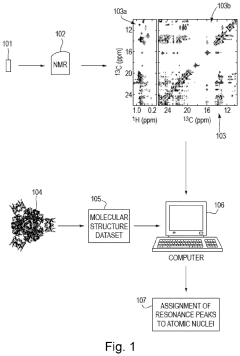
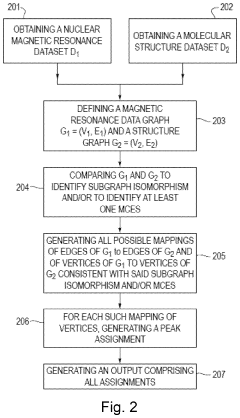
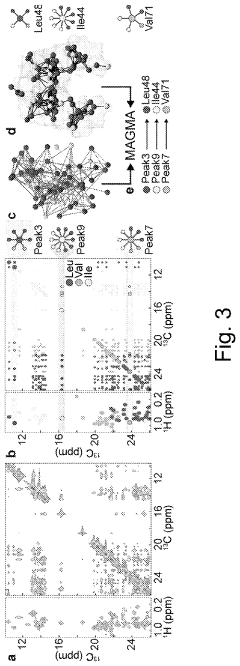
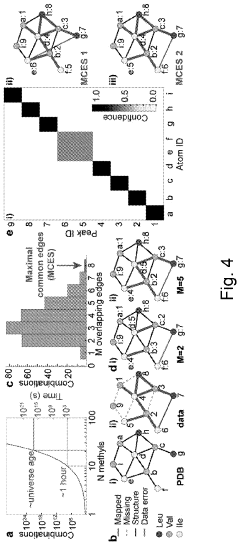
- A graph-matching algorithm that combines structural models with experimental multidimensional magnetic resonance data to accurately identify confident and ambiguous peak assignments by comparing experimental distance restraints with structural models, reducing the need for laborious experiments and providing exact sets of plausible assignments.
Nuclear magnetic resonance system
PatentActiveGB2597439A
Innovation
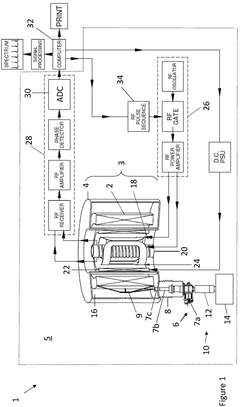
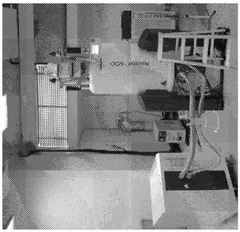
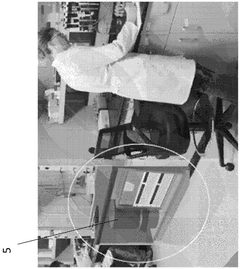
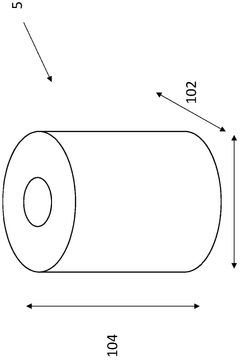
- A compact nuclear magnetic resonance system utilizing a superconducting magnetic coil cooled by a cryocooler, eliminating the need for liquid helium and achieving medium-to-high magnetic field strengths, allowing for a compact design suitable for laboratory benches.
Sample Preparation Requirements and Considerations
Sample preparation represents a critical differentiating factor between Nuclear Magnetic Resonance (NMR) spectroscopy and Optical Spectroscopy techniques when analyzing solutions. NMR typically requires larger sample volumes, generally between 0.5-0.7 mL for standard 5mm tubes, which can be a limitation when working with precious or limited samples. In contrast, optical methods like UV-Vis or fluorescence spectroscopy can operate with significantly smaller volumes, often requiring only microliters of solution.
The solvent selection process differs substantially between these techniques. NMR analysis demands deuterated solvents (e.g., CDCl3, D2O, DMSO-d6) to avoid overwhelming proton signals from common solvents, adding considerable cost to sample preparation. Optical spectroscopy offers greater flexibility with solvent choice, primarily requiring transparency in the wavelength region of interest, allowing the use of standard, less expensive solvents.
Concentration requirements also diverge significantly. NMR typically requires relatively concentrated samples (1-100 mM range) to achieve adequate signal-to-noise ratios within reasonable acquisition times. Optical methods generally work with much more dilute solutions (μM to nM range), often necessitating serial dilutions to avoid detector saturation and maintain linearity of response.
Sample homogeneity presents another key distinction. NMR is relatively forgiving regarding sample clarity, capable of analyzing turbid or slightly colored solutions without significant interference. Optical methods, however, are highly sensitive to particulates, requiring filtration or centrifugation to remove suspended particles that cause light scattering and compromise data quality.
Temperature control considerations also differ between techniques. NMR instruments typically incorporate sophisticated temperature regulation systems, allowing precise control during experiments. This capability enables temperature-dependent studies directly within the spectrometer. Optical methods often require external temperature control devices when temperature-dependent measurements are needed.
Sample recovery represents a final important distinction. NMR spectroscopy is inherently non-destructive, allowing complete sample recovery after analysis—a significant advantage for valuable compounds. Many optical techniques are also non-destructive, though certain advanced applications involving photochemical reactions or specialized sample handling may result in sample alteration or loss.
The solvent selection process differs substantially between these techniques. NMR analysis demands deuterated solvents (e.g., CDCl3, D2O, DMSO-d6) to avoid overwhelming proton signals from common solvents, adding considerable cost to sample preparation. Optical spectroscopy offers greater flexibility with solvent choice, primarily requiring transparency in the wavelength region of interest, allowing the use of standard, less expensive solvents.
Concentration requirements also diverge significantly. NMR typically requires relatively concentrated samples (1-100 mM range) to achieve adequate signal-to-noise ratios within reasonable acquisition times. Optical methods generally work with much more dilute solutions (μM to nM range), often necessitating serial dilutions to avoid detector saturation and maintain linearity of response.
Sample homogeneity presents another key distinction. NMR is relatively forgiving regarding sample clarity, capable of analyzing turbid or slightly colored solutions without significant interference. Optical methods, however, are highly sensitive to particulates, requiring filtration or centrifugation to remove suspended particles that cause light scattering and compromise data quality.
Temperature control considerations also differ between techniques. NMR instruments typically incorporate sophisticated temperature regulation systems, allowing precise control during experiments. This capability enables temperature-dependent studies directly within the spectrometer. Optical methods often require external temperature control devices when temperature-dependent measurements are needed.
Sample recovery represents a final important distinction. NMR spectroscopy is inherently non-destructive, allowing complete sample recovery after analysis—a significant advantage for valuable compounds. Many optical techniques are also non-destructive, though certain advanced applications involving photochemical reactions or specialized sample handling may result in sample alteration or loss.
Cost-Benefit Analysis of Spectroscopic Techniques
When evaluating spectroscopic techniques for solution analysis, cost-benefit considerations play a crucial role in decision-making processes. Nuclear Magnetic Resonance (NMR) spectroscopy represents a significant capital investment, with high-field instruments typically ranging from $500,000 to over $2 million, depending on field strength and capabilities. Additionally, NMR facilities require specialized infrastructure including vibration isolation, temperature control, and often cryogenic cooling systems, further increasing initial setup costs.
Operational expenses for NMR are dominated by cryogen consumption (liquid helium and nitrogen) for superconducting magnets, although newer models with closed-cycle cooling systems reduce these recurring costs. Maintenance contracts typically range from $20,000 to $50,000 annually, representing a substantial ongoing commitment.
In contrast, optical spectroscopy techniques (UV-Vis, IR, Raman) generally require lower initial investments, with high-quality instruments available between $30,000 and $150,000. These systems demand less specialized infrastructure and minimal consumables, resulting in lower total cost of ownership over the instrument lifecycle.
The benefit analysis reveals complementary strengths. NMR provides unparalleled structural information, particularly for organic compounds, with exceptional reproducibility and quantitative accuracy without requiring reference standards. The non-destructive nature of NMR preserves valuable samples, offering significant long-term value despite higher initial costs.
Optical techniques deliver superior detection limits (often in the ppb range versus NMR's typical ppm limits) and faster analysis times (seconds to minutes versus NMR's minutes to hours). This translates to higher throughput capabilities and efficiency gains in routine analytical workflows.
Return on investment calculations must consider application-specific factors. For structural elucidation of complex molecules, NMR's comprehensive information justifies its premium cost. For high-throughput screening or targeted analysis of known compounds, optical methods often provide better cost-efficiency.
Organizational considerations also impact the cost-benefit equation. Larger institutions can distribute NMR costs across multiple research groups or projects, while smaller organizations may benefit from the versatility and accessibility of optical techniques. Outsourcing options exist for both methodologies, though sample shipping and handling requirements differ significantly.
The optimal approach often involves strategic implementation of complementary techniques, leveraging the strengths of each method while minimizing overall analytical costs. This hybrid strategy maximizes analytical capabilities while optimizing resource allocation across the analytical workflow.
Operational expenses for NMR are dominated by cryogen consumption (liquid helium and nitrogen) for superconducting magnets, although newer models with closed-cycle cooling systems reduce these recurring costs. Maintenance contracts typically range from $20,000 to $50,000 annually, representing a substantial ongoing commitment.
In contrast, optical spectroscopy techniques (UV-Vis, IR, Raman) generally require lower initial investments, with high-quality instruments available between $30,000 and $150,000. These systems demand less specialized infrastructure and minimal consumables, resulting in lower total cost of ownership over the instrument lifecycle.
The benefit analysis reveals complementary strengths. NMR provides unparalleled structural information, particularly for organic compounds, with exceptional reproducibility and quantitative accuracy without requiring reference standards. The non-destructive nature of NMR preserves valuable samples, offering significant long-term value despite higher initial costs.
Optical techniques deliver superior detection limits (often in the ppb range versus NMR's typical ppm limits) and faster analysis times (seconds to minutes versus NMR's minutes to hours). This translates to higher throughput capabilities and efficiency gains in routine analytical workflows.
Return on investment calculations must consider application-specific factors. For structural elucidation of complex molecules, NMR's comprehensive information justifies its premium cost. For high-throughput screening or targeted analysis of known compounds, optical methods often provide better cost-efficiency.
Organizational considerations also impact the cost-benefit equation. Larger institutions can distribute NMR costs across multiple research groups or projects, while smaller organizations may benefit from the versatility and accessibility of optical techniques. Outsourcing options exist for both methodologies, though sample shipping and handling requirements differ significantly.
The optimal approach often involves strategic implementation of complementary techniques, leveraging the strengths of each method while minimizing overall analytical costs. This hybrid strategy maximizes analytical capabilities while optimizing resource allocation across the analytical workflow.
Unlock deeper insights with Patsnap Eureka Quick Research — get a full tech report to explore trends and direct your research. Try now!
Generate Your Research Report Instantly with AI Agent
Supercharge your innovation with Patsnap Eureka AI Agent Platform!