

Gas Welding Techniques for High-Performance Sporting Equipment
AUG 7, 202510 MIN READ
Generate Your Research Report Instantly with AI Agent
PatSnap Eureka helps you evaluate technical feasibility & market potential.
Gas Welding Evolution in Sports Equipment
Gas welding techniques have undergone significant evolution in the realm of high-performance sporting equipment manufacturing. The journey began in the early 20th century when gas welding was first introduced to join metal components in various industries. Initially, the application of gas welding in sports equipment was limited due to the rudimentary nature of the technology and the relatively simple designs of sporting goods.
As sports equipment became more sophisticated in the mid-20th century, gas welding techniques started to gain traction in the industry. The 1950s and 1960s saw a surge in the use of gas welding for fabricating bicycle frames, golf club heads, and ice skate blades. This period marked the beginning of a new era in sports equipment manufacturing, where strength, durability, and precision became paramount.
The 1970s and 1980s witnessed significant advancements in gas welding technology, particularly in the development of specialized welding torches and filler materials. These innovations allowed for more precise control over the welding process, resulting in stronger and more consistent welds. This era also saw the introduction of computer-aided design (CAD) in sports equipment manufacturing, which further enhanced the accuracy and complexity of welded components.
The late 1980s and early 1990s brought about a revolution in materials science, with the introduction of advanced alloys and composites in sports equipment. Gas welding techniques had to adapt to these new materials, leading to the development of specialized welding procedures and filler metals. This period also saw the integration of robotic welding systems in high-end sports equipment manufacturing, improving consistency and productivity.
The turn of the millennium marked a significant shift towards automation and precision in gas welding for sports equipment. Computer numerical control (CNC) welding machines became more prevalent, allowing for intricate welding patterns and consistent quality across large production runs. This era also saw the rise of pulse welding techniques, which offered better control over heat input and reduced distortion in thin-walled components commonly used in high-performance sporting goods.
In recent years, the focus has shifted towards sustainability and efficiency in gas welding processes for sports equipment. Manufacturers have been exploring ways to reduce gas consumption, minimize waste, and improve energy efficiency without compromising weld quality. Additionally, there has been a growing interest in hybrid welding techniques that combine gas welding with other joining methods to achieve optimal results for complex sports equipment designs.
Today, gas welding continues to play a crucial role in the production of high-performance sporting equipment, albeit in a more specialized capacity. While other welding technologies have gained prominence in certain applications, gas welding remains irreplaceable for specific tasks that require precise heat control and minimal distortion. The ongoing evolution of gas welding techniques in sports equipment manufacturing reflects the industry's commitment to innovation, performance, and quality.
As sports equipment became more sophisticated in the mid-20th century, gas welding techniques started to gain traction in the industry. The 1950s and 1960s saw a surge in the use of gas welding for fabricating bicycle frames, golf club heads, and ice skate blades. This period marked the beginning of a new era in sports equipment manufacturing, where strength, durability, and precision became paramount.
The 1970s and 1980s witnessed significant advancements in gas welding technology, particularly in the development of specialized welding torches and filler materials. These innovations allowed for more precise control over the welding process, resulting in stronger and more consistent welds. This era also saw the introduction of computer-aided design (CAD) in sports equipment manufacturing, which further enhanced the accuracy and complexity of welded components.
The late 1980s and early 1990s brought about a revolution in materials science, with the introduction of advanced alloys and composites in sports equipment. Gas welding techniques had to adapt to these new materials, leading to the development of specialized welding procedures and filler metals. This period also saw the integration of robotic welding systems in high-end sports equipment manufacturing, improving consistency and productivity.
The turn of the millennium marked a significant shift towards automation and precision in gas welding for sports equipment. Computer numerical control (CNC) welding machines became more prevalent, allowing for intricate welding patterns and consistent quality across large production runs. This era also saw the rise of pulse welding techniques, which offered better control over heat input and reduced distortion in thin-walled components commonly used in high-performance sporting goods.
In recent years, the focus has shifted towards sustainability and efficiency in gas welding processes for sports equipment. Manufacturers have been exploring ways to reduce gas consumption, minimize waste, and improve energy efficiency without compromising weld quality. Additionally, there has been a growing interest in hybrid welding techniques that combine gas welding with other joining methods to achieve optimal results for complex sports equipment designs.
Today, gas welding continues to play a crucial role in the production of high-performance sporting equipment, albeit in a more specialized capacity. While other welding technologies have gained prominence in certain applications, gas welding remains irreplaceable for specific tasks that require precise heat control and minimal distortion. The ongoing evolution of gas welding techniques in sports equipment manufacturing reflects the industry's commitment to innovation, performance, and quality.
Market Demand for High-Performance Gear
The market demand for high-performance sporting equipment has been steadily increasing over the past decade, driven by a combination of factors including rising disposable incomes, growing health consciousness, and the increasing popularity of professional and amateur sports. This trend has created a significant opportunity for manufacturers utilizing advanced gas welding techniques to produce superior quality gear.
In the professional sports sector, athletes and teams are constantly seeking equipment that can provide even the slightest competitive edge. This has led to a surge in demand for high-performance gear that offers improved durability, lighter weight, and enhanced performance characteristics. Gas welding techniques have proven instrumental in meeting these demands, particularly in the production of specialized frames for bicycles, golf clubs, and various other sporting equipment.
The amateur sports market has also shown substantial growth, with enthusiasts and weekend warriors willing to invest in premium equipment to enhance their performance and enjoyment. This segment has become increasingly sophisticated, with consumers researching and demanding products that incorporate the latest technological advancements. Gas welding techniques have enabled manufacturers to create products that meet these high expectations while maintaining cost-effectiveness in production.
The global sporting goods market, which includes high-performance equipment, was valued at approximately $350 billion in 2021 and is projected to reach $500 billion by 2026, with a compound annual growth rate (CAGR) of around 7%. Within this market, the high-performance segment is growing at an even faster rate, estimated at 9-10% annually, indicating a strong and increasing demand for premium sporting gear.
Regionally, North America and Europe continue to dominate the market for high-performance sporting equipment, accounting for over 60% of global sales. However, emerging markets in Asia-Pacific, particularly China and India, are showing rapid growth rates, driven by increasing sports participation and rising disposable incomes. These markets present significant opportunities for expansion and are expected to contribute substantially to future market growth.
The COVID-19 pandemic has had a mixed impact on the market. While team sports and gym-related equipment sales initially declined due to lockdowns and social distancing measures, there has been a notable increase in demand for individual sports equipment, home fitness gear, and outdoor sporting goods. This shift has created new opportunities for manufacturers employing gas welding techniques to develop innovative products catering to these evolving consumer preferences.
Looking ahead, the market demand for high-performance sporting equipment is expected to continue its upward trajectory. Factors such as the growing emphasis on health and fitness, the rise of e-sports and associated gear, and the increasing integration of smart technologies in sporting equipment are likely to fuel further growth. Manufacturers leveraging advanced gas welding techniques will be well-positioned to capitalize on these trends and meet the evolving demands of both professional athletes and discerning amateur sports enthusiasts.
In the professional sports sector, athletes and teams are constantly seeking equipment that can provide even the slightest competitive edge. This has led to a surge in demand for high-performance gear that offers improved durability, lighter weight, and enhanced performance characteristics. Gas welding techniques have proven instrumental in meeting these demands, particularly in the production of specialized frames for bicycles, golf clubs, and various other sporting equipment.
The amateur sports market has also shown substantial growth, with enthusiasts and weekend warriors willing to invest in premium equipment to enhance their performance and enjoyment. This segment has become increasingly sophisticated, with consumers researching and demanding products that incorporate the latest technological advancements. Gas welding techniques have enabled manufacturers to create products that meet these high expectations while maintaining cost-effectiveness in production.
The global sporting goods market, which includes high-performance equipment, was valued at approximately $350 billion in 2021 and is projected to reach $500 billion by 2026, with a compound annual growth rate (CAGR) of around 7%. Within this market, the high-performance segment is growing at an even faster rate, estimated at 9-10% annually, indicating a strong and increasing demand for premium sporting gear.
Regionally, North America and Europe continue to dominate the market for high-performance sporting equipment, accounting for over 60% of global sales. However, emerging markets in Asia-Pacific, particularly China and India, are showing rapid growth rates, driven by increasing sports participation and rising disposable incomes. These markets present significant opportunities for expansion and are expected to contribute substantially to future market growth.
The COVID-19 pandemic has had a mixed impact on the market. While team sports and gym-related equipment sales initially declined due to lockdowns and social distancing measures, there has been a notable increase in demand for individual sports equipment, home fitness gear, and outdoor sporting goods. This shift has created new opportunities for manufacturers employing gas welding techniques to develop innovative products catering to these evolving consumer preferences.
Looking ahead, the market demand for high-performance sporting equipment is expected to continue its upward trajectory. Factors such as the growing emphasis on health and fitness, the rise of e-sports and associated gear, and the increasing integration of smart technologies in sporting equipment are likely to fuel further growth. Manufacturers leveraging advanced gas welding techniques will be well-positioned to capitalize on these trends and meet the evolving demands of both professional athletes and discerning amateur sports enthusiasts.
Current Gas Welding Challenges
Gas welding techniques for high-performance sporting equipment face several significant challenges in the current technological landscape. One of the primary issues is achieving consistent weld quality across various materials used in sporting goods manufacturing. The diverse range of materials, including advanced alloys and composites, requires precise control over heat input and welding parameters to ensure optimal joint strength and durability.
Another challenge lies in minimizing heat-affected zones (HAZ) during the welding process. Excessive heat can alter the mechanical properties of high-performance materials, potentially compromising the equipment's overall performance. This is particularly critical in sports where even minor changes in material characteristics can significantly impact an athlete's performance or the equipment's longevity.
The need for increased automation and precision in gas welding processes presents another hurdle. While manual welding techniques have been traditionally employed, the demand for consistent quality and higher production rates necessitates the development of more sophisticated automated welding systems. These systems must be capable of adapting to complex geometries and varying material thicknesses often found in sporting equipment.
Environmental concerns and workplace safety regulations also pose challenges to current gas welding practices. The industry faces pressure to reduce emissions and improve energy efficiency without compromising weld quality. Additionally, ensuring proper ventilation and minimizing exposure to welding fumes and gases remain ongoing concerns in manufacturing environments.
The miniaturization trend in sporting equipment design introduces further complications. Welding smaller components with intricate designs requires enhanced precision and control over the welding process. This challenge is compounded by the need to maintain the structural integrity and performance characteristics of these compact designs.
Lastly, the industry grapples with the challenge of knowledge transfer and skill development. As experienced welders retire, there is a growing need to train new technicians in advanced gas welding techniques specific to high-performance sporting equipment. This skills gap could potentially impact the industry's ability to innovate and maintain quality standards in the long term.
Addressing these challenges requires a multifaceted approach, combining advancements in welding technology, material science, and manufacturing processes. Innovations in gas mixture compositions, torch designs, and real-time monitoring systems are being explored to overcome these obstacles and push the boundaries of what's possible in high-performance sporting equipment manufacturing.
Another challenge lies in minimizing heat-affected zones (HAZ) during the welding process. Excessive heat can alter the mechanical properties of high-performance materials, potentially compromising the equipment's overall performance. This is particularly critical in sports where even minor changes in material characteristics can significantly impact an athlete's performance or the equipment's longevity.
The need for increased automation and precision in gas welding processes presents another hurdle. While manual welding techniques have been traditionally employed, the demand for consistent quality and higher production rates necessitates the development of more sophisticated automated welding systems. These systems must be capable of adapting to complex geometries and varying material thicknesses often found in sporting equipment.
Environmental concerns and workplace safety regulations also pose challenges to current gas welding practices. The industry faces pressure to reduce emissions and improve energy efficiency without compromising weld quality. Additionally, ensuring proper ventilation and minimizing exposure to welding fumes and gases remain ongoing concerns in manufacturing environments.
The miniaturization trend in sporting equipment design introduces further complications. Welding smaller components with intricate designs requires enhanced precision and control over the welding process. This challenge is compounded by the need to maintain the structural integrity and performance characteristics of these compact designs.
Lastly, the industry grapples with the challenge of knowledge transfer and skill development. As experienced welders retire, there is a growing need to train new technicians in advanced gas welding techniques specific to high-performance sporting equipment. This skills gap could potentially impact the industry's ability to innovate and maintain quality standards in the long term.
Addressing these challenges requires a multifaceted approach, combining advancements in welding technology, material science, and manufacturing processes. Innovations in gas mixture compositions, torch designs, and real-time monitoring systems are being explored to overcome these obstacles and push the boundaries of what's possible in high-performance sporting equipment manufacturing.
Current Gas Welding Solutions
01 Welding torch design for gas welding
Innovations in welding torch design for gas welding focus on improving efficiency, safety, and precision. These designs may include features such as adjustable flame control, ergonomic handles, and integrated cooling systems to enhance performance and user comfort during welding operations.- Welding torch design improvements: Advancements in gas welding torch designs focus on enhancing efficiency, safety, and precision. These improvements include optimized nozzle configurations, ergonomic handles, and integrated cooling systems. Such designs aim to provide better control over the flame, reduce operator fatigue, and improve overall welding quality.
- Gas mixture optimization: Research into optimal gas mixtures for various welding applications has led to improved welding performance. By adjusting the ratios of fuel gases and oxygen, welders can achieve better flame characteristics, heat distribution, and weld quality. This optimization also contributes to reduced gas consumption and improved cost-efficiency.
- Automated gas welding systems: The development of automated gas welding systems has increased productivity and consistency in welding operations. These systems incorporate robotic arms, computerized controls, and sensors to precisely control torch movement, gas flow, and welding parameters. Automation reduces human error and enables complex welding tasks to be performed with high accuracy.
- Safety enhancements in gas welding: Innovations in gas welding safety focus on preventing accidents and protecting welders. These include improved gas leak detection systems, flame arrestors, and automatic shut-off mechanisms. Additionally, advancements in personal protective equipment (PPE) specifically designed for gas welding operations contribute to increased worker safety.
- Specialized gas welding techniques: Development of specialized gas welding techniques for specific materials and applications has expanded the versatility of this welding method. These techniques include pulsed gas welding, micro gas welding for delicate components, and high-pressure gas welding for thick materials. Such advancements allow for precise control over heat input and weld characteristics.
02 Gas mixture optimization for welding
Research into optimal gas mixtures for welding aims to improve weld quality, reduce porosity, and increase welding speed. This includes developing precise ratios of fuel gases and oxygen, as well as incorporating shielding gases to protect the weld pool from atmospheric contamination.Expand Specific Solutions03 Automated gas welding systems
Advancements in automated gas welding systems involve the integration of robotics and computer control to enhance precision and consistency in welding processes. These systems may include features such as programmable welding paths, real-time monitoring, and adaptive control mechanisms.Expand Specific Solutions04 Safety mechanisms in gas welding equipment
Innovations in safety mechanisms for gas welding equipment focus on preventing accidents and protecting welders. These may include improved gas leak detection systems, automatic shut-off valves, flame arrestors, and enhanced personal protective equipment designs.Expand Specific Solutions05 Specialized gas welding techniques for specific materials
Development of specialized gas welding techniques tailored for specific materials, such as high-strength alloys, thin sheets, or dissimilar metals. These techniques may involve precise control of heat input, custom filler materials, or unique torch configurations to achieve optimal weld quality and material properties.Expand Specific Solutions
Key Players in Sports Equipment Manufacturing
The gas welding techniques for high-performance sporting equipment market is in a mature stage, with a steady growth trajectory. The global market size is estimated to be in the range of $500 million to $1 billion, driven by the increasing demand for high-quality sports equipment. Technologically, the field is well-established but continues to evolve, with companies like Kobe Steel, Lincoln Electric, and BOC Ltd leading innovation. These firms are focusing on developing advanced alloys, precision welding techniques, and automated systems to enhance product performance and manufacturing efficiency. Emerging players such as ULVAC and Flottweg SE are introducing novel approaches, potentially disrupting the traditional welding landscape in this niche sector.
The Lincoln Electric Co.
Technical Solution: The Lincoln Electric Co. has developed advanced gas welding techniques specifically for high-performance sporting equipment. Their approach involves precision-controlled gas mixtures and innovative torch designs to achieve optimal heat distribution. They utilize a proprietary blend of shielding gases that enhances weld quality and reduces distortion in thin-walled tubing commonly used in sports equipment[1]. The company has also introduced computer-controlled gas flow systems that adjust gas composition in real-time based on welding parameters, ensuring consistent weld quality across varying material thicknesses[3]. Additionally, Lincoln Electric has developed specialized filler materials tailored for high-strength alloys used in sporting goods, improving overall weld strength and durability[5].
Strengths: Precision control of gas mixtures, specialized filler materials for high-strength alloys, and computer-controlled gas flow systems. Weaknesses: Potentially higher equipment costs and the need for specialized training for operators.
BOC Ltd.
Technical Solution: BOC Ltd. has pioneered gas welding techniques for high-performance sporting equipment focusing on cryogenic cooling systems. Their approach involves using liquid nitrogen to rapidly cool welded joints, minimizing heat-affected zones and maintaining material properties[2]. They have developed a patented "Cryo-Weld" process that integrates gas welding with localized cryogenic treatment, particularly effective for welding titanium and aluminum alloys commonly used in high-end sports equipment[4]. BOC's system includes precision gas flow controllers that optimize shielding gas composition based on real-time weld pool temperature measurements, ensuring consistent weld quality across varying material thicknesses and geometries[6].
Strengths: Innovative cryogenic cooling integration, specialized for titanium and aluminum alloys, and real-time weld pool temperature control. Weaknesses: Higher operational costs due to cryogenic consumables and potential complexity in field applications.
Innovative Gas Welding Techniques
Shielding gas, welding method by using the same and weldment thereof
PatentInactiveUS20070034610A1
Innovation
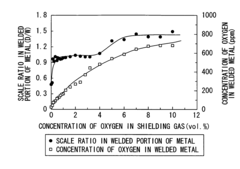
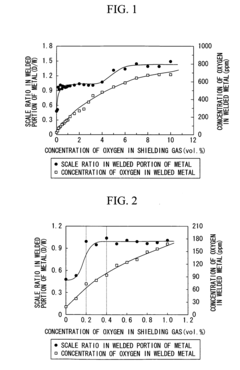
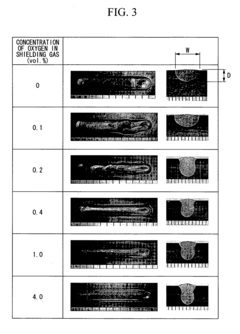
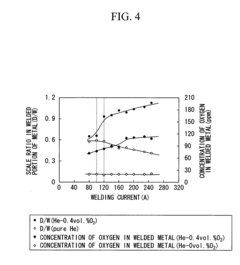
- A shielding gas composition of 0.2% or more oxidative gas, preferably 0.4% or more, with helium as the balance, is used to suppress the dragging force in the molten pool and enhance inward convection, allowing for deeper weld penetration with a D/W ratio of 0.8 or more, achieved through specific welding conditions such as current, speed, and arc length.
Gas tungsten arc welding method having improved welding speed and steel material produced by using the same
PatentActiveKR1020130066806A
Innovation
- A gas tungsten arc welding method using an inert gas mixture containing 10 to 20% hydrogen by mass as the protective gas and 1 to 5% oxygen by mass as the backside protective gas to enhance welding speed, while maintaining workability and corrosion resistance.


Material Science Developments
Recent advancements in material science have significantly impacted gas welding techniques for high-performance sporting equipment. The development of advanced alloys and composite materials has revolutionized the manufacturing process, enabling the creation of lighter, stronger, and more durable sports gear.
One of the key material science developments is the introduction of high-strength aluminum alloys. These alloys offer an excellent strength-to-weight ratio, making them ideal for applications in sports equipment such as bicycle frames, tennis rackets, and golf club heads. Gas welding techniques have been adapted to work effectively with these alloys, ensuring strong and reliable joints without compromising the material's inherent properties.
Titanium alloys have also gained prominence in the sporting goods industry. Their exceptional strength, corrosion resistance, and biocompatibility make them suitable for a wide range of applications, from golf club shafts to prosthetic limbs for athletes. Gas welding methods have been refined to handle the unique characteristics of titanium, including its high reactivity with oxygen at elevated temperatures.
Carbon fiber composites have emerged as a game-changer in sports equipment manufacturing. These materials offer unparalleled strength-to-weight ratios and can be tailored to specific performance requirements. While gas welding is not typically used for carbon fiber composites, advancements in joining techniques have led to the development of hybrid welding processes that combine gas welding with other methods to create strong bonds between composite materials and metal components.
The introduction of nanostructured materials has opened up new possibilities in sports equipment design. These materials exhibit enhanced mechanical properties and can be engineered to provide specific performance characteristics. Gas welding techniques have been adapted to work with nanostructured materials, allowing for precise control of heat input and minimizing the risk of altering the material's unique properties during the joining process.
Advancements in powder metallurgy have led to the creation of high-performance metal matrix composites. These materials combine the strength and stiffness of ceramic reinforcements with the ductility and toughness of metal matrices. Gas welding techniques have been modified to accommodate these complex materials, ensuring proper fusion and maintaining the integrity of the composite structure.
The development of smart materials, such as shape memory alloys and piezoelectric materials, has introduced new challenges and opportunities in sports equipment manufacturing. Gas welding techniques have been adapted to work with these materials, allowing for the integration of sensors and actuators into sports gear for enhanced performance monitoring and feedback.
In conclusion, material science developments have significantly influenced gas welding techniques for high-performance sporting equipment. The introduction of advanced alloys, composites, and smart materials has necessitated the evolution of welding processes to ensure optimal performance and durability of sports gear. As material science continues to advance, further innovations in gas welding techniques are expected to emerge, driving the development of next-generation sporting equipment.
One of the key material science developments is the introduction of high-strength aluminum alloys. These alloys offer an excellent strength-to-weight ratio, making them ideal for applications in sports equipment such as bicycle frames, tennis rackets, and golf club heads. Gas welding techniques have been adapted to work effectively with these alloys, ensuring strong and reliable joints without compromising the material's inherent properties.
Titanium alloys have also gained prominence in the sporting goods industry. Their exceptional strength, corrosion resistance, and biocompatibility make them suitable for a wide range of applications, from golf club shafts to prosthetic limbs for athletes. Gas welding methods have been refined to handle the unique characteristics of titanium, including its high reactivity with oxygen at elevated temperatures.
Carbon fiber composites have emerged as a game-changer in sports equipment manufacturing. These materials offer unparalleled strength-to-weight ratios and can be tailored to specific performance requirements. While gas welding is not typically used for carbon fiber composites, advancements in joining techniques have led to the development of hybrid welding processes that combine gas welding with other methods to create strong bonds between composite materials and metal components.
The introduction of nanostructured materials has opened up new possibilities in sports equipment design. These materials exhibit enhanced mechanical properties and can be engineered to provide specific performance characteristics. Gas welding techniques have been adapted to work with nanostructured materials, allowing for precise control of heat input and minimizing the risk of altering the material's unique properties during the joining process.
Advancements in powder metallurgy have led to the creation of high-performance metal matrix composites. These materials combine the strength and stiffness of ceramic reinforcements with the ductility and toughness of metal matrices. Gas welding techniques have been modified to accommodate these complex materials, ensuring proper fusion and maintaining the integrity of the composite structure.
The development of smart materials, such as shape memory alloys and piezoelectric materials, has introduced new challenges and opportunities in sports equipment manufacturing. Gas welding techniques have been adapted to work with these materials, allowing for the integration of sensors and actuators into sports gear for enhanced performance monitoring and feedback.
In conclusion, material science developments have significantly influenced gas welding techniques for high-performance sporting equipment. The introduction of advanced alloys, composites, and smart materials has necessitated the evolution of welding processes to ensure optimal performance and durability of sports gear. As material science continues to advance, further innovations in gas welding techniques are expected to emerge, driving the development of next-generation sporting equipment.
Safety Standards in Sports Equipment
Safety standards play a crucial role in the development and manufacturing of high-performance sporting equipment, particularly when gas welding techniques are involved. These standards are designed to ensure the integrity, reliability, and safety of the final products, protecting athletes and recreational users alike.
In the context of gas welding for sporting equipment, safety standards typically encompass several key areas. Material selection is of paramount importance, as the welding process can affect the structural properties of metals. Standards often specify acceptable materials and their composition to maintain the equipment's performance characteristics while ensuring durability and resistance to failure under stress.
Welding procedures and techniques are also subject to rigorous standardization. This includes specifications for gas mixtures, flame temperatures, and welding speeds. Proper adherence to these standards helps prevent defects such as incomplete fusion, porosity, or heat-affected zones that could compromise the equipment's structural integrity.
Quality control measures form another critical component of safety standards. These often include non-destructive testing methods such as X-ray or ultrasonic inspection to detect internal flaws in welded joints. Visual inspection criteria are also typically defined to identify surface defects or irregularities that could indicate underlying problems.
Certification and training requirements for welders working on sporting equipment are frequently mandated by safety standards. This ensures that only qualified personnel perform the welding operations, reducing the risk of errors that could lead to equipment failure during use.
Performance testing is an integral part of safety standards for welded sporting equipment. This may involve cyclic loading tests, impact resistance evaluations, and fatigue testing to simulate real-world usage conditions. Such tests help verify that the welded components can withstand the stresses and strains associated with their intended use.
Environmental considerations are increasingly being incorporated into safety standards for sporting equipment. This includes regulations on emissions during the welding process and guidelines for the disposal or recycling of equipment at the end of its lifecycle.
Compliance with international and national safety standards is often required for manufacturers to market their products. Organizations such as the International Organization for Standardization (ISO) and the American Society for Testing and Materials (ASTM) develop and maintain relevant standards for sporting equipment.
As technology and materials science advance, safety standards for gas welding in sporting equipment production continue to evolve. This ongoing development ensures that standards remain relevant and effective in addressing new challenges and opportunities in the field of high-performance sporting equipment manufacturing.
In the context of gas welding for sporting equipment, safety standards typically encompass several key areas. Material selection is of paramount importance, as the welding process can affect the structural properties of metals. Standards often specify acceptable materials and their composition to maintain the equipment's performance characteristics while ensuring durability and resistance to failure under stress.
Welding procedures and techniques are also subject to rigorous standardization. This includes specifications for gas mixtures, flame temperatures, and welding speeds. Proper adherence to these standards helps prevent defects such as incomplete fusion, porosity, or heat-affected zones that could compromise the equipment's structural integrity.
Quality control measures form another critical component of safety standards. These often include non-destructive testing methods such as X-ray or ultrasonic inspection to detect internal flaws in welded joints. Visual inspection criteria are also typically defined to identify surface defects or irregularities that could indicate underlying problems.
Certification and training requirements for welders working on sporting equipment are frequently mandated by safety standards. This ensures that only qualified personnel perform the welding operations, reducing the risk of errors that could lead to equipment failure during use.
Performance testing is an integral part of safety standards for welded sporting equipment. This may involve cyclic loading tests, impact resistance evaluations, and fatigue testing to simulate real-world usage conditions. Such tests help verify that the welded components can withstand the stresses and strains associated with their intended use.
Environmental considerations are increasingly being incorporated into safety standards for sporting equipment. This includes regulations on emissions during the welding process and guidelines for the disposal or recycling of equipment at the end of its lifecycle.
Compliance with international and national safety standards is often required for manufacturers to market their products. Organizations such as the International Organization for Standardization (ISO) and the American Society for Testing and Materials (ASTM) develop and maintain relevant standards for sporting equipment.
As technology and materials science advance, safety standards for gas welding in sporting equipment production continue to evolve. This ongoing development ensures that standards remain relevant and effective in addressing new challenges and opportunities in the field of high-performance sporting equipment manufacturing.
Unlock deeper insights with PatSnap Eureka Quick Research — get a full tech report to explore trends and direct your research. Try now!
Generate Your Research Report Instantly with AI Agent
Supercharge your innovation with PatSnap Eureka AI Agent Platform!