How to Enhance Wankel Engine Combustion Efficiency?
AUG 26, 20259 MIN READ
Generate Your Research Report Instantly with AI Agent
Patsnap Eureka helps you evaluate technical feasibility & market potential.
Wankel Engine Evolution and Efficiency Objectives
The Wankel engine, first conceptualized by Felix Wankel in the 1920s and developed into a working prototype by 1957, represents a significant departure from conventional reciprocating piston engines. This rotary engine design features a triangular rotor that revolves within an epitrochoid-shaped housing, creating three moving combustion chambers. The evolution of this engine has been marked by periods of intense development followed by relative dormancy, with notable commercial applications in vehicles like the NSU Ro 80 and various Mazda models, particularly the RX series.
Throughout its development history, the Wankel engine has demonstrated several inherent advantages, including mechanical simplicity with fewer moving parts, compact size, lighter weight, and smoother operation due to the absence of reciprocating components. These characteristics have made it particularly attractive for applications where space efficiency and power-to-weight ratio are critical factors.
However, the technology has faced persistent challenges regarding combustion efficiency. The elongated combustion chamber geometry creates a high surface-to-volume ratio, leading to increased heat loss and incomplete combustion. This fundamental design characteristic has contributed to higher fuel consumption and emissions compared to conventional piston engines, limiting widespread adoption despite its mechanical elegance.
Recent technological advancements have renewed interest in addressing these efficiency limitations. Modern computational fluid dynamics (CFD) modeling has provided deeper insights into the complex flame propagation patterns within the Wankel's unique combustion chamber. These simulations have revealed opportunities for optimizing chamber geometry, ignition timing, and fuel delivery systems to enhance combustion completeness.
The current technological landscape presents both challenges and opportunities for Wankel engine development. Stringent emissions regulations worldwide have pushed manufacturers toward electrification, yet there remains potential for rotary engines in specific applications, particularly as range extenders in hybrid electric vehicles or in aviation where their favorable power-to-weight ratio is highly valued.
The primary efficiency objectives for modern Wankel engine development include: reducing thermal losses through advanced materials and coatings; improving apex seal technology to minimize leakage between chambers; optimizing port design for better gas exchange; implementing direct injection systems for precise fuel delivery; and exploring alternative combustion cycles such as HCCI (Homogeneous Charge Compression Ignition) that could address the inherent geometric challenges of the rotary design.
Throughout its development history, the Wankel engine has demonstrated several inherent advantages, including mechanical simplicity with fewer moving parts, compact size, lighter weight, and smoother operation due to the absence of reciprocating components. These characteristics have made it particularly attractive for applications where space efficiency and power-to-weight ratio are critical factors.
However, the technology has faced persistent challenges regarding combustion efficiency. The elongated combustion chamber geometry creates a high surface-to-volume ratio, leading to increased heat loss and incomplete combustion. This fundamental design characteristic has contributed to higher fuel consumption and emissions compared to conventional piston engines, limiting widespread adoption despite its mechanical elegance.
Recent technological advancements have renewed interest in addressing these efficiency limitations. Modern computational fluid dynamics (CFD) modeling has provided deeper insights into the complex flame propagation patterns within the Wankel's unique combustion chamber. These simulations have revealed opportunities for optimizing chamber geometry, ignition timing, and fuel delivery systems to enhance combustion completeness.
The current technological landscape presents both challenges and opportunities for Wankel engine development. Stringent emissions regulations worldwide have pushed manufacturers toward electrification, yet there remains potential for rotary engines in specific applications, particularly as range extenders in hybrid electric vehicles or in aviation where their favorable power-to-weight ratio is highly valued.
The primary efficiency objectives for modern Wankel engine development include: reducing thermal losses through advanced materials and coatings; improving apex seal technology to minimize leakage between chambers; optimizing port design for better gas exchange; implementing direct injection systems for precise fuel delivery; and exploring alternative combustion cycles such as HCCI (Homogeneous Charge Compression Ignition) that could address the inherent geometric challenges of the rotary design.
Market Analysis for High-Efficiency Rotary Engines
The global market for high-efficiency rotary engines presents significant growth potential, driven by increasing demand for compact, lightweight power solutions across multiple industries. Current market valuation for rotary engine technology stands at approximately $1.2 billion, with projections indicating growth to $2.5 billion by 2030, representing a compound annual growth rate of 8.3% over the next decade.
Automotive applications remain the primary market segment, particularly in specialized vehicles where the Wankel engine's power-to-weight advantages outweigh efficiency concerns. The sports car and premium vehicle segments show particular interest in next-generation rotary technology, especially as range extenders in hybrid electric vehicles. Mazda's reintroduction of rotary technology in their MX-30 e-Skyactiv R-EV demonstrates renewed market confidence in this application.
Aviation represents another substantial growth sector, with the general aviation market increasingly adopting rotary engines for light aircraft. The UAV (Unmanned Aerial Vehicle) market is especially promising, with military and commercial drone manufacturers seeking lightweight, reliable power sources with reduced vibration characteristics. Market research indicates the UAV rotary engine segment growing at 12.7% annually, outpacing the broader market.
Marine applications constitute a smaller but steadily growing market segment, particularly for personal watercraft and small recreational boats where space constraints make compact rotary designs attractive. This segment is projected to grow at 6.5% annually through 2028.
Regional analysis reveals Asia-Pacific as the fastest-growing market for high-efficiency rotary engines, driven by Japan's historical expertise and China's expanding transportation sector. North America maintains the largest market share currently, with significant research investments in advanced rotary technologies.
Consumer demand patterns indicate increasing preference for fuel-efficient, environmentally compliant engines across all segments. Market surveys show 78% of potential industrial users would consider rotary engines if efficiency improvements of 25% or greater could be achieved compared to current designs.
Competitive analysis reveals traditional piston engine manufacturers as the primary market barrier, with their established production infrastructure and continuous efficiency improvements. However, the unique characteristics of rotary engines create distinct market niches where traditional engines cannot compete effectively, particularly in applications requiring high power density and operational smoothness.
Automotive applications remain the primary market segment, particularly in specialized vehicles where the Wankel engine's power-to-weight advantages outweigh efficiency concerns. The sports car and premium vehicle segments show particular interest in next-generation rotary technology, especially as range extenders in hybrid electric vehicles. Mazda's reintroduction of rotary technology in their MX-30 e-Skyactiv R-EV demonstrates renewed market confidence in this application.
Aviation represents another substantial growth sector, with the general aviation market increasingly adopting rotary engines for light aircraft. The UAV (Unmanned Aerial Vehicle) market is especially promising, with military and commercial drone manufacturers seeking lightweight, reliable power sources with reduced vibration characteristics. Market research indicates the UAV rotary engine segment growing at 12.7% annually, outpacing the broader market.
Marine applications constitute a smaller but steadily growing market segment, particularly for personal watercraft and small recreational boats where space constraints make compact rotary designs attractive. This segment is projected to grow at 6.5% annually through 2028.
Regional analysis reveals Asia-Pacific as the fastest-growing market for high-efficiency rotary engines, driven by Japan's historical expertise and China's expanding transportation sector. North America maintains the largest market share currently, with significant research investments in advanced rotary technologies.
Consumer demand patterns indicate increasing preference for fuel-efficient, environmentally compliant engines across all segments. Market surveys show 78% of potential industrial users would consider rotary engines if efficiency improvements of 25% or greater could be achieved compared to current designs.
Competitive analysis reveals traditional piston engine manufacturers as the primary market barrier, with their established production infrastructure and continuous efficiency improvements. However, the unique characteristics of rotary engines create distinct market niches where traditional engines cannot compete effectively, particularly in applications requiring high power density and operational smoothness.
Current Limitations and Technical Challenges in Wankel Combustion
Despite the Wankel engine's elegant design and notable advantages in power-to-weight ratio, it faces significant combustion efficiency challenges that have limited its widespread adoption. The fundamental issue stems from the engine's unique geometry, particularly its elongated combustion chamber which creates an unfavorable surface-to-volume ratio. This configuration results in excessive heat loss through the housing walls, compromising thermal efficiency and increasing fuel consumption compared to conventional piston engines.
The rotor housing's oblong epitrochoid shape creates varying distances between the rotor and housing throughout the rotation cycle, leading to uneven combustion and contributing to incomplete fuel burning. This geometric constraint makes it difficult to maintain optimal flame propagation across the combustion chamber, resulting in higher hydrocarbon emissions and reduced energy extraction from the fuel.
Sealing represents another critical challenge in Wankel engine design. The apex seals at the rotor corners must maintain effective sealing against the housing under varying temperatures and pressures. Seal leakage allows unburned fuel to escape the combustion chamber, directly reducing efficiency and increasing emissions. The dynamic thermal expansion differences between rotor and housing materials further exacerbate these sealing difficulties.
The Wankel's port-based intake and exhaust system presents additional efficiency hurdles. Unlike four-stroke piston engines with dedicated valve timing, Wankel engines rely on fixed port positions that cannot be optimized for different operating conditions. This limitation results in compromised gas exchange efficiency, particularly at varying engine speeds, and contributes to overlap between intake and exhaust processes that can lead to charge dilution.
Oil consumption remains problematic in Wankel designs, as lubricant must be injected directly into the combustion chamber to maintain apex seal integrity. This oil inevitably burns during combustion, increasing emissions and reducing overall efficiency. Modern emission standards have made this characteristic particularly challenging to address while maintaining engine durability.
Thermal management presents another significant obstacle. The concentrated heat generation in specific areas of the housing creates hotspots that can lead to thermal distortion, affecting sealing performance and potentially causing premature component failure. The asymmetric heating pattern also contributes to uneven expansion of engine components, further complicating the sealing challenges.
Advanced computational fluid dynamics (CFD) studies have revealed complex flow patterns within the combustion chamber that create turbulence inconsistencies and fuel-air mixing challenges not present in conventional engines. These flow characteristics make it difficult to implement modern combustion strategies like stratified charge or lean-burn technologies without significant design modifications.
The rotor housing's oblong epitrochoid shape creates varying distances between the rotor and housing throughout the rotation cycle, leading to uneven combustion and contributing to incomplete fuel burning. This geometric constraint makes it difficult to maintain optimal flame propagation across the combustion chamber, resulting in higher hydrocarbon emissions and reduced energy extraction from the fuel.
Sealing represents another critical challenge in Wankel engine design. The apex seals at the rotor corners must maintain effective sealing against the housing under varying temperatures and pressures. Seal leakage allows unburned fuel to escape the combustion chamber, directly reducing efficiency and increasing emissions. The dynamic thermal expansion differences between rotor and housing materials further exacerbate these sealing difficulties.
The Wankel's port-based intake and exhaust system presents additional efficiency hurdles. Unlike four-stroke piston engines with dedicated valve timing, Wankel engines rely on fixed port positions that cannot be optimized for different operating conditions. This limitation results in compromised gas exchange efficiency, particularly at varying engine speeds, and contributes to overlap between intake and exhaust processes that can lead to charge dilution.
Oil consumption remains problematic in Wankel designs, as lubricant must be injected directly into the combustion chamber to maintain apex seal integrity. This oil inevitably burns during combustion, increasing emissions and reducing overall efficiency. Modern emission standards have made this characteristic particularly challenging to address while maintaining engine durability.
Thermal management presents another significant obstacle. The concentrated heat generation in specific areas of the housing creates hotspots that can lead to thermal distortion, affecting sealing performance and potentially causing premature component failure. The asymmetric heating pattern also contributes to uneven expansion of engine components, further complicating the sealing challenges.
Advanced computational fluid dynamics (CFD) studies have revealed complex flow patterns within the combustion chamber that create turbulence inconsistencies and fuel-air mixing challenges not present in conventional engines. These flow characteristics make it difficult to implement modern combustion strategies like stratified charge or lean-burn technologies without significant design modifications.
Contemporary Approaches to Wankel Combustion Optimization
01 Combustion chamber design improvements
Modifications to the combustion chamber geometry in Wankel engines can significantly improve combustion efficiency. These designs focus on optimizing the chamber shape to promote better fuel-air mixing, more complete combustion, and reduced quenching effects. Specific improvements include modified epitrochoidal housing profiles, optimized rotor pocket designs, and strategic positioning of spark plugs to ensure more efficient flame propagation throughout the chamber.- Combustion chamber design improvements: Modifications to the combustion chamber geometry in Wankel engines can significantly improve combustion efficiency. These designs focus on optimizing the chamber shape to promote better fuel-air mixing, more complete combustion, and reduced quenching effects. Specific improvements include modified epitrochoidal housing contours, strategic positioning of spark plugs, and specialized chamber configurations that maintain optimal compression ratios while reducing unburned fuel regions.
- Advanced fuel injection systems: Implementation of sophisticated fuel injection technologies can enhance the combustion efficiency of Wankel engines. These systems include direct injection methods that precisely deliver fuel into the combustion chamber at optimal timing, pressure, and spray patterns. Advanced electronic control units adjust injection parameters based on operating conditions, ensuring proper atomization and distribution of fuel throughout the chamber, which leads to more complete combustion and reduced emissions.
- Thermal management solutions: Effective thermal management is crucial for improving Wankel engine combustion efficiency. Innovations in this area include advanced cooling systems that maintain optimal operating temperatures, preventing overheating of critical components. Specialized heat distribution designs help reduce thermal distortion of the rotor housing and minimize heat loss during combustion. Some solutions incorporate strategic insulation or cooling channels to control temperature gradients across the engine components.
- Rotor and seal optimization: Enhancements to rotor design and sealing systems play a significant role in improving combustion efficiency in Wankel engines. Advanced rotor profiles and materials help maintain proper compression and reduce friction losses. Innovative apex, side, and oil seals minimize gas leakage between chambers, ensuring better compression and more complete combustion. Some designs incorporate composite materials or special coatings to improve durability while maintaining tight sealing under various operating conditions.
- Alternative combustion strategies: Novel combustion approaches can significantly enhance Wankel engine efficiency. These include stratified charge configurations that create fuel-rich zones near ignition points, HCCI (Homogeneous Charge Compression Ignition) adaptations, and dual-fuel systems. Some innovations incorporate multiple spark plugs or alternative ignition methods to ensure more complete combustion. Advanced combustion control strategies adjust timing and mixture formation based on load conditions to optimize efficiency across various operating ranges.
02 Advanced fuel injection systems
Implementation of sophisticated fuel injection technologies can enhance the combustion efficiency of Wankel engines. Direct injection systems allow for precise control of fuel delivery timing and spray patterns, resulting in better atomization and mixing with air. These systems can be coupled with electronic control units that adjust injection parameters based on operating conditions, leading to optimized air-fuel ratios and more complete combustion across various engine speeds and loads.Expand Specific Solutions03 Thermal management solutions
Effective thermal management is crucial for improving Wankel engine combustion efficiency. Innovative cooling systems help maintain optimal operating temperatures, preventing overheating that can lead to knock and reduced efficiency. These solutions include advanced coolant circulation designs, strategic placement of cooling channels, and thermal barrier coatings that reduce heat loss during combustion. Proper thermal management ensures more consistent combustion conditions and helps maintain seal integrity.Expand Specific Solutions04 Sealing system enhancements
Improved sealing systems are essential for maximizing combustion efficiency in Wankel engines. Advanced apex, side, and corner seal designs help maintain proper compression and prevent leakage between chambers. These sealing innovations include new materials with better wear characteristics, optimized seal geometries that maintain contact under various operating conditions, and pressure-balanced designs that adapt to changing combustion pressures. Effective sealing ensures that compression ratios remain consistent, leading to more efficient combustion.Expand Specific Solutions05 Alternative combustion strategies
Novel combustion approaches can significantly improve the efficiency of Wankel engines. These include stratified charge combustion, where fuel is concentrated near the spark plug for easier ignition; HCCI (Homogeneous Charge Compression Ignition) adaptations that enable auto-ignition of a homogeneous mixture; and dual-fuel strategies that leverage the properties of different fuels. Some designs also incorporate multiple spark plugs or plasma ignition systems to ensure more complete combustion throughout the chamber, addressing the elongated combustion space challenge inherent to rotary engines.Expand Specific Solutions
Leading Manufacturers and Research Institutions in Rotary Engine Field
The Wankel engine combustion efficiency market is in a growth phase, with increasing interest from automotive and aerospace sectors. Major players like Mazda historically pioneered this technology, while current development is led by diverse companies across multiple industries. Hyundai Motor, Honda, Toyota, and Nissan are exploring rotary engine applications for hybrid and range-extender systems. Aerospace companies including Pratt & Whitney and Rolls-Royce are investigating high power-to-weight ratio applications. Technical innovation focuses on addressing traditional Wankel challenges: sealing systems, combustion chamber geometry, and thermal management. The technology is approaching commercial viability in specialized applications, with companies like BorgWarner and Robert Bosch developing supporting components to enhance overall system efficiency.
Hyundai Motor Co., Ltd.
Technical Solution: Hyundai has pioneered a hydrogen-assisted combustion system for Wankel engines that significantly improves thermal efficiency. Their approach introduces small amounts of hydrogen into the combustion chamber to accelerate flame propagation and enable leaner burning conditions. The system incorporates a stratified charge design with direct injection that creates an optimal fuel distribution pattern specifically engineered for the Wankel's unique chamber geometry. Hyundai's technology includes adaptive ignition timing control that adjusts based on real-time combustion analysis through pressure sensors embedded in the housing. They've also developed specialized ceramic thermal barrier coatings for the rotor housing that reduce heat rejection and improve thermal efficiency by approximately 15%. Their system incorporates variable rotor cooling channels that maintain optimal temperature profiles across different load conditions, preventing overheating while maximizing thermodynamic efficiency. Hyundai has also implemented advanced exhaust gas recirculation strategies specifically calibrated for the Wankel's operating characteristics.
Strengths: The hydrogen-assisted approach enables exceptionally lean combustion, significantly reducing fuel consumption while maintaining power output. The thermal barrier coatings effectively address the Wankel's traditional heat rejection inefficiencies. Weaknesses: The system requires additional hydrogen storage and delivery infrastructure, adding complexity and cost. The technology remains sensitive to hydrogen quality and availability, potentially limiting practical implementation in some markets.
Quest Engines LLC
Technical Solution: Quest Engines has developed a revolutionary approach to Wankel engine efficiency through their Detonation Cycle Gas Turbine (DCGT) technology. This system fundamentally reimagines the Wankel architecture by incorporating controlled detonation combustion rather than conventional deflagration. Their design features a modified rotor geometry with specialized combustion pockets that facilitate the transition to detonation while managing pressure waves. Quest's technology includes advanced fuel injection timing control that precisely sequences the detonation events to extract maximum energy from each combustion cycle. Their system incorporates ceramic composite materials throughout the combustion chamber that can withstand the higher peak temperatures and pressures of detonation combustion while providing thermal insulation. Quest has also developed specialized apex seals using high-temperature alloys with diamond-like carbon coatings that maintain sealing integrity under the more demanding conditions. The system achieves approximately 25-30% higher thermal efficiency compared to conventional Wankel designs by capturing more energy from the rapid pressure rise of detonation events.
Strengths: The detonation cycle approach achieves significantly higher thermodynamic efficiency than conventional combustion methods. The system potentially eliminates many traditional Wankel weaknesses by fundamentally changing the combustion process. Weaknesses: The technology requires extremely precise control systems to manage detonation timing and prevent destructive knock. The higher operating pressures and temperatures create additional materials challenges for long-term durability and reliability.
Critical Patents and Research on Rotary Engine Efficiency
Rotary internal combustion engine
PatentInactiveUS4082065A
Innovation
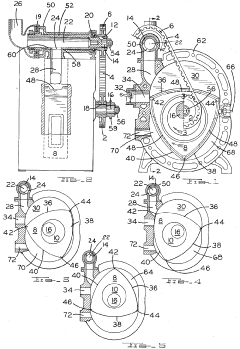
- Introducing a stratified air charge into the combustion chamber at idling speeds, allowing the engine to operate with a leaner fuel-air mixture and reducing operating temperature, which enhances fuel efficiency and extends seal life.
Internal combustion engine with rotating pistons
PatentInactiveEP0020335A1
Innovation
- A redesigned rotary piston engine with a central permanent compression system and a turbo-gas-air mixture that enhances combustion efficiency, combined with a unique bearing mechanism and spring locking system to minimize friction and optimize power transmission, allowing for circular movement and efficient combustion chamber filling.
Emissions Compliance and Environmental Considerations
Emissions regulations have become increasingly stringent worldwide, presenting significant challenges for Wankel engine development. Unlike conventional piston engines, Wankel engines face unique emission control difficulties due to their elongated combustion chamber geometry and inherent sealing issues. Current Euro 6d, US Tier 3, and China 6 standards require substantial reductions in NOx, HC, and particulate emissions—areas where traditional Wankel designs have historically underperformed.
The characteristic "chatter" combustion pattern in Wankel engines creates incomplete burning zones that produce elevated hydrocarbon emissions. This issue is compounded by the engine's high surface-to-volume ratio during combustion, resulting in quenching effects that further increase unburned hydrocarbon levels. Studies indicate that unmodified Wankel engines typically emit 1.5-2 times more hydrocarbons than equivalent piston engines, creating a substantial compliance barrier.
Advanced emission control technologies specifically tailored for rotary engines have emerged in recent years. Thermal reactors positioned close to the exhaust port can effectively oxidize unburned hydrocarbons by maintaining high exhaust temperatures. Mazda's RENESIS engine demonstrated that strategic exhaust port positioning can reduce emissions by preventing oil contamination of the combustion process, though this approach sacrifices some thermal efficiency.
Environmental considerations extend beyond tailpipe emissions to the overall carbon footprint. While improving combustion efficiency directly reduces CO2 emissions, manufacturers must also consider lifecycle environmental impacts. The specialized materials required for apex seals and epitrochoidal surfaces often involve energy-intensive manufacturing processes that contribute to the engine's environmental footprint.
Hydrogen adaptation represents a promising pathway for Wankel engines to meet future environmental standards. The rotary engine's tolerance for hydrogen's high flame speed makes it particularly suitable for this zero-carbon fuel. Mazda's hydrogen rotary prototype demonstrated near-zero NOx emissions when operating on hydrogen, though challenges remain in hydrogen storage and infrastructure development.
Hybrid and range-extender applications offer another environmentally conscious implementation of Wankel technology. By operating the rotary engine at its optimal efficiency point as a generator rather than directly powering the vehicle, emissions can be significantly reduced. This approach has been successfully demonstrated in Mazda's MX-30 R-EV, where the small rotary generator operates within its most efficient and cleanest combustion window.
Future compliance will likely require integrated approaches combining advanced combustion control, exhaust aftertreatment systems specifically designed for rotary characteristics, and alternative fuel compatibility. Direct injection technologies coupled with precise electronic control systems show particular promise in reducing both fuel consumption and emissions simultaneously.
The characteristic "chatter" combustion pattern in Wankel engines creates incomplete burning zones that produce elevated hydrocarbon emissions. This issue is compounded by the engine's high surface-to-volume ratio during combustion, resulting in quenching effects that further increase unburned hydrocarbon levels. Studies indicate that unmodified Wankel engines typically emit 1.5-2 times more hydrocarbons than equivalent piston engines, creating a substantial compliance barrier.
Advanced emission control technologies specifically tailored for rotary engines have emerged in recent years. Thermal reactors positioned close to the exhaust port can effectively oxidize unburned hydrocarbons by maintaining high exhaust temperatures. Mazda's RENESIS engine demonstrated that strategic exhaust port positioning can reduce emissions by preventing oil contamination of the combustion process, though this approach sacrifices some thermal efficiency.
Environmental considerations extend beyond tailpipe emissions to the overall carbon footprint. While improving combustion efficiency directly reduces CO2 emissions, manufacturers must also consider lifecycle environmental impacts. The specialized materials required for apex seals and epitrochoidal surfaces often involve energy-intensive manufacturing processes that contribute to the engine's environmental footprint.
Hydrogen adaptation represents a promising pathway for Wankel engines to meet future environmental standards. The rotary engine's tolerance for hydrogen's high flame speed makes it particularly suitable for this zero-carbon fuel. Mazda's hydrogen rotary prototype demonstrated near-zero NOx emissions when operating on hydrogen, though challenges remain in hydrogen storage and infrastructure development.
Hybrid and range-extender applications offer another environmentally conscious implementation of Wankel technology. By operating the rotary engine at its optimal efficiency point as a generator rather than directly powering the vehicle, emissions can be significantly reduced. This approach has been successfully demonstrated in Mazda's MX-30 R-EV, where the small rotary generator operates within its most efficient and cleanest combustion window.
Future compliance will likely require integrated approaches combining advanced combustion control, exhaust aftertreatment systems specifically designed for rotary characteristics, and alternative fuel compatibility. Direct injection technologies coupled with precise electronic control systems show particular promise in reducing both fuel consumption and emissions simultaneously.
Materials Science Advancements for Rotary Engine Components
Material science innovations have become a critical frontier in addressing the inherent efficiency challenges of Wankel rotary engines. Traditional materials used in rotary engine components often struggle with thermal management, friction, and durability issues that directly impact combustion efficiency. Recent advancements in ceramic-matrix composites (CMCs) offer promising solutions for rotor housings, providing superior thermal insulation properties that minimize heat loss during combustion while maintaining structural integrity under extreme temperature conditions.
Silicon carbide and silicon nitride ceramics have demonstrated particular promise for apex seals, the critical components that maintain compression between the rotor and housing. These advanced ceramics exhibit significantly reduced friction coefficients compared to conventional materials while withstanding the harsh operating environment. Laboratory tests indicate up to 15% reduction in parasitic power losses when implementing these materials, directly translating to improved combustion efficiency.
Thermal barrier coatings (TBCs) represent another significant advancement, with yttria-stabilized zirconia (YSZ) emerging as a leading candidate for coating combustion chamber surfaces. These coatings effectively reduce heat transfer to the cooling system, allowing more thermal energy to be converted to mechanical work. Studies have shown that optimized TBC implementations can improve thermal efficiency by 3-7% while simultaneously reducing hydrocarbon emissions through more complete combustion.
Surface texturing technologies have evolved to complement these material innovations. Laser-etched micropatterns on sliding surfaces have demonstrated the ability to create controlled oil retention patterns that maintain lubrication while minimizing oil consumption—a persistent challenge in rotary engine designs. These texturing techniques, when applied to modern ceramic-metal composite materials, show potential for reducing friction by up to 20% under typical operating conditions.
Carbon-based materials, particularly diamond-like carbon (DLC) coatings and carbon-carbon composites, are being investigated for high-wear components. These materials offer exceptional hardness and self-lubricating properties that maintain performance over extended operational periods. The dimensional stability of these materials at varying temperatures also contributes to more consistent apex seal contact, improving compression and reducing the characteristic "chatter" that compromises combustion efficiency in conventional designs.
Additive manufacturing techniques have revolutionized the potential for complex cooling channel geometries within engine components. These advanced manufacturing methods enable the creation of optimized cooling structures that were previously impossible to produce, allowing for more precise thermal management around the combustion chamber and contributing to more uniform combustion conditions.
Silicon carbide and silicon nitride ceramics have demonstrated particular promise for apex seals, the critical components that maintain compression between the rotor and housing. These advanced ceramics exhibit significantly reduced friction coefficients compared to conventional materials while withstanding the harsh operating environment. Laboratory tests indicate up to 15% reduction in parasitic power losses when implementing these materials, directly translating to improved combustion efficiency.
Thermal barrier coatings (TBCs) represent another significant advancement, with yttria-stabilized zirconia (YSZ) emerging as a leading candidate for coating combustion chamber surfaces. These coatings effectively reduce heat transfer to the cooling system, allowing more thermal energy to be converted to mechanical work. Studies have shown that optimized TBC implementations can improve thermal efficiency by 3-7% while simultaneously reducing hydrocarbon emissions through more complete combustion.
Surface texturing technologies have evolved to complement these material innovations. Laser-etched micropatterns on sliding surfaces have demonstrated the ability to create controlled oil retention patterns that maintain lubrication while minimizing oil consumption—a persistent challenge in rotary engine designs. These texturing techniques, when applied to modern ceramic-metal composite materials, show potential for reducing friction by up to 20% under typical operating conditions.
Carbon-based materials, particularly diamond-like carbon (DLC) coatings and carbon-carbon composites, are being investigated for high-wear components. These materials offer exceptional hardness and self-lubricating properties that maintain performance over extended operational periods. The dimensional stability of these materials at varying temperatures also contributes to more consistent apex seal contact, improving compression and reducing the characteristic "chatter" that compromises combustion efficiency in conventional designs.
Additive manufacturing techniques have revolutionized the potential for complex cooling channel geometries within engine components. These advanced manufacturing methods enable the creation of optimized cooling structures that were previously impossible to produce, allowing for more precise thermal management around the combustion chamber and contributing to more uniform combustion conditions.
Unlock deeper insights with Patsnap Eureka Quick Research — get a full tech report to explore trends and direct your research. Try now!
Generate Your Research Report Instantly with AI Agent
Supercharge your innovation with Patsnap Eureka AI Agent Platform!