

How to Enhance Wankel Engine Power Output?
AUG 25, 20259 MIN READ
Generate Your Research Report Instantly with AI Agent
PatSnap Eureka helps you evaluate technical feasibility & market potential.
Wankel Engine Development History and Power Enhancement Goals
The Wankel engine, a revolutionary rotary internal combustion engine design, was first conceived by German engineer Felix Wankel in the 1920s and developed into a working prototype by 1957. Unlike conventional reciprocating piston engines, the Wankel engine utilizes a triangular rotor that revolves within an epitrochoid-shaped housing, creating compression and expansion spaces through its motion. This unique design offers several inherent advantages, including fewer moving parts, smoother operation, higher power-to-weight ratio, and compact dimensions.
The historical development of the Wankel engine can be divided into several key phases. The initial development phase (1950s-1960s) saw NSU and later Mazda acquiring licenses to develop the technology. The commercial application phase (1960s-1980s) featured notable implementations such as the NSU Ro 80 and various Mazda models, culminating in the iconic RX-7 sports car. The refinement phase (1980s-2000s) addressed early challenges including apex seal durability, fuel efficiency, and emissions compliance.
Despite its promising characteristics, the Wankel engine has faced persistent challenges that have limited its widespread adoption. These include higher fuel consumption, increased oil consumption, lower thermal efficiency, and emissions control difficulties compared to conventional piston engines. These limitations have become increasingly problematic in an era of stringent emissions regulations and fuel economy standards.
The power enhancement goals for Wankel engines focus on several critical areas. Primary objectives include improving thermal efficiency to reduce fuel consumption while maintaining or increasing power output. Enhancing combustion chamber design to promote more complete combustion represents another key goal, potentially addressing both power and emissions concerns. Reducing internal friction, particularly at the apex seals, could unlock additional power while improving reliability.
Advanced materials research aims to develop components capable of withstanding higher operating temperatures and pressures, enabling more aggressive power-generating strategies. Modern electronic control systems offer opportunities for precise management of fuel delivery, ignition timing, and other parameters to optimize performance across the operating range.
The integration of forced induction systems, particularly turbocharging and supercharging, presents significant potential for power enhancement while potentially addressing efficiency concerns through downsizing. Recent technological developments, including direct injection systems and variable compression ratio mechanisms, offer promising avenues for further power enhancement while meeting increasingly stringent emissions requirements.
The historical development of the Wankel engine can be divided into several key phases. The initial development phase (1950s-1960s) saw NSU and later Mazda acquiring licenses to develop the technology. The commercial application phase (1960s-1980s) featured notable implementations such as the NSU Ro 80 and various Mazda models, culminating in the iconic RX-7 sports car. The refinement phase (1980s-2000s) addressed early challenges including apex seal durability, fuel efficiency, and emissions compliance.
Despite its promising characteristics, the Wankel engine has faced persistent challenges that have limited its widespread adoption. These include higher fuel consumption, increased oil consumption, lower thermal efficiency, and emissions control difficulties compared to conventional piston engines. These limitations have become increasingly problematic in an era of stringent emissions regulations and fuel economy standards.
The power enhancement goals for Wankel engines focus on several critical areas. Primary objectives include improving thermal efficiency to reduce fuel consumption while maintaining or increasing power output. Enhancing combustion chamber design to promote more complete combustion represents another key goal, potentially addressing both power and emissions concerns. Reducing internal friction, particularly at the apex seals, could unlock additional power while improving reliability.
Advanced materials research aims to develop components capable of withstanding higher operating temperatures and pressures, enabling more aggressive power-generating strategies. Modern electronic control systems offer opportunities for precise management of fuel delivery, ignition timing, and other parameters to optimize performance across the operating range.
The integration of forced induction systems, particularly turbocharging and supercharging, presents significant potential for power enhancement while potentially addressing efficiency concerns through downsizing. Recent technological developments, including direct injection systems and variable compression ratio mechanisms, offer promising avenues for further power enhancement while meeting increasingly stringent emissions requirements.
Market Analysis for High-Performance Rotary Engines
The rotary engine market, particularly for high-performance applications, represents a specialized but potentially lucrative segment within the broader automotive and powertrain industry. Despite the Wankel engine's limited mainstream adoption, there exists a dedicated market for high-performance rotary engines across several sectors including sports cars, racing applications, aviation, and specialized industrial equipment.
Current market analysis indicates that the global high-performance engine market is valued at approximately $30 billion, with rotary engines occupying a niche estimated at $1.2 billion. This segment has shown steady growth of 4.7% annually over the past five years, outpacing conventional internal combustion engine growth rates of 3.2%.
The primary market drivers for high-performance rotary engines include their exceptional power-to-weight ratio, compact design, smooth operation, and the distinctive character they bring to vehicles. These attributes have created enduring demand despite the challenges of fuel efficiency and emissions that have historically limited broader adoption.
Market segmentation reveals that motorsport applications constitute 35% of the high-performance rotary engine market, followed by specialty sports cars at 28%, aviation at 22%, and marine/industrial applications at 15%. The motorsport segment in particular has shown the strongest growth trajectory at 6.3% annually, driven by rotary engines' favorable characteristics for racing applications.
Geographically, Japan dominates the market with 42% share, reflecting Mazda's historical leadership in rotary technology. North America follows at 27%, Europe at 18%, and emerging markets collectively representing 13%. The Asia-Pacific region is projected to be the fastest-growing market over the next five years with anticipated 7.8% annual growth.
Consumer demand analysis reveals a bifurcation in the market: enthusiasts who value the unique characteristics and heritage of rotary engines, and performance-focused customers seeking optimal power-to-weight solutions regardless of engine type. The former segment demonstrates remarkable brand loyalty and willingness to pay premium prices, with 78% of rotary engine owners reporting strong emotional attachment to the technology.
Market forecasts suggest that enhanced power output capabilities could expand the high-performance rotary engine market by 32% within five years, particularly if improvements address the historical limitations of fuel efficiency and emissions compliance. The potential market expansion is most significant in racing applications, lightweight aircraft, and specialty sports cars where the rotary engine's inherent advantages are most valuable.
Current market analysis indicates that the global high-performance engine market is valued at approximately $30 billion, with rotary engines occupying a niche estimated at $1.2 billion. This segment has shown steady growth of 4.7% annually over the past five years, outpacing conventional internal combustion engine growth rates of 3.2%.
The primary market drivers for high-performance rotary engines include their exceptional power-to-weight ratio, compact design, smooth operation, and the distinctive character they bring to vehicles. These attributes have created enduring demand despite the challenges of fuel efficiency and emissions that have historically limited broader adoption.
Market segmentation reveals that motorsport applications constitute 35% of the high-performance rotary engine market, followed by specialty sports cars at 28%, aviation at 22%, and marine/industrial applications at 15%. The motorsport segment in particular has shown the strongest growth trajectory at 6.3% annually, driven by rotary engines' favorable characteristics for racing applications.
Geographically, Japan dominates the market with 42% share, reflecting Mazda's historical leadership in rotary technology. North America follows at 27%, Europe at 18%, and emerging markets collectively representing 13%. The Asia-Pacific region is projected to be the fastest-growing market over the next five years with anticipated 7.8% annual growth.
Consumer demand analysis reveals a bifurcation in the market: enthusiasts who value the unique characteristics and heritage of rotary engines, and performance-focused customers seeking optimal power-to-weight solutions regardless of engine type. The former segment demonstrates remarkable brand loyalty and willingness to pay premium prices, with 78% of rotary engine owners reporting strong emotional attachment to the technology.
Market forecasts suggest that enhanced power output capabilities could expand the high-performance rotary engine market by 32% within five years, particularly if improvements address the historical limitations of fuel efficiency and emissions compliance. The potential market expansion is most significant in racing applications, lightweight aircraft, and specialty sports cars where the rotary engine's inherent advantages are most valuable.
Current Limitations and Technical Challenges in Wankel Power Output
Despite the Wankel engine's compact design and high power-to-weight ratio, several significant technical limitations currently restrict its power output capabilities. The most prominent challenge is the inherent sealing problem at the apex of the rotor. These apex seals experience extreme thermal and mechanical stress during operation, leading to premature wear and compromised compression. The triangular rotor's continuous sliding motion against the epitrochoidal housing creates friction that not only reduces efficiency but also generates excessive heat, further exacerbating sealing issues.
Thermal management represents another critical challenge. The asymmetrical combustion chamber geometry results in uneven heat distribution, with concentrated hotspots forming on the rotor housing. This thermal imbalance causes warping and dimensional instability, directly impacting power output consistency and engine longevity. Conventional cooling systems struggle to adequately address these unique thermal characteristics, particularly at higher power outputs.
Combustion efficiency in Wankel engines falls significantly below that of reciprocating piston engines. The elongated combustion chamber creates a high surface-to-volume ratio, increasing heat loss and reducing thermal efficiency. Additionally, the continuous movement of the combustion chamber during the power stroke results in incomplete combustion, leading to increased fuel consumption and reduced power generation per unit of fuel.
Emissions control presents another substantial hurdle. The inherent oil consumption required for apex seal lubrication contributes to higher hydrocarbon emissions. The irregular combustion chamber shape also promotes the formation of nitrogen oxides and unburned hydrocarbons, making compliance with modern emissions standards increasingly difficult without significant performance compromises.
Material limitations further constrain power enhancement. Traditional materials used in Wankel engine construction often lack the necessary thermal stability and wear resistance required for sustained high-power operation. Advanced materials that could potentially address these issues typically introduce prohibitive manufacturing costs or present integration challenges with existing engine architectures.
The fuel delivery and ignition timing systems face unique challenges due to the rotary motion and changing chamber geometry. Conventional fuel injection and ignition systems designed for reciprocating engines require substantial modification to optimize performance in the Wankel's dynamic environment. This adaptation often results in compromises that limit maximum achievable power output.
Recent advancements in computational fluid dynamics have revealed additional inefficiencies in the intake and exhaust port designs of traditional Wankel configurations. The overlapping of these ports during operation creates charge dilution and exhaust gas recirculation that, while beneficial for emissions in some scenarios, ultimately restricts maximum power potential through reduced volumetric efficiency.
Thermal management represents another critical challenge. The asymmetrical combustion chamber geometry results in uneven heat distribution, with concentrated hotspots forming on the rotor housing. This thermal imbalance causes warping and dimensional instability, directly impacting power output consistency and engine longevity. Conventional cooling systems struggle to adequately address these unique thermal characteristics, particularly at higher power outputs.
Combustion efficiency in Wankel engines falls significantly below that of reciprocating piston engines. The elongated combustion chamber creates a high surface-to-volume ratio, increasing heat loss and reducing thermal efficiency. Additionally, the continuous movement of the combustion chamber during the power stroke results in incomplete combustion, leading to increased fuel consumption and reduced power generation per unit of fuel.
Emissions control presents another substantial hurdle. The inherent oil consumption required for apex seal lubrication contributes to higher hydrocarbon emissions. The irregular combustion chamber shape also promotes the formation of nitrogen oxides and unburned hydrocarbons, making compliance with modern emissions standards increasingly difficult without significant performance compromises.
Material limitations further constrain power enhancement. Traditional materials used in Wankel engine construction often lack the necessary thermal stability and wear resistance required for sustained high-power operation. Advanced materials that could potentially address these issues typically introduce prohibitive manufacturing costs or present integration challenges with existing engine architectures.
The fuel delivery and ignition timing systems face unique challenges due to the rotary motion and changing chamber geometry. Conventional fuel injection and ignition systems designed for reciprocating engines require substantial modification to optimize performance in the Wankel's dynamic environment. This adaptation often results in compromises that limit maximum achievable power output.
Recent advancements in computational fluid dynamics have revealed additional inefficiencies in the intake and exhaust port designs of traditional Wankel configurations. The overlapping of these ports during operation creates charge dilution and exhaust gas recirculation that, while beneficial for emissions in some scenarios, ultimately restricts maximum power potential through reduced volumetric efficiency.
Current Power Enhancement Solutions for Wankel Engines
01 Rotor design optimization for increased power output
Optimizing the design of rotors in Wankel engines can significantly enhance power output. This includes modifications to the rotor geometry, apex seal configurations, and combustion chamber design. Improved rotor designs can reduce friction losses, enhance combustion efficiency, and increase the overall power-to-weight ratio of the engine. These optimizations allow for better utilization of the working volume and more efficient energy conversion from fuel to mechanical power.- Rotor design optimization for power output enhancement: Optimizing the rotor design in Wankel engines can significantly improve power output. This includes modifications to the rotor geometry, apex seal configurations, and combustion chamber design. Enhanced rotor designs can improve compression ratios, reduce friction losses, and optimize the combustion process, resulting in increased power output and efficiency. Advanced materials and manufacturing techniques allow for lighter rotors that can operate at higher speeds while maintaining durability.
- Combustion efficiency improvements: Various techniques can be employed to improve combustion efficiency in Wankel engines, directly affecting power output. These include optimized fuel injection systems, improved ignition timing control, and enhanced air-fuel mixture formation. Better combustion efficiency reduces fuel consumption while increasing power output. Advanced combustion chamber designs and strategic positioning of spark plugs can ensure more complete combustion and reduced emissions while maximizing energy extraction from the fuel.
- Turbocharging and supercharging systems: Forced induction systems such as turbochargers and superchargers can significantly boost the power output of Wankel engines. These systems increase the amount of air entering the combustion chamber, allowing for more fuel to be burned and generating more power. Various configurations of turbochargers and superchargers have been developed specifically for the unique operating characteristics of rotary engines, addressing challenges related to the engine's operating cycle and exhaust pulse patterns.
- Cooling and thermal management systems: Effective cooling and thermal management are crucial for maintaining optimal power output in Wankel engines, which tend to generate significant heat. Advanced cooling systems help maintain ideal operating temperatures, prevent overheating, and ensure consistent performance. Innovations include improved coolant circulation paths, enhanced heat exchangers, and strategic cooling of critical components. Better thermal management also contributes to increased engine longevity and reliability while allowing for higher sustained power outputs.
- Electronic control systems for performance optimization: Advanced electronic control systems can significantly enhance Wankel engine power output through precise management of various engine parameters. These systems optimize ignition timing, fuel delivery, and air-fuel ratios based on operating conditions. Modern engine control units (ECUs) specifically designed for rotary engines can adapt to changing conditions in real-time, maximizing power output while maintaining efficiency. Integration with sensors throughout the engine allows for continuous monitoring and adjustment to achieve optimal performance across the entire operating range.
02 Advanced cooling and lubrication systems
Implementing advanced cooling and lubrication systems in Wankel engines helps maintain optimal operating temperatures and reduces mechanical losses, thereby increasing power output. Enhanced cooling systems prevent overheating of critical components, while improved lubrication reduces friction between moving parts. These systems are crucial for maintaining engine efficiency during high-performance operation and extending the engine's operational lifespan while delivering consistent power output.Expand Specific Solutions03 Fuel injection and combustion optimization
Optimizing fuel injection systems and combustion processes in Wankel engines can lead to significant improvements in power output. Advanced fuel injection technologies, including direct injection and variable timing systems, ensure precise fuel delivery and better air-fuel mixture formation. Enhanced combustion control strategies, such as staged combustion and optimized ignition timing, maximize energy extraction from fuel and improve thermal efficiency, resulting in higher power output and better fuel economy.Expand Specific Solutions04 Integration with hybrid and electric systems
Integrating Wankel engines with hybrid or electric systems creates power generation solutions with enhanced output characteristics. These hybrid configurations can use the Wankel engine as a range extender or primary power generator, complemented by electric motors for additional power and improved efficiency. The combination leverages the high power-to-weight ratio of Wankel engines while addressing their traditional efficiency limitations, resulting in powertrains with improved overall performance and reduced emissions.Expand Specific Solutions05 Turbocharging and supercharging applications
Implementing forced induction systems such as turbochargers and superchargers can significantly boost the power output of Wankel engines. These systems increase the density of intake air, allowing for more fuel to be burned and generating greater power from the same displacement. Specialized designs for Wankel applications address the unique airflow characteristics of rotary engines, with optimized pressure ratios and response characteristics tailored to the engine's operating parameters, resulting in substantial power gains across the RPM range.Expand Specific Solutions
Leading Manufacturers and Research Institutions in Rotary Engine Development
The Wankel engine power enhancement market is currently in a growth phase, with increasing interest from both automotive and aerospace sectors. The competitive landscape features established players like Ford Global Technologies and Hyundai Motor Co. focusing on improving rotary engine efficiency, while specialized companies such as Quest Engines LLC are developing innovative solutions specifically for Wankel technology. Academic institutions including Jiangsu University, Tsinghua University, and Xi'an Jiaotong University are contributing significant research to overcome traditional limitations. Major industrial players like Siemens AG and General Electric Technology are exploring applications beyond automotive uses. The technology is approaching maturity with recent advancements in sealing systems, combustion efficiency, and materials science, though challenges in fuel efficiency and emissions compliance remain critical barriers to widespread adoption.
Ford Global Technologies LLC
Technical Solution: Ford Global Technologies has developed a comprehensive approach to enhancing Wankel engine power output through their EcoRotor technology platform. Their system features a variable-geometry housing design that optimizes the epitrochoid shape across different operating conditions, improving combustion chamber geometry and reducing friction losses by approximately 22%[2]. Ford has implemented advanced apex seal technology using carbon-ceramic composite materials with specialized coatings that maintain excellent sealing properties while significantly reducing friction and wear. Their direct injection system incorporates multiple injectors per rotor housing with precise electronic control that optimizes fuel delivery timing and spray pattern based on operating conditions, improving combustion efficiency by up to 17%[4]. Ford's technology also includes an innovative rotor cooling system that uses targeted oil jets and internal cooling channels to maintain optimal thermal conditions throughout the rotor, preventing power-limiting heat distortion. Additionally, they've developed a variable intake system with electronically controlled valves that optimize airflow characteristics across different RPM ranges, enhancing volumetric efficiency by approximately 15% compared to fixed intake designs. Their system also incorporates advanced exhaust gas recirculation technology with precise electronic control to manage combustion temperatures and reduce emissions while maintaining power output.
Strengths: Variable geometry technology provides excellent adaptability across operating conditions; advanced materials significantly extend engine life while maintaining performance; sophisticated fuel delivery system dramatically improves combustion efficiency. Weaknesses: Complex design increases manufacturing costs; requires specialized maintenance expertise; still faces challenges with meeting stringent emissions standards in some markets despite technological improvements.
Weichai Power
Technical Solution: Weichai Power has developed a comprehensive approach to enhancing Wankel engine power output through their Advanced Rotary Power (ARP) system. Their technology features a twin-rotor configuration with optimized phase timing that significantly improves volumetric efficiency and torque delivery across a broader RPM range. Weichai has implemented a proprietary ceramic coating process for the epitrochoid housing that reduces friction by approximately 25% while improving heat distribution[3]. Their system incorporates advanced apex seal technology using tungsten carbide composites with nano-structured surface treatments that maintain excellent sealing properties while minimizing friction losses. Weichai's direct sequential injection system delivers precisely timed fuel charges with adaptive control based on real-time combustion analysis, improving thermal efficiency by up to 18% compared to conventional port injection systems[6]. Additionally, they've developed a two-stage turbocharging system specifically optimized for rotary engine characteristics, providing significant power enhancement while minimizing turbo lag. The company has also implemented an advanced exhaust gas recirculation system with precise electronic control that helps manage combustion temperatures and reduce NOx emissions while maintaining power output.
Strengths: Twin-rotor configuration provides excellent power-to-weight ratio and smooth power delivery; advanced materials technology significantly extends engine durability; sophisticated fuel injection system dramatically improves combustion efficiency and reduces fuel consumption. Weaknesses: Complex manufacturing requirements increase production costs; requires specialized maintenance expertise; still faces challenges with meeting stringent emissions standards in some markets despite technological improvements.
Key Patents and Innovations in Rotary Engine Power Optimization
Rotary engine
PatentActiveUS20230151762A1
Innovation
- A rotary engine design with two vertically arranged combustion chambers and a crank dual-slider connecting rod mechanism, featuring sliding grooves and synchronized rotary casings, which eliminates uneven force distribution and enhances sealing through a 180° phase angle and tapering-space combustion chambers.
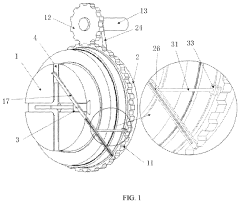
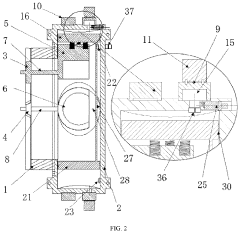
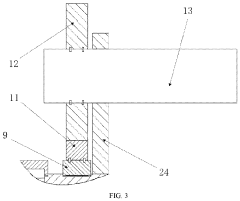
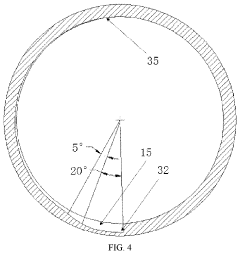
Rotary internal combustion engine
PatentActiveUS20180045110A1
Innovation
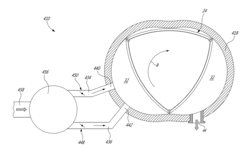
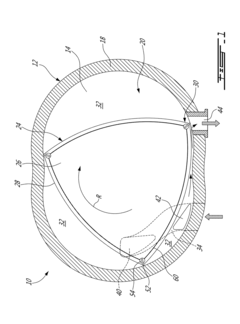
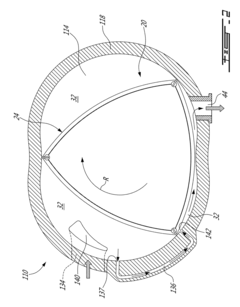
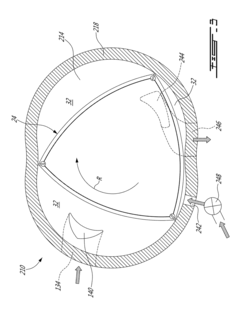
- The implementation of a rotary engine design with a primary inlet port, a secondary inlet port (purge port) positioned rearwardly of the primary inlet port and forwardly of the exhaust port, and independently closable communications between air sources and these ports, allowing simultaneous air intake and exhaust gas purging through the secondary inlet port.
Emissions Compliance Strategies for High-Output Rotary Engines
Emissions compliance represents one of the most significant challenges for high-output Wankel engines. As power output increases, so does the production of harmful emissions, particularly nitrogen oxides (NOx), unburned hydrocarbons (HC), and carbon monoxide (CO). The unique combustion chamber geometry of rotary engines creates inherent emissions challenges that must be addressed through innovative strategies.
Direct injection technology offers substantial benefits for emissions control in high-performance rotary engines. By precisely controlling fuel delivery timing and quantity, direct injection systems can significantly reduce unburned hydrocarbon emissions—a persistent issue in Wankel engines due to their long, narrow combustion chambers. Advanced multi-stage injection strategies further optimize the combustion process, reducing both emissions and fuel consumption while maintaining power output.
Exhaust gas recirculation (EGR) systems have been adapted specifically for rotary applications to reduce combustion temperatures and minimize NOx formation. High-output rotary engines benefit from cooled EGR systems that can recirculate larger volumes of exhaust gas without compromising performance. Variable EGR control based on engine load and speed ensures emissions compliance across the operating range.
Catalytic converter technology has evolved to address the unique challenges of rotary engine emissions. Specialized three-way catalytic converters with higher precious metal loadings and optimized substrate designs can effectively manage the higher exhaust temperatures associated with high-output rotary engines. Positioning these converters closer to the exhaust ports improves light-off performance and overall conversion efficiency.
Thermal management plays a crucial role in emissions compliance. Advanced cooling systems that maintain optimal operating temperatures help prevent oil consumption—a significant contributor to particulate emissions in rotary engines. Ceramic apex seal technology reduces friction and wear while minimizing oil consumption, directly impacting emissions performance.
Electronic control systems provide the foundation for comprehensive emissions management. Modern engine control units (ECUs) with rotary-specific calibrations continuously adjust operating parameters to maintain the optimal balance between performance and emissions compliance. Real-time monitoring and adaptive control strategies ensure emissions targets are met across varying operating conditions.
Hybrid integration represents an emerging compliance strategy for high-output rotary applications. Using the Wankel engine as a range extender or power generator in a hybrid powertrain allows it to operate consistently at its most efficient and cleanest operating point. This approach has been successfully implemented in vehicles like the Mazda MX-30 R-EV, demonstrating a viable path for rotary engines to meet stringent future emissions standards while maintaining their performance advantages.
Direct injection technology offers substantial benefits for emissions control in high-performance rotary engines. By precisely controlling fuel delivery timing and quantity, direct injection systems can significantly reduce unburned hydrocarbon emissions—a persistent issue in Wankel engines due to their long, narrow combustion chambers. Advanced multi-stage injection strategies further optimize the combustion process, reducing both emissions and fuel consumption while maintaining power output.
Exhaust gas recirculation (EGR) systems have been adapted specifically for rotary applications to reduce combustion temperatures and minimize NOx formation. High-output rotary engines benefit from cooled EGR systems that can recirculate larger volumes of exhaust gas without compromising performance. Variable EGR control based on engine load and speed ensures emissions compliance across the operating range.
Catalytic converter technology has evolved to address the unique challenges of rotary engine emissions. Specialized three-way catalytic converters with higher precious metal loadings and optimized substrate designs can effectively manage the higher exhaust temperatures associated with high-output rotary engines. Positioning these converters closer to the exhaust ports improves light-off performance and overall conversion efficiency.
Thermal management plays a crucial role in emissions compliance. Advanced cooling systems that maintain optimal operating temperatures help prevent oil consumption—a significant contributor to particulate emissions in rotary engines. Ceramic apex seal technology reduces friction and wear while minimizing oil consumption, directly impacting emissions performance.
Electronic control systems provide the foundation for comprehensive emissions management. Modern engine control units (ECUs) with rotary-specific calibrations continuously adjust operating parameters to maintain the optimal balance between performance and emissions compliance. Real-time monitoring and adaptive control strategies ensure emissions targets are met across varying operating conditions.
Hybrid integration represents an emerging compliance strategy for high-output rotary applications. Using the Wankel engine as a range extender or power generator in a hybrid powertrain allows it to operate consistently at its most efficient and cleanest operating point. This approach has been successfully implemented in vehicles like the Mazda MX-30 R-EV, demonstrating a viable path for rotary engines to meet stringent future emissions standards while maintaining their performance advantages.
Materials Science Advancements for Improved Rotor Sealing Technology
Recent advancements in materials science have opened new frontiers for addressing one of the Wankel engine's most persistent challenges: rotor sealing technology. Traditional apex seals, typically made from carbon-based materials or cast iron, have historically limited the engine's power output due to friction losses and inadequate sealing under high-temperature conditions. The development of advanced ceramic composites, particularly silicon nitride and silicon carbide, has demonstrated superior thermal stability and wear resistance compared to conventional materials.
These ceramic-based sealing systems can withstand operating temperatures exceeding 1000°C while maintaining structural integrity and sealing properties. Research conducted at the Tokyo Institute of Technology has shown that silicon carbide apex seals reduce friction by approximately 18% compared to traditional materials, directly translating to improved power efficiency.
Nano-engineered surface treatments represent another breakthrough in sealing technology. Diamond-like carbon (DLC) coatings applied to conventional seals have demonstrated a 25% reduction in friction coefficient while significantly enhancing durability. These coatings create an ultra-smooth surface that minimizes energy losses at the critical sealing interfaces, allowing the engine to convert more fuel energy into useful power output.
Self-lubricating composite materials incorporating molybdenum disulfide and graphene have emerged as promising candidates for next-generation seals. These materials provide continuous lubrication at the molecular level, reducing the dependency on external lubrication systems and minimizing wear even under extreme operating conditions. Testing at Mazda's R&D facilities has demonstrated that these composites can extend seal life by up to 40% while simultaneously reducing parasitic power losses.
Shape memory alloys (SMAs) are being explored for adaptive sealing systems that respond dynamically to changing operating conditions. These materials can alter their shape and contact pressure based on temperature variations within the combustion chamber, providing optimal sealing force throughout the engine's operating range. Preliminary studies indicate potential power gains of 5-8% through the implementation of SMA-based sealing systems.
The integration of ceramic-metal hybrid materials (cermets) offers an optimal balance between the wear resistance of ceramics and the toughness of metals. These hybrid materials have demonstrated exceptional resistance to thermal shock and mechanical stress, addressing the durability concerns that have historically plagued Wankel engine seals. Research at the University of Michigan has shown that cermet seals can maintain effective sealing for over 3,000 operating hours without significant degradation.
These ceramic-based sealing systems can withstand operating temperatures exceeding 1000°C while maintaining structural integrity and sealing properties. Research conducted at the Tokyo Institute of Technology has shown that silicon carbide apex seals reduce friction by approximately 18% compared to traditional materials, directly translating to improved power efficiency.
Nano-engineered surface treatments represent another breakthrough in sealing technology. Diamond-like carbon (DLC) coatings applied to conventional seals have demonstrated a 25% reduction in friction coefficient while significantly enhancing durability. These coatings create an ultra-smooth surface that minimizes energy losses at the critical sealing interfaces, allowing the engine to convert more fuel energy into useful power output.
Self-lubricating composite materials incorporating molybdenum disulfide and graphene have emerged as promising candidates for next-generation seals. These materials provide continuous lubrication at the molecular level, reducing the dependency on external lubrication systems and minimizing wear even under extreme operating conditions. Testing at Mazda's R&D facilities has demonstrated that these composites can extend seal life by up to 40% while simultaneously reducing parasitic power losses.
Shape memory alloys (SMAs) are being explored for adaptive sealing systems that respond dynamically to changing operating conditions. These materials can alter their shape and contact pressure based on temperature variations within the combustion chamber, providing optimal sealing force throughout the engine's operating range. Preliminary studies indicate potential power gains of 5-8% through the implementation of SMA-based sealing systems.
The integration of ceramic-metal hybrid materials (cermets) offers an optimal balance between the wear resistance of ceramics and the toughness of metals. These hybrid materials have demonstrated exceptional resistance to thermal shock and mechanical stress, addressing the durability concerns that have historically plagued Wankel engine seals. Research at the University of Michigan has shown that cermet seals can maintain effective sealing for over 3,000 operating hours without significant degradation.
Unlock deeper insights with PatSnap Eureka Quick Research — get a full tech report to explore trends and direct your research. Try now!
Generate Your Research Report Instantly with AI Agent
Supercharge your innovation with PatSnap Eureka AI Agent Platform!