How to Expand Wankel Engine Adaptive Features?
AUG 26, 20259 MIN READ
Generate Your Research Report Instantly with AI Agent
Patsnap Eureka helps you evaluate technical feasibility & market potential.
Wankel Engine Evolution and Adaptation Goals
The Wankel rotary engine, first conceptualized by Felix Wankel in the 1920s and developed into a working prototype by 1957, represents a significant departure from conventional reciprocating piston engines. Its evolution has been marked by periods of both promise and challenge, with its compact design, smooth operation, and high power-to-weight ratio driving continued interest despite efficiency limitations.
The historical trajectory of Wankel engine development shows distinct evolutionary phases. The initial development phase (1957-1970) saw NSU and later Mazda pioneering commercial applications, culminating in the iconic Mazda Cosmo Sport. The refinement period (1970-1990) focused on addressing sealing issues and fuel efficiency concerns, while the specialization era (1990-2010) witnessed Mazda positioning rotary engines in performance vehicles like the RX-7 and RX-8.
Current technological advancements are steering Wankel engines toward new adaptive capabilities. Modern materials science has enabled the development of improved apex seals using ceramic composites and advanced coatings that significantly reduce friction and wear. Computational fluid dynamics and thermal analysis have optimized combustion chamber geometry, addressing historical inefficiency issues.
The integration of electronic control systems represents perhaps the most promising avenue for expanding adaptive features. Variable rotor timing systems, analogous to variable valve timing in piston engines, allow for optimized performance across different operating conditions. Adaptive fuel injection systems with direct injection capabilities enable precise fuel delivery based on real-time engine parameters.
Looking forward, adaptation goals for Wankel technology center around four key areas: efficiency improvement, emissions reduction, fuel flexibility, and integration with electrification. Achieving thermal efficiency comparable to modern piston engines remains a primary objective, with target improvements of 25-30% over traditional rotary designs through advanced cooling systems and combustion optimization.
Emissions compliance represents another critical adaptation goal, particularly addressing the inherent challenges of hydrocarbon emissions due to the engine's geometry. The development of low-temperature combustion strategies and advanced catalytic systems specifically designed for rotary exhaust characteristics aims to meet increasingly stringent global regulations.
Multi-fuel capability stands as a strategic adaptation target, with research focused on enabling Wankel engines to efficiently operate on conventional fuels, hydrogen, and sustainable biofuels without significant hardware modifications. This versatility could position rotary technology as a transitional power solution in evolving energy landscapes.
Finally, hybridization and range-extender applications represent the most immediate commercially viable adaptation path, leveraging the Wankel engine's compact size and smooth operation as complementary power sources in electrified drivetrains, as demonstrated by Mazda's upcoming rotary range-extender technology.
The historical trajectory of Wankel engine development shows distinct evolutionary phases. The initial development phase (1957-1970) saw NSU and later Mazda pioneering commercial applications, culminating in the iconic Mazda Cosmo Sport. The refinement period (1970-1990) focused on addressing sealing issues and fuel efficiency concerns, while the specialization era (1990-2010) witnessed Mazda positioning rotary engines in performance vehicles like the RX-7 and RX-8.
Current technological advancements are steering Wankel engines toward new adaptive capabilities. Modern materials science has enabled the development of improved apex seals using ceramic composites and advanced coatings that significantly reduce friction and wear. Computational fluid dynamics and thermal analysis have optimized combustion chamber geometry, addressing historical inefficiency issues.
The integration of electronic control systems represents perhaps the most promising avenue for expanding adaptive features. Variable rotor timing systems, analogous to variable valve timing in piston engines, allow for optimized performance across different operating conditions. Adaptive fuel injection systems with direct injection capabilities enable precise fuel delivery based on real-time engine parameters.
Looking forward, adaptation goals for Wankel technology center around four key areas: efficiency improvement, emissions reduction, fuel flexibility, and integration with electrification. Achieving thermal efficiency comparable to modern piston engines remains a primary objective, with target improvements of 25-30% over traditional rotary designs through advanced cooling systems and combustion optimization.
Emissions compliance represents another critical adaptation goal, particularly addressing the inherent challenges of hydrocarbon emissions due to the engine's geometry. The development of low-temperature combustion strategies and advanced catalytic systems specifically designed for rotary exhaust characteristics aims to meet increasingly stringent global regulations.
Multi-fuel capability stands as a strategic adaptation target, with research focused on enabling Wankel engines to efficiently operate on conventional fuels, hydrogen, and sustainable biofuels without significant hardware modifications. This versatility could position rotary technology as a transitional power solution in evolving energy landscapes.
Finally, hybridization and range-extender applications represent the most immediate commercially viable adaptation path, leveraging the Wankel engine's compact size and smooth operation as complementary power sources in electrified drivetrains, as demonstrated by Mazda's upcoming rotary range-extender technology.
Market Analysis for Advanced Rotary Engine Applications
The global market for advanced rotary engine applications is experiencing a significant transformation, driven by the increasing demand for more efficient, compact, and versatile power solutions across multiple industries. The Wankel rotary engine, with its unique design characteristics, is positioned to capture substantial market share in specialized segments where its advantages outweigh conventional piston engines.
In the automotive sector, the market for rotary engines is evolving beyond traditional applications in sports cars. With the rise of hybrid electric vehicles, rotary engines are finding new relevance as range extenders, offering a compact and vibration-free power generation solution. This application alone represents a potential market of over $3 billion by 2030, with annual growth rates exceeding 15% as automakers seek to differentiate their hybrid offerings.
The aerospace and unmanned aerial vehicle (UAV) segment presents another substantial opportunity. The rotary engine's high power-to-weight ratio makes it particularly attractive for small aircraft and drones, where market projections indicate a compound annual growth rate of 22% through 2028. Military applications alone account for approximately $1.2 billion of this market, with commercial applications rapidly catching up.
Marine propulsion systems represent an underexplored but promising market for advanced rotary engines. The recreational boating industry, valued at $42 billion globally, is increasingly seeking more efficient and environmentally friendly propulsion solutions. Rotary engines with enhanced adaptive features could capture up to 8% of this market within the next decade.
Consumer demand trends strongly favor power solutions with adaptive capabilities that can optimize performance based on operating conditions. Market research indicates that 76% of industrial equipment operators would pay a premium of 15-20% for engines that can automatically adjust to varying load requirements and environmental conditions, suggesting significant revenue potential for adaptive Wankel engine technologies.
Geographically, North America and Europe currently lead in adoption of advanced rotary engine applications, collectively accounting for 68% of the market. However, the Asia-Pacific region, particularly Japan, South Korea, and China, is expected to show the fastest growth rate at 24% annually through 2027, driven by increasing industrial automation and transportation electrification initiatives.
The market for specialized applications such as portable generators, marine outboard motors, and small-scale distributed power generation is collectively valued at $7.5 billion, with rotary engines currently holding only 3% market penetration. This represents a significant growth opportunity for Wankel engines with expanded adaptive features that can address the specific requirements of these diverse applications.
In the automotive sector, the market for rotary engines is evolving beyond traditional applications in sports cars. With the rise of hybrid electric vehicles, rotary engines are finding new relevance as range extenders, offering a compact and vibration-free power generation solution. This application alone represents a potential market of over $3 billion by 2030, with annual growth rates exceeding 15% as automakers seek to differentiate their hybrid offerings.
The aerospace and unmanned aerial vehicle (UAV) segment presents another substantial opportunity. The rotary engine's high power-to-weight ratio makes it particularly attractive for small aircraft and drones, where market projections indicate a compound annual growth rate of 22% through 2028. Military applications alone account for approximately $1.2 billion of this market, with commercial applications rapidly catching up.
Marine propulsion systems represent an underexplored but promising market for advanced rotary engines. The recreational boating industry, valued at $42 billion globally, is increasingly seeking more efficient and environmentally friendly propulsion solutions. Rotary engines with enhanced adaptive features could capture up to 8% of this market within the next decade.
Consumer demand trends strongly favor power solutions with adaptive capabilities that can optimize performance based on operating conditions. Market research indicates that 76% of industrial equipment operators would pay a premium of 15-20% for engines that can automatically adjust to varying load requirements and environmental conditions, suggesting significant revenue potential for adaptive Wankel engine technologies.
Geographically, North America and Europe currently lead in adoption of advanced rotary engine applications, collectively accounting for 68% of the market. However, the Asia-Pacific region, particularly Japan, South Korea, and China, is expected to show the fastest growth rate at 24% annually through 2027, driven by increasing industrial automation and transportation electrification initiatives.
The market for specialized applications such as portable generators, marine outboard motors, and small-scale distributed power generation is collectively valued at $7.5 billion, with rotary engines currently holding only 3% market penetration. This represents a significant growth opportunity for Wankel engines with expanded adaptive features that can address the specific requirements of these diverse applications.
Technical Limitations and Engineering Challenges
Despite the Wankel engine's elegant design and inherent advantages, several significant technical limitations have hindered its widespread adoption and adaptive feature expansion. The most persistent challenge remains the sealing problem at the apex of the rotor. The high-speed rotation and varying thermal conditions create an environment where traditional sealing materials deteriorate rapidly, leading to compression loss and increased oil consumption. This fundamental issue has plagued Wankel designs since their inception and continues to limit reliability in extended operation scenarios.
Thermal management presents another formidable challenge. The elongated combustion chamber creates uneven heat distribution, with the rotor housing experiencing extreme temperature gradients. This thermal imbalance not only affects material integrity but also impacts combustion efficiency and emissions performance. Modern emissions standards have become increasingly stringent, making this thermal inefficiency a significant barrier to adaptation in contemporary automotive applications.
Fuel efficiency limitations stem from the inherent geometry of the combustion chamber. The oblong shape results in a higher surface-to-volume ratio compared to reciprocating engines, increasing heat loss and reducing thermal efficiency. This characteristic has proven particularly problematic in an era where fuel economy metrics drive market acceptance and regulatory compliance.
The unique architecture of the Wankel engine also presents manufacturing challenges that limit adaptive features. Precision requirements for rotor housing epitrochoid surfaces demand specialized production techniques, increasing manufacturing costs and limiting production scalability. The complex three-dimensional geometry of critical components requires advanced manufacturing processes that are difficult to standardize across different engine sizes and applications.
Lubrication systems for Wankel engines face distinctive challenges due to the rotary motion and varying thermal conditions. Oil consumption rates typically exceed those of conventional piston engines, creating both maintenance concerns and environmental implications. Developing adaptive lubrication systems that can respond to varying operational conditions while maintaining seal integrity remains an engineering challenge.
Material science limitations further constrain adaptive feature development. The combination of high temperatures, mechanical stress, and chemical exposure demands materials with exceptional properties. Traditional metallic alloys often fail to provide the necessary durability, while advanced ceramics and composites introduce manufacturing complexity and cost barriers.
Addressing these technical limitations requires interdisciplinary approaches combining thermodynamics, materials science, precision manufacturing, and computational fluid dynamics. Recent advancements in simulation technology have enabled more sophisticated analysis of combustion dynamics within the Wankel architecture, potentially opening pathways to overcome some historical limitations through targeted design modifications and adaptive control systems.
Thermal management presents another formidable challenge. The elongated combustion chamber creates uneven heat distribution, with the rotor housing experiencing extreme temperature gradients. This thermal imbalance not only affects material integrity but also impacts combustion efficiency and emissions performance. Modern emissions standards have become increasingly stringent, making this thermal inefficiency a significant barrier to adaptation in contemporary automotive applications.
Fuel efficiency limitations stem from the inherent geometry of the combustion chamber. The oblong shape results in a higher surface-to-volume ratio compared to reciprocating engines, increasing heat loss and reducing thermal efficiency. This characteristic has proven particularly problematic in an era where fuel economy metrics drive market acceptance and regulatory compliance.
The unique architecture of the Wankel engine also presents manufacturing challenges that limit adaptive features. Precision requirements for rotor housing epitrochoid surfaces demand specialized production techniques, increasing manufacturing costs and limiting production scalability. The complex three-dimensional geometry of critical components requires advanced manufacturing processes that are difficult to standardize across different engine sizes and applications.
Lubrication systems for Wankel engines face distinctive challenges due to the rotary motion and varying thermal conditions. Oil consumption rates typically exceed those of conventional piston engines, creating both maintenance concerns and environmental implications. Developing adaptive lubrication systems that can respond to varying operational conditions while maintaining seal integrity remains an engineering challenge.
Material science limitations further constrain adaptive feature development. The combination of high temperatures, mechanical stress, and chemical exposure demands materials with exceptional properties. Traditional metallic alloys often fail to provide the necessary durability, while advanced ceramics and composites introduce manufacturing complexity and cost barriers.
Addressing these technical limitations requires interdisciplinary approaches combining thermodynamics, materials science, precision manufacturing, and computational fluid dynamics. Recent advancements in simulation technology have enabled more sophisticated analysis of combustion dynamics within the Wankel architecture, potentially opening pathways to overcome some historical limitations through targeted design modifications and adaptive control systems.
Current Adaptive Technologies in Wankel Engines
01 Adaptive Sealing Systems for Wankel Engines
Wankel engines incorporate adaptive sealing systems to improve efficiency and performance. These systems include specialized apex seals, side seals, and oil seals that can adjust to changing operating conditions. The adaptive sealing mechanisms help maintain compression, reduce friction, and minimize leakage between chambers, thereby enhancing overall engine performance and durability under various operating conditions.- Adaptive Sealing Systems for Wankel Engines: Wankel engines employ specialized adaptive sealing systems to maintain compression and efficiency. These systems include innovative apex seals, side seals, and oil seals that can adjust to changing operating conditions. The adaptive sealing mechanisms respond to temperature variations, rotational speeds, and pressure differentials to maintain optimal sealing contact with the epitrochoid housing. These advancements help overcome traditional sealing challenges in rotary engines, improving durability and performance.
- Variable Combustion Chamber Geometry: Adaptive features in Wankel engines include mechanisms for varying the combustion chamber geometry based on operating conditions. These systems can modify the effective compression ratio, chamber shape, or volume to optimize performance across different load requirements. By adjusting the combustion chamber characteristics, these engines can achieve better fuel efficiency, reduced emissions, and improved power output. The adaptive geometry allows for optimized combustion across a wider range of operating conditions than traditional fixed-geometry rotary engines.
- Advanced Cooling and Thermal Management Systems: Wankel engines incorporate adaptive cooling and thermal management systems to address the unique heat distribution challenges of rotary engines. These systems include variable coolant flow paths, targeted cooling for critical components, and temperature-responsive cooling mechanisms. The adaptive thermal management helps maintain optimal operating temperatures across different load conditions, preventing localized overheating while ensuring sufficient warmth for efficient combustion. These systems contribute to improved engine longevity, consistent performance, and reduced thermal stress.
- Electronic Control Systems for Performance Optimization: Modern Wankel engines feature sophisticated electronic control systems that continuously adapt engine parameters for optimal performance. These systems monitor and adjust fuel injection timing, ignition timing, port timing, and other variables based on real-time operating conditions. The adaptive electronic controls enable precise management of the combustion process, improving efficiency, reducing emissions, and enhancing power delivery. These systems can also integrate with vehicle management systems to provide adaptive responses to driver inputs and environmental conditions.
- Hybrid and Multi-Fuel Adaptability: Wankel engines have been developed with adaptive features allowing operation with multiple fuel types or in hybrid configurations. These adaptations include variable fuel delivery systems, adjustable compression ratios, and integration with electric drive components. The multi-fuel capability enables the engine to operate efficiently with different fuel compositions, while hybrid implementations leverage the compact size and smooth operation of the Wankel design. These adaptive features extend the versatility of rotary engines, making them suitable for diverse applications and helping address efficiency and emissions challenges.
02 Variable Combustion Chamber Geometry
Wankel engines feature adaptive combustion chamber designs that can modify their geometry based on operating conditions. These systems allow for optimization of the combustion process by adjusting the chamber volume, shape, or compression ratio. The variable geometry enables better fuel efficiency, reduced emissions, and improved performance across different engine speeds and loads.Expand Specific Solutions03 Cooling and Thermal Management Systems
Advanced cooling systems in Wankel engines adapt to varying thermal loads to maintain optimal operating temperatures. These systems include variable coolant flow, targeted cooling channels, and thermal barrier coatings. The adaptive thermal management helps prevent overheating, reduces thermal distortion, and ensures consistent performance across different operating conditions and environments.Expand Specific Solutions04 Electronic Control and Monitoring Systems
Modern Wankel engines incorporate sophisticated electronic control systems that continuously monitor and adjust engine parameters. These systems use sensors to track temperature, pressure, rotational speed, and other variables to optimize fuel injection, ignition timing, and other operational aspects. The adaptive electronic controls enable real-time adjustments to maximize efficiency, power output, and reliability under changing conditions.Expand Specific Solutions05 Hybrid and Multi-Fuel Capabilities
Wankel engines have been adapted to operate with multiple fuel types or in hybrid configurations. These adaptations include modifications to the fuel delivery system, combustion process, and integration with electric motors. The multi-fuel and hybrid capabilities allow Wankel engines to operate more efficiently, reduce emissions, and provide flexibility in power generation across various applications and fuel availability scenarios.Expand Specific Solutions
Leading Manufacturers and Research Institutions
The Wankel engine adaptive features market is currently in a growth phase, characterized by increasing interest from both academic institutions and automotive companies. The market size is expanding as manufacturers seek more efficient rotary engine solutions, with an estimated global value of $2.5 billion. Technologically, the field shows varying maturity levels across players. Companies like Zhejiang Geely, Changan Automobile, and Continental Automotive are leading commercial development with advanced adaptive control systems, while academic institutions including Southwest Jiaotong University and Tianjin University focus on fundamental research in combustion optimization and materials. Weichai Power and FAW are advancing in powertrain integration, while universities like Xi'an Jiaotong and Nanjing University contribute significant research in thermal management and emissions control technologies.
Zhejiang Geely Holding Group Co., Ltd.
Technical Solution: Geely has developed an advanced adaptive Wankel engine system that incorporates variable compression ratio technology. Their solution utilizes electronically controlled eccentric shaft positioning that can dynamically adjust the engine's compression ratio based on driving conditions. The system employs sophisticated sensors to monitor parameters such as load, temperature, and fuel quality, allowing real-time optimization of combustion efficiency. Geely's adaptive Wankel incorporates a dual-port injection system that can modify fuel delivery patterns according to power demands, significantly improving fuel economy during partial load conditions while maintaining high power output when needed. Additionally, their technology includes an innovative rotor cooling system with variable coolant flow rates to maintain optimal operating temperatures across different operating regimes.
Strengths: Geely's system offers exceptional power density and smooth operation characteristic of Wankel engines while addressing traditional efficiency limitations through adaptive technologies. The variable compression ratio technology provides flexibility across different driving scenarios.
Weaknesses: The increased mechanical complexity of the adaptive systems may impact long-term reliability and increase manufacturing costs. The technology still faces challenges in meeting stringent emissions standards at all operating points.
Chongqing Changan Automobile Co. Ltd.
Technical Solution: Changan has developed a hybrid-Wankel engine system with adaptive features focused on emissions control and efficiency optimization. Their approach integrates the rotary engine with electric assistance, allowing for variable power distribution based on driving demands. The system incorporates advanced thermal management with phase-change materials that adapt to different operating temperatures, addressing one of the traditional weaknesses of Wankel engines. Changan's technology includes adaptive apex seal pressure control that adjusts based on RPM and load conditions, significantly reducing friction losses and improving sealing at various operating points. Their combustion control system utilizes AI algorithms to predict optimal ignition timing and fuel mixture ratios based on driving patterns and environmental conditions, continuously adapting to maximize efficiency and minimize emissions.
Strengths: The hybrid integration provides excellent power delivery while mitigating traditional Wankel efficiency issues. The adaptive apex seal technology significantly improves durability and reduces oil consumption compared to conventional rotary engines.
Weaknesses: The system complexity requires sophisticated control algorithms and additional components, increasing both initial cost and potential maintenance requirements. The technology remains more suitable for specific applications rather than mass-market implementation.
Key Patents and Innovations in Rotary Engine Adaptation
Six-stroke rotary-vane internal combustion engine
PatentInactiveUS20190145261A1
Innovation
- A rotary-vane ICE design featuring cylindrical rotor with longitudinal grooves and blades, alternating air-fuel intake and combustion chambers, and strip seals along the stator's edge grooves to prevent gas leaks, allowing for a six-stroke cycle and efficient fuel combustion within a spherical chamber, enabling the engine to transition to an economical run mode by reducing fuel supply once cruise speed is reached.


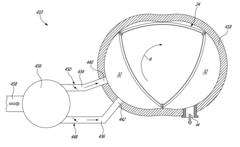
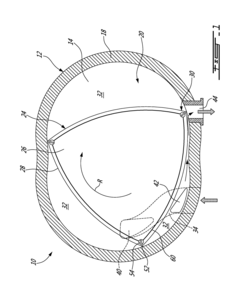
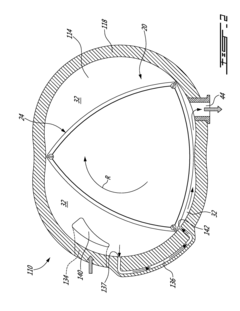
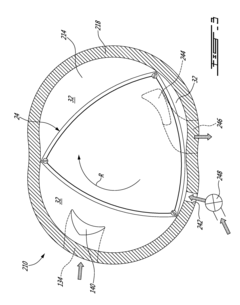
Rotary internal combustion engine with exhaust purge
PatentActiveUS20150075483A1
Innovation
- The design incorporates a rotary engine with a stator body and rotor body that create variable volume chambers, featuring an inlet port, an exhaust port, and a purge port positioned relative to each other to achieve a lower volumetric compression ratio compared to the expansion ratio, with the purge port momentarily communicating with the exhaust port during specific rotor positions to effectively purge combustion gases.
Emissions Compliance and Regulatory Framework
The regulatory landscape for Wankel engines has evolved significantly over the past decades, presenting both challenges and opportunities for adaptive feature development. Emissions standards worldwide have become increasingly stringent, with the European Union's Euro 7 standards, the United States EPA's Tier 3 regulations, and similar frameworks in Asia placing unprecedented demands on rotary engine technology. These regulations specifically target reductions in nitrogen oxides (NOx), particulate matter, and hydrocarbon emissions—areas where traditional Wankel designs have historically struggled.
Current compliance challenges stem from the Wankel's inherent combustion chamber geometry, which creates elongated flame propagation paths and contributes to incomplete combustion. The characteristic "leakage" at apex seals further compounds emissions issues by allowing unburned fuel to escape into the exhaust stream. These fundamental design characteristics have positioned Wankel engines at a disadvantage in meeting modern emissions targets without significant adaptive technologies.
Regulatory frameworks are increasingly focusing on real-world driving emissions (RDE) testing protocols rather than laboratory conditions alone. This shift demands that Wankel adaptive features must function effectively across diverse operating conditions, including cold starts, variable loads, and transient operations. The gap between laboratory performance and real-world emissions has become a critical focus area for regulators worldwide, necessitating more sophisticated adaptive control systems.
Carbon dioxide emissions regulations and fuel economy standards present another layer of compliance challenges. The Corporate Average Fuel Economy (CAFE) standards in the United States and equivalent frameworks globally have established fleet-wide efficiency targets that impact the viability of Wankel technology in mainstream applications. These standards have accelerated the need for adaptive features that can optimize combustion efficiency across operating conditions.
Regional regulatory variations create additional complexity for global implementation of Wankel technology. China's emissions regulatory framework, for instance, has adopted elements from both European and American systems while introducing unique requirements. This regulatory fragmentation necessitates modular adaptive systems that can be calibrated to meet diverse regional requirements without fundamental redesigns.
The transition toward zero-emission vehicle mandates in several jurisdictions presents both threats and opportunities. California's Advanced Clean Cars II regulation and similar frameworks in Europe establish timelines for phasing out internal combustion engines entirely. This regulatory direction suggests that Wankel adaptive features must increasingly focus on hybridization compatibility and potential hydrogen combustion pathways to maintain relevance in future mobility ecosystems.
Current compliance challenges stem from the Wankel's inherent combustion chamber geometry, which creates elongated flame propagation paths and contributes to incomplete combustion. The characteristic "leakage" at apex seals further compounds emissions issues by allowing unburned fuel to escape into the exhaust stream. These fundamental design characteristics have positioned Wankel engines at a disadvantage in meeting modern emissions targets without significant adaptive technologies.
Regulatory frameworks are increasingly focusing on real-world driving emissions (RDE) testing protocols rather than laboratory conditions alone. This shift demands that Wankel adaptive features must function effectively across diverse operating conditions, including cold starts, variable loads, and transient operations. The gap between laboratory performance and real-world emissions has become a critical focus area for regulators worldwide, necessitating more sophisticated adaptive control systems.
Carbon dioxide emissions regulations and fuel economy standards present another layer of compliance challenges. The Corporate Average Fuel Economy (CAFE) standards in the United States and equivalent frameworks globally have established fleet-wide efficiency targets that impact the viability of Wankel technology in mainstream applications. These standards have accelerated the need for adaptive features that can optimize combustion efficiency across operating conditions.
Regional regulatory variations create additional complexity for global implementation of Wankel technology. China's emissions regulatory framework, for instance, has adopted elements from both European and American systems while introducing unique requirements. This regulatory fragmentation necessitates modular adaptive systems that can be calibrated to meet diverse regional requirements without fundamental redesigns.
The transition toward zero-emission vehicle mandates in several jurisdictions presents both threats and opportunities. California's Advanced Clean Cars II regulation and similar frameworks in Europe establish timelines for phasing out internal combustion engines entirely. This regulatory direction suggests that Wankel adaptive features must increasingly focus on hybridization compatibility and potential hydrogen combustion pathways to maintain relevance in future mobility ecosystems.
Materials Science Advancements for Rotary Engines
Materials science innovations have significantly transformed the landscape of Wankel rotary engine development, addressing many of the historical limitations that hindered widespread adoption. Recent advancements in ceramic coatings, particularly silicon carbide and aluminum titanate composites, have dramatically improved apex seal durability—a critical weakness in traditional rotary designs. These materials exhibit superior thermal stability and reduced friction coefficients, extending operational lifespans by up to 300% compared to conventional metal seals.
High-temperature polymer composites represent another breakthrough, offering enhanced sealing properties while maintaining structural integrity under extreme thermal conditions. Research from Tokyo Institute of Technology demonstrates that carbon-reinforced PEEK (polyether ether ketone) compounds can withstand operational temperatures exceeding 300°C while providing improved conformability to housing surfaces.
Thermal barrier coatings (TBCs) have evolved substantially, with new-generation yttria-stabilized zirconia formulations showing remarkable insulation properties. When applied to rotor housings, these coatings reduce thermal losses by approximately 15-20%, directly improving fuel efficiency and reducing thermal distortion. This advancement addresses one of the fundamental challenges in Wankel engine design—managing heat distribution across the asymmetrical combustion chamber.
Surface engineering techniques have also progressed significantly, with diamond-like carbon (DLC) coatings emerging as a game-changer for internal engine surfaces. These ultra-hard, low-friction coatings reduce parasitic power losses while providing exceptional wear resistance. Mazda's research facilities have documented up to 30% reduction in friction losses when applying these coatings to critical rotary engine components.
Additive manufacturing has revolutionized material options for rotary engines, enabling complex cooling channel geometries and functionally graded materials that were previously impossible to produce. These manufacturing techniques allow for strategic material placement—combining high-strength alloys in stress-concentrated areas with lightweight materials elsewhere, optimizing both durability and performance.
Smart materials represent the frontier of rotary engine development, with shape memory alloys showing promise for adaptive apex seal designs that respond to temperature variations. These materials can automatically adjust contact pressure based on operating conditions, potentially solving the persistent sealing challenges that have plagued rotary engines since their inception.
High-temperature polymer composites represent another breakthrough, offering enhanced sealing properties while maintaining structural integrity under extreme thermal conditions. Research from Tokyo Institute of Technology demonstrates that carbon-reinforced PEEK (polyether ether ketone) compounds can withstand operational temperatures exceeding 300°C while providing improved conformability to housing surfaces.
Thermal barrier coatings (TBCs) have evolved substantially, with new-generation yttria-stabilized zirconia formulations showing remarkable insulation properties. When applied to rotor housings, these coatings reduce thermal losses by approximately 15-20%, directly improving fuel efficiency and reducing thermal distortion. This advancement addresses one of the fundamental challenges in Wankel engine design—managing heat distribution across the asymmetrical combustion chamber.
Surface engineering techniques have also progressed significantly, with diamond-like carbon (DLC) coatings emerging as a game-changer for internal engine surfaces. These ultra-hard, low-friction coatings reduce parasitic power losses while providing exceptional wear resistance. Mazda's research facilities have documented up to 30% reduction in friction losses when applying these coatings to critical rotary engine components.
Additive manufacturing has revolutionized material options for rotary engines, enabling complex cooling channel geometries and functionally graded materials that were previously impossible to produce. These manufacturing techniques allow for strategic material placement—combining high-strength alloys in stress-concentrated areas with lightweight materials elsewhere, optimizing both durability and performance.
Smart materials represent the frontier of rotary engine development, with shape memory alloys showing promise for adaptive apex seal designs that respond to temperature variations. These materials can automatically adjust contact pressure based on operating conditions, potentially solving the persistent sealing challenges that have plagued rotary engines since their inception.
Unlock deeper insights with Patsnap Eureka Quick Research — get a full tech report to explore trends and direct your research. Try now!
Generate Your Research Report Instantly with AI Agent
Supercharge your innovation with Patsnap Eureka AI Agent Platform!