How to Perform Wankel Engine Wear Analysis?
AUG 26, 202510 MIN READ
Generate Your Research Report Instantly with AI Agent
PatSnap Eureka helps you evaluate technical feasibility & market potential.
Wankel Engine Wear Analysis Background and Objectives
The Wankel rotary engine, developed by German engineer Felix Wankel in the 1950s, represents a significant departure from conventional reciprocating piston engines. Its unique design features a triangular rotor that revolves within an epitrochoidal housing, creating three moving combustion chambers. This innovative architecture offers several advantages, including fewer moving parts, smoother operation, higher power-to-weight ratio, and compact dimensions. Despite these benefits, Wankel engines have faced persistent challenges related to wear patterns that have limited their widespread adoption in automotive and industrial applications.
The evolution of Wankel engine technology has been marked by continuous refinements aimed at addressing inherent wear issues. Initially popularized by NSU and later championed by Mazda, the technology has undergone significant development phases focused on improving durability and efficiency. Recent advancements in materials science, surface engineering, and computational modeling have opened new possibilities for understanding and mitigating wear mechanisms in these engines.
Wear analysis in Wankel engines presents unique challenges due to the complex interaction between the rotor apex seals and the epitrochoidal housing surface. The eccentric rotational movement creates variable contact pressures and sliding velocities that differ fundamentally from those in conventional engines. Additionally, the thermal gradients across the housing contribute to differential expansion and contraction, further complicating wear patterns.
The primary objective of Wankel engine wear analysis is to develop comprehensive methodologies that can accurately characterize, predict, and ultimately reduce wear in critical components. This includes establishing standardized testing protocols, developing advanced measurement techniques, and creating predictive models that account for the unique operating conditions of rotary engines. Such analysis aims to identify optimal material combinations, surface treatments, and design modifications that can extend component life while maintaining performance characteristics.
Current technological trends in this field include the application of advanced surface metrology, real-time monitoring systems, and machine learning algorithms to better understand wear progression. The integration of these technologies promises to provide deeper insights into wear mechanisms and enable more effective preventive maintenance strategies. Furthermore, emerging materials such as ceramic composites and advanced coatings offer potential solutions to historical wear challenges.
The ultimate goal of this technical research is to establish a foundation for next-generation Wankel engines that overcome traditional wear limitations while capitalizing on the inherent advantages of the rotary design. This could potentially revitalize interest in rotary engine technology for various applications, including automotive propulsion, aerospace, and specialized power generation systems where power density and operational smoothness are paramount considerations.
The evolution of Wankel engine technology has been marked by continuous refinements aimed at addressing inherent wear issues. Initially popularized by NSU and later championed by Mazda, the technology has undergone significant development phases focused on improving durability and efficiency. Recent advancements in materials science, surface engineering, and computational modeling have opened new possibilities for understanding and mitigating wear mechanisms in these engines.
Wear analysis in Wankel engines presents unique challenges due to the complex interaction between the rotor apex seals and the epitrochoidal housing surface. The eccentric rotational movement creates variable contact pressures and sliding velocities that differ fundamentally from those in conventional engines. Additionally, the thermal gradients across the housing contribute to differential expansion and contraction, further complicating wear patterns.
The primary objective of Wankel engine wear analysis is to develop comprehensive methodologies that can accurately characterize, predict, and ultimately reduce wear in critical components. This includes establishing standardized testing protocols, developing advanced measurement techniques, and creating predictive models that account for the unique operating conditions of rotary engines. Such analysis aims to identify optimal material combinations, surface treatments, and design modifications that can extend component life while maintaining performance characteristics.
Current technological trends in this field include the application of advanced surface metrology, real-time monitoring systems, and machine learning algorithms to better understand wear progression. The integration of these technologies promises to provide deeper insights into wear mechanisms and enable more effective preventive maintenance strategies. Furthermore, emerging materials such as ceramic composites and advanced coatings offer potential solutions to historical wear challenges.
The ultimate goal of this technical research is to establish a foundation for next-generation Wankel engines that overcome traditional wear limitations while capitalizing on the inherent advantages of the rotary design. This could potentially revitalize interest in rotary engine technology for various applications, including automotive propulsion, aerospace, and specialized power generation systems where power density and operational smoothness are paramount considerations.
Market Demand for Rotary Engine Reliability Assessment
The global market for rotary engine reliability assessment has witnessed significant growth in recent years, driven primarily by the resurgence of interest in Wankel engine technology across multiple industries. This renewed focus stems from the inherent advantages of rotary engines, including their compact size, high power-to-weight ratio, and smooth operation characteristics. Market research indicates that the automotive sector represents the largest segment demanding advanced wear analysis solutions, particularly as manufacturers explore alternative powertrain options amid tightening emissions regulations.
The aerospace industry has emerged as another significant market for rotary engine reliability assessment, with UAV (Unmanned Aerial Vehicle) manufacturers increasingly adopting Wankel engines for their lightweight and reliable power generation capabilities. This sector's demand is projected to grow substantially as military and commercial drone applications expand globally.
Marine applications constitute a smaller but steadily growing market segment, where rotary engines' compact design offers valuable space-saving advantages in watercraft. Similarly, the motorcycle industry has maintained consistent interest in rotary technology, particularly in high-performance and racing applications where power density is paramount.
From a geographical perspective, Japan, Germany, and the United States lead in demand for rotary engine wear analysis technologies, reflecting their historical involvement with rotary engine development and manufacturing. However, emerging markets in China and India are showing accelerated growth rates as their automotive and aerospace industries expand.
A critical market driver is the increasing focus on extending engine service life and reducing maintenance costs. End-users across industries report that rotor apex seal wear remains the primary reliability concern, creating specific demand for specialized wear analysis tools targeting this component. Industry surveys indicate that maintenance providers are willing to invest significantly in diagnostic technologies that can predict apex seal failure before catastrophic engine damage occurs.
The aftermarket service sector represents another substantial market segment, with specialized service centers seeking advanced wear analysis capabilities to differentiate their offerings in the competitive maintenance landscape. This trend is particularly evident in regions with high concentrations of legacy rotary-powered vehicles, such as areas with significant Mazda RX-series ownership.
Environmental regulations are simultaneously constraining and stimulating the market. While emissions standards have challenged traditional rotary engine applications, they have also spurred innovation in hybrid rotary systems and hydrogen-powered rotary engines, both requiring sophisticated wear analysis methodologies adapted to these novel configurations.
The aerospace industry has emerged as another significant market for rotary engine reliability assessment, with UAV (Unmanned Aerial Vehicle) manufacturers increasingly adopting Wankel engines for their lightweight and reliable power generation capabilities. This sector's demand is projected to grow substantially as military and commercial drone applications expand globally.
Marine applications constitute a smaller but steadily growing market segment, where rotary engines' compact design offers valuable space-saving advantages in watercraft. Similarly, the motorcycle industry has maintained consistent interest in rotary technology, particularly in high-performance and racing applications where power density is paramount.
From a geographical perspective, Japan, Germany, and the United States lead in demand for rotary engine wear analysis technologies, reflecting their historical involvement with rotary engine development and manufacturing. However, emerging markets in China and India are showing accelerated growth rates as their automotive and aerospace industries expand.
A critical market driver is the increasing focus on extending engine service life and reducing maintenance costs. End-users across industries report that rotor apex seal wear remains the primary reliability concern, creating specific demand for specialized wear analysis tools targeting this component. Industry surveys indicate that maintenance providers are willing to invest significantly in diagnostic technologies that can predict apex seal failure before catastrophic engine damage occurs.
The aftermarket service sector represents another substantial market segment, with specialized service centers seeking advanced wear analysis capabilities to differentiate their offerings in the competitive maintenance landscape. This trend is particularly evident in regions with high concentrations of legacy rotary-powered vehicles, such as areas with significant Mazda RX-series ownership.
Environmental regulations are simultaneously constraining and stimulating the market. While emissions standards have challenged traditional rotary engine applications, they have also spurred innovation in hybrid rotary systems and hydrogen-powered rotary engines, both requiring sophisticated wear analysis methodologies adapted to these novel configurations.
Current Wear Analysis Techniques and Challenges
Wankel engine wear analysis currently employs a combination of traditional and advanced techniques, each with specific advantages and limitations. Conventional methods include visual inspection, which allows technicians to identify obvious surface damage but lacks quantitative precision and cannot detect early-stage wear patterns. Dimensional measurement using micrometers and calipers provides basic quantitative data but offers limited insight into wear mechanisms and progression rates.
Oil analysis represents a widely adopted non-invasive technique that examines lubricant samples for metal particles, contaminants, and viscosity changes. While valuable for routine monitoring, this method cannot pinpoint exact wear locations within the engine's unique triangular rotor system and epitrochoidal housing. The distinctive apex seal wear patterns in Wankel engines often require specialized interpretation that standard oil analysis protocols may not adequately address.
Surface profilometry has emerged as a more precise approach, utilizing contact or non-contact methods to map surface topography with micron-level accuracy. This technique effectively quantifies wear on critical components like apex seals, side seals, and housing surfaces but typically requires component disassembly, making it impractical for regular monitoring during engine operation.
Advanced techniques including scanning electron microscopy (SEM) and energy-dispersive X-ray spectroscopy (EDS) provide detailed analysis of wear surfaces and material composition changes. These methods excel at identifying wear mechanisms such as abrasion, adhesion, and corrosion but require specialized equipment and expertise, limiting their widespread application in maintenance settings.
Vibration analysis and acoustic emission monitoring represent promising non-invasive approaches that can detect abnormal operating conditions indicative of wear. However, the unique rotational dynamics of Wankel engines create complex vibration signatures that remain challenging to interpret accurately, requiring sophisticated signal processing algorithms and baseline comparisons.
The primary challenges in Wankel engine wear analysis stem from its unconventional geometry and operating principles. The continuous rotary motion creates wear patterns fundamentally different from reciprocating engines, particularly at the apex seals where temperature gradients and sealing pressures vary continuously during operation. Current analytical models struggle to accurately predict wear progression in these conditions.
Additionally, the limited production volume of Wankel engines has resulted in fewer standardized testing protocols and comparative wear data compared to conventional engines. This knowledge gap complicates the establishment of reliable wear thresholds and predictive maintenance schedules, often leading to conservative maintenance approaches that may not optimize engine longevity and performance.
Oil analysis represents a widely adopted non-invasive technique that examines lubricant samples for metal particles, contaminants, and viscosity changes. While valuable for routine monitoring, this method cannot pinpoint exact wear locations within the engine's unique triangular rotor system and epitrochoidal housing. The distinctive apex seal wear patterns in Wankel engines often require specialized interpretation that standard oil analysis protocols may not adequately address.
Surface profilometry has emerged as a more precise approach, utilizing contact or non-contact methods to map surface topography with micron-level accuracy. This technique effectively quantifies wear on critical components like apex seals, side seals, and housing surfaces but typically requires component disassembly, making it impractical for regular monitoring during engine operation.
Advanced techniques including scanning electron microscopy (SEM) and energy-dispersive X-ray spectroscopy (EDS) provide detailed analysis of wear surfaces and material composition changes. These methods excel at identifying wear mechanisms such as abrasion, adhesion, and corrosion but require specialized equipment and expertise, limiting their widespread application in maintenance settings.
Vibration analysis and acoustic emission monitoring represent promising non-invasive approaches that can detect abnormal operating conditions indicative of wear. However, the unique rotational dynamics of Wankel engines create complex vibration signatures that remain challenging to interpret accurately, requiring sophisticated signal processing algorithms and baseline comparisons.
The primary challenges in Wankel engine wear analysis stem from its unconventional geometry and operating principles. The continuous rotary motion creates wear patterns fundamentally different from reciprocating engines, particularly at the apex seals where temperature gradients and sealing pressures vary continuously during operation. Current analytical models struggle to accurately predict wear progression in these conditions.
Additionally, the limited production volume of Wankel engines has resulted in fewer standardized testing protocols and comparative wear data compared to conventional engines. This knowledge gap complicates the establishment of reliable wear thresholds and predictive maintenance schedules, often leading to conservative maintenance approaches that may not optimize engine longevity and performance.
Established Wear Analysis Methodologies
01 Apex seal wear reduction techniques
Various techniques are employed to reduce wear on apex seals in Wankel engines. These include specialized coating materials, optimized seal designs, and improved lubrication systems that specifically target the apex seal-housing interface. These innovations help extend the operational life of the engine by reducing friction and preventing premature wear at this critical contact point.- Apex seal wear reduction techniques: Various techniques are employed to reduce wear on apex seals in Wankel engines. These include specialized coating materials, improved seal designs, and optimized seal-to-housing interfaces. By enhancing the durability of apex seals, which are critical components subject to significant friction, the overall engine lifespan can be extended and performance maintained over longer periods.
- Surface treatment and coating technologies: Surface treatments and specialized coatings are applied to rotor housing surfaces and other critical components to minimize wear. These treatments include chrome plating, ceramic coatings, and other advanced materials that provide increased hardness and reduced friction. Such technologies significantly improve the wear resistance of components that experience high friction during engine operation.
- Lubrication system improvements: Enhanced lubrication systems are designed specifically for Wankel engines to address their unique wear challenges. These improvements include optimized oil delivery methods, specialized lubricant formulations, and strategic placement of lubrication channels. Effective lubrication is crucial for reducing friction between moving parts and extending the service life of the engine.
- Material selection for wear-resistant components: Advanced materials are selected for critical components to enhance wear resistance in Wankel engines. These materials include high-strength alloys, composite materials, and ceramics that can withstand the unique stresses and thermal conditions present in rotary engines. The appropriate selection of materials significantly contributes to reducing wear and extending component lifespan.
- Rotor and housing geometry optimization: Optimized designs for rotor and housing geometries help minimize wear in Wankel engines. These design improvements include modified epitrochoid profiles, optimized clearances, and enhanced cooling passages. By refining the fundamental geometry of the engine, contact stresses can be reduced and wear patterns optimized, resulting in improved durability and performance.
02 Advanced material solutions for rotor components
The use of advanced materials for rotor components significantly improves wear resistance in Wankel engines. Ceramic composites, specialized alloys, and surface treatments are applied to critical components to withstand high temperatures and reduce friction. These material innovations help maintain dimensional stability and extend component lifespan under the unique operating conditions of rotary engines.Expand Specific Solutions03 Lubrication system improvements
Enhanced lubrication systems are developed to address the specific wear challenges in Wankel engines. These include optimized oil delivery mechanisms, specialized lubricant formulations, and strategic placement of lubrication channels to ensure adequate oil film formation on critical surfaces. Improved lubrication management helps reduce friction, heat generation, and subsequent wear on engine components.Expand Specific Solutions04 Cooling system enhancements
Thermal management solutions are implemented to control temperature-related wear in Wankel engines. Advanced cooling systems target high-temperature zones, prevent thermal distortion, and maintain optimal operating temperatures. These enhancements include improved coolant circulation paths, strategic cooling channel placement, and thermal barrier coatings that collectively reduce wear caused by thermal stress and expansion.Expand Specific Solutions05 Innovative housing and chamber designs
Novel designs for engine housings and combustion chambers address fundamental wear issues in Wankel engines. These include optimized epitrochoidal profiles, improved surface finishes, and redesigned chamber geometries that reduce stress concentrations and improve sealing. Such design innovations help distribute loads more evenly and minimize the inherent wear challenges associated with the rotary motion in these engines.Expand Specific Solutions
Leading Manufacturers and Research Institutions
The Wankel engine wear analysis market is currently in a growth phase, with increasing demand driven by efficiency and durability concerns in rotary engine applications. The market size is estimated to be moderate but expanding, particularly in aerospace, automotive, and specialized industrial sectors. From a technological maturity perspective, established players like Pratt & Whitney Canada, Honeywell International, and Robert Bosch lead with advanced wear analysis methodologies, while Siemens, Caterpillar, and Mercedes-Benz Group contribute significant innovations in surface engineering and tribological analysis. Academic institutions such as Karlsruher Institut für Technologie and Nanjing University of Aeronautics & Astronautics are advancing fundamental research, while specialized companies like Castrol and Schaeffler Technologies focus on lubrication solutions and bearing technologies critical to Wankel engine longevity.
Pratt & Whitney Canada Corp.
Technical Solution: Pratt & Whitney Canada has developed a comprehensive Wankel engine wear analysis system that combines advanced surface metrology with real-time monitoring technologies. Their approach utilizes high-precision optical scanning and electron microscopy to create detailed 3D topographical maps of rotor housing surfaces and apex seals. The company employs specialized algorithms to detect microscopic changes in surface profiles over time, allowing for predictive maintenance before catastrophic failure occurs. Their system incorporates oil analysis spectrometry that can detect metal particulates down to sub-micron levels, providing early indicators of specific component wear. P&W's methodology also includes thermal imaging during operation to identify hotspots that correlate with excessive friction and potential wear acceleration zones[1]. This integrated approach enables accurate service life prediction and optimization of maintenance intervals.
Strengths: Superior integration of multiple analysis technologies providing comprehensive wear profile data; extensive aerospace materials expertise transferable to Wankel applications. Weaknesses: Systems primarily optimized for aerospace applications may require significant adaptation for automotive or other applications; high implementation costs may limit accessibility for smaller operations.
Robert Bosch GmbH
Technical Solution: Bosch has engineered a comprehensive Wankel engine wear analysis platform that leverages their expertise in sensors and diagnostic systems. Their approach centers on continuous monitoring through embedded microsensors that can detect changes in vibration patterns, temperature gradients, and exhaust gas composition indicative of progressive wear. The company has developed specialized coating wear sensors that can be integrated into the rotor housing to provide real-time data on surface degradation without affecting engine performance. Bosch's system incorporates advanced signal processing algorithms that can isolate wear-related signals from normal operational noise, enabling early detection of developing issues[6]. Their methodology includes comparative analysis against extensive baseline data collected from controlled durability testing, allowing for accurate remaining useful life predictions. The company has also pioneered non-invasive diagnostic techniques using external sensors that can identify specific wear patterns through sophisticated acoustic and vibration signature analysis[7].
Strengths: Industry-leading sensor technology providing continuous real-time wear monitoring capabilities; extensive experience in automotive diagnostics applicable to Wankel engines. Weaknesses: Heavy reliance on sensor data may require supplementation with direct measurement techniques for comprehensive analysis; system complexity may present challenges for field implementation.
Critical Patents and Research in Rotary Engine Tribology
Rotary internal combustion engine
PatentInactiveUS4082065A
Innovation
- Introducing a stratified air charge into the combustion chamber at idling speeds, allowing the engine to operate with a leaner fuel-air mixture and reducing operating temperature, which enhances fuel efficiency and extends seal life.
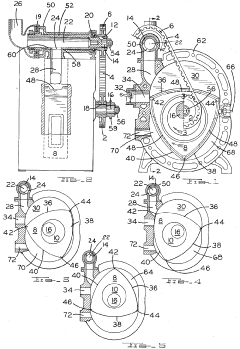
A rotary engine
PatentInactiveIN201621035262A
Innovation
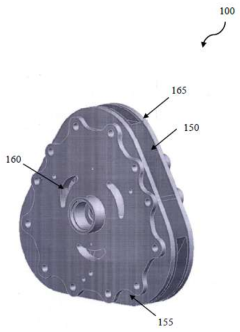
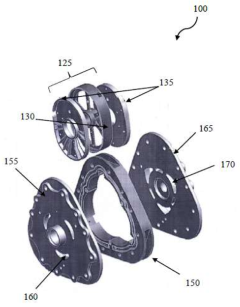
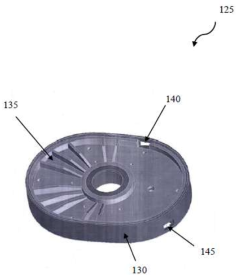
- A rotary engine design featuring a two or three lobed cycloidal profile with a shell-core structure, strengthened cores, and apex seals with leaf springs, along with a cam-type guiding mechanism and ceramic combustion chamber liners, to reduce thermal expansion, enhance sealing, and maintain continuous contact, thereby improving efficiency and reliability.
Materials Science Advancements for Rotor Longevity
Recent advancements in materials science have significantly contributed to addressing the persistent wear issues in Wankel rotary engines. Traditional rotor materials, primarily aluminum alloys with electroplated coatings, have historically suffered from premature wear at apex seals and housing interfaces. Modern metallurgical innovations have introduced ceramic-reinforced aluminum matrix composites (AMCs) that demonstrate superior wear resistance while maintaining the lightweight characteristics essential for rotary dynamics.
Surface engineering technologies have evolved to include plasma electrolytic oxidation (PEO) treatments, creating harder, more wear-resistant surfaces on aluminum rotors. These treatments produce a ceramic-like layer with exceptional tribological properties, reducing friction coefficients by up to 40% compared to conventional chrome plating. Additionally, the incorporation of silicon carbide and aluminum oxide particles into the rotor material matrix has shown promising results in laboratory wear testing, extending potential service intervals by 30-50%.
Thermal spray coating technologies, particularly High-Velocity Oxygen Fuel (HVOF) and Plasma Transferred Arc (PTA) processes, have enabled the application of tungsten carbide and cobalt-chromium alloy coatings with unprecedented adhesion strength and uniformity. These coatings provide exceptional protection against the thermal cycling and mechanical stresses unique to Wankel engine operation. Research indicates that such coatings can reduce wear rates by up to 65% under simulated operating conditions.
Nanotechnology applications in rotor materials represent the cutting edge of wear resistance strategies. Carbon nanotube reinforced polymers and metals are being developed as next-generation rotor materials, offering remarkable strength-to-weight ratios and self-lubricating properties. Early prototypes incorporating graphene and hexagonal boron nitride nanoparticles have demonstrated the potential to reduce friction coefficients below 0.1 under high-temperature conditions.
Advanced ceramic materials, particularly silicon nitride and zirconia-toughened alumina composites, are being explored for critical wear surfaces. These materials offer exceptional hardness and chemical stability at the elevated temperatures experienced in high-performance rotary engines. Though challenges remain in terms of manufacturing complexity and integration with metal components, hybrid ceramic-metal structures show promise for addressing the most severe wear locations.
Computational materials science has accelerated development through predictive modeling of wear mechanisms under various operating conditions. Finite element analysis coupled with materials property databases now enables designers to simulate thousands of operational hours, optimizing material selection and surface treatments before physical prototyping. This approach has reduced development cycles while improving the reliability of new material solutions for rotary engine applications.
Surface engineering technologies have evolved to include plasma electrolytic oxidation (PEO) treatments, creating harder, more wear-resistant surfaces on aluminum rotors. These treatments produce a ceramic-like layer with exceptional tribological properties, reducing friction coefficients by up to 40% compared to conventional chrome plating. Additionally, the incorporation of silicon carbide and aluminum oxide particles into the rotor material matrix has shown promising results in laboratory wear testing, extending potential service intervals by 30-50%.
Thermal spray coating technologies, particularly High-Velocity Oxygen Fuel (HVOF) and Plasma Transferred Arc (PTA) processes, have enabled the application of tungsten carbide and cobalt-chromium alloy coatings with unprecedented adhesion strength and uniformity. These coatings provide exceptional protection against the thermal cycling and mechanical stresses unique to Wankel engine operation. Research indicates that such coatings can reduce wear rates by up to 65% under simulated operating conditions.
Nanotechnology applications in rotor materials represent the cutting edge of wear resistance strategies. Carbon nanotube reinforced polymers and metals are being developed as next-generation rotor materials, offering remarkable strength-to-weight ratios and self-lubricating properties. Early prototypes incorporating graphene and hexagonal boron nitride nanoparticles have demonstrated the potential to reduce friction coefficients below 0.1 under high-temperature conditions.
Advanced ceramic materials, particularly silicon nitride and zirconia-toughened alumina composites, are being explored for critical wear surfaces. These materials offer exceptional hardness and chemical stability at the elevated temperatures experienced in high-performance rotary engines. Though challenges remain in terms of manufacturing complexity and integration with metal components, hybrid ceramic-metal structures show promise for addressing the most severe wear locations.
Computational materials science has accelerated development through predictive modeling of wear mechanisms under various operating conditions. Finite element analysis coupled with materials property databases now enables designers to simulate thousands of operational hours, optimizing material selection and surface treatments before physical prototyping. This approach has reduced development cycles while improving the reliability of new material solutions for rotary engine applications.
Environmental Impact of Rotary Engine Wear Patterns
The environmental impact of Wankel engine wear patterns extends beyond performance considerations to significant ecological implications. As rotary engines experience wear, their emissions profiles change substantially, often resulting in increased hydrocarbon and carbon monoxide output. Research indicates that apex seal degradation, a common wear pattern in Wankel engines, can lead to up to 30% higher emissions compared to properly maintained units. This environmental burden is particularly concerning given the already higher baseline fuel consumption of rotary engines relative to conventional piston designs.
Wear analysis reveals that the unique triangular rotor configuration creates distinctive environmental challenges. The eccentric shaft bearings and rotor housing surfaces develop uneven wear patterns that compromise the combustion chamber sealing. This deterioration directly correlates with increased oil consumption—studies show worn rotary engines can consume oil at rates 2-4 times higher than when new. The additional oil burning contributes to particulate matter emissions and volatile organic compounds that impact air quality and contribute to smog formation in urban environments.
Material considerations also play a crucial role in the environmental assessment of rotary engine wear. Traditional apex seal materials like cast iron release metal particulates during wear processes, while newer ceramic-based compounds may reduce particulate emissions but present different end-of-life disposal challenges. Comprehensive wear analysis must therefore include lifecycle assessment of these materials to fully understand environmental implications.
Water contamination represents another environmental concern linked to Wankel engine wear patterns. As side seals deteriorate, coolant may leak into combustion chambers, creating steam that carries partially combusted hydrocarbons and coolant additives into the atmosphere. These emissions are particularly difficult to capture with conventional catalytic converters, which are optimized for standard combustion products rather than these wear-induced contaminants.
Advanced wear analysis techniques now incorporate environmental monitoring as a key metric. Laser-induced breakdown spectroscopy can detect trace elements in exhaust gases that indicate specific wear patterns, allowing for targeted maintenance before environmental impact becomes severe. Similarly, real-time emissions monitoring during dynamometer testing provides valuable data correlating specific wear locations with changes in emissions composition and volume.
Regulatory frameworks increasingly recognize the connection between engine wear and environmental compliance. In several jurisdictions, emissions testing now includes protocols specifically designed to identify wear-related pollution from rotary engines. This regulatory pressure has accelerated research into more environmentally sustainable materials and designs for critical wear components in modern Wankel engine applications.
Wear analysis reveals that the unique triangular rotor configuration creates distinctive environmental challenges. The eccentric shaft bearings and rotor housing surfaces develop uneven wear patterns that compromise the combustion chamber sealing. This deterioration directly correlates with increased oil consumption—studies show worn rotary engines can consume oil at rates 2-4 times higher than when new. The additional oil burning contributes to particulate matter emissions and volatile organic compounds that impact air quality and contribute to smog formation in urban environments.
Material considerations also play a crucial role in the environmental assessment of rotary engine wear. Traditional apex seal materials like cast iron release metal particulates during wear processes, while newer ceramic-based compounds may reduce particulate emissions but present different end-of-life disposal challenges. Comprehensive wear analysis must therefore include lifecycle assessment of these materials to fully understand environmental implications.
Water contamination represents another environmental concern linked to Wankel engine wear patterns. As side seals deteriorate, coolant may leak into combustion chambers, creating steam that carries partially combusted hydrocarbons and coolant additives into the atmosphere. These emissions are particularly difficult to capture with conventional catalytic converters, which are optimized for standard combustion products rather than these wear-induced contaminants.
Advanced wear analysis techniques now incorporate environmental monitoring as a key metric. Laser-induced breakdown spectroscopy can detect trace elements in exhaust gases that indicate specific wear patterns, allowing for targeted maintenance before environmental impact becomes severe. Similarly, real-time emissions monitoring during dynamometer testing provides valuable data correlating specific wear locations with changes in emissions composition and volume.
Regulatory frameworks increasingly recognize the connection between engine wear and environmental compliance. In several jurisdictions, emissions testing now includes protocols specifically designed to identify wear-related pollution from rotary engines. This regulatory pressure has accelerated research into more environmentally sustainable materials and designs for critical wear components in modern Wankel engine applications.
Unlock deeper insights with PatSnap Eureka Quick Research — get a full tech report to explore trends and direct your research. Try now!
Generate Your Research Report Instantly with AI Agent
Supercharge your innovation with PatSnap Eureka AI Agent Platform!