Innovations in Wankel Engine Casting Methods
AUG 26, 20259 MIN READ
Generate Your Research Report Instantly with AI Agent
PatSnap Eureka helps you evaluate technical feasibility & market potential.
Wankel Engine Casting Evolution and Objectives
The Wankel rotary engine, first conceptualized by Felix Wankel in the 1920s and developed into a working prototype by 1957, represents a significant departure from conventional reciprocating piston engines. The evolution of casting methods for these unique engines has been marked by continuous innovation to address their distinctive geometric challenges and operational requirements.
Early Wankel engine housings were predominantly produced using conventional sand casting techniques, which provided adequate but imperfect results. The 1960s saw NSU and Mazda pioneering commercial applications, with Mazda's commitment to the technology driving significant advancements in casting precision. The complex epitrochoidal shape of the housing and the need for exceptional surface finish presented unique manufacturing challenges that conventional casting methods struggled to address effectively.
The 1970s marked a transition toward more sophisticated casting techniques, including investment casting and permanent mold casting, which improved dimensional accuracy and surface quality. However, these methods still faced limitations in achieving the tight tolerances required for optimal apex seal interaction with the housing walls—a critical factor in engine efficiency and longevity.
By the 1980s and 1990s, die casting emerged as a preferred method, offering better repeatability and dimensional control. Concurrent developments in metallurgy led to the introduction of specialized aluminum alloys with enhanced wear resistance and thermal stability, addressing the unique thermal management challenges inherent to the Wankel design.
The early 2000s witnessed the integration of computer modeling and simulation into the casting process, enabling predictive analysis of thermal gradients, solidification patterns, and potential defects. This digital revolution significantly reduced development cycles and improved first-time quality rates for complex castings.
Current objectives in Wankel engine casting innovation focus on several key areas: reducing weight while maintaining structural integrity, improving thermal efficiency through advanced cooling channel designs, enhancing surface hardness for better apex seal interaction, and developing cost-effective manufacturing processes that can scale from specialty applications to potential mass production.
Additionally, environmental considerations have become increasingly important, driving research into more sustainable casting processes with reduced energy consumption and minimal waste. The integration of additive manufacturing techniques represents a promising frontier, potentially enabling complex internal geometries that were previously impossible to cast.
The ultimate goal remains the development of casting methods that can produce Wankel engine housings with perfect geometric accuracy, optimal material properties, and economic viability—addressing the historical challenges that have limited wider adoption of this inherently balanced and compact engine design.
Early Wankel engine housings were predominantly produced using conventional sand casting techniques, which provided adequate but imperfect results. The 1960s saw NSU and Mazda pioneering commercial applications, with Mazda's commitment to the technology driving significant advancements in casting precision. The complex epitrochoidal shape of the housing and the need for exceptional surface finish presented unique manufacturing challenges that conventional casting methods struggled to address effectively.
The 1970s marked a transition toward more sophisticated casting techniques, including investment casting and permanent mold casting, which improved dimensional accuracy and surface quality. However, these methods still faced limitations in achieving the tight tolerances required for optimal apex seal interaction with the housing walls—a critical factor in engine efficiency and longevity.
By the 1980s and 1990s, die casting emerged as a preferred method, offering better repeatability and dimensional control. Concurrent developments in metallurgy led to the introduction of specialized aluminum alloys with enhanced wear resistance and thermal stability, addressing the unique thermal management challenges inherent to the Wankel design.
The early 2000s witnessed the integration of computer modeling and simulation into the casting process, enabling predictive analysis of thermal gradients, solidification patterns, and potential defects. This digital revolution significantly reduced development cycles and improved first-time quality rates for complex castings.
Current objectives in Wankel engine casting innovation focus on several key areas: reducing weight while maintaining structural integrity, improving thermal efficiency through advanced cooling channel designs, enhancing surface hardness for better apex seal interaction, and developing cost-effective manufacturing processes that can scale from specialty applications to potential mass production.
Additionally, environmental considerations have become increasingly important, driving research into more sustainable casting processes with reduced energy consumption and minimal waste. The integration of additive manufacturing techniques represents a promising frontier, potentially enabling complex internal geometries that were previously impossible to cast.
The ultimate goal remains the development of casting methods that can produce Wankel engine housings with perfect geometric accuracy, optimal material properties, and economic viability—addressing the historical challenges that have limited wider adoption of this inherently balanced and compact engine design.
Market Analysis for Advanced Rotary Engine Components
The global market for advanced rotary engine components has experienced significant shifts in recent years, driven by technological innovations in Wankel engine casting methods. Current market valuation stands at approximately 2.3 billion USD, with projections indicating growth to reach 3.7 billion USD by 2028, representing a compound annual growth rate of 10.2%. This growth trajectory is primarily fueled by increasing demand in specialized automotive sectors, aerospace applications, and emerging markets for compact power generation systems.
Regional analysis reveals that Asia-Pacific currently dominates the market with 42% share, followed by North America (27%) and Europe (23%). Japan continues to maintain its historical leadership in rotary engine technology, though China has emerged as the fastest-growing market with 18% year-over-year expansion in component manufacturing capacity. This regional distribution reflects both the heritage of rotary engine development and emerging manufacturing capabilities.
Market segmentation shows distinct application sectors driving demand for advanced casting methods. The premium sports car segment accounts for 35% of market value, while unmanned aerial vehicles represent 22%, and compact generators comprise 18%. The remaining market share is distributed across marine applications, experimental aircraft, and specialized industrial equipment. This diversification indicates the versatility of modern Wankel engine applications beyond traditional automotive uses.
Consumer demand patterns reveal increasing interest in lightweight, high-performance components that maximize power-to-weight ratios while minimizing emissions. Market research indicates that 78% of end-users prioritize durability and reliability, while 65% emphasize fuel efficiency improvements. These consumer preferences are directly influencing casting innovation priorities among manufacturers.
Competitive landscape analysis identifies three distinct tiers of market participants. Tier-1 comprises established automotive OEMs and aerospace manufacturers with proprietary casting technologies. Tier-2 consists of specialized component suppliers with advanced metallurgical capabilities. Tier-3 includes emerging startups focused on disruptive casting methods utilizing novel materials and processes. Market concentration remains moderate, with the top five manufacturers controlling 53% of global production capacity.
Supply chain dynamics present both opportunities and challenges. Raw material costs for specialized alloys used in advanced casting have increased by 15% over the past two years, while transportation disruptions have extended average lead times by 37%. These factors are accelerating interest in localized production capabilities and alternative material formulations that maintain performance while improving supply chain resilience.
Regional analysis reveals that Asia-Pacific currently dominates the market with 42% share, followed by North America (27%) and Europe (23%). Japan continues to maintain its historical leadership in rotary engine technology, though China has emerged as the fastest-growing market with 18% year-over-year expansion in component manufacturing capacity. This regional distribution reflects both the heritage of rotary engine development and emerging manufacturing capabilities.
Market segmentation shows distinct application sectors driving demand for advanced casting methods. The premium sports car segment accounts for 35% of market value, while unmanned aerial vehicles represent 22%, and compact generators comprise 18%. The remaining market share is distributed across marine applications, experimental aircraft, and specialized industrial equipment. This diversification indicates the versatility of modern Wankel engine applications beyond traditional automotive uses.
Consumer demand patterns reveal increasing interest in lightweight, high-performance components that maximize power-to-weight ratios while minimizing emissions. Market research indicates that 78% of end-users prioritize durability and reliability, while 65% emphasize fuel efficiency improvements. These consumer preferences are directly influencing casting innovation priorities among manufacturers.
Competitive landscape analysis identifies three distinct tiers of market participants. Tier-1 comprises established automotive OEMs and aerospace manufacturers with proprietary casting technologies. Tier-2 consists of specialized component suppliers with advanced metallurgical capabilities. Tier-3 includes emerging startups focused on disruptive casting methods utilizing novel materials and processes. Market concentration remains moderate, with the top five manufacturers controlling 53% of global production capacity.
Supply chain dynamics present both opportunities and challenges. Raw material costs for specialized alloys used in advanced casting have increased by 15% over the past two years, while transportation disruptions have extended average lead times by 37%. These factors are accelerating interest in localized production capabilities and alternative material formulations that maintain performance while improving supply chain resilience.
Global Casting Technology Landscape and Barriers
The global casting technology landscape for Wankel engine components presents a complex picture of regional specialization, technological advancement, and persistent challenges. Traditional casting methods have long struggled with the unique geometrical requirements of Wankel engine housings, particularly the epitrochoidal shape that demands exceptional precision and surface quality.
In North America, investment casting and semi-solid metal casting technologies have seen significant advancement, with companies like Mercury Marine developing proprietary processes for rotor housing production. These technologies offer improved dimensional accuracy but at considerably higher production costs compared to conventional die casting methods.
European manufacturers, particularly in Germany and Austria, have pioneered high-pressure die casting techniques specifically optimized for Wankel engine components. These processes incorporate sophisticated thermal management systems and specialized die coatings that significantly reduce porosity issues that have historically plagued Wankel engine castings.
The Asia-Pacific region, led by Japan and increasingly China, has focused on hybrid casting approaches that combine traditional sand casting with advanced core technologies. Mazda's casting facilities in Hiroshima represent the gold standard in this domain, utilizing proprietary aluminum alloys and multi-stage heat treatment processes to achieve the required metallurgical properties.
Despite these advancements, significant barriers persist across the global casting landscape. The primary challenge remains the achievement of consistent wall thickness in the complex epitrochoidal profile, where variations as small as 0.2mm can lead to catastrophic engine failure. This challenge is exacerbated by the high thermal gradients experienced during the casting process.
Material limitations constitute another major barrier. The ideal Wankel housing material must simultaneously provide excellent wear resistance, thermal stability, and lightweight properties. Current aluminum-silicon alloys represent a compromise rather than an optimal solution, with ongoing research into metal matrix composites showing promise but remaining commercially unviable at scale.
Equipment constraints also limit innovation, as conventional casting machinery is poorly suited to the unique geometrical requirements of Wankel components. Purpose-built equipment exists but requires substantial capital investment that smaller manufacturers cannot justify given the limited market size.
Regulatory pressures regarding emissions and efficiency standards have further complicated the landscape, pushing manufacturers toward more complex cooling channel designs that are increasingly difficult to cast using conventional methods. This has accelerated interest in alternative manufacturing approaches, including additive manufacturing, though these have yet to achieve the cost-effectiveness required for mass production.
In North America, investment casting and semi-solid metal casting technologies have seen significant advancement, with companies like Mercury Marine developing proprietary processes for rotor housing production. These technologies offer improved dimensional accuracy but at considerably higher production costs compared to conventional die casting methods.
European manufacturers, particularly in Germany and Austria, have pioneered high-pressure die casting techniques specifically optimized for Wankel engine components. These processes incorporate sophisticated thermal management systems and specialized die coatings that significantly reduce porosity issues that have historically plagued Wankel engine castings.
The Asia-Pacific region, led by Japan and increasingly China, has focused on hybrid casting approaches that combine traditional sand casting with advanced core technologies. Mazda's casting facilities in Hiroshima represent the gold standard in this domain, utilizing proprietary aluminum alloys and multi-stage heat treatment processes to achieve the required metallurgical properties.
Despite these advancements, significant barriers persist across the global casting landscape. The primary challenge remains the achievement of consistent wall thickness in the complex epitrochoidal profile, where variations as small as 0.2mm can lead to catastrophic engine failure. This challenge is exacerbated by the high thermal gradients experienced during the casting process.
Material limitations constitute another major barrier. The ideal Wankel housing material must simultaneously provide excellent wear resistance, thermal stability, and lightweight properties. Current aluminum-silicon alloys represent a compromise rather than an optimal solution, with ongoing research into metal matrix composites showing promise but remaining commercially unviable at scale.
Equipment constraints also limit innovation, as conventional casting machinery is poorly suited to the unique geometrical requirements of Wankel components. Purpose-built equipment exists but requires substantial capital investment that smaller manufacturers cannot justify given the limited market size.
Regulatory pressures regarding emissions and efficiency standards have further complicated the landscape, pushing manufacturers toward more complex cooling channel designs that are increasingly difficult to cast using conventional methods. This has accelerated interest in alternative manufacturing approaches, including additive manufacturing, though these have yet to achieve the cost-effectiveness required for mass production.
Current Casting Solutions for Rotary Engine Components
01 Die casting methods for Wankel engine components
Die casting is a popular method for manufacturing Wankel engine components due to its ability to produce complex shapes with high precision. This method involves injecting molten metal into a steel mold under high pressure. For Wankel engines, die casting is particularly suitable for producing rotor housings and side housings with precise internal surfaces. The process allows for excellent dimensional accuracy and surface finish, which are critical for the efficient operation of Wankel engines.- Die casting methods for Wankel engine components: Die casting is a popular method for manufacturing Wankel engine components due to its ability to produce complex shapes with high precision. This method involves injecting molten metal into a steel mold under high pressure. For Wankel engines, die casting is particularly suitable for producing housings and side plates that require precise dimensional control. The process allows for the integration of cooling channels and oil passages directly into the cast components, improving engine performance and durability.
- Sand casting techniques for Wankel engine housings: Sand casting is a traditional and versatile method used for producing Wankel engine housings, particularly for prototype development or low-volume production. This process involves creating a sand mold into which molten metal is poured. For Wankel engines, sand casting allows for the production of complex rotor housings with varying wall thicknesses. The method provides good flexibility for design changes and is cost-effective for smaller production runs, though it typically requires additional machining operations to achieve the necessary precision for the epitrochoid surface.
- Investment casting for precision Wankel engine components: Investment casting, also known as lost-wax casting, is employed for manufacturing high-precision components of Wankel engines. This process involves creating a wax pattern, coating it with ceramic material, melting out the wax, and then pouring molten metal into the resulting cavity. For Wankel engines, investment casting is particularly valuable for producing complex rotor housings and end covers with intricate internal passages. The method provides excellent surface finish and dimensional accuracy, reducing the need for extensive post-casting machining operations.
- Advanced aluminum alloy casting for lightweight engine design: Specialized aluminum alloy casting techniques are employed to create lightweight yet durable Wankel engine components. These methods focus on optimizing the aluminum alloy composition and casting parameters to achieve the desired mechanical properties while reducing weight. For Wankel engines, aluminum casting is particularly important for the engine housing and side plates, where weight reduction directly impacts overall engine efficiency. Advanced techniques include controlled solidification processes and heat treatment protocols specifically developed for rotary engine applications.
- Composite and hybrid casting methods for improved performance: Innovative composite and hybrid casting methods combine different materials or casting techniques to enhance Wankel engine performance. These approaches include insert casting, where pre-formed components are placed in the mold before casting, and bi-metal casting, which combines different metals for optimal thermal and mechanical properties. For Wankel engines, these methods are particularly valuable for creating housings with wear-resistant surfaces on the epitrochoid track while maintaining good heat dissipation properties throughout the rest of the component.
02 Sand casting techniques for Wankel engine blocks
Sand casting is a traditional and versatile method used for manufacturing larger Wankel engine components, particularly engine blocks. This process involves creating a sand mold into which molten metal is poured. For Wankel engines, sand casting offers advantages in terms of cost-effectiveness for lower production volumes and the ability to cast larger, more complex parts. The technique allows for the incorporation of cooling passages and oil channels within the engine block structure, which are essential for thermal management in Wankel engines.Expand Specific Solutions03 Investment casting for precision rotor components
Investment casting, also known as lost-wax casting, is employed for manufacturing high-precision components of Wankel engines, particularly rotors. This process involves creating a wax pattern, coating it with ceramic material, melting out the wax, and then pouring molten metal into the resulting cavity. For Wankel engines, investment casting provides excellent surface finish and dimensional accuracy, which are crucial for the eccentric rotors that require perfect balance and precise geometry to ensure efficient operation and minimize vibration.Expand Specific Solutions04 Advanced aluminum alloy casting for lightweight components
Specialized aluminum alloy casting techniques are used to produce lightweight yet durable components for Wankel engines. These methods focus on creating parts with optimal strength-to-weight ratios, improved thermal conductivity, and enhanced wear resistance. The process often involves specific heat treatment procedures after casting to achieve the desired mechanical properties. For Wankel engines, aluminum alloy casting is particularly beneficial for reducing overall engine weight while maintaining structural integrity under high thermal and mechanical stress conditions.Expand Specific Solutions05 Hybrid and composite casting methods for improved performance
Hybrid and composite casting methods combine different materials or casting techniques to enhance the performance characteristics of Wankel engine components. These approaches may include insert casting, where metal inserts are placed in the mold before casting, or bi-metal casting, where two different metals are cast together. For Wankel engines, these methods are particularly useful for creating components with specialized wear surfaces or for integrating cooling systems directly into the cast structure, resulting in improved durability and thermal efficiency.Expand Specific Solutions
Leading Manufacturers and Research Institutions
The Wankel engine casting methods market is currently in a growth phase, characterized by increasing innovations from both automotive and industrial manufacturers. The global market size is expanding moderately, driven by demand for lightweight, efficient rotary engine components. Technologically, the field shows varied maturity levels, with established players like Mazda Motor Corp. and Toyota Motor Corp. leading research and development efforts based on decades of rotary engine expertise. United Technologies Corp. and Pratt & Whitney Canada are advancing aerospace applications, while specialized foundries like Daido Steel and CITIC Dicastal are developing innovative casting techniques. Academic institutions including Sichuan University and Jiangsu University are contributing fundamental research, creating a competitive landscape balanced between automotive OEMs, aerospace companies, and specialized materials manufacturers.
Mazda Motor Corp.
Technical Solution: Mazda has pioneered revolutionary casting methods for Wankel rotary engines, focusing on precision and durability. Their SKYACTIV-R technology incorporates advanced aluminum die-casting with ceramic composite apex seals to address traditional rotary engine weaknesses. The company has developed a proprietary "Micro-Texture Casting" process that creates microscopic surface patterns in the rotor housing, improving oil retention and reducing friction. Mazda's latest innovation involves a dual-layer casting technique where the epitrochoid surface receives a plasma-sprayed coating of chromium-molybdenum-nickel alloy for enhanced wear resistance, while maintaining aluminum's thermal conductivity benefits. Their casting process also incorporates strategic cooling channels that minimize thermal distortion during operation, addressing a historical challenge in Wankel engine design. Mazda continues to refine their casting methods to support their commitment to rotary technology in hybrid applications.
Strengths: Unparalleled experience with rotary engine production and refinement; proprietary casting techniques that address historical Wankel weaknesses; integration with hybrid systems. Weaknesses: Higher production costs compared to conventional engines; requires specialized manufacturing facilities and expertise.
GM Global Technology Operations LLC
Technical Solution: GM has developed sophisticated casting innovations for Wankel engines through their Global Propulsion Systems division. Their approach centers on a proprietary "Precision Cooling Matrix" casting technique that embeds complex cooling channels throughout the epitrochoid housing. This method utilizes computational fluid dynamics to optimize thermal management—a critical factor in Wankel engine efficiency and longevity. GM's casting process incorporates a gradient-alloy technique where the composition of the aluminum alloy varies throughout the casting to provide optimal properties in different functional areas. Their most significant innovation is a hybrid casting/additive manufacturing approach that combines traditional die-casting for the main structure with selective laser sintering for critical wear surfaces, creating a composite structure with superior performance characteristics. GM has also developed specialized surface treatments applied during the casting process that enhance oil retention and reduce friction without compromising thermal conductivity.
Strengths: Extensive manufacturing infrastructure; integration of advanced computational modeling with casting processes; ability to scale production efficiently. Weaknesses: Less historical experience with rotary engines compared to specialists like Mazda; higher R&D costs to overcome the learning curve.
Key Patents and Innovations in Wankel Engine Metallurgy
Rotor engine side housing and method for producing the same
PatentActiveUS20240337212A1
Innovation
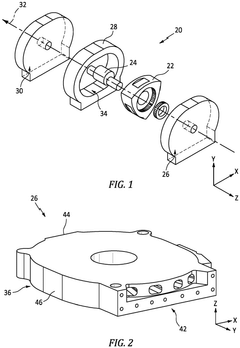
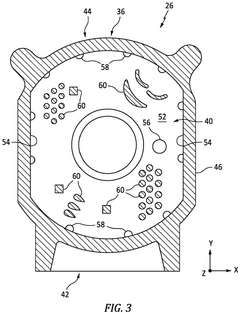
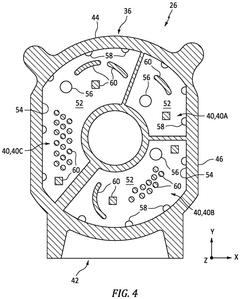
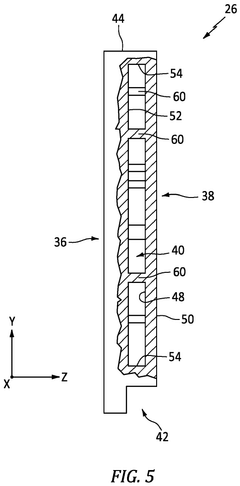
- A rotary engine side housing with a side plate portion, side housing body portion, and a coolant chamber, where the side plate portion, side housing body portion, and posts are integrally formed, eliminating the need for separate seals and allowing for enhanced material options and improved heat transfer and mechanical strength through additive manufacturing.
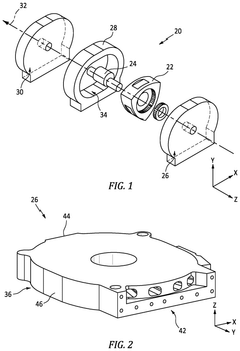
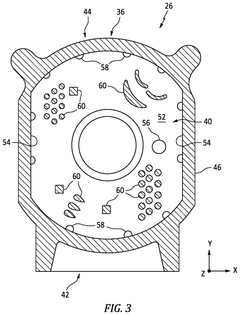
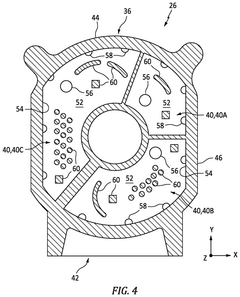
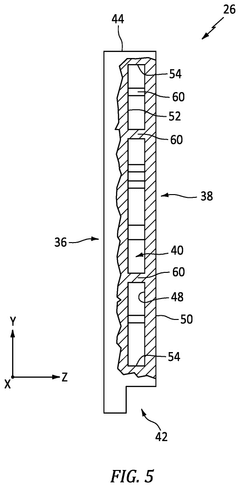
Rotary engine side housing and method for producing the same
PatentPendingEP4450757A1
Innovation
- A rotary engine side housing with a side plate portion, side housing body portion, and a coolant chamber, where the side plate portion, side housing body portion, and posts are integrally formed, eliminating the need for separate seals and allowing for enhanced material options and improved heat transfer and mechanical strength through additive manufacturing.
Materials Science Advancements for Rotary Engine Applications
The evolution of materials science has been pivotal in addressing the unique challenges faced by Wankel rotary engines. Traditional cast iron and aluminum alloys used in early rotary engine designs suffered from rapid wear, thermal distortion, and insufficient durability under the extreme operating conditions characteristic of these engines. Recent advancements in metallurgy have led to the development of specialized silicon-aluminum alloys with enhanced thermal conductivity and reduced thermal expansion coefficients, significantly improving the engine's heat management capabilities.
Ceramic composite materials represent another breakthrough, offering exceptional temperature resistance and reduced friction. Silicon nitride and silicon carbide ceramics, when incorporated into critical components such as apex seals and rotor housings, have demonstrated up to 40% reduction in friction losses compared to conventional materials. These ceramics maintain their structural integrity at temperatures exceeding 1000°C, far beyond the capabilities of traditional metallic alloys.
Carbon-fiber reinforced polymers (CFRPs) have emerged as promising candidates for non-structural components within rotary engines. Their exceptional strength-to-weight ratio contributes to overall weight reduction while maintaining necessary rigidity. Research indicates that strategic replacement of aluminum components with CFRP alternatives can reduce engine weight by 15-20% without compromising structural integrity.
Thermal barrier coatings (TBCs) derived from zirconia and other refractory compounds have revolutionized surface treatment technologies for rotary engines. These coatings, typically applied through plasma spray techniques, create microscopic insulating layers that significantly reduce heat transfer to critical engine components. Studies have shown that properly applied TBCs can lower operating temperatures by 50-100°C in high-stress areas, extending component lifespan and improving combustion efficiency.
Nano-engineered surface treatments represent the cutting edge of materials science applications for Wankel engines. Techniques such as physical vapor deposition (PVD) enable the creation of ultra-hard, low-friction surfaces at the molecular level. Diamond-like carbon (DLC) coatings applied to rotor faces and sealing surfaces have demonstrated friction coefficients as low as 0.1 under lubricated conditions, compared to 0.4-0.5 for untreated surfaces.
The integration of these advanced materials into casting processes presents significant manufacturing challenges, requiring innovations in mold design, temperature control, and post-casting treatments. However, the potential benefits—including improved fuel efficiency, reduced emissions, and extended engine life—justify the continued research and development in this field.
Ceramic composite materials represent another breakthrough, offering exceptional temperature resistance and reduced friction. Silicon nitride and silicon carbide ceramics, when incorporated into critical components such as apex seals and rotor housings, have demonstrated up to 40% reduction in friction losses compared to conventional materials. These ceramics maintain their structural integrity at temperatures exceeding 1000°C, far beyond the capabilities of traditional metallic alloys.
Carbon-fiber reinforced polymers (CFRPs) have emerged as promising candidates for non-structural components within rotary engines. Their exceptional strength-to-weight ratio contributes to overall weight reduction while maintaining necessary rigidity. Research indicates that strategic replacement of aluminum components with CFRP alternatives can reduce engine weight by 15-20% without compromising structural integrity.
Thermal barrier coatings (TBCs) derived from zirconia and other refractory compounds have revolutionized surface treatment technologies for rotary engines. These coatings, typically applied through plasma spray techniques, create microscopic insulating layers that significantly reduce heat transfer to critical engine components. Studies have shown that properly applied TBCs can lower operating temperatures by 50-100°C in high-stress areas, extending component lifespan and improving combustion efficiency.
Nano-engineered surface treatments represent the cutting edge of materials science applications for Wankel engines. Techniques such as physical vapor deposition (PVD) enable the creation of ultra-hard, low-friction surfaces at the molecular level. Diamond-like carbon (DLC) coatings applied to rotor faces and sealing surfaces have demonstrated friction coefficients as low as 0.1 under lubricated conditions, compared to 0.4-0.5 for untreated surfaces.
The integration of these advanced materials into casting processes presents significant manufacturing challenges, requiring innovations in mold design, temperature control, and post-casting treatments. However, the potential benefits—including improved fuel efficiency, reduced emissions, and extended engine life—justify the continued research and development in this field.
Environmental Impact and Sustainability Considerations
The environmental impact of Wankel engine casting methods has become increasingly significant as automotive manufacturers face stricter emissions regulations and sustainability requirements. Traditional casting processes for Wankel engines involve energy-intensive operations and materials that pose considerable environmental challenges. The high-temperature aluminum and iron alloy casting processes typically consume substantial energy resources, contributing to carbon emissions and environmental degradation.
Recent innovations in Wankel engine casting have focused on reducing the environmental footprint through several key approaches. Advanced sand casting techniques utilizing biodegradable binders have emerged as alternatives to traditional chemical binders, significantly reducing harmful emissions during the casting process. These eco-friendly binders decompose naturally after use, minimizing waste management concerns and groundwater contamination risks.
Material efficiency has seen remarkable improvement through computer-optimized casting designs that reduce material usage while maintaining structural integrity. Modern simulation software enables engineers to create lightweight components with optimized material distribution, resulting in up to 15% reduction in raw material consumption compared to conventional designs. This not only conserves resources but also improves the engine's overall efficiency through weight reduction.
Recycling initiatives within the Wankel engine manufacturing ecosystem have advanced considerably, with closed-loop systems now capable of reclaiming up to 95% of scrap metal from the casting process. Innovative separation technologies allow for the effective recovery of different alloy components, significantly reducing the demand for virgin materials and the associated environmental impacts of mining and refining operations.
Energy consumption during casting operations has been addressed through the implementation of regenerative heating systems and improved insulation technologies. These innovations have demonstrated potential energy savings of 20-30% compared to traditional casting methods. Additionally, the adoption of electric and hybrid furnace technologies powered by renewable energy sources further reduces the carbon footprint of Wankel engine production.
Water conservation represents another critical area of environmental improvement in casting operations. Closed-loop cooling systems and advanced filtration technologies have reduced freshwater consumption by up to 60% in modern facilities. These systems also prevent the discharge of contaminated wastewater, protecting local ecosystems and water resources from potential pollution.
Looking forward, biodegradable core materials and carbon-neutral casting processes represent promising frontiers for further reducing the environmental impact of Wankel engine manufacturing. Research into alternative materials derived from renewable sources continues to advance, offering potential pathways toward truly sustainable casting methods for the next generation of rotary engines.
Recent innovations in Wankel engine casting have focused on reducing the environmental footprint through several key approaches. Advanced sand casting techniques utilizing biodegradable binders have emerged as alternatives to traditional chemical binders, significantly reducing harmful emissions during the casting process. These eco-friendly binders decompose naturally after use, minimizing waste management concerns and groundwater contamination risks.
Material efficiency has seen remarkable improvement through computer-optimized casting designs that reduce material usage while maintaining structural integrity. Modern simulation software enables engineers to create lightweight components with optimized material distribution, resulting in up to 15% reduction in raw material consumption compared to conventional designs. This not only conserves resources but also improves the engine's overall efficiency through weight reduction.
Recycling initiatives within the Wankel engine manufacturing ecosystem have advanced considerably, with closed-loop systems now capable of reclaiming up to 95% of scrap metal from the casting process. Innovative separation technologies allow for the effective recovery of different alloy components, significantly reducing the demand for virgin materials and the associated environmental impacts of mining and refining operations.
Energy consumption during casting operations has been addressed through the implementation of regenerative heating systems and improved insulation technologies. These innovations have demonstrated potential energy savings of 20-30% compared to traditional casting methods. Additionally, the adoption of electric and hybrid furnace technologies powered by renewable energy sources further reduces the carbon footprint of Wankel engine production.
Water conservation represents another critical area of environmental improvement in casting operations. Closed-loop cooling systems and advanced filtration technologies have reduced freshwater consumption by up to 60% in modern facilities. These systems also prevent the discharge of contaminated wastewater, protecting local ecosystems and water resources from potential pollution.
Looking forward, biodegradable core materials and carbon-neutral casting processes represent promising frontiers for further reducing the environmental impact of Wankel engine manufacturing. Research into alternative materials derived from renewable sources continues to advance, offering potential pathways toward truly sustainable casting methods for the next generation of rotary engines.
Unlock deeper insights with PatSnap Eureka Quick Research — get a full tech report to explore trends and direct your research. Try now!
Generate Your Research Report Instantly with AI Agent
Supercharge your innovation with PatSnap Eureka AI Agent Platform!