Optimal NMR Sampling: Impact on Signal Resolution
SEP 22, 20259 MIN READ
Generate Your Research Report Instantly with AI Agent
PatSnap Eureka helps you evaluate technical feasibility & market potential.
NMR Sampling Evolution and Objectives
Nuclear Magnetic Resonance (NMR) spectroscopy has evolved significantly since its discovery in the 1940s, transforming from a physics curiosity to an indispensable analytical tool across multiple scientific disciplines. The evolution of NMR sampling techniques represents a critical aspect of this transformation, directly impacting the resolution, sensitivity, and overall quality of spectral data obtained.
Early NMR experiments relied on continuous wave (CW) methods, where the magnetic field was slowly swept while recording the absorption signal at a fixed radio frequency. This approach, while groundbreaking at its time, suffered from significant limitations in terms of sensitivity and acquisition time. The paradigm shift occurred in the 1970s with the introduction of Fourier Transform NMR (FT-NMR), which revolutionized the field by enabling simultaneous excitation and detection of all nuclei.
The subsequent decades witnessed remarkable advancements in sampling strategies, including the development of multi-dimensional NMR techniques that dramatically enhanced spectral resolution by spreading signals across multiple frequency dimensions. These innovations proved particularly valuable for structural biology and complex mixture analysis, where signal overlap had previously posed substantial challenges.
Recent years have seen the emergence of non-uniform sampling (NUS) methods, which strategically collect only a subset of the traditional data points, followed by sophisticated reconstruction algorithms to recover the complete spectrum. This approach has significantly reduced acquisition times while maintaining or even improving spectral quality, addressing one of the fundamental limitations of conventional NMR experiments.
The primary objectives of optimal NMR sampling research center on maximizing signal resolution while minimizing experimental time. Enhanced resolution enables the differentiation of closely spaced signals, critical for accurate structural elucidation and quantitative analysis. Simultaneously, reduced acquisition times increase sample throughput, minimize sample degradation during measurement, and expand the applicability of NMR to unstable or transient systems.
Another key goal involves improving sensitivity, particularly for nuclei with low natural abundance or inherently weak signals. Advanced sampling strategies, coupled with hardware improvements such as cryogenic probes and higher field magnets, have progressively lowered detection limits, making NMR viable for increasingly dilute samples.
Looking forward, the field aims to develop adaptive sampling methods that dynamically optimize data collection based on real-time analysis of incoming signals. Machine learning approaches show particular promise in this regard, potentially enabling intelligent sampling schemes that adapt to the specific characteristics of each sample, further enhancing both resolution and efficiency.
Early NMR experiments relied on continuous wave (CW) methods, where the magnetic field was slowly swept while recording the absorption signal at a fixed radio frequency. This approach, while groundbreaking at its time, suffered from significant limitations in terms of sensitivity and acquisition time. The paradigm shift occurred in the 1970s with the introduction of Fourier Transform NMR (FT-NMR), which revolutionized the field by enabling simultaneous excitation and detection of all nuclei.
The subsequent decades witnessed remarkable advancements in sampling strategies, including the development of multi-dimensional NMR techniques that dramatically enhanced spectral resolution by spreading signals across multiple frequency dimensions. These innovations proved particularly valuable for structural biology and complex mixture analysis, where signal overlap had previously posed substantial challenges.
Recent years have seen the emergence of non-uniform sampling (NUS) methods, which strategically collect only a subset of the traditional data points, followed by sophisticated reconstruction algorithms to recover the complete spectrum. This approach has significantly reduced acquisition times while maintaining or even improving spectral quality, addressing one of the fundamental limitations of conventional NMR experiments.
The primary objectives of optimal NMR sampling research center on maximizing signal resolution while minimizing experimental time. Enhanced resolution enables the differentiation of closely spaced signals, critical for accurate structural elucidation and quantitative analysis. Simultaneously, reduced acquisition times increase sample throughput, minimize sample degradation during measurement, and expand the applicability of NMR to unstable or transient systems.
Another key goal involves improving sensitivity, particularly for nuclei with low natural abundance or inherently weak signals. Advanced sampling strategies, coupled with hardware improvements such as cryogenic probes and higher field magnets, have progressively lowered detection limits, making NMR viable for increasingly dilute samples.
Looking forward, the field aims to develop adaptive sampling methods that dynamically optimize data collection based on real-time analysis of incoming signals. Machine learning approaches show particular promise in this regard, potentially enabling intelligent sampling schemes that adapt to the specific characteristics of each sample, further enhancing both resolution and efficiency.
Market Applications of High-Resolution NMR
High-resolution NMR spectroscopy has established itself as an indispensable analytical tool across numerous industries, with applications expanding as signal resolution capabilities improve through optimal sampling techniques. The pharmaceutical sector represents one of the largest markets for high-resolution NMR, where it plays a crucial role in drug discovery and development processes. Enhanced signal resolution enables researchers to identify and characterize complex molecular structures with greater precision, accelerating the identification of potential drug candidates and reducing development timelines.
In the biotechnology field, high-resolution NMR facilitates protein structure determination and analysis of biomolecular interactions, providing critical insights for therapeutic development. The ability to resolve overlapping signals in complex biological samples has made NMR an essential tool for studying protein-ligand interactions and conformational changes, directly impacting drug design strategies.
The food and beverage industry utilizes high-resolution NMR for quality control, authentication, and compositional analysis. With improved signal resolution, manufacturers can detect minute contaminants, verify product authenticity, and ensure consistent quality across production batches. This application has grown particularly important in premium markets where product authenticity commands significant price premiums.
Environmental monitoring represents another expanding application area, where high-resolution NMR enables the identification of pollutants in complex environmental matrices. The non-destructive nature of NMR analysis, combined with minimal sample preparation requirements, makes it particularly valuable for environmental studies requiring preservation of sample integrity.
The petrochemical industry leverages high-resolution NMR for detailed characterization of complex hydrocarbon mixtures, optimizing refining processes and product formulations. Enhanced signal resolution allows for more accurate quantification of individual components in petroleum products, directly impacting production efficiency and product quality.
Materials science applications have grown substantially, with high-resolution NMR providing insights into polymer structures, crystallinity, and molecular dynamics. These capabilities support the development of advanced materials with tailored properties for specialized applications across industries.
The global market for high-resolution NMR instrumentation and services continues to expand, driven by technological advancements in sampling techniques that improve signal resolution. Research institutions and analytical service providers represent significant market segments, with growing demand from emerging economies as research infrastructure develops. As resolution capabilities continue to improve through optimal sampling strategies, new application areas are expected to emerge, further expanding market opportunities.
In the biotechnology field, high-resolution NMR facilitates protein structure determination and analysis of biomolecular interactions, providing critical insights for therapeutic development. The ability to resolve overlapping signals in complex biological samples has made NMR an essential tool for studying protein-ligand interactions and conformational changes, directly impacting drug design strategies.
The food and beverage industry utilizes high-resolution NMR for quality control, authentication, and compositional analysis. With improved signal resolution, manufacturers can detect minute contaminants, verify product authenticity, and ensure consistent quality across production batches. This application has grown particularly important in premium markets where product authenticity commands significant price premiums.
Environmental monitoring represents another expanding application area, where high-resolution NMR enables the identification of pollutants in complex environmental matrices. The non-destructive nature of NMR analysis, combined with minimal sample preparation requirements, makes it particularly valuable for environmental studies requiring preservation of sample integrity.
The petrochemical industry leverages high-resolution NMR for detailed characterization of complex hydrocarbon mixtures, optimizing refining processes and product formulations. Enhanced signal resolution allows for more accurate quantification of individual components in petroleum products, directly impacting production efficiency and product quality.
Materials science applications have grown substantially, with high-resolution NMR providing insights into polymer structures, crystallinity, and molecular dynamics. These capabilities support the development of advanced materials with tailored properties for specialized applications across industries.
The global market for high-resolution NMR instrumentation and services continues to expand, driven by technological advancements in sampling techniques that improve signal resolution. Research institutions and analytical service providers represent significant market segments, with growing demand from emerging economies as research infrastructure develops. As resolution capabilities continue to improve through optimal sampling strategies, new application areas are expected to emerge, further expanding market opportunities.
Current Limitations in NMR Sampling Techniques
Nuclear Magnetic Resonance (NMR) spectroscopy, while powerful for molecular structure determination, faces significant limitations in its current sampling techniques that impact signal resolution. Traditional NMR sampling approaches follow the Nyquist-Shannon theorem, requiring uniform sampling at rates at least twice the highest frequency component. This fundamental constraint creates a trade-off between spectral resolution and experimental time that becomes increasingly problematic as molecular complexity increases.
The most pressing limitation is the exponential increase in acquisition time with dimensionality. For multidimensional NMR experiments crucial for protein structure analysis, the required sampling points grow exponentially with each added dimension. A typical 3D experiment may require days of instrument time, while higher-dimensional experiments become practically unfeasible despite their theoretical value.
Signal-to-noise ratio (SNR) degradation presents another significant challenge. As sampling density decreases to accommodate time constraints, spectral quality deteriorates due to aliasing artifacts and reduced sensitivity. This is particularly problematic for dilute samples or nuclei with low natural abundance, where signal detection already operates at sensitivity limits.
Hardware constraints further compound these limitations. Current NMR probe technology, while advanced, still faces physical limits in terms of sensitivity and stability during long acquisition periods. Gradient recovery delays and pulse sequence timing requirements impose dead times that cannot be utilized for data collection, reducing overall experimental efficiency.
Data processing bottlenecks emerge from the massive datasets generated in multidimensional experiments. Conventional Fourier transform methods struggle with non-uniformly sampled data, requiring complex reconstruction algorithms that may introduce computational artifacts or require significant processing resources.
Sample stability represents a critical biological limitation, as proteins and other biomolecules may degrade during extended measurement periods, compromising data integrity. This creates a fundamental conflict between the need for extended acquisition times to achieve high resolution and the practical limitations of sample viability.
Quantitative accuracy suffers from current sampling approaches, as peak intensities—crucial for dynamics studies and binding analyses—can be distorted by sampling artifacts and reconstruction methods. This undermines the reliability of quantitative measurements essential for many applications.
These limitations collectively constrain the practical utility of NMR spectroscopy, particularly for complex biomolecular systems where high resolution is most needed but hardest to achieve with conventional sampling approaches.
The most pressing limitation is the exponential increase in acquisition time with dimensionality. For multidimensional NMR experiments crucial for protein structure analysis, the required sampling points grow exponentially with each added dimension. A typical 3D experiment may require days of instrument time, while higher-dimensional experiments become practically unfeasible despite their theoretical value.
Signal-to-noise ratio (SNR) degradation presents another significant challenge. As sampling density decreases to accommodate time constraints, spectral quality deteriorates due to aliasing artifacts and reduced sensitivity. This is particularly problematic for dilute samples or nuclei with low natural abundance, where signal detection already operates at sensitivity limits.
Hardware constraints further compound these limitations. Current NMR probe technology, while advanced, still faces physical limits in terms of sensitivity and stability during long acquisition periods. Gradient recovery delays and pulse sequence timing requirements impose dead times that cannot be utilized for data collection, reducing overall experimental efficiency.
Data processing bottlenecks emerge from the massive datasets generated in multidimensional experiments. Conventional Fourier transform methods struggle with non-uniformly sampled data, requiring complex reconstruction algorithms that may introduce computational artifacts or require significant processing resources.
Sample stability represents a critical biological limitation, as proteins and other biomolecules may degrade during extended measurement periods, compromising data integrity. This creates a fundamental conflict between the need for extended acquisition times to achieve high resolution and the practical limitations of sample viability.
Quantitative accuracy suffers from current sampling approaches, as peak intensities—crucial for dynamics studies and binding analyses—can be distorted by sampling artifacts and reconstruction methods. This undermines the reliability of quantitative measurements essential for many applications.
These limitations collectively constrain the practical utility of NMR spectroscopy, particularly for complex biomolecular systems where high resolution is most needed but hardest to achieve with conventional sampling approaches.
Contemporary Optimal NMR Sampling Approaches
01 Advanced NMR signal acquisition techniques
Various techniques have been developed to improve NMR signal acquisition, including specialized pulse sequences and sampling methods. These approaches enhance the quality of NMR data by optimizing how signals are collected from the sample. Advanced acquisition methods can significantly improve signal-to-noise ratio and spectral resolution by reducing artifacts and maximizing the information content obtained during the measurement process.- Advanced NMR sampling techniques for improved resolution: Various advanced sampling techniques have been developed to enhance NMR signal resolution. These include non-uniform sampling methods, compressed sensing approaches, and specialized pulse sequences that optimize data acquisition. These techniques allow for higher resolution spectra while maintaining or reducing experimental time, enabling more detailed structural analysis of complex molecules.
- Hardware improvements for NMR signal resolution: Hardware innovations play a crucial role in enhancing NMR signal resolution. These include advanced probe designs, improved gradient coils, and optimized RF circuits that minimize noise and maximize signal detection. Such hardware developments enable higher sensitivity and spectral resolution, allowing for more accurate analysis of molecular structures and dynamics.
- Digital signal processing methods for NMR resolution enhancement: Digital signal processing techniques are employed to enhance NMR signal resolution post-acquisition. These include advanced Fourier transform algorithms, digital filtering, and mathematical methods for spectral deconvolution. By applying these computational approaches, researchers can extract more information from NMR data and achieve higher effective resolution even from standard acquisition protocols.
- Multi-dimensional NMR techniques for resolution improvement: Multi-dimensional NMR techniques spread signals across multiple frequency dimensions, significantly enhancing spectral resolution. These methods correlate different nuclear interactions and provide separation of overlapping resonances. By extending analysis beyond one dimension, these techniques allow for more detailed structural elucidation and are particularly valuable for complex biomolecules and mixtures.
- Specialized NMR probes and sample preparation for resolution enhancement: Specialized NMR probes and optimized sample preparation methods significantly impact signal resolution. These include cryogenic probes, microcoil designs, and sample conditioning techniques that improve homogeneity. By optimizing the sample environment and detection systems, these approaches minimize line broadening effects and maximize the information content obtainable from NMR experiments.
02 Digital signal processing for NMR resolution enhancement
Digital signal processing techniques are applied to NMR data to enhance resolution and extract more information from the acquired signals. These methods include advanced filtering algorithms, Fourier transformation techniques, and mathematical models that can separate overlapping signals. By applying sophisticated computational approaches to raw NMR data, researchers can achieve higher effective resolution and better distinguish between closely spaced spectral features.Expand Specific Solutions03 Hardware innovations for improved NMR resolution
Hardware developments play a crucial role in enhancing NMR signal resolution. Innovations include improved magnet designs, advanced probe technologies, and specialized coil configurations. These hardware components work together to create more uniform magnetic fields, reduce electronic noise, and increase sensitivity, all of which contribute to higher resolution NMR spectra and more accurate molecular structure determination.Expand Specific Solutions04 Multi-dimensional NMR sampling strategies
Multi-dimensional NMR techniques employ sophisticated sampling strategies to enhance spectral resolution while managing experimental time constraints. These approaches include non-uniform sampling, projection reconstruction, and radial sampling methods. By optimizing how the multi-dimensional signal space is sampled, these techniques can significantly improve resolution in complex spectra and enable the analysis of larger biomolecules with better signal clarity.Expand Specific Solutions05 Quantum computing approaches to NMR resolution
Emerging quantum computing technologies are being applied to NMR spectroscopy to overcome traditional resolution limitations. These approaches leverage quantum mechanical principles to process NMR signals in novel ways, potentially breaking through classical resolution barriers. Quantum-enhanced NMR methods can provide unprecedented spectral resolution by exploiting quantum coherence and entanglement properties, opening new possibilities for molecular structure determination and analysis.Expand Specific Solutions
Leading Organizations in NMR Technology
The NMR sampling technology landscape is currently in a mature growth phase, characterized by significant market expansion driven by healthcare and research applications. The global market size for NMR technologies is substantial, with established players like JEOL, Bruker Switzerland, and Hitachi dominating the high-end segment. Technological maturity varies across applications, with companies like Philips, Siemens Healthineers, and Toshiba leading in clinical implementations, while academic institutions such as Kyoto University and East China Normal University drive fundamental research innovations. Emerging players including Aspect Imaging and Mindray are disrupting the market with compact, specialized solutions. The technology continues to evolve toward higher resolution capabilities, with collaborative efforts between industry leaders and research institutions accelerating development of next-generation signal processing algorithms.
Koninklijke Philips NV
Technical Solution: Philips has developed the Compressed SENSE technology for their Ingenia MRI systems, which combines compressed sensing principles with parallel imaging to optimize NMR sampling patterns, reducing scan times by up to 50% while maintaining or even improving image quality[1]. Their SmartSpeed technology utilizes artificial intelligence to determine optimal k-space sampling trajectories based on the specific anatomy being imaged, resulting in enhanced signal resolution particularly in challenging body regions[2]. Philips' MultiVane XD implements motion-robust sampling strategies that adaptively correct for patient movement during acquisition, significantly improving resolution in uncooperative patients or areas affected by physiological motion[3]. Their 3D APT (Amide Proton Transfer) technology employs specialized sampling schemes optimized for chemical exchange saturation transfer, enabling high-resolution molecular imaging without contrast agents[4]. Additionally, Philips has pioneered time-resolved MR angiography techniques with CENTRA keyhole sampling, which strategically acquires central k-space data more frequently than peripheral data, enabling high temporal and spatial resolution for dynamic vascular imaging.
Strengths: Excellent clinical workflow integration; strong focus on patient comfort while maintaining image quality; sophisticated motion correction algorithms integrated with sampling strategies. Weaknesses: Less flexibility for research applications compared to dedicated NMR systems; optimization primarily focused on clinical rather than analytical applications; higher cost for specialized applications.
JEOL Ltd.
Technical Solution: JEOL has developed the ROYAL HFX probe system that revolutionizes NMR sampling by enabling simultaneous multi-nuclear detection, significantly improving experimental efficiency and signal resolution[1]. Their ECZ Luminous spectrometer series incorporates advanced digital filtering techniques that optimize signal acquisition by selectively sampling relevant spectral regions, reducing noise and enhancing resolution[2]. JEOL's Delta software platform features adaptive sampling algorithms that automatically adjust acquisition parameters based on sample characteristics, ensuring optimal signal quality across diverse applications[3]. The company has pioneered fast sampling techniques using their ZETA gradient hardware, which enables ultra-fast spatial encoding and reduces experimental times by up to 75% while maintaining high resolution[4]. Additionally, JEOL has implemented innovative non-uniform sampling strategies combined with maximum entropy reconstruction methods, allowing researchers to obtain high-resolution multi-dimensional spectra in significantly reduced timeframes.
Strengths: Superior multi-nuclear detection capabilities; excellent gradient performance enabling advanced sampling techniques; user-friendly software with automated optimization features. Weaknesses: More limited global service network compared to competitors; higher learning curve for advanced features; fewer third-party software integration options.
Key Patents in NMR Signal Resolution Enhancement
R.f. pulse cascade for generating NMR spectra
PatentInactiveEP0502850A1
Innovation
- A method using a sequence of n high-frequency (HF) pulses with amplitude-modulated bell-shaped distributions, optimized to minimize deviation from a square-wave function in the frequency domain, employing a limited number of parameters to achieve optimal approximation of the signal response.
Method for controlling an excitation and detection circuit for nuclear magnetic resonance
PatentInactiveEP2068164A1
Innovation
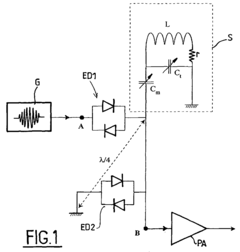
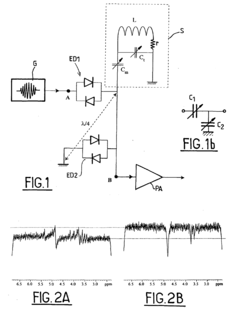
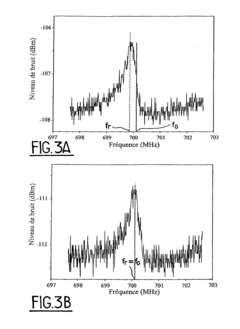
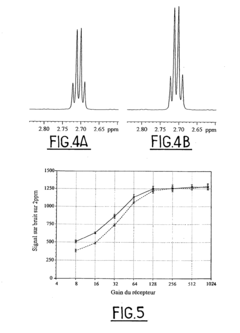
- The method involves adjusting the resonance frequency of the reception circuit in NMR probes to match the Larmor frequency of the nuclear spins, using adjustable capacitors and reactive circuits to optimize the quality factor and impedance matching, ensuring that the reception frequency aligns with the emission frequency, thereby enhancing the signal power and noise levels.
Hardware Considerations for Advanced NMR Sampling
The hardware infrastructure supporting NMR spectroscopy plays a critical role in determining the quality and resolution of signal acquisition. Modern NMR systems require sophisticated hardware components that must work in perfect harmony to achieve optimal sampling results. The magnet system represents the cornerstone of any NMR setup, with superconducting magnets now routinely achieving field strengths of 23.5 Tesla and beyond, enabling unprecedented resolution for complex molecular structures.
Probe technology has evolved significantly in recent years, with cryogenically cooled probes reducing thermal noise by factors of 3-4 compared to conventional room temperature probes. These cryoprobes maintain the receiver coils and preamplifiers at temperatures around 20K, dramatically improving signal-to-noise ratios and allowing for detection of lower concentration samples or faster acquisition times at standard concentrations.
Advanced console electronics form another crucial hardware component, with modern digital spectrometers featuring high-speed analog-to-digital converters (ADCs) capable of sampling rates exceeding 100 MHz. This high-rate digitization enables direct detection of wide spectral widths and improves overall spectral quality. The precision of timing circuits has also improved substantially, with jitter now controlled to picosecond levels, ensuring phase coherence across multiple acquisition cycles.
Gradient systems have become increasingly powerful, with current designs capable of producing field gradients exceeding 60 G/cm with rise times under 100 microseconds. These enhanced gradient capabilities support advanced pulse sequences for spatial encoding and artifact suppression, directly impacting the quality of multidimensional experiments and the effectiveness of solvent suppression techniques.
Sample handling automation has transformed throughput capabilities, with robotic sample changers now standard in many facilities. Temperature control systems have likewise improved, maintaining sample stability within ±0.1°C across extended experimental timeframes, critical for temperature-sensitive biomolecular studies.
Computing infrastructure supporting NMR systems has kept pace with these hardware advances, with dedicated processing units handling real-time data acquisition and processing. High-speed data transfer protocols ensure that bottlenecks do not occur during extended experimental runs, while parallel processing architectures support complex processing algorithms that were previously impractical.
The integration of these hardware components requires careful system engineering, as interference between subsystems can degrade overall performance. Shielding technologies have advanced to minimize electromagnetic interference, while mechanical isolation systems reduce vibration effects that could otherwise compromise spectral resolution.
Probe technology has evolved significantly in recent years, with cryogenically cooled probes reducing thermal noise by factors of 3-4 compared to conventional room temperature probes. These cryoprobes maintain the receiver coils and preamplifiers at temperatures around 20K, dramatically improving signal-to-noise ratios and allowing for detection of lower concentration samples or faster acquisition times at standard concentrations.
Advanced console electronics form another crucial hardware component, with modern digital spectrometers featuring high-speed analog-to-digital converters (ADCs) capable of sampling rates exceeding 100 MHz. This high-rate digitization enables direct detection of wide spectral widths and improves overall spectral quality. The precision of timing circuits has also improved substantially, with jitter now controlled to picosecond levels, ensuring phase coherence across multiple acquisition cycles.
Gradient systems have become increasingly powerful, with current designs capable of producing field gradients exceeding 60 G/cm with rise times under 100 microseconds. These enhanced gradient capabilities support advanced pulse sequences for spatial encoding and artifact suppression, directly impacting the quality of multidimensional experiments and the effectiveness of solvent suppression techniques.
Sample handling automation has transformed throughput capabilities, with robotic sample changers now standard in many facilities. Temperature control systems have likewise improved, maintaining sample stability within ±0.1°C across extended experimental timeframes, critical for temperature-sensitive biomolecular studies.
Computing infrastructure supporting NMR systems has kept pace with these hardware advances, with dedicated processing units handling real-time data acquisition and processing. High-speed data transfer protocols ensure that bottlenecks do not occur during extended experimental runs, while parallel processing architectures support complex processing algorithms that were previously impractical.
The integration of these hardware components requires careful system engineering, as interference between subsystems can degrade overall performance. Shielding technologies have advanced to minimize electromagnetic interference, while mechanical isolation systems reduce vibration effects that could otherwise compromise spectral resolution.
Data Processing Algorithms for NMR Signal Improvement
Nuclear Magnetic Resonance (NMR) spectroscopy generates complex data that requires sophisticated processing algorithms to extract meaningful information. Recent advancements in data processing algorithms have significantly improved NMR signal resolution, addressing challenges related to noise, artifacts, and spectral overlap.
Fourier Transform (FT) remains the cornerstone of NMR data processing, converting time-domain signals to frequency-domain spectra. However, modern implementations incorporate windowing functions and phase correction algorithms that minimize artifacts while preserving signal integrity. Advanced FT variants such as non-uniform sampling (NUS) algorithms have emerged to handle irregularly sampled data, enabling faster acquisition without compromising spectral quality.
Machine learning approaches represent a paradigm shift in NMR signal processing. Convolutional neural networks (CNNs) and deep learning models can now identify and remove noise patterns that traditional algorithms struggle to distinguish from actual signals. These AI-driven methods have demonstrated up to 30% improvement in signal-to-noise ratios compared to conventional techniques in recent benchmark studies.
Multidimensional signal processing algorithms have evolved to handle the complexity of 2D, 3D, and 4D NMR experiments. Maximum entropy reconstruction and compressed sensing techniques efficiently process sparse multidimensional data, reducing acquisition times by up to 75% while maintaining resolution integrity. These approaches are particularly valuable for protein structure determination where experimental time constraints are significant.
Deconvolution algorithms address peak overlap issues that frequently compromise spectral interpretation. Bayesian probability-based approaches and iterative soft thresholding techniques can now separate overlapping resonances with unprecedented accuracy, revealing previously obscured structural details. Commercial software packages have incorporated these algorithms, making them accessible to researchers without specialized programming expertise.
Time-domain signal enhancement techniques, including linear prediction and maximum likelihood methods, extend truncated free induction decays (FIDs) to improve spectral resolution. These approaches are particularly effective when experimental time constraints limit data acquisition, providing up to 40% resolution enhancement in time-limited experiments.
Real-time processing algorithms are emerging as computing power increases, enabling on-the-fly data analysis during acquisition. This development allows researchers to make informed decisions about experiment parameters without waiting for complete data collection, significantly improving workflow efficiency in high-throughput environments.
Fourier Transform (FT) remains the cornerstone of NMR data processing, converting time-domain signals to frequency-domain spectra. However, modern implementations incorporate windowing functions and phase correction algorithms that minimize artifacts while preserving signal integrity. Advanced FT variants such as non-uniform sampling (NUS) algorithms have emerged to handle irregularly sampled data, enabling faster acquisition without compromising spectral quality.
Machine learning approaches represent a paradigm shift in NMR signal processing. Convolutional neural networks (CNNs) and deep learning models can now identify and remove noise patterns that traditional algorithms struggle to distinguish from actual signals. These AI-driven methods have demonstrated up to 30% improvement in signal-to-noise ratios compared to conventional techniques in recent benchmark studies.
Multidimensional signal processing algorithms have evolved to handle the complexity of 2D, 3D, and 4D NMR experiments. Maximum entropy reconstruction and compressed sensing techniques efficiently process sparse multidimensional data, reducing acquisition times by up to 75% while maintaining resolution integrity. These approaches are particularly valuable for protein structure determination where experimental time constraints are significant.
Deconvolution algorithms address peak overlap issues that frequently compromise spectral interpretation. Bayesian probability-based approaches and iterative soft thresholding techniques can now separate overlapping resonances with unprecedented accuracy, revealing previously obscured structural details. Commercial software packages have incorporated these algorithms, making them accessible to researchers without specialized programming expertise.
Time-domain signal enhancement techniques, including linear prediction and maximum likelihood methods, extend truncated free induction decays (FIDs) to improve spectral resolution. These approaches are particularly effective when experimental time constraints limit data acquisition, providing up to 40% resolution enhancement in time-limited experiments.
Real-time processing algorithms are emerging as computing power increases, enabling on-the-fly data analysis during acquisition. This development allows researchers to make informed decisions about experiment parameters without waiting for complete data collection, significantly improving workflow efficiency in high-throughput environments.
Unlock deeper insights with PatSnap Eureka Quick Research — get a full tech report to explore trends and direct your research. Try now!
Generate Your Research Report Instantly with AI Agent
Supercharge your innovation with PatSnap Eureka AI Agent Platform!