
All Acrylic Emulsion: Comprehensive Analysis Of Composition, Performance Characteristics, And Industrial Applications
AUG 25, 20269 MIN READ
Generate Your Research Report Instantly with AI Agent
Patsnap Eureka helps you evaluate technical feasibility & market potential.
Gate Valve Evolution and Objectives
Gate valves have been a critical component in mining operations for decades, evolving significantly to meet the demanding requirements of the industry. The evolution of gate valves in mining can be traced back to the early 20th century when basic designs were first introduced to control fluid flow in mineral processing and extraction systems. Over time, these valves have undergone substantial improvements in materials, design, and functionality to enhance their reliability and performance in harsh mining environments.
The primary objective of gate valve development in mining operations has been to increase operational efficiency while ensuring safety and minimizing downtime. This has led to the incorporation of advanced materials such as high-grade stainless steel and specialized alloys that can withstand corrosive fluids, abrasive slurries, and extreme pressures commonly encountered in mining processes. The design of gate valves has also evolved to include features like double-block and bleed configurations, which provide enhanced sealing capabilities and improved isolation for maintenance purposes.
Another significant advancement in gate valve technology for mining applications has been the integration of smart monitoring and control systems. These innovations aim to provide real-time data on valve performance, enabling predictive maintenance and reducing the risk of unexpected failures. The development of actuators and control systems has also improved, allowing for more precise and responsive valve operations, which is crucial in complex mining processes where timing and accuracy are essential.
The reliability assessment of gate valves in mining operations has become increasingly sophisticated, mirroring the technological advancements in valve design. The objectives of these assessments have expanded beyond simple functionality tests to include comprehensive evaluations of valve performance under various operating conditions, longevity predictions, and failure mode analyses. This shift reflects the growing recognition of the critical role that gate valves play in maintaining operational continuity and safety in mining environments.
Current objectives in gate valve reliability assessment for mining operations focus on developing more accurate and efficient methodologies. These include the use of advanced non-destructive testing techniques, such as acoustic emission testing and thermography, to detect potential issues before they lead to valve failure. Additionally, there is a growing emphasis on incorporating data analytics and machine learning algorithms to process the vast amounts of operational data collected from smart valve systems, enabling more precise predictions of valve reliability and optimal maintenance schedules.
The primary objective of gate valve development in mining operations has been to increase operational efficiency while ensuring safety and minimizing downtime. This has led to the incorporation of advanced materials such as high-grade stainless steel and specialized alloys that can withstand corrosive fluids, abrasive slurries, and extreme pressures commonly encountered in mining processes. The design of gate valves has also evolved to include features like double-block and bleed configurations, which provide enhanced sealing capabilities and improved isolation for maintenance purposes.
Another significant advancement in gate valve technology for mining applications has been the integration of smart monitoring and control systems. These innovations aim to provide real-time data on valve performance, enabling predictive maintenance and reducing the risk of unexpected failures. The development of actuators and control systems has also improved, allowing for more precise and responsive valve operations, which is crucial in complex mining processes where timing and accuracy are essential.
The reliability assessment of gate valves in mining operations has become increasingly sophisticated, mirroring the technological advancements in valve design. The objectives of these assessments have expanded beyond simple functionality tests to include comprehensive evaluations of valve performance under various operating conditions, longevity predictions, and failure mode analyses. This shift reflects the growing recognition of the critical role that gate valves play in maintaining operational continuity and safety in mining environments.
Current objectives in gate valve reliability assessment for mining operations focus on developing more accurate and efficient methodologies. These include the use of advanced non-destructive testing techniques, such as acoustic emission testing and thermography, to detect potential issues before they lead to valve failure. Additionally, there is a growing emphasis on incorporating data analytics and machine learning algorithms to process the vast amounts of operational data collected from smart valve systems, enabling more precise predictions of valve reliability and optimal maintenance schedules.
Mining Industry Demand Analysis
The mining industry's demand for reliable gate valves has been steadily increasing due to the critical role these components play in various mining operations. Gate valves are essential for controlling the flow of fluids, slurries, and gases in mining processes, making their reliability a key factor in operational efficiency and safety.
In recent years, the global mining industry has experienced significant growth, with the market size reaching $1.84 trillion in 2021. This expansion has led to an increased focus on equipment reliability, particularly for crucial components like gate valves. The industry's emphasis on minimizing downtime and maximizing productivity has driven the need for more robust and dependable valve systems.
The harsh operating conditions in mining environments, characterized by abrasive materials, high pressures, and corrosive substances, pose significant challenges to gate valve reliability. As a result, mining companies are actively seeking advanced reliability assessment methodologies to ensure the longevity and performance of these critical components.
The demand for reliability assessment methodologies is further fueled by the industry's shift towards predictive maintenance strategies. Mining operators are increasingly adopting data-driven approaches to optimize maintenance schedules and prevent unexpected failures. This trend has created a growing market for sophisticated reliability assessment tools and techniques specifically tailored for gate valves in mining applications.
Safety considerations also play a crucial role in driving the demand for reliable gate valves and associated assessment methodologies. The potential consequences of valve failures in mining operations can be severe, ranging from production losses to environmental hazards and worker safety risks. As regulatory requirements become more stringent, mining companies are investing in advanced reliability assessment techniques to ensure compliance and mitigate risks.
The geographical distribution of mining activities also influences the demand for gate valve reliability assessment. Regions with significant mining operations, such as Australia, North America, and South America, are experiencing particularly high demand for these methodologies. Additionally, emerging mining markets in Africa and Asia are contributing to the global need for robust reliability assessment tools.
As the mining industry continues to evolve, the demand for reliability assessment methodologies for gate valves is expected to grow further. Factors such as the increasing adoption of automation and remote operations in mining, the push for sustainable practices, and the need for cost-effective maintenance strategies will continue to drive innovation in this field.
In recent years, the global mining industry has experienced significant growth, with the market size reaching $1.84 trillion in 2021. This expansion has led to an increased focus on equipment reliability, particularly for crucial components like gate valves. The industry's emphasis on minimizing downtime and maximizing productivity has driven the need for more robust and dependable valve systems.
The harsh operating conditions in mining environments, characterized by abrasive materials, high pressures, and corrosive substances, pose significant challenges to gate valve reliability. As a result, mining companies are actively seeking advanced reliability assessment methodologies to ensure the longevity and performance of these critical components.
The demand for reliability assessment methodologies is further fueled by the industry's shift towards predictive maintenance strategies. Mining operators are increasingly adopting data-driven approaches to optimize maintenance schedules and prevent unexpected failures. This trend has created a growing market for sophisticated reliability assessment tools and techniques specifically tailored for gate valves in mining applications.
Safety considerations also play a crucial role in driving the demand for reliable gate valves and associated assessment methodologies. The potential consequences of valve failures in mining operations can be severe, ranging from production losses to environmental hazards and worker safety risks. As regulatory requirements become more stringent, mining companies are investing in advanced reliability assessment techniques to ensure compliance and mitigate risks.
The geographical distribution of mining activities also influences the demand for gate valve reliability assessment. Regions with significant mining operations, such as Australia, North America, and South America, are experiencing particularly high demand for these methodologies. Additionally, emerging mining markets in Africa and Asia are contributing to the global need for robust reliability assessment tools.
As the mining industry continues to evolve, the demand for reliability assessment methodologies for gate valves is expected to grow further. Factors such as the increasing adoption of automation and remote operations in mining, the push for sustainable practices, and the need for cost-effective maintenance strategies will continue to drive innovation in this field.
Current Challenges in Valve Reliability
Gate valves play a critical role in mining operations, controlling the flow of materials and fluids throughout the extraction and processing stages. However, ensuring their reliability in such harsh environments presents significant challenges. The current reliability assessment methodologies for gate valves in mining operations face several limitations and obstacles.
One of the primary challenges is the lack of standardized testing procedures specifically tailored for mining applications. While general valve reliability standards exist, they often fail to account for the unique conditions encountered in mining operations, such as extreme temperatures, high pressures, and exposure to abrasive materials. This gap in standardization makes it difficult to accurately assess and compare valve performance across different mining sites and applications.
The complex and dynamic nature of mining environments also poses a significant challenge to reliability assessment. Gate valves in mining operations are subject to varying loads, frequent cycling, and exposure to corrosive substances. These factors can lead to accelerated wear and unexpected failure modes that may not be captured by traditional reliability assessment methods. As a result, current methodologies may underestimate the true failure rates and maintenance requirements of gate valves in mining settings.
Another challenge lies in the limited availability of long-term performance data for gate valves in mining operations. Due to the relatively recent focus on reliability engineering in this sector, historical data on valve failures and maintenance patterns may be incomplete or inconsistent. This lack of comprehensive data hinders the development of accurate predictive models and makes it difficult to establish reliable benchmarks for valve performance in mining applications.
The integration of advanced sensing and monitoring technologies into gate valves presents both opportunities and challenges for reliability assessment. While these technologies offer the potential for real-time condition monitoring and predictive maintenance, they also introduce new failure modes and complexity to the system. Current reliability assessment methodologies may not adequately account for the interdependencies between mechanical components and electronic sensors, leading to potential blind spots in reliability predictions.
Furthermore, the diverse range of gate valve designs and materials used in mining operations complicates the development of universally applicable reliability assessment methods. Different valve configurations may exhibit unique failure modes and reliability characteristics, requiring tailored assessment approaches. This diversity makes it challenging to establish industry-wide reliability standards and best practices for gate valves in mining applications.
Lastly, the economic pressures faced by the mining industry often lead to a focus on short-term cost reduction rather than long-term reliability improvements. This mindset can result in the use of less robust valve designs or inadequate maintenance practices, which in turn compromises the accuracy and effectiveness of reliability assessments. Overcoming this challenge requires a shift in industry culture towards recognizing the long-term benefits of investing in reliable valve technologies and comprehensive assessment methodologies.
One of the primary challenges is the lack of standardized testing procedures specifically tailored for mining applications. While general valve reliability standards exist, they often fail to account for the unique conditions encountered in mining operations, such as extreme temperatures, high pressures, and exposure to abrasive materials. This gap in standardization makes it difficult to accurately assess and compare valve performance across different mining sites and applications.
The complex and dynamic nature of mining environments also poses a significant challenge to reliability assessment. Gate valves in mining operations are subject to varying loads, frequent cycling, and exposure to corrosive substances. These factors can lead to accelerated wear and unexpected failure modes that may not be captured by traditional reliability assessment methods. As a result, current methodologies may underestimate the true failure rates and maintenance requirements of gate valves in mining settings.
Another challenge lies in the limited availability of long-term performance data for gate valves in mining operations. Due to the relatively recent focus on reliability engineering in this sector, historical data on valve failures and maintenance patterns may be incomplete or inconsistent. This lack of comprehensive data hinders the development of accurate predictive models and makes it difficult to establish reliable benchmarks for valve performance in mining applications.
The integration of advanced sensing and monitoring technologies into gate valves presents both opportunities and challenges for reliability assessment. While these technologies offer the potential for real-time condition monitoring and predictive maintenance, they also introduce new failure modes and complexity to the system. Current reliability assessment methodologies may not adequately account for the interdependencies between mechanical components and electronic sensors, leading to potential blind spots in reliability predictions.
Furthermore, the diverse range of gate valve designs and materials used in mining operations complicates the development of universally applicable reliability assessment methods. Different valve configurations may exhibit unique failure modes and reliability characteristics, requiring tailored assessment approaches. This diversity makes it challenging to establish industry-wide reliability standards and best practices for gate valves in mining applications.
Lastly, the economic pressures faced by the mining industry often lead to a focus on short-term cost reduction rather than long-term reliability improvements. This mindset can result in the use of less robust valve designs or inadequate maintenance practices, which in turn compromises the accuracy and effectiveness of reliability assessments. Overcoming this challenge requires a shift in industry culture towards recognizing the long-term benefits of investing in reliable valve technologies and comprehensive assessment methodologies.
Existing Reliability Assessment Methods
01 Improved sealing mechanisms
Gate valves with enhanced sealing mechanisms contribute to increased reliability. These improvements include advanced seal designs, materials, and configurations that prevent leakage and ensure consistent performance under various operating conditions. Such sealing innovations help maintain valve integrity over extended periods, reducing maintenance requirements and improving overall system reliability.- Improved sealing mechanisms: Gate valves with enhanced sealing mechanisms contribute to improved reliability. These designs focus on preventing leakage and ensuring tight seals under various operating conditions. Advanced sealing technologies may include innovative materials, precision-engineered components, and optimized sealing surfaces to maintain integrity over extended periods.
- Corrosion-resistant materials and coatings: The use of corrosion-resistant materials and protective coatings in gate valve construction significantly enhances their reliability. These materials and coatings protect critical components from degradation due to harsh environments, chemicals, and wear, thereby extending the valve's operational lifespan and reducing maintenance requirements.
- Advanced actuation systems: Incorporating advanced actuation systems in gate valves improves their reliability by ensuring precise and consistent operation. These systems may include electric, hydraulic, or pneumatic actuators with enhanced control mechanisms, fail-safe features, and real-time monitoring capabilities to optimize valve performance and prevent failures.
- Innovative valve body designs: Gate valve reliability is enhanced through innovative body designs that improve flow characteristics, reduce wear, and minimize pressure drop. These designs may incorporate optimized flow paths, reinforced structures, and advanced manufacturing techniques to create more durable and efficient valve bodies capable of withstanding high pressures and temperatures.
- Predictive maintenance and monitoring systems: Integration of predictive maintenance and monitoring systems significantly improves gate valve reliability. These systems utilize sensors, data analytics, and machine learning algorithms to detect potential issues before they lead to failures. Real-time monitoring of valve performance, wear patterns, and operating conditions allows for proactive maintenance and optimization of valve operation.
02 Advanced materials and coatings
The use of advanced materials and coatings in gate valve construction significantly enhances their reliability. Corrosion-resistant alloys, wear-resistant coatings, and high-performance polymers are employed to improve durability, reduce friction, and extend the valve's operational lifespan. These material innovations contribute to better performance in harsh environments and under extreme conditions.Expand Specific Solutions03 Intelligent monitoring and diagnostics
Integration of smart technologies for real-time monitoring and diagnostics improves gate valve reliability. Sensors, actuators, and control systems are incorporated to detect potential issues, predict maintenance needs, and optimize valve performance. These intelligent features enable proactive maintenance strategies, reducing unexpected failures and enhancing overall system reliability.Expand Specific Solutions04 Optimized valve design and flow characteristics
Advancements in gate valve design focus on optimizing flow characteristics and reducing wear. Improved gate geometries, streamlined flow paths, and innovative actuation mechanisms contribute to enhanced reliability by minimizing turbulence, reducing stress on components, and ensuring smooth operation. These design optimizations result in more consistent performance and extended service life.Expand Specific Solutions05 Enhanced testing and quality control procedures
Implementing rigorous testing and quality control procedures during manufacturing and installation improves gate valve reliability. Advanced testing methods, including non-destructive testing, pressure testing, and accelerated life cycle simulations, are employed to identify potential weaknesses and ensure compliance with industry standards. These enhanced procedures result in more reliable valve performance in the field.Expand Specific Solutions
Key Players in Mining Valve Industry
The reliability assessment of gate valves in mining operations is currently in a growth phase, with increasing market demand driven by safety concerns and operational efficiency requirements. The global mining valve market is projected to expand significantly, reflecting the industry's focus on enhancing equipment reliability. Technologically, the field is advancing rapidly, with companies like PetroChina, China National Petroleum Corp., and Equinor Energy AS leading innovation in valve design and assessment methodologies. Academic institutions such as China University of Mining & Technology and Taiyuan University of Technology are contributing to research and development, bridging the gap between theoretical models and practical applications. The involvement of diverse players indicates a maturing technology landscape, though standardization of assessment methods remains an ongoing challenge.
China National Petroleum Corp.
Technical Solution: China National Petroleum Corp. (CNPC) has developed a comprehensive reliability assessment methodology for gate valves in mining operations, focusing on both quantitative and qualitative approaches. Their method incorporates Failure Mode and Effects Analysis (FMEA) to identify potential failure modes and their impacts on system performance[1]. CNPC utilizes advanced non-destructive testing techniques, such as acoustic emission and ultrasonic testing, to detect early signs of valve degradation[2]. They have also implemented a real-time monitoring system that collects data on valve performance, including pressure, temperature, and flow rates, which feeds into their predictive maintenance algorithms[3]. CNPC's methodology includes a risk-based inspection (RBI) approach, allowing for optimized inspection intervals based on the criticality and condition of each valve[4].
Strengths: Comprehensive approach combining multiple assessment techniques; Real-time monitoring capabilities; Risk-based inspection for optimized maintenance. Weaknesses: May require significant investment in technology and training; Complexity of the system may lead to challenges in implementation across all operations.
Equinor Energy AS
Technical Solution: Equinor Energy AS has developed a reliability assessment methodology for gate valves that focuses on the harsh conditions often encountered in offshore mining operations. Their approach incorporates advanced statistical modeling techniques, such as Weibull analysis and Monte Carlo simulations, to predict valve failure rates and optimize maintenance schedules[5]. Equinor has implemented a digital twin concept for critical gate valves, allowing for real-time monitoring and predictive maintenance[6]. Their methodology also includes a corrosion management program specifically designed for subsea gate valves, utilizing advanced materials and coatings to enhance valve longevity in corrosive environments[7]. Equinor's reliability assessment process integrates operational data with design specifications to create a holistic view of valve performance and reliability over time.
Strengths: Tailored for harsh offshore environments; Advanced statistical modeling for accurate predictions; Digital twin technology for real-time monitoring. Weaknesses: May be less applicable to non-offshore mining operations; High initial costs for implementing digital twin technology.
Core Innovations in Valve Testing
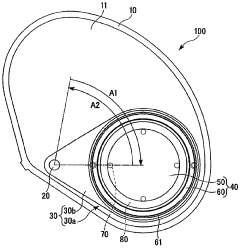
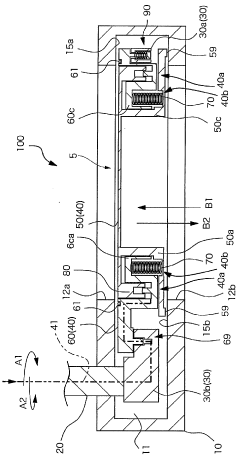
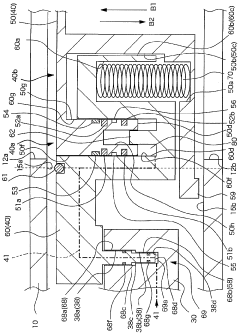
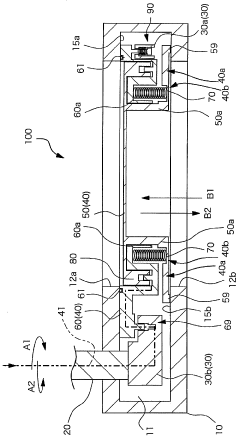
Gate valve and slide valve
PatentWO2012121410A1
Innovation
- A gate valve design featuring a neutral valve body with movable valve portions and biasing mechanisms that allow for adjustable sealing and reduced complexity, including air cylinders and seal portions for efficient operation and easy assembly, along with a rotating shaft and connecting member configuration for simplified attachment.
Reliability evaluation method for hoist main shaft of kilometer-deep mine considering multiple failure modes
PatentActiveCA3014415A1
Innovation
- A reliability evaluation method is developed using a parametrical three-dimensional model of the main shaft, a sampling matrix for random variables, finite element analysis, neural network approach, saddlepoint approximation, and Clayton copula function to establish joint failure probabilities, considering the correlation between strength and stiffness failures.


Environmental Impact Considerations
The environmental impact of gate valves in mining operations is a critical consideration in reliability assessment methodologies. These valves play a crucial role in controlling fluid flow and pressure in various mining processes, and their performance can significantly affect the surrounding ecosystem.
One of the primary environmental concerns associated with gate valves is the potential for leakage. Faulty or poorly maintained valves can lead to the release of hazardous materials, such as chemicals, oils, or contaminated water, into the environment. This can result in soil and water pollution, affecting local flora and fauna. Reliability assessment methodologies must, therefore, incorporate rigorous leak detection and prevention measures to minimize these risks.
The energy efficiency of gate valves is another important environmental factor. Inefficient valves can lead to increased power consumption, contributing to higher greenhouse gas emissions. Reliability assessments should evaluate the energy performance of gate valves and consider the implementation of more efficient designs or technologies to reduce the overall carbon footprint of mining operations.
Noise pollution is an often-overlooked environmental impact of gate valves. In mining environments, high-pressure valves can generate significant noise levels, potentially disturbing local wildlife and nearby communities. Reliability assessment methodologies should include noise evaluation protocols and explore noise reduction techniques to mitigate this impact.
The lifecycle environmental impact of gate valves is also a crucial consideration. This includes the environmental costs of manufacturing, transportation, installation, maintenance, and eventual disposal or recycling of the valves. Reliability assessments should factor in the use of sustainable materials, the potential for refurbishment, and the recyclability of valve components to minimize long-term environmental impact.
Water conservation is another critical aspect, particularly in arid mining regions. Gate valves play a vital role in water management systems, and their reliability directly affects water usage efficiency. Assessment methodologies should evaluate how valve performance contributes to water conservation efforts and explore innovative designs that can enhance water-saving capabilities.
Lastly, the impact of gate valve failures on biodiversity must be considered. A catastrophic valve failure could lead to the release of large volumes of contaminated water or chemicals, potentially devastating local ecosystems. Reliability assessment methodologies should incorporate risk analysis for such scenarios and propose robust fail-safe mechanisms to protect biodiversity in the event of valve malfunction.
One of the primary environmental concerns associated with gate valves is the potential for leakage. Faulty or poorly maintained valves can lead to the release of hazardous materials, such as chemicals, oils, or contaminated water, into the environment. This can result in soil and water pollution, affecting local flora and fauna. Reliability assessment methodologies must, therefore, incorporate rigorous leak detection and prevention measures to minimize these risks.
The energy efficiency of gate valves is another important environmental factor. Inefficient valves can lead to increased power consumption, contributing to higher greenhouse gas emissions. Reliability assessments should evaluate the energy performance of gate valves and consider the implementation of more efficient designs or technologies to reduce the overall carbon footprint of mining operations.
Noise pollution is an often-overlooked environmental impact of gate valves. In mining environments, high-pressure valves can generate significant noise levels, potentially disturbing local wildlife and nearby communities. Reliability assessment methodologies should include noise evaluation protocols and explore noise reduction techniques to mitigate this impact.
The lifecycle environmental impact of gate valves is also a crucial consideration. This includes the environmental costs of manufacturing, transportation, installation, maintenance, and eventual disposal or recycling of the valves. Reliability assessments should factor in the use of sustainable materials, the potential for refurbishment, and the recyclability of valve components to minimize long-term environmental impact.
Water conservation is another critical aspect, particularly in arid mining regions. Gate valves play a vital role in water management systems, and their reliability directly affects water usage efficiency. Assessment methodologies should evaluate how valve performance contributes to water conservation efforts and explore innovative designs that can enhance water-saving capabilities.
Lastly, the impact of gate valve failures on biodiversity must be considered. A catastrophic valve failure could lead to the release of large volumes of contaminated water or chemicals, potentially devastating local ecosystems. Reliability assessment methodologies should incorporate risk analysis for such scenarios and propose robust fail-safe mechanisms to protect biodiversity in the event of valve malfunction.
Safety Standards and Regulations
Safety standards and regulations play a crucial role in ensuring the reliability and safe operation of gate valves in mining operations. The mining industry is subject to stringent regulatory requirements due to the inherent risks associated with extractive activities. These standards are designed to protect workers, the environment, and the integrity of mining operations.
In the context of gate valve reliability assessment, several key safety standards and regulations are applicable. The Mine Safety and Health Administration (MSHA) in the United States, for instance, provides comprehensive guidelines for the use and maintenance of valves in mining operations. These guidelines outline specific requirements for valve selection, installation, inspection, and maintenance procedures to ensure optimal performance and safety.
International standards such as ISO 14313 and API 6D provide specifications for pipeline valves, including gate valves, used in the petroleum and natural gas industries. While not specific to mining, these standards are often adopted in mining operations due to their rigorous safety and performance requirements. They cover aspects such as design, materials, testing, and marking of valves, which are essential for reliability assessment.
The European Union's ATEX Directive is another important regulation that impacts gate valve reliability in mining operations. This directive sets standards for equipment used in potentially explosive atmospheres, which is particularly relevant in underground mining environments. Compliance with ATEX ensures that gate valves are designed and manufactured to minimize the risk of ignition in hazardous areas.
National standards also play a significant role in shaping safety regulations for mining equipment. For example, the Australian Standard AS 4041 provides guidelines for pressure piping, including valves used in mining operations. This standard emphasizes the importance of proper material selection, design, and testing to ensure the reliability and safety of gate valves under various operating conditions.
Regulatory bodies often require regular inspections and certifications of mining equipment, including gate valves. These inspections are critical for identifying potential issues before they lead to failures or accidents. The frequency and scope of these inspections are typically outlined in industry-specific regulations and may vary depending on the type of mining operation and the specific application of the gate valves.
In recent years, there has been an increasing focus on predictive maintenance and condition monitoring in safety regulations. This shift recognizes the importance of proactive reliability assessment methodologies in preventing equipment failures and enhancing overall safety in mining operations. As a result, many regulatory bodies now encourage or require the implementation of advanced monitoring systems for critical equipment like gate valves.
In the context of gate valve reliability assessment, several key safety standards and regulations are applicable. The Mine Safety and Health Administration (MSHA) in the United States, for instance, provides comprehensive guidelines for the use and maintenance of valves in mining operations. These guidelines outline specific requirements for valve selection, installation, inspection, and maintenance procedures to ensure optimal performance and safety.
International standards such as ISO 14313 and API 6D provide specifications for pipeline valves, including gate valves, used in the petroleum and natural gas industries. While not specific to mining, these standards are often adopted in mining operations due to their rigorous safety and performance requirements. They cover aspects such as design, materials, testing, and marking of valves, which are essential for reliability assessment.
The European Union's ATEX Directive is another important regulation that impacts gate valve reliability in mining operations. This directive sets standards for equipment used in potentially explosive atmospheres, which is particularly relevant in underground mining environments. Compliance with ATEX ensures that gate valves are designed and manufactured to minimize the risk of ignition in hazardous areas.
National standards also play a significant role in shaping safety regulations for mining equipment. For example, the Australian Standard AS 4041 provides guidelines for pressure piping, including valves used in mining operations. This standard emphasizes the importance of proper material selection, design, and testing to ensure the reliability and safety of gate valves under various operating conditions.
Regulatory bodies often require regular inspections and certifications of mining equipment, including gate valves. These inspections are critical for identifying potential issues before they lead to failures or accidents. The frequency and scope of these inspections are typically outlined in industry-specific regulations and may vary depending on the type of mining operation and the specific application of the gate valves.
In recent years, there has been an increasing focus on predictive maintenance and condition monitoring in safety regulations. This shift recognizes the importance of proactive reliability assessment methodologies in preventing equipment failures and enhancing overall safety in mining operations. As a result, many regulatory bodies now encourage or require the implementation of advanced monitoring systems for critical equipment like gate valves.
Unlock deeper insights with Patsnap Eureka Quick Research — get a full tech report to explore trends and direct your research. Try now!
Generate Your Research Report Instantly with AI Agent
Supercharge your innovation with Patsnap Eureka AI Agent Platform!