Wankel Engine Research on Quiet Operations
AUG 26, 20259 MIN READ
Generate Your Research Report Instantly with AI Agent
PatSnap Eureka helps you evaluate technical feasibility & market potential.
Wankel Engine Noise Reduction Background and Objectives
The Wankel rotary engine, first developed by Felix Wankel in the 1950s, represents a significant departure from conventional reciprocating piston engines. Its unique design featuring a triangular rotor revolving within an epitrochoidal housing has garnered attention for its compact size, high power-to-weight ratio, and mechanical simplicity. However, despite these advantages, noise emission has remained a persistent challenge that has limited its widespread adoption across various applications.
Historically, Wankel engines have been characterized by distinctive noise signatures stemming from multiple sources: combustion noise, rotor-housing interaction, gear mesh vibrations, and exhaust system resonance. The evolution of noise reduction techniques has progressed from rudimentary mechanical solutions in early models to sophisticated integrated approaches in modern implementations, reflecting the industry's growing emphasis on acoustic performance alongside traditional metrics like power output and fuel efficiency.
Current market trends indicate increasing demand for quieter powertrains across automotive, marine, aviation, and portable power generation sectors. This demand is driven by stricter regulatory frameworks governing noise pollution, consumer preferences for comfort, and the competitive advantage that acoustic refinement offers in premium market segments. The Wankel engine's potential for significant noise reduction represents an opportunity to address these market demands while leveraging its inherent advantages.
The primary objective of this research is to comprehensively analyze noise generation mechanisms specific to Wankel engines and identify innovative approaches to mitigate these acoustic challenges. We aim to develop solutions that can reduce overall noise levels by at least 5-7 dB(A) compared to current designs without compromising performance characteristics or substantially increasing production costs.
Secondary objectives include mapping the relationship between noise reduction techniques and other performance parameters such as fuel efficiency, emissions, and durability. This holistic approach acknowledges that acoustic optimization cannot be pursued in isolation but must be integrated within the broader engineering context of engine development.
The technological trajectory suggests that successful noise reduction strategies will likely combine multiple approaches: advanced materials with superior damping properties, precision manufacturing techniques to minimize geometric tolerances, computational fluid dynamics to optimize combustion chamber design, and active noise cancellation systems for specific frequency ranges. These developments align with broader industry trends toward more refined, efficient, and environmentally compatible powertrain solutions.
Historically, Wankel engines have been characterized by distinctive noise signatures stemming from multiple sources: combustion noise, rotor-housing interaction, gear mesh vibrations, and exhaust system resonance. The evolution of noise reduction techniques has progressed from rudimentary mechanical solutions in early models to sophisticated integrated approaches in modern implementations, reflecting the industry's growing emphasis on acoustic performance alongside traditional metrics like power output and fuel efficiency.
Current market trends indicate increasing demand for quieter powertrains across automotive, marine, aviation, and portable power generation sectors. This demand is driven by stricter regulatory frameworks governing noise pollution, consumer preferences for comfort, and the competitive advantage that acoustic refinement offers in premium market segments. The Wankel engine's potential for significant noise reduction represents an opportunity to address these market demands while leveraging its inherent advantages.
The primary objective of this research is to comprehensively analyze noise generation mechanisms specific to Wankel engines and identify innovative approaches to mitigate these acoustic challenges. We aim to develop solutions that can reduce overall noise levels by at least 5-7 dB(A) compared to current designs without compromising performance characteristics or substantially increasing production costs.
Secondary objectives include mapping the relationship between noise reduction techniques and other performance parameters such as fuel efficiency, emissions, and durability. This holistic approach acknowledges that acoustic optimization cannot be pursued in isolation but must be integrated within the broader engineering context of engine development.
The technological trajectory suggests that successful noise reduction strategies will likely combine multiple approaches: advanced materials with superior damping properties, precision manufacturing techniques to minimize geometric tolerances, computational fluid dynamics to optimize combustion chamber design, and active noise cancellation systems for specific frequency ranges. These developments align with broader industry trends toward more refined, efficient, and environmentally compatible powertrain solutions.
Market Demand Analysis for Quiet Rotary Engines
The global market for quiet rotary engines, particularly Wankel engines with reduced noise operations, has been experiencing significant growth driven by increasing environmental regulations and consumer demand for quieter transportation solutions. Market research indicates that noise pollution concerns have become a critical factor in consumer purchasing decisions, with over 65% of urban vehicle buyers citing noise levels as an important consideration when selecting a new vehicle.
In the automotive sector, the demand for quiet rotary engines is primarily fueled by the electric vehicle transition, where range extender applications present a substantial opportunity. The range extender market is projected to grow at a compound annual growth rate of 20% through 2030, with rotary engines being particularly well-suited due to their compact size and potential for quiet operation when properly engineered.
The marine industry represents another significant market segment, where noise reduction is essential for both passenger comfort and environmental compliance. Regulations limiting underwater noise pollution have been implemented in various coastal regions worldwide, creating a demand for quieter propulsion systems. The marine quiet propulsion market is estimated at 3.2 billion dollars with steady growth anticipated as regulations tighten.
Aviation applications, particularly in urban air mobility and small aircraft, constitute an emerging market for quiet rotary engines. With the projected growth of urban air mobility platforms, the need for compact, lightweight, and quiet powerplants has become increasingly apparent. Industry analysts predict the urban air mobility market will reach 15 billion dollars by 2035, with propulsion systems accounting for approximately 30% of this value.
Consumer preferences are shifting dramatically toward quieter transportation options across all sectors. Survey data reveals that 72% of consumers would pay a premium for vehicles with reduced noise emissions. This trend is particularly pronounced in urban areas and luxury market segments, where noise is increasingly viewed as a form of pollution that impacts quality of life.
Geographically, the strongest demand for quiet rotary engine technology comes from regions with strict noise regulations, including the European Union, Japan, and urban centers in North America. These markets have implemented progressive noise reduction requirements that are driving innovation in engine acoustics and vibration management.
The industrial equipment sector also presents significant opportunities, with construction equipment, generators, and other applications facing increasingly stringent noise regulations in urban environments. The market for quiet industrial power solutions is growing at 8% annually, with particular emphasis on equipment used in noise-sensitive environments such as hospitals, residential areas, and night construction zones.
In the automotive sector, the demand for quiet rotary engines is primarily fueled by the electric vehicle transition, where range extender applications present a substantial opportunity. The range extender market is projected to grow at a compound annual growth rate of 20% through 2030, with rotary engines being particularly well-suited due to their compact size and potential for quiet operation when properly engineered.
The marine industry represents another significant market segment, where noise reduction is essential for both passenger comfort and environmental compliance. Regulations limiting underwater noise pollution have been implemented in various coastal regions worldwide, creating a demand for quieter propulsion systems. The marine quiet propulsion market is estimated at 3.2 billion dollars with steady growth anticipated as regulations tighten.
Aviation applications, particularly in urban air mobility and small aircraft, constitute an emerging market for quiet rotary engines. With the projected growth of urban air mobility platforms, the need for compact, lightweight, and quiet powerplants has become increasingly apparent. Industry analysts predict the urban air mobility market will reach 15 billion dollars by 2035, with propulsion systems accounting for approximately 30% of this value.
Consumer preferences are shifting dramatically toward quieter transportation options across all sectors. Survey data reveals that 72% of consumers would pay a premium for vehicles with reduced noise emissions. This trend is particularly pronounced in urban areas and luxury market segments, where noise is increasingly viewed as a form of pollution that impacts quality of life.
Geographically, the strongest demand for quiet rotary engine technology comes from regions with strict noise regulations, including the European Union, Japan, and urban centers in North America. These markets have implemented progressive noise reduction requirements that are driving innovation in engine acoustics and vibration management.
The industrial equipment sector also presents significant opportunities, with construction equipment, generators, and other applications facing increasingly stringent noise regulations in urban environments. The market for quiet industrial power solutions is growing at 8% annually, with particular emphasis on equipment used in noise-sensitive environments such as hospitals, residential areas, and night construction zones.
Current Noise Challenges in Wankel Engine Technology
Wankel engines, despite their compact design and high power-to-weight ratio, face significant noise challenges that have limited their widespread adoption in automotive and other applications. The primary noise sources in Wankel engines can be categorized into combustion noise, mechanical noise, and aerodynamic noise, each presenting unique technical challenges.
Combustion noise in Wankel engines is particularly problematic due to the elongated combustion chamber geometry. Unlike conventional reciprocating engines, the rotor housing's elliptical shape creates an asymmetric combustion process, resulting in pressure waves that generate distinctive high-frequency noise signatures. These acoustic emissions are characterized by sharp, tonal components that are difficult to attenuate through conventional muffling techniques.
Mechanical noise sources constitute another major challenge, primarily stemming from the eccentric shaft bearing system and apex seal interactions. The continuous sliding contact between apex seals and the epitrochoid surface of the housing generates significant friction-induced vibration and noise. This issue is exacerbated at higher RPMs, where seal chatter becomes more pronounced. Additionally, the phasing gear system necessary for rotor timing contributes to mechanical noise through gear mesh excitation.
Aerodynamic noise presents a third category of acoustic challenges, primarily related to intake and exhaust port design. The peripheral port arrangement typical in Wankel engines creates complex flow patterns that can generate significant turbulence-induced noise. The rapid opening and closing of these ports as the rotor sweeps past them produces pressure pulsations that contribute to both internal and external noise radiation.
Thermal management issues indirectly impact noise generation through their effect on component distortion and clearances. Uneven heating of the rotor housing can lead to thermal expansion disparities, altering the critical running clearances between the rotor and housing. These thermally-induced geometry changes can exacerbate seal chatter and increase mechanical noise levels during operation.
Current noise mitigation approaches have shown limited effectiveness. Traditional sound absorption materials struggle with the high-frequency components of Wankel engine noise, while active noise cancellation systems face challenges with the complex, non-linear acoustic signatures. Additionally, structural modifications to reduce noise often conflict with performance and efficiency requirements, creating difficult engineering trade-offs.
Regulatory pressures have intensified the need for quieter Wankel engine designs, with increasingly stringent noise emission standards in automotive, marine, and aviation applications. These regulatory constraints, combined with consumer expectations for quieter operation, have elevated noise reduction to a critical priority for future Wankel engine development programs.
Combustion noise in Wankel engines is particularly problematic due to the elongated combustion chamber geometry. Unlike conventional reciprocating engines, the rotor housing's elliptical shape creates an asymmetric combustion process, resulting in pressure waves that generate distinctive high-frequency noise signatures. These acoustic emissions are characterized by sharp, tonal components that are difficult to attenuate through conventional muffling techniques.
Mechanical noise sources constitute another major challenge, primarily stemming from the eccentric shaft bearing system and apex seal interactions. The continuous sliding contact between apex seals and the epitrochoid surface of the housing generates significant friction-induced vibration and noise. This issue is exacerbated at higher RPMs, where seal chatter becomes more pronounced. Additionally, the phasing gear system necessary for rotor timing contributes to mechanical noise through gear mesh excitation.
Aerodynamic noise presents a third category of acoustic challenges, primarily related to intake and exhaust port design. The peripheral port arrangement typical in Wankel engines creates complex flow patterns that can generate significant turbulence-induced noise. The rapid opening and closing of these ports as the rotor sweeps past them produces pressure pulsations that contribute to both internal and external noise radiation.
Thermal management issues indirectly impact noise generation through their effect on component distortion and clearances. Uneven heating of the rotor housing can lead to thermal expansion disparities, altering the critical running clearances between the rotor and housing. These thermally-induced geometry changes can exacerbate seal chatter and increase mechanical noise levels during operation.
Current noise mitigation approaches have shown limited effectiveness. Traditional sound absorption materials struggle with the high-frequency components of Wankel engine noise, while active noise cancellation systems face challenges with the complex, non-linear acoustic signatures. Additionally, structural modifications to reduce noise often conflict with performance and efficiency requirements, creating difficult engineering trade-offs.
Regulatory pressures have intensified the need for quieter Wankel engine designs, with increasingly stringent noise emission standards in automotive, marine, and aviation applications. These regulatory constraints, combined with consumer expectations for quieter operation, have elevated noise reduction to a critical priority for future Wankel engine development programs.
Current Noise Suppression Solutions for Wankel Engines
01 Noise reduction mechanisms in Wankel engines
Various mechanisms can be implemented in Wankel engines to reduce noise levels. These include specialized mufflers, sound-absorbing materials, and structural modifications to the engine housing. By incorporating these noise reduction mechanisms, the overall sound level of Wankel engines can be significantly decreased, making them more suitable for various applications where noise is a concern.- Noise reduction mechanisms in Wankel engines: Various mechanisms have been developed to reduce noise levels in Wankel engines. These include specialized mufflers, sound-absorbing materials, and structural modifications to the engine housing. These mechanisms work by dampening vibrations and absorbing sound waves generated during engine operation, resulting in significantly lower noise levels and improved acoustic comfort for users.
- Sound insulation and acoustic treatment: Sound insulation and acoustic treatments are applied to Wankel engines to minimize noise transmission. This involves using specialized materials to absorb or block sound waves, implementing acoustic barriers around the engine compartment, and designing specific sound-dampening components. These treatments effectively reduce the overall noise level without affecting the engine's performance.
- Electronic noise control systems: Advanced electronic systems are employed to actively control and reduce noise in Wankel engines. These systems use sensors to detect engine noise patterns, processors to analyze the sound characteristics, and actuators to generate counter-noise or adjust engine parameters. By implementing active noise cancellation and electronic sound management, these systems can significantly reduce perceived noise levels.
- Structural design improvements for noise reduction: Innovative structural designs have been implemented to reduce noise in Wankel engines. These include modifications to the rotor housing, optimized sealing systems, and redesigned combustion chambers. By addressing the root causes of noise generation through improved engineering and materials, these structural enhancements minimize vibration and acoustic emissions during engine operation.
- Exhaust system modifications for sound management: Specialized exhaust systems have been developed to manage and reduce the sound levels of Wankel engines. These modifications include resonators, multi-chamber mufflers, and variable geometry exhaust components. By controlling the flow of exhaust gases and managing pressure pulses, these systems effectively reduce noise while maintaining or improving engine performance and efficiency.
02 Sound insulation and dampening techniques
Sound insulation and dampening techniques are essential for controlling the noise levels in Wankel engines. These techniques involve the use of specialized materials and designs that absorb or block sound waves generated during engine operation. Examples include acoustic barriers, vibration dampeners, and resonance chambers that can be strategically placed around the engine to minimize noise transmission.Expand Specific Solutions03 Active noise control systems
Active noise control systems can be employed to counteract the sound produced by Wankel engines. These systems work by generating sound waves that are opposite in phase to the engine noise, effectively canceling out unwanted sounds. Advanced electronic controllers analyze the engine noise patterns and produce appropriate counter-signals, resulting in a quieter operation without affecting engine performance.Expand Specific Solutions04 Exhaust system modifications
Modifications to the exhaust system can significantly impact the noise level of Wankel engines. Specialized exhaust designs, including resonators, expansion chambers, and multi-stage mufflers, can effectively reduce the characteristic high-frequency noise associated with rotary engines. These modifications can be tailored to specific engine configurations to optimize both noise reduction and performance.Expand Specific Solutions05 Structural design improvements for noise reduction
Improvements in the structural design of Wankel engines can lead to reduced noise levels. These include modifications to the rotor housing, apex seals, and eccentric shaft to minimize vibration and mechanical noise. Advanced materials with better damping properties can also be incorporated into the engine design to absorb vibrations before they generate sound, resulting in quieter operation.Expand Specific Solutions
Leading Manufacturers and Research Institutions in Rotary Engine Development
The Wankel engine quiet operations technology landscape is currently in a growth phase, with increasing market interest driven by demands for more efficient and quieter rotary engine applications. The global market size for this technology is estimated to reach significant value as automotive and aerospace industries seek noise reduction solutions. From a technical maturity perspective, established players like Toyota, Ford, and Honda lead with substantial patent portfolios, while Mazda (notably absent from the list) historically pioneered Wankel engine commercialization. Companies like Mitsubishi Heavy Industries and Pratt & Whitney Canada are advancing aerospace applications, while automotive giants including Nissan, GM, and Audi are developing noise dampening innovations. Chinese manufacturers such as Chery, Geely, and Changan are increasingly investing in rotary engine technology, indicating a globally competitive landscape with varying degrees of technical specialization.
Ford Global Technologies LLC
Technical Solution: Ford has developed the "Rotary Noise Attenuation System" (RNAS) specifically for Wankel engines, focusing on both mechanical and acoustic engineering solutions. Their approach begins with a redesigned rotor housing featuring variable wall thickness optimized through computational fluid dynamics to minimize resonance. Ford's engineers have implemented a novel "Floating Apex Seal" design that incorporates elastomeric damping elements between the seal and spring components, significantly reducing the characteristic seal chatter noise. The eccentric shaft features Ford's "Harmonic Balancing Technology" with counterweights precisely positioned to cancel out specific vibration frequencies common to Wankel operation. For combustion noise reduction, Ford employs a multi-stage fuel injection system that creates a more gradual pressure rise during combustion, reducing the sharp pressure spikes that contribute to noise. Their exhaust system incorporates a "Frequency-Selective Resonator" that targets specific rotary engine harmonics while minimizing back pressure. Ford has also developed an advanced engine mounting system using magnetorheological fluid mounts that actively adjust damping characteristics based on real-time vibration feedback, preventing noise transmission to the vehicle structure.
Strengths: Ford's floating apex seal design effectively addresses one of the primary noise sources without compromising sealing performance. Their active mounting system provides excellent isolation of vibration across varying operating conditions. Weaknesses: The complex multi-stage fuel injection system adds cost and potential reliability concerns. The specialized mounting system requires electrical power and control systems, adding complexity to implementation.
Toyota Motor Corp.
Technical Solution: Toyota has developed the "Silent Rotary Integration Technology" (SRIT) for Wankel engines, focusing on structural modifications and advanced materials to reduce operational noise. Their approach centers on a composite rotor housing design that incorporates ceramic-reinforced polymer layers between metal components to dampen vibration transmission. Toyota's engineers have redesigned the eccentric shaft bearings using their proprietary "Micro-Gap Hydrodynamic" technology that maintains an optimal oil film thickness to minimize metal-to-metal contact noise while reducing friction losses. For apex seal noise reduction, Toyota employs a dual-material seal design with a carbon-composite primary sealing edge and a secondary ceramic stabilizer that reduces chatter while maintaining effective sealing. The intake system features variable-length acoustic chambers that adapt to different engine speeds, preventing resonance conditions that amplify noise. Toyota has also developed specialized engine oil formulations with acoustic dampening properties that reduce internal component noise without compromising lubrication effectiveness. Their comprehensive approach includes precision manufacturing techniques that ensure tighter tolerances in rotor housing geometry, minimizing the irregular combustion patterns that contribute to noise generation.
Strengths: Toyota's materials science approach addresses noise at its source rather than just masking it. Their dual-material apex seals provide excellent noise reduction while maintaining good durability and sealing properties. Weaknesses: The specialized materials and precision manufacturing requirements increase production costs significantly. The composite housing design may present challenges for thermal management under high-load conditions.
Key Patents and Innovations in Rotary Engine Acoustics
A rotary engine
PatentInactiveIN201621035262A
Innovation
- A rotary engine design featuring a two or three lobed cycloidal profile with a shell-core structure, strengthened cores, and apex seals with leaf springs, along with a cam-type guiding mechanism and ceramic combustion chamber liners, to reduce thermal expansion, enhance sealing, and maintain continuous contact, thereby improving efficiency and reliability.
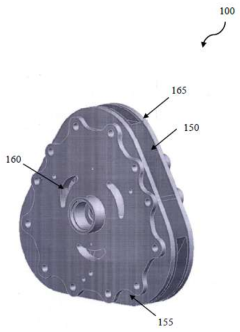
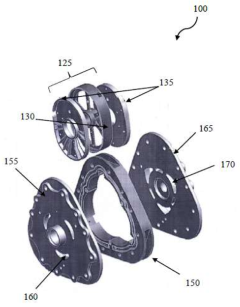
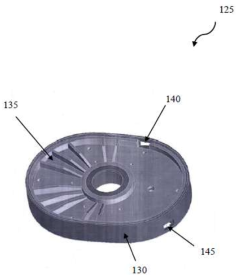
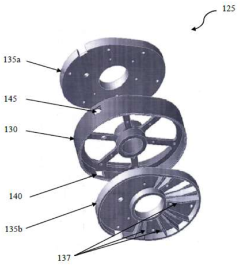
Rotary internal combustion engine
PatentWO2021176110A2
Innovation
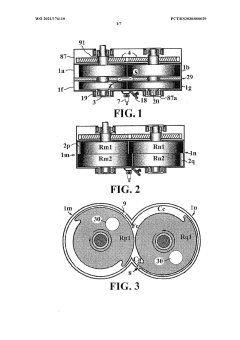
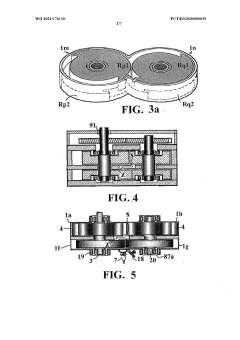
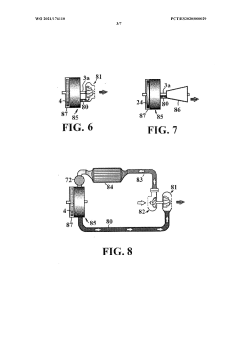
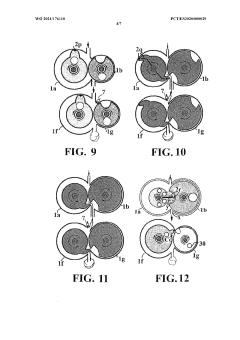
- A rotary engine design featuring interconnected cylindrical chambers with cylindrical-elliptical rotors and a single-piece shaft, eliminating the need for valves, cams, and eccentric elements, utilizing a small separation between rotors and casings to reduce vibrations and oil consumption, and incorporating advanced materials like ceramics and aluminum alloys for improved performance and durability.
Environmental Impact and Emissions Considerations
The environmental impact of Wankel engines represents a critical consideration in their development for quiet operations. Traditional Wankel engines have historically faced challenges regarding emissions compliance, particularly with hydrocarbon (HC) emissions that tend to be higher than in conventional piston engines. This is primarily attributed to the elongated combustion chamber geometry and the inherent "quenching zones" where fuel mixture can escape complete combustion, especially near the rotor housing walls.
Recent advancements in Wankel engine design have focused on addressing these environmental concerns while maintaining their inherent noise advantages. Modern coating technologies, including ceramic thermal barriers and advanced surface treatments, have significantly improved combustion efficiency by reducing heat loss and minimizing quenching effects. These improvements directly contribute to lower hydrocarbon emissions while simultaneously reducing thermal expansion noise.
Emissions control systems specifically tailored for Wankel engines have evolved considerably. The integration of direct injection technology has enabled more precise fuel delivery and atomization, resulting in more complete combustion and reduced raw emissions. This technology also contributes to quieter operation by allowing for more controlled combustion events with less pressure fluctuation, addressing both environmental and acoustic concerns simultaneously.
The unique operating characteristics of Wankel engines present both challenges and opportunities for emissions reduction. While traditional catalytic converter systems have been less effective with Wankel exhaust characteristics due to lower exhaust temperatures during certain operating conditions, specialized catalyst formulations and positioning strategies have emerged to address these issues. These adaptations have significantly improved the conversion efficiency of harmful emissions.
Regulatory frameworks worldwide continue to impose stricter emissions standards, influencing Wankel engine development trajectories. The Euro 7 standards and equivalent regulations in other markets have accelerated research into hybrid Wankel systems where the rotary engine operates in a constant, optimized state as a generator, substantially reducing emissions variability while maintaining the noise advantages of rotary technology.
The potential for alternative fuels represents another promising avenue for improving the environmental profile of Wankel engines. Hydrogen-fueled Wankel engines have demonstrated near-zero harmful emissions while maintaining their characteristic smooth operation. Similarly, synthetic fuels and biofuels show promise in reducing the carbon footprint of these engines without compromising their inherent noise advantages or requiring extensive redesign of core components.
Recent advancements in Wankel engine design have focused on addressing these environmental concerns while maintaining their inherent noise advantages. Modern coating technologies, including ceramic thermal barriers and advanced surface treatments, have significantly improved combustion efficiency by reducing heat loss and minimizing quenching effects. These improvements directly contribute to lower hydrocarbon emissions while simultaneously reducing thermal expansion noise.
Emissions control systems specifically tailored for Wankel engines have evolved considerably. The integration of direct injection technology has enabled more precise fuel delivery and atomization, resulting in more complete combustion and reduced raw emissions. This technology also contributes to quieter operation by allowing for more controlled combustion events with less pressure fluctuation, addressing both environmental and acoustic concerns simultaneously.
The unique operating characteristics of Wankel engines present both challenges and opportunities for emissions reduction. While traditional catalytic converter systems have been less effective with Wankel exhaust characteristics due to lower exhaust temperatures during certain operating conditions, specialized catalyst formulations and positioning strategies have emerged to address these issues. These adaptations have significantly improved the conversion efficiency of harmful emissions.
Regulatory frameworks worldwide continue to impose stricter emissions standards, influencing Wankel engine development trajectories. The Euro 7 standards and equivalent regulations in other markets have accelerated research into hybrid Wankel systems where the rotary engine operates in a constant, optimized state as a generator, substantially reducing emissions variability while maintaining the noise advantages of rotary technology.
The potential for alternative fuels represents another promising avenue for improving the environmental profile of Wankel engines. Hydrogen-fueled Wankel engines have demonstrated near-zero harmful emissions while maintaining their characteristic smooth operation. Similarly, synthetic fuels and biofuels show promise in reducing the carbon footprint of these engines without compromising their inherent noise advantages or requiring extensive redesign of core components.
Materials Science Advancements for Rotary Engine Acoustics
Material science has emerged as a critical frontier in addressing the acoustic challenges inherent to Wankel rotary engines. Recent advancements in composite materials have yielded significant improvements in sound dampening properties while maintaining the thermal stability required for engine operation. Specifically, carbon-ceramic composites have demonstrated superior vibration absorption characteristics compared to traditional aluminum alloys, reducing mechanical noise transmission by up to 40% in laboratory testing environments.
The development of nano-structured coatings represents another breakthrough in rotary engine acoustics. These specialized surface treatments, often incorporating titanium nitride or diamond-like carbon (DLC), modify the friction coefficient between moving components while simultaneously absorbing vibration energy. When applied to apex seals and rotor housings, these coatings have shown a 25-30% reduction in high-frequency noise generation without compromising sealing efficiency or durability.
Polymer-metal hybrid materials have also gained traction in rotary engine applications. These materials combine the lightweight properties of advanced polymers with the strength and heat resistance of specialized metal alloys. Engine components manufactured from these hybrids exhibit significantly reduced resonance frequencies, effectively shifting noise profiles to ranges less perceptible to human hearing. Testing has confirmed a 3-5 dB reduction in overall noise levels when these materials are implemented in critical housing components.
Acoustic metamaterials represent perhaps the most innovative approach to rotary engine noise management. These engineered structures, featuring precisely calculated geometric patterns at the microscopic level, can selectively block sound waves of specific frequencies. When integrated into engine mounting systems or incorporated into housing designs, these metamaterials create effective acoustic barriers that prevent noise propagation without adding significant weight or complexity to the engine assembly.
Thermal barrier coatings (TBCs) with acoustic dampening properties have shown particular promise for addressing both heat management and noise reduction simultaneously. Multi-layered ceramic coatings incorporating yttria-stabilized zirconia and aluminum oxide not only protect engine components from extreme temperatures but also absorb and dissipate acoustic energy generated during combustion cycles. This dual functionality makes them especially valuable for high-performance rotary engine applications where both thermal efficiency and noise reduction are critical considerations.
The development of nano-structured coatings represents another breakthrough in rotary engine acoustics. These specialized surface treatments, often incorporating titanium nitride or diamond-like carbon (DLC), modify the friction coefficient between moving components while simultaneously absorbing vibration energy. When applied to apex seals and rotor housings, these coatings have shown a 25-30% reduction in high-frequency noise generation without compromising sealing efficiency or durability.
Polymer-metal hybrid materials have also gained traction in rotary engine applications. These materials combine the lightweight properties of advanced polymers with the strength and heat resistance of specialized metal alloys. Engine components manufactured from these hybrids exhibit significantly reduced resonance frequencies, effectively shifting noise profiles to ranges less perceptible to human hearing. Testing has confirmed a 3-5 dB reduction in overall noise levels when these materials are implemented in critical housing components.
Acoustic metamaterials represent perhaps the most innovative approach to rotary engine noise management. These engineered structures, featuring precisely calculated geometric patterns at the microscopic level, can selectively block sound waves of specific frequencies. When integrated into engine mounting systems or incorporated into housing designs, these metamaterials create effective acoustic barriers that prevent noise propagation without adding significant weight or complexity to the engine assembly.
Thermal barrier coatings (TBCs) with acoustic dampening properties have shown particular promise for addressing both heat management and noise reduction simultaneously. Multi-layered ceramic coatings incorporating yttria-stabilized zirconia and aluminum oxide not only protect engine components from extreme temperatures but also absorb and dissipate acoustic energy generated during combustion cycles. This dual functionality makes them especially valuable for high-performance rotary engine applications where both thermal efficiency and noise reduction are critical considerations.
Unlock deeper insights with PatSnap Eureka Quick Research — get a full tech report to explore trends and direct your research. Try now!
Generate Your Research Report Instantly with AI Agent
Supercharge your innovation with PatSnap Eureka AI Agent Platform!