Tungsten Breakthroughs: Enhancing Material Strength
Tungsten Strength Enhancement: Background and Objectives
Tungsten, known for its exceptional strength and high melting point, has been a cornerstone material in various industries for decades. The quest to enhance its strength has been ongoing, driven by the increasing demands of advanced technologies and extreme operating conditions. This pursuit of tungsten strength enhancement is rooted in the material's unique properties, including its high density, excellent thermal conductivity, and resistance to wear and corrosion.
The evolution of tungsten strength enhancement techniques can be traced back to the early 20th century when powder metallurgy processes were first applied to tungsten production. Since then, significant advancements have been made in alloying, microstructure control, and novel processing methods. These developments have been crucial in expanding tungsten's applications in aerospace, nuclear energy, and cutting-edge manufacturing sectors.
Recent years have witnessed a surge in research focused on nano-engineering and advanced composite materials incorporating tungsten. These efforts aim to overcome the inherent brittleness of tungsten while maintaining or improving its strength. The emergence of additive manufacturing technologies has also opened new avenues for creating complex tungsten-based structures with tailored properties.
The primary objective of current tungsten strength enhancement research is to develop materials that can withstand extreme conditions in next-generation fusion reactors, hypersonic vehicles, and advanced tooling applications. Researchers are exploring various strategies, including grain boundary engineering, dispersion strengthening, and the development of tungsten-based alloys with improved ductility and radiation resistance.
Another critical goal is to address the environmental and resource sustainability concerns associated with tungsten production and use. This includes developing more efficient extraction and processing methods, as well as investigating recycling and reuse strategies for tungsten-based products.
The technological trajectory in tungsten strength enhancement is closely aligned with broader trends in materials science, such as the integration of computational modeling and high-throughput experimentation. These approaches are accelerating the discovery and optimization of new tungsten-based materials with superior mechanical properties.
As we look to the future, the field of tungsten strength enhancement is poised for significant breakthroughs. The convergence of nanotechnology, advanced manufacturing, and materials informatics is expected to yield novel tungsten-based materials with unprecedented combinations of strength, ductility, and thermal stability. These advancements will not only expand the application spectrum of tungsten but also contribute to solving some of the most pressing challenges in energy, transportation, and advanced manufacturing sectors.
Market Demand Analysis for High-Strength Tungsten
The market demand for high-strength tungsten has been steadily increasing across various industries due to its unique properties and versatile applications. In the aerospace sector, there is a growing need for lightweight yet durable materials capable of withstanding extreme temperatures and pressures. High-strength tungsten alloys are being sought after for use in rocket nozzles, heat shields, and structural components of spacecraft, driving significant market growth in this segment.
The automotive industry is another major driver of demand for enhanced tungsten materials. As vehicle manufacturers strive to improve fuel efficiency and reduce emissions, they are turning to lightweight, high-strength materials for engine components, turbocharger parts, and exhaust systems. The superior heat resistance and wear properties of advanced tungsten alloys make them ideal candidates for these applications, leading to increased market demand.
In the energy sector, particularly in nuclear power and oil & gas industries, there is a rising need for materials that can withstand harsh environments and high temperatures. High-strength tungsten is being utilized in reactor components, drilling equipment, and downhole tools, contributing to the overall market expansion.
The electronics industry is also fueling demand for improved tungsten materials. As devices become smaller and more powerful, there is a need for heat-resistant materials that can efficiently dissipate thermal energy. High-strength tungsten alloys are being incorporated into heat sinks, electrical contacts, and other components in advanced electronic systems.
Military and defense applications represent another significant market segment for enhanced tungsten materials. The demand for armor-piercing ammunition, kinetic energy penetrators, and radiation shielding materials is driving the need for high-strength tungsten alloys with improved performance characteristics.
In the medical field, there is a growing interest in using high-strength tungsten for radiation shielding in diagnostic and therapeutic equipment. The material's high density and ability to attenuate radiation make it an attractive option for protecting both patients and healthcare professionals.
The global market for high-strength tungsten is expected to experience substantial growth in the coming years, driven by technological advancements and increasing applications across multiple industries. As research and development efforts continue to enhance the material's properties, new market opportunities are likely to emerge, further expanding the demand for high-strength tungsten products.
Current Challenges in Tungsten Strength Improvement
Despite significant advancements in tungsten material science, several challenges persist in improving its strength. One of the primary obstacles is the inherent brittleness of tungsten, which limits its ductility and toughness. This characteristic makes it susceptible to cracking and failure under certain stress conditions, particularly at lower temperatures.
The high melting point of tungsten, while advantageous in many applications, poses difficulties in processing and shaping the material. Traditional manufacturing methods often struggle to maintain the desired microstructure and properties, leading to inconsistencies in strength across different batches or components.
Another significant challenge lies in the grain structure of tungsten. Coarse grains, which are typical in conventionally processed tungsten, can lead to reduced strength and increased brittleness. Efforts to refine the grain structure have shown promise but face obstacles in scaling up to industrial production levels while maintaining uniformity.
The presence of impurities and defects in tungsten materials continues to be a concern. Even small amounts of contaminants can significantly affect the mechanical properties, leading to unpredictable behavior and reduced strength. Developing more efficient purification techniques and controlling defect formation during processing remain ongoing challenges.
Tungsten's susceptibility to oxidation at elevated temperatures presents another hurdle. While tungsten exhibits excellent strength at high temperatures, the formation of volatile oxides can lead to material degradation and loss of structural integrity in oxidizing environments.
The development of tungsten composites and alloys, aimed at enhancing strength while mitigating brittleness, faces challenges in achieving optimal composition and microstructure. Balancing the trade-offs between strength, ductility, and other desirable properties requires extensive research and precise control over material synthesis and processing parameters.
Furthermore, the radiation-induced embrittlement of tungsten in nuclear applications remains a significant concern. Understanding and mitigating the effects of neutron irradiation on tungsten's mechanical properties is crucial for its use in fusion reactors and other nuclear environments.
Lastly, the cost-effective production of high-strength tungsten materials on an industrial scale presents economic challenges. Developing economically viable processes that can consistently produce tungsten with enhanced strength properties without significantly increasing production costs is an ongoing area of research and development.
Existing Tungsten Strengthening Techniques
01 Alloying elements to enhance tungsten strength
Various alloying elements can be added to tungsten to improve its strength. These elements can include rhenium, molybdenum, tantalum, or other refractory metals. The addition of these elements can result in solid solution strengthening, grain refinement, or the formation of beneficial secondary phases, leading to increased overall strength of the tungsten-based material.- Alloying to enhance tungsten strength: Alloying tungsten with other elements can significantly improve its strength. Common alloying elements include rhenium, molybdenum, and tantalum. These additions can enhance grain boundary strength, increase ductility, and improve high-temperature performance of tungsten-based materials.
- Nanostructured tungsten for improved strength: Developing nanostructured tungsten materials can lead to substantial improvements in strength. Techniques such as severe plastic deformation, powder metallurgy, and controlled heat treatments can be used to create nanocrystalline or ultrafine-grained tungsten with enhanced mechanical properties.
- Surface treatment and coating for tungsten strength: Various surface treatments and coating techniques can be applied to tungsten to improve its strength and wear resistance. These may include nitriding, carburizing, or applying hard coatings such as tungsten carbide or diamond-like carbon (DLC) layers.
- Composite materials incorporating tungsten: Creating composite materials that incorporate tungsten can result in materials with enhanced strength. These composites may combine tungsten with other metals, ceramics, or reinforcing fibers to achieve a balance of properties such as high strength, toughness, and temperature resistance.
- Heat treatment and processing for tungsten strengthening: Optimized heat treatment processes and thermomechanical processing can significantly improve the strength of tungsten. This may involve controlled heating and cooling cycles, work hardening, or specialized forming techniques to refine the microstructure and enhance mechanical properties.
02 Heat treatment processes for strengthening tungsten
Specific heat treatment processes can be employed to enhance the strength of tungsten. These may include controlled heating and cooling cycles, annealing, or quenching. Such treatments can modify the microstructure, reduce internal stresses, and optimize grain size, resulting in improved mechanical properties and increased strength of tungsten components.Expand Specific Solutions03 Nanostructured tungsten for improved strength
Developing nanostructured tungsten materials can significantly enhance strength. This can be achieved through various processing techniques such as severe plastic deformation, powder metallurgy, or advanced sintering methods. The resulting nanostructured tungsten exhibits a high density of grain boundaries, which act as barriers to dislocation motion, thereby increasing strength.Expand Specific Solutions04 Composite materials incorporating tungsten for enhanced strength
Tungsten can be incorporated into composite materials to create high-strength components. These composites may combine tungsten with other metals, ceramics, or reinforcing fibers. The resulting materials can exhibit superior strength compared to pure tungsten while maintaining other desirable properties such as high temperature resistance or radiation shielding capabilities.Expand Specific Solutions05 Surface treatment techniques for improving tungsten strength
Various surface treatment techniques can be applied to enhance the strength of tungsten components. These may include surface hardening methods, coating applications, or surface modification processes. Such treatments can improve wear resistance, reduce surface defects, and create beneficial compressive stresses, ultimately contributing to increased overall strength of tungsten parts.Expand Specific Solutions
Key Players in Tungsten Material Research
The tungsten industry is experiencing significant advancements in material strength enhancement, driven by increasing demand across various sectors. The market is in a growth phase, with a projected global market size reaching $5.7 billion by 2027. Technological maturity varies among key players, with companies like Xiamen Tungsten Co., Ltd. and A.L.M.T. Corp. leading in innovation. Central South University and Huazhong University of Science & Technology contribute to academic research, while industry giants such as Hitachi Ltd. and United Technologies Corp. focus on practical applications. Emerging players like Guangzhou Huasite Alloy Products Co., Ltd. and Beijing Tianlong Tungsten & Molybdenum Technology Co. Ltd. are also making strides in developing novel tungsten-based materials, indicating a competitive and dynamic landscape in tungsten technology advancements.
A.L.M.T. Corp.
Advanced Technology & Materials Co., Ltd.
Innovative Approaches to Tungsten Reinforcement
- A method of forming a tungsten rhenium composite at high temperature and high pressure, incorporating an ultra hard material like cubic boron nitride or diamond, which results in a polycrystalline composite with improved wear resistance and high-temperature performance, utilizing HPHT sintering to create a strong bond between the ultra hard material and the W-Re matrix.


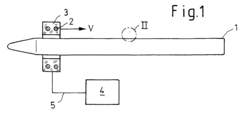
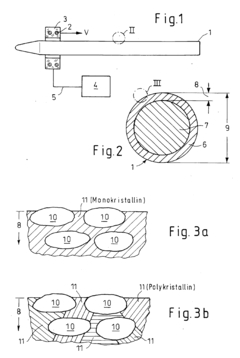
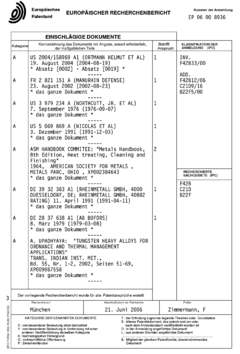
- A method involving cold-forming a tungsten-heavy metal alloy penetrator blank and then heating the near-surface edge layer above its recrystallization temperature to refine binder grains and increase toughness, creating a ductile outer shell without the need for separate cover production or complex attachment.
Environmental Impact of Tungsten Processing
The environmental impact of tungsten processing is a critical consideration in the pursuit of enhancing material strength through tungsten breakthroughs. The extraction and refinement of tungsten ore, primarily wolframite and scheelite, involve energy-intensive processes that contribute to greenhouse gas emissions and potential soil and water contamination.
Mining operations for tungsten often require extensive land use, leading to habitat disruption and potential biodiversity loss. Open-pit mining, a common method for tungsten extraction, can result in significant landscape alterations and soil erosion. Furthermore, the use of heavy machinery in mining activities contributes to air pollution through diesel emissions and dust generation.
The beneficiation process, which involves crushing, grinding, and separating tungsten from other minerals, consumes substantial amounts of water and energy. This process can lead to the production of tailings, which may contain harmful substances such as arsenic, lead, and cadmium. Proper management of these tailings is crucial to prevent soil and groundwater contamination.
Hydrometallurgical and pyrometallurgical processes used in tungsten refinement also pose environmental challenges. These processes often involve the use of chemicals such as sodium hydroxide and hydrochloric acid, which can have adverse effects on ecosystems if not properly managed. Additionally, the high temperatures required for some tungsten processing steps result in significant energy consumption and associated carbon emissions.
Recycling and recovery of tungsten from scrap materials have gained importance as a means to mitigate the environmental impact of primary production. However, the recycling process itself can generate hazardous waste and requires energy input, albeit generally less than primary production.
Efforts to enhance material strength through tungsten breakthroughs must consider these environmental implications. Innovations in processing technologies that reduce energy consumption, minimize waste generation, and improve resource efficiency are essential. For instance, the development of more efficient ore concentration techniques and the implementation of closed-loop water systems can significantly reduce the environmental footprint of tungsten processing.
Moreover, the adoption of cleaner production practices, such as the use of renewable energy sources in processing facilities and the implementation of advanced pollution control technologies, can help mitigate the environmental impact. Research into alternative, more environmentally friendly extraction methods and the development of novel tungsten alloys that require less raw material input are also promising avenues for reducing the ecological burden of tungsten processing while advancing material strength enhancements.
Applications of Enhanced-Strength Tungsten
Enhanced-strength tungsten has a wide range of applications across various industries, leveraging its improved mechanical properties and durability. In the aerospace sector, this advanced material is utilized in the production of high-performance components for aircraft engines and rocket nozzles. The increased strength-to-weight ratio allows for lighter yet more robust parts, contributing to improved fuel efficiency and overall performance of aerospace vehicles.
The nuclear industry benefits significantly from enhanced-strength tungsten in the development of radiation shielding and reactor components. Its superior heat resistance and structural integrity make it an ideal choice for containment vessels and control rods in nuclear power plants. The material's enhanced properties also extend its lifespan in these demanding environments, reducing maintenance requirements and improving overall safety.
In the field of electronics, enhanced-strength tungsten finds applications in the manufacturing of high-performance microchips and semiconductor devices. The material's improved thermal management capabilities and resistance to electromigration contribute to the development of more reliable and efficient electronic components. This is particularly crucial in the production of advanced processors and memory devices for supercomputers and data centers.
The automotive industry incorporates enhanced-strength tungsten in the production of wear-resistant parts, such as engine components and transmission systems. The material's increased durability and heat resistance lead to improved performance and longevity of critical vehicle parts, ultimately enhancing overall vehicle reliability and efficiency.
In the medical field, enhanced-strength tungsten is utilized in the development of advanced surgical instruments and implants. Its biocompatibility, combined with improved mechanical properties, makes it suitable for orthopedic implants and dental prosthetics. The material's enhanced strength also allows for the creation of more precise and durable surgical tools, improving the outcomes of complex medical procedures.
The energy sector benefits from enhanced-strength tungsten in the production of drilling equipment for oil and gas exploration. The material's improved wear resistance and toughness extend the lifespan of drilling components, reducing downtime and increasing operational efficiency in challenging extraction environments.
Lastly, the defense industry employs enhanced-strength tungsten in the development of armor-piercing projectiles and protective armor systems. The material's high density and improved mechanical properties make it effective in both offensive and defensive applications, contributing to the advancement of military technologies and personnel protection.