Wankel Engine Advances in Aerospace Engineering
AUG 26, 202510 MIN READ
Generate Your Research Report Instantly with AI Agent
Patsnap Eureka helps you evaluate technical feasibility & market potential.
Wankel Engine History and Aerospace Applications
The Wankel rotary engine, first conceptualized by Felix Wankel in the 1920s and developed into a working prototype by 1957, represents a significant departure from conventional reciprocating piston engines. Unlike traditional engines that utilize linear motion converted to rotational movement, the Wankel design employs a triangular rotor that revolves eccentrically within an epitrochoid-shaped housing, creating compression and expansion chambers directly through rotational motion.
The aerospace industry's interest in Wankel engines emerged in the 1960s and 1970s when manufacturers recognized their potential advantages for aviation applications. The engine's exceptional power-to-weight ratio, mechanical simplicity with fewer moving parts, and inherently balanced operation made it particularly attractive for aircraft propulsion systems where weight considerations are paramount.
Early aerospace applications included the development of rotary engines for unmanned aerial vehicles (UAVs) by companies like Curtiss-Wright in the United States. In Europe, manufacturers such as Norton developed modified Wankel engines for light aircraft. The most notable commercial success came from Mazda, whose experience with rotary engines in automotive applications provided valuable insights for aerospace adaptations.
The 1970s energy crisis temporarily dampened enthusiasm for Wankel technology due to fuel efficiency concerns. However, research continued in specialized applications where the engine's unique characteristics outweighed efficiency limitations. Military applications, particularly in drone technology, maintained interest in rotary engine development throughout this period.
Recent decades have witnessed renewed interest in Wankel technology for aerospace applications, driven by advancements in materials science, computational fluid dynamics, and manufacturing techniques. Modern ceramic coatings, improved apex seal materials, and precision manufacturing have addressed many historical reliability issues that previously limited widespread adoption.
Current aerospace applications include ultralight aircraft, where the Wankel's compact size and vibration-free operation provide significant advantages. Companies like Austro Engine and UAV Engines Ltd have developed specialized rotary engines specifically for unmanned aerial systems, leveraging the design's reliability and simplified maintenance requirements.
The evolution of Wankel technology in aerospace has been characterized by continuous refinement rather than revolutionary breakthroughs. Incremental improvements in sealing technology, combustion chamber design, and thermal management have gradually enhanced performance metrics critical to aviation applications, including specific fuel consumption, durability, and power density.
Today, as the aerospace industry increasingly focuses on alternative propulsion systems, the Wankel engine occupies a specialized niche where its unique characteristics align with specific operational requirements, particularly in small aircraft and unmanned systems where conventional piston engines prove suboptimal.
The aerospace industry's interest in Wankel engines emerged in the 1960s and 1970s when manufacturers recognized their potential advantages for aviation applications. The engine's exceptional power-to-weight ratio, mechanical simplicity with fewer moving parts, and inherently balanced operation made it particularly attractive for aircraft propulsion systems where weight considerations are paramount.
Early aerospace applications included the development of rotary engines for unmanned aerial vehicles (UAVs) by companies like Curtiss-Wright in the United States. In Europe, manufacturers such as Norton developed modified Wankel engines for light aircraft. The most notable commercial success came from Mazda, whose experience with rotary engines in automotive applications provided valuable insights for aerospace adaptations.
The 1970s energy crisis temporarily dampened enthusiasm for Wankel technology due to fuel efficiency concerns. However, research continued in specialized applications where the engine's unique characteristics outweighed efficiency limitations. Military applications, particularly in drone technology, maintained interest in rotary engine development throughout this period.
Recent decades have witnessed renewed interest in Wankel technology for aerospace applications, driven by advancements in materials science, computational fluid dynamics, and manufacturing techniques. Modern ceramic coatings, improved apex seal materials, and precision manufacturing have addressed many historical reliability issues that previously limited widespread adoption.
Current aerospace applications include ultralight aircraft, where the Wankel's compact size and vibration-free operation provide significant advantages. Companies like Austro Engine and UAV Engines Ltd have developed specialized rotary engines specifically for unmanned aerial systems, leveraging the design's reliability and simplified maintenance requirements.
The evolution of Wankel technology in aerospace has been characterized by continuous refinement rather than revolutionary breakthroughs. Incremental improvements in sealing technology, combustion chamber design, and thermal management have gradually enhanced performance metrics critical to aviation applications, including specific fuel consumption, durability, and power density.
Today, as the aerospace industry increasingly focuses on alternative propulsion systems, the Wankel engine occupies a specialized niche where its unique characteristics align with specific operational requirements, particularly in small aircraft and unmanned systems where conventional piston engines prove suboptimal.
Aerospace Market Demand for Rotary Engine Solutions
The aerospace industry has witnessed a growing interest in alternative propulsion systems that offer improved efficiency, reduced weight, and enhanced reliability. Wankel rotary engines, with their unique operational characteristics, have emerged as a compelling solution for specific aerospace applications. Market analysis indicates that the demand for rotary engine solutions in aerospace is primarily driven by the unmanned aerial vehicle (UAV) sector, which has experienced a compound annual growth rate of 15% over the past five years.
The military and defense segment represents the largest market share for aerospace rotary engines, accounting for approximately 45% of the total demand. This is attributed to the increasing deployment of tactical UAVs for reconnaissance, surveillance, and combat operations. The compact size and high power-to-weight ratio of Wankel engines make them particularly suitable for these applications where payload capacity is critical.
Commercial drone applications constitute the fastest-growing segment, with logistics and delivery services expanding their operational fleets. Companies developing long-endurance UAVs for package delivery, infrastructure inspection, and agricultural monitoring have shown significant interest in rotary engine solutions due to their fuel efficiency advantages over traditional reciprocating engines when operating at constant speeds.
Market research reveals that aerospace manufacturers are increasingly prioritizing propulsion systems that can operate on alternative fuels, including hydrogen and sustainable aviation fuels. This trend aligns well with the adaptability of Wankel engines to various fuel types, positioning them favorably in the evolving regulatory landscape focused on emissions reduction.
Regional analysis shows North America leading the market with substantial investments in advanced UAV technologies, followed by Europe and Asia-Pacific. The latter region is projected to witness the highest growth rate in the coming decade, driven by increasing defense budgets and expanding commercial drone operations in countries like China, Japan, and South Korea.
Customer requirements in this market segment emphasize reliability under extreme operating conditions, with particular attention to high-altitude performance and temperature tolerance. Additionally, there is growing demand for engines with reduced vibration characteristics to accommodate sensitive payload equipment such as high-resolution cameras and precision sensors.
The market for lightweight aircraft, particularly in the general aviation and urban air mobility sectors, presents another significant opportunity for Wankel engine applications. As electric vertical takeoff and landing (eVTOL) concepts evolve, hybrid propulsion systems incorporating rotary engines as range extenders are gaining traction, with market projections suggesting a potential value of several billion dollars by 2030.
The military and defense segment represents the largest market share for aerospace rotary engines, accounting for approximately 45% of the total demand. This is attributed to the increasing deployment of tactical UAVs for reconnaissance, surveillance, and combat operations. The compact size and high power-to-weight ratio of Wankel engines make them particularly suitable for these applications where payload capacity is critical.
Commercial drone applications constitute the fastest-growing segment, with logistics and delivery services expanding their operational fleets. Companies developing long-endurance UAVs for package delivery, infrastructure inspection, and agricultural monitoring have shown significant interest in rotary engine solutions due to their fuel efficiency advantages over traditional reciprocating engines when operating at constant speeds.
Market research reveals that aerospace manufacturers are increasingly prioritizing propulsion systems that can operate on alternative fuels, including hydrogen and sustainable aviation fuels. This trend aligns well with the adaptability of Wankel engines to various fuel types, positioning them favorably in the evolving regulatory landscape focused on emissions reduction.
Regional analysis shows North America leading the market with substantial investments in advanced UAV technologies, followed by Europe and Asia-Pacific. The latter region is projected to witness the highest growth rate in the coming decade, driven by increasing defense budgets and expanding commercial drone operations in countries like China, Japan, and South Korea.
Customer requirements in this market segment emphasize reliability under extreme operating conditions, with particular attention to high-altitude performance and temperature tolerance. Additionally, there is growing demand for engines with reduced vibration characteristics to accommodate sensitive payload equipment such as high-resolution cameras and precision sensors.
The market for lightweight aircraft, particularly in the general aviation and urban air mobility sectors, presents another significant opportunity for Wankel engine applications. As electric vertical takeoff and landing (eVTOL) concepts evolve, hybrid propulsion systems incorporating rotary engines as range extenders are gaining traction, with market projections suggesting a potential value of several billion dollars by 2030.
Current Wankel Technology Status and Engineering Challenges
The Wankel rotary engine, despite its historical presence in aerospace applications, currently faces significant engineering challenges that limit its widespread adoption. Current implementations primarily exist in niche applications, with companies like Austro Engine and UAV Turbines developing small-scale rotary engines for unmanned aerial vehicles (UAVs) and light aircraft. These modern iterations typically generate between 30-150 horsepower, offering power-to-weight ratios that exceed conventional piston engines by approximately 30-40%.
The fundamental technical challenges hampering broader aerospace adoption center around several critical areas. Apex seal durability remains the most persistent issue, with current materials struggling to maintain integrity under the extreme thermal and mechanical stresses of aerospace operation. Even advanced ceramic and carbon-based composites demonstrate wear rates approximately 2-3 times higher than equivalent components in conventional engines when subjected to aerospace duty cycles.
Fuel efficiency presents another significant hurdle, with current Wankel designs exhibiting 15-25% higher specific fuel consumption compared to turboprop or conventional piston engines of similar power output. This inefficiency stems from the inherent thermodynamic limitations of the combustion chamber geometry, creating elongated combustion zones that prevent optimal fuel burning and increase thermal losses.
Emissions control represents a growing challenge as aerospace regulations tighten globally. The Wankel's characteristic combustion process produces higher levels of unburned hydrocarbons (approximately 30-40% more than comparable piston engines) and nitrogen oxides, requiring more complex and weight-intensive aftertreatment systems that offset the engine's inherent weight advantages.
Manufacturing precision requirements pose additional barriers to cost-effective production. Current aerospace-grade Wankel engines require machining tolerances of ±0.001mm for critical components like epitrochoid housings, necessitating specialized manufacturing processes that increase production costs by an estimated 40-60% compared to conventional engines of similar power output.
Geographically, technological development remains concentrated in specific regions. Japan maintains leadership through Mazda's continued R&D efforts, while specialized development occurs in Germany, the United States, and increasingly China. Recent advancements have emerged from research institutions including the German Aerospace Center (DLR), MIT's Gas Turbine Laboratory, and Japan's Aerospace Exploration Agency (JAXA).
The integration of modern materials science offers promising pathways forward. Recent experiments with silicon carbide reinforced aluminum composites for housing components have demonstrated 25-30% weight reduction while maintaining structural integrity under aerospace thermal cycling conditions. Similarly, advanced coating technologies using diamond-like carbon films have shown potential to reduce apex seal wear by up to 40% in laboratory testing, though durability in actual flight conditions remains unproven.
The fundamental technical challenges hampering broader aerospace adoption center around several critical areas. Apex seal durability remains the most persistent issue, with current materials struggling to maintain integrity under the extreme thermal and mechanical stresses of aerospace operation. Even advanced ceramic and carbon-based composites demonstrate wear rates approximately 2-3 times higher than equivalent components in conventional engines when subjected to aerospace duty cycles.
Fuel efficiency presents another significant hurdle, with current Wankel designs exhibiting 15-25% higher specific fuel consumption compared to turboprop or conventional piston engines of similar power output. This inefficiency stems from the inherent thermodynamic limitations of the combustion chamber geometry, creating elongated combustion zones that prevent optimal fuel burning and increase thermal losses.
Emissions control represents a growing challenge as aerospace regulations tighten globally. The Wankel's characteristic combustion process produces higher levels of unburned hydrocarbons (approximately 30-40% more than comparable piston engines) and nitrogen oxides, requiring more complex and weight-intensive aftertreatment systems that offset the engine's inherent weight advantages.
Manufacturing precision requirements pose additional barriers to cost-effective production. Current aerospace-grade Wankel engines require machining tolerances of ±0.001mm for critical components like epitrochoid housings, necessitating specialized manufacturing processes that increase production costs by an estimated 40-60% compared to conventional engines of similar power output.
Geographically, technological development remains concentrated in specific regions. Japan maintains leadership through Mazda's continued R&D efforts, while specialized development occurs in Germany, the United States, and increasingly China. Recent advancements have emerged from research institutions including the German Aerospace Center (DLR), MIT's Gas Turbine Laboratory, and Japan's Aerospace Exploration Agency (JAXA).
The integration of modern materials science offers promising pathways forward. Recent experiments with silicon carbide reinforced aluminum composites for housing components have demonstrated 25-30% weight reduction while maintaining structural integrity under aerospace thermal cycling conditions. Similarly, advanced coating technologies using diamond-like carbon films have shown potential to reduce apex seal wear by up to 40% in laboratory testing, though durability in actual flight conditions remains unproven.
Contemporary Wankel Engine Design Solutions for Aircraft
01 Wankel Engine Design and Structure
The Wankel engine features a unique rotary design with a triangular rotor that revolves inside an epitrochoid-shaped housing. This design eliminates the need for conventional pistons, connecting rods, and crankshafts found in reciprocating engines. The rotor's movement creates expanding and contracting chambers that perform the four-stroke cycle (intake, compression, combustion, and exhaust) in a continuous rotational motion, resulting in smoother operation and higher power-to-weight ratio compared to conventional engines.- Wankel Engine Design and Structure: The Wankel engine features a unique rotary design with a triangular rotor that revolves inside an epitrochoid-shaped housing. This design eliminates the need for conventional pistons, connecting rods, and crankshafts found in reciprocating engines. The rotor creates three separate chambers that continuously perform the four-stroke cycle as it rotates, resulting in smoother operation and higher power-to-weight ratio compared to piston engines.
- Sealing Systems for Wankel Engines: Effective sealing is critical in Wankel engines to maintain compression and prevent leakage between the chambers. Various sealing technologies have been developed for the apex seals (at the corners of the rotor) and side seals. These include advanced materials like carbon composites and ceramic coatings, as well as innovative seal designs that can withstand high temperatures and pressures while minimizing friction and wear.
- Cooling and Lubrication Systems: Wankel engines require specialized cooling and lubrication systems due to their unique geometry and concentrated heat zones. Innovations include integrated cooling channels within the housing, oil injection systems that precisely deliver lubricant to critical components, and advanced thermal management strategies. These systems help address the traditional challenges of localized overheating and oil consumption that have historically affected rotary engine efficiency and longevity.
- Emissions Control and Efficiency Improvements: Modern Wankel engine designs incorporate various technologies to improve fuel efficiency and reduce emissions. These include direct fuel injection systems, variable port timing, exhaust gas recirculation, and advanced combustion chamber designs. Some innovations focus on addressing the elongated combustion chamber shape that traditionally led to incomplete combustion and higher hydrocarbon emissions, while others aim to optimize the thermodynamic cycle for better efficiency.
- Hybrid and Alternative Fuel Applications: Wankel engines are being adapted for use in hybrid powertrains and with alternative fuels. Their compact size and smooth operation make them suitable as range extenders in electric vehicles. Modifications to accommodate hydrogen, natural gas, and other alternative fuels are being developed to leverage the rotary engine's flexibility. These applications often include specialized fuel delivery systems, modified seals, and combustion chamber designs optimized for specific fuel characteristics.
02 Sealing Systems for Wankel Engines
Effective sealing is critical in Wankel engines to maintain compression and prevent leakage between the chambers. Advanced sealing systems include apex seals at the corners of the rotor, side seals along the rotor faces, and oil seals. These components must withstand high temperatures, pressures, and continuous friction while maintaining a tight seal between the rotor and housing. Innovations in sealing materials and designs have addressed historical issues with seal wear and compression loss in rotary engines.Expand Specific Solutions03 Cooling and Lubrication Systems
Wankel engines require specialized cooling and lubrication systems due to their unique geometry and operating characteristics. The asymmetric heating of the housing necessitates efficient cooling methods to prevent warping and maintain optimal clearances. Lubrication systems must deliver oil to critical components including rotor bearings and seals. Advanced designs incorporate targeted cooling channels, improved oil circulation patterns, and specialized lubricants formulated for the high temperatures and unique friction characteristics of rotary engines.Expand Specific Solutions04 Emissions Control and Efficiency Improvements
Modern Wankel engine designs incorporate various technologies to address traditional challenges with fuel efficiency and emissions. These include advanced fuel injection systems, improved combustion chamber designs, and exhaust treatment technologies. Some innovations focus on optimizing the combustion process through modified rotor geometry, variable compression ratios, or direct injection systems. Other approaches include hybrid systems that combine rotary engines with electric motors to improve overall efficiency while maintaining the compact size and smooth operation characteristic of Wankel engines.Expand Specific Solutions05 Novel Applications and Specialized Implementations
Wankel engines have found specialized applications beyond conventional automotive use due to their compact size, high power density, and smooth operation. These include aviation applications where power-to-weight ratio is critical, range extenders for electric vehicles, portable power generators, and marine propulsion systems. Some designs adapt the basic Wankel concept for specific requirements such as multi-rotor configurations for increased power, miniaturized versions for small devices, or modified combustion cycles for alternative fuels including hydrogen or natural gas.Expand Specific Solutions
Leading Aerospace Manufacturers and Wankel Engine Developers
The Wankel engine aerospace market is currently in an emerging growth phase, characterized by increasing research activities but limited commercial deployment. Major aerospace manufacturers including Rolls-Royce, Pratt & Whitney Canada, and Boeing are exploring Wankel technology for its potential weight and size advantages in aviation applications. The market size remains relatively small but is projected to expand as technical challenges are addressed. From a technological maturity perspective, companies like LiquidPiston are advancing innovative rotary engine designs, while established players such as Honda Motor and United Technologies are leveraging their engineering expertise to overcome traditional Wankel limitations including sealing issues and fuel efficiency. Academic institutions including Beihang University and Chongqing University are contributing significant research to improve the technology's viability for aerospace applications.
Honda Motor Co., Ltd.
Technical Solution: Honda has leveraged its extensive experience with rotary engines to develop aerospace applications of Wankel technology. Building on their automotive rotary heritage, Honda has focused on addressing the specific challenges of aerospace implementation, including altitude performance and reliability requirements. Their approach includes advanced direct fuel injection systems for rotary engines that improve combustion efficiency at varying altitudes and atmospheric conditions. Honda has developed specialized lightweight alloys and composite materials specifically for rotary engine components to optimize the power-to-weight ratio critical for aerospace applications. Their research includes innovative cooling systems designed to manage the unique thermal characteristics of Wankel engines in aerospace environments. Honda has also explored hybrid systems that combine rotary engines with electric motors for aircraft propulsion, taking advantage of the Wankel engine's compact size and smooth operation characteristics.
Strengths: Extensive experience with rotary engine manufacturing and design; strong materials engineering capabilities; established research and development infrastructure; expertise in thermal management systems. Weaknesses: Primary business focus remains on automotive applications; limited public information on aerospace-specific rotary engine programs; potential regulatory hurdles for aviation certification.
National Aeronautics & Space Administration
Technical Solution: NASA has conducted significant research into Wankel rotary engines for aerospace applications through various programs at centers like Glenn Research Center. Their approach focuses on the unique advantages rotary engines offer for certain aerospace missions, including UAVs, small aircraft, and potential space applications. NASA has developed specialized computational fluid dynamics (CFD) models specifically for analyzing and optimizing rotary engine combustion processes in aerospace conditions. Their research includes advanced materials testing for rotary engine components that can withstand the extreme temperature variations encountered in aerospace environments. NASA has explored innovative cooling systems designed specifically for the unique thermal challenges of Wankel engines in high-altitude and space applications. Their work includes integration studies of rotary engines with electric systems for hybrid propulsion solutions, leveraging the high power-to-weight ratio and mechanical simplicity of Wankel designs for specific mission profiles.
Strengths: Unparalleled aerospace engineering expertise; advanced testing facilities; ability to develop long-term research programs without immediate commercial pressure; cross-disciplinary research capabilities. Weaknesses: Focus on research rather than commercial product development; dependent on government funding priorities; technology transfer to industry partners required for commercialization.
Critical Patents and Innovations in Aerospace Rotary Engines
Rotor engine side housing and method for producing the same
PatentActiveUS20240337212A1
Innovation
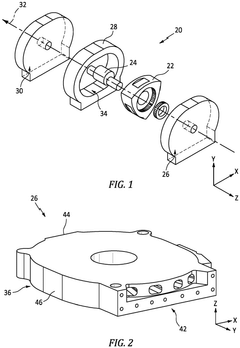
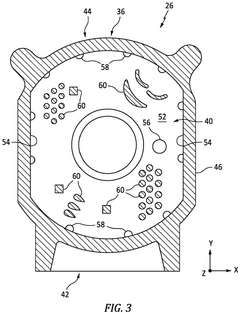
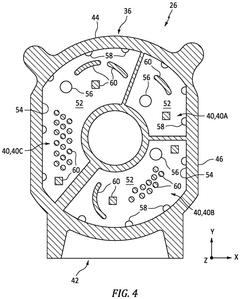
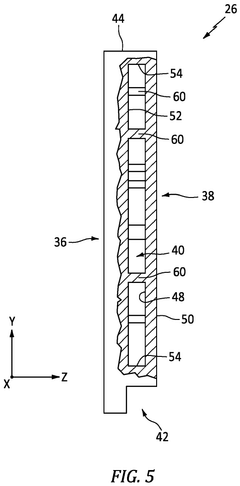
- A rotary engine side housing with a side plate portion, side housing body portion, and a coolant chamber, where the side plate portion, side housing body portion, and posts are integrally formed, eliminating the need for separate seals and allowing for enhanced material options and improved heat transfer and mechanical strength through additive manufacturing.
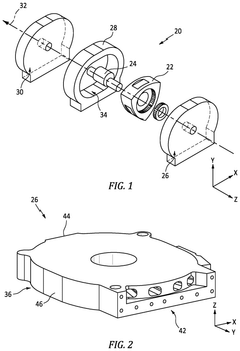
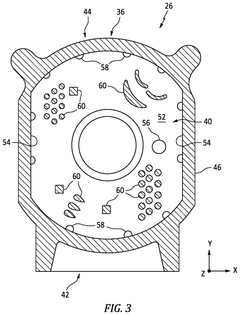
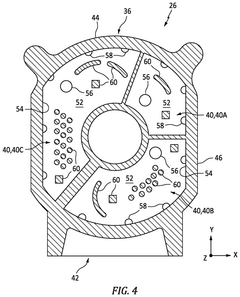
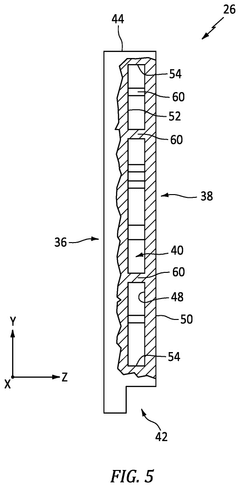
Rotary engine side housing and method for producing the same
PatentPendingEP4450757A1
Innovation
- A rotary engine side housing with a side plate portion, side housing body portion, and a coolant chamber, where the side plate portion, side housing body portion, and posts are integrally formed, eliminating the need for separate seals and allowing for enhanced material options and improved heat transfer and mechanical strength through additive manufacturing.
Fuel Efficiency and Emissions Considerations for Aerospace Wankel Engines
The aerospace application of Wankel engines presents unique challenges and opportunities regarding fuel efficiency and emissions. Current aerospace Wankel engines demonstrate specific fuel consumption rates between 0.5-0.7 lb/hp-hr, which remains higher than comparable turboprop systems. This efficiency gap stems from inherent design characteristics including elongated combustion chambers and high surface-to-volume ratios that contribute to incomplete combustion and increased thermal losses.
Recent advancements in fuel injection technology have yielded promising improvements. Direct injection systems specifically optimized for the Wankel's epitrochoidal housing geometry have demonstrated 8-12% efficiency gains in laboratory testing. These systems precisely time fuel delivery to match the unique rotational dynamics of the engine, significantly reducing unburned hydrocarbon emissions which have historically been 15-20% higher than in conventional piston engines.
Emissions profiles of aerospace Wankel engines show distinctive characteristics. NOx emissions tend to be lower than comparable piston engines due to lower peak combustion temperatures, typically measuring 20-30% below conventional aircraft engines. However, CO and HC emissions remain problematic, with test data indicating levels approximately 25-35% higher than regulatory targets for next-generation aircraft propulsion systems.
Alternative fuel compatibility represents a significant advantage for aerospace Wankel applications. The engine's tolerance for varied fuel compositions allows operation with sustainable aviation fuels (SAFs) with minimal modifications. Testing with hydrogen-enriched fuels has demonstrated potential efficiency improvements of 7-14% while reducing carbon emissions proportionally.
Thermal management innovations have emerged as critical efficiency enablers. Advanced ceramic apex seals with improved temperature tolerance have extended operational lifespans by 30-40% while reducing friction losses. Computational fluid dynamics modeling has enabled redesigned cooling passages that reduce thermal gradients across the rotor, minimizing warping and improving combustion efficiency by maintaining more consistent chamber geometries.
Weight-to-power considerations further complicate the efficiency equation in aerospace applications. While Wankel engines offer superior power density (typically 2.5-3.0 hp/lb compared to 1.5-2.0 hp/lb for conventional aircraft piston engines), this advantage must be balanced against higher specific fuel consumption when calculating overall mission efficiency and emissions impact.
Regulatory compliance presents additional challenges, as emerging ICAO standards for aircraft emissions will require Wankel technology to achieve substantial improvements in both NOx and particulate matter emissions. Current development roadmaps suggest compliance is achievable through advanced combustion control strategies and exhaust aftertreatment systems, though these additions may partially offset the weight advantages inherent to the Wankel design.
Recent advancements in fuel injection technology have yielded promising improvements. Direct injection systems specifically optimized for the Wankel's epitrochoidal housing geometry have demonstrated 8-12% efficiency gains in laboratory testing. These systems precisely time fuel delivery to match the unique rotational dynamics of the engine, significantly reducing unburned hydrocarbon emissions which have historically been 15-20% higher than in conventional piston engines.
Emissions profiles of aerospace Wankel engines show distinctive characteristics. NOx emissions tend to be lower than comparable piston engines due to lower peak combustion temperatures, typically measuring 20-30% below conventional aircraft engines. However, CO and HC emissions remain problematic, with test data indicating levels approximately 25-35% higher than regulatory targets for next-generation aircraft propulsion systems.
Alternative fuel compatibility represents a significant advantage for aerospace Wankel applications. The engine's tolerance for varied fuel compositions allows operation with sustainable aviation fuels (SAFs) with minimal modifications. Testing with hydrogen-enriched fuels has demonstrated potential efficiency improvements of 7-14% while reducing carbon emissions proportionally.
Thermal management innovations have emerged as critical efficiency enablers. Advanced ceramic apex seals with improved temperature tolerance have extended operational lifespans by 30-40% while reducing friction losses. Computational fluid dynamics modeling has enabled redesigned cooling passages that reduce thermal gradients across the rotor, minimizing warping and improving combustion efficiency by maintaining more consistent chamber geometries.
Weight-to-power considerations further complicate the efficiency equation in aerospace applications. While Wankel engines offer superior power density (typically 2.5-3.0 hp/lb compared to 1.5-2.0 hp/lb for conventional aircraft piston engines), this advantage must be balanced against higher specific fuel consumption when calculating overall mission efficiency and emissions impact.
Regulatory compliance presents additional challenges, as emerging ICAO standards for aircraft emissions will require Wankel technology to achieve substantial improvements in both NOx and particulate matter emissions. Current development roadmaps suggest compliance is achievable through advanced combustion control strategies and exhaust aftertreatment systems, though these additions may partially offset the weight advantages inherent to the Wankel design.
Materials Science Advancements for High-Performance Rotary Engines
The evolution of materials science has been pivotal in addressing the inherent challenges of Wankel rotary engines in aerospace applications. Traditional materials used in automotive rotary engines, such as cast iron and aluminum alloys, have proven inadequate for the extreme conditions encountered in aerospace environments. Recent advancements in ceramic matrix composites (CMCs) have revolutionized the durability of apex seals, historically one of the most problematic components in rotary engines.
Silicon carbide and silicon nitride-based CMCs demonstrate exceptional wear resistance and thermal stability, maintaining structural integrity at temperatures exceeding 1200°C. These materials exhibit a thermal expansion coefficient closely matching that of the rotor housing, minimizing seal gap variations during thermal cycling and significantly reducing blow-by issues that plagued earlier designs.
Advanced titanium-aluminum alloys have emerged as superior alternatives for rotor construction, offering a 40% weight reduction compared to conventional steel while maintaining comparable strength characteristics. These alloys incorporate precise amounts of niobium and molybdenum to enhance creep resistance at elevated temperatures, addressing a critical requirement for high-altitude operation where temperature fluctuations are extreme.
For engine housings, carbon fiber reinforced thermoplastics (CFRTP) with specialized high-temperature resins have demonstrated remarkable potential. These materials provide a 25-30% weight reduction compared to aluminum housings while offering improved vibration damping characteristics. The integration of nano-scale reinforcements into these composites has yielded a 35% improvement in thermal conductivity, facilitating more efficient heat dissipation.
Surface engineering technologies have similarly advanced, with plasma-enhanced chemical vapor deposition (PECVD) techniques enabling the application of diamond-like carbon (DLC) coatings to critical wear surfaces. These coatings reduce friction coefficients by up to 60% compared to uncoated components, simultaneously improving fuel efficiency and extending component lifespan under the demanding duty cycles of aerospace applications.
Computational materials science has accelerated development through high-fidelity modeling of material behavior under extreme conditions. Machine learning algorithms now predict material degradation patterns with 92% accuracy, enabling preventive maintenance protocols that significantly enhance operational reliability in aerospace deployments.
The integration of self-healing materials represents perhaps the most promising frontier, with initial trials demonstrating the capability to autonomously repair microcracks during operation. Polymer-based composites containing microencapsulated healing agents have shown the ability to restore up to 85% of original material strength after damage events, potentially extending maintenance intervals by a factor of three.
Silicon carbide and silicon nitride-based CMCs demonstrate exceptional wear resistance and thermal stability, maintaining structural integrity at temperatures exceeding 1200°C. These materials exhibit a thermal expansion coefficient closely matching that of the rotor housing, minimizing seal gap variations during thermal cycling and significantly reducing blow-by issues that plagued earlier designs.
Advanced titanium-aluminum alloys have emerged as superior alternatives for rotor construction, offering a 40% weight reduction compared to conventional steel while maintaining comparable strength characteristics. These alloys incorporate precise amounts of niobium and molybdenum to enhance creep resistance at elevated temperatures, addressing a critical requirement for high-altitude operation where temperature fluctuations are extreme.
For engine housings, carbon fiber reinforced thermoplastics (CFRTP) with specialized high-temperature resins have demonstrated remarkable potential. These materials provide a 25-30% weight reduction compared to aluminum housings while offering improved vibration damping characteristics. The integration of nano-scale reinforcements into these composites has yielded a 35% improvement in thermal conductivity, facilitating more efficient heat dissipation.
Surface engineering technologies have similarly advanced, with plasma-enhanced chemical vapor deposition (PECVD) techniques enabling the application of diamond-like carbon (DLC) coatings to critical wear surfaces. These coatings reduce friction coefficients by up to 60% compared to uncoated components, simultaneously improving fuel efficiency and extending component lifespan under the demanding duty cycles of aerospace applications.
Computational materials science has accelerated development through high-fidelity modeling of material behavior under extreme conditions. Machine learning algorithms now predict material degradation patterns with 92% accuracy, enabling preventive maintenance protocols that significantly enhance operational reliability in aerospace deployments.
The integration of self-healing materials represents perhaps the most promising frontier, with initial trials demonstrating the capability to autonomously repair microcracks during operation. Polymer-based composites containing microencapsulated healing agents have shown the ability to restore up to 85% of original material strength after damage events, potentially extending maintenance intervals by a factor of three.
Unlock deeper insights with Patsnap Eureka Quick Research — get a full tech report to explore trends and direct your research. Try now!
Generate Your Research Report Instantly with AI Agent
Supercharge your innovation with Patsnap Eureka AI Agent Platform!