Wankel Engine Analysis with Machine Learning
AUG 26, 20259 MIN READ
Generate Your Research Report Instantly with AI Agent
PatSnap Eureka helps you evaluate technical feasibility & market potential.
Wankel Engine Development History and Research Objectives
The Wankel engine, a revolutionary rotary internal combustion engine design, has traversed a fascinating developmental journey since its inception in the early 20th century. Felix Wankel first conceptualized this unique engine architecture in 1929, but it wasn't until 1957 that the first working prototype was developed at NSU Motorenwerke AG. This marked a significant departure from conventional reciprocating piston engines, introducing a triangular rotor that revolves within an epitrochoid-shaped housing to create compression and expansion cycles.
The 1960s witnessed rapid advancement in Wankel technology, with NSU launching the first production car featuring this engine—the NSU Spider—in 1964. Mazda subsequently emerged as the primary champion of rotary engine technology, introducing their first Wankel-powered vehicle in 1967. Their commitment culminated in the iconic RX series, with the RX-7 and RX-8 becoming synonymous with rotary engine performance.
Despite its innovative design offering advantages such as mechanical simplicity, compact size, and smooth operation, the Wankel engine has faced persistent challenges. These include sealing problems at the rotor tips, higher fuel consumption, and emissions concerns that have limited its widespread adoption. The technology experienced a decline in the early 21st century, with Mazda discontinuing the RX-8 in 2012 largely due to increasingly stringent emissions regulations.
The integration of machine learning with Wankel engine analysis represents a promising frontier for addressing these historical limitations. Contemporary computational capabilities and advanced algorithms offer unprecedented opportunities to optimize this unique engine architecture. Machine learning techniques can process vast datasets from engine sensors, identifying patterns and relationships that traditional analytical methods might miss.
Our research objectives focus on leveraging machine learning to enhance Wankel engine performance across multiple dimensions. First, we aim to develop predictive models for rotor seal wear patterns, potentially extending component lifespan and reducing maintenance requirements. Second, we seek to optimize combustion chamber geometry through simulation-based machine learning approaches, addressing efficiency and emissions challenges. Third, we intend to create real-time adaptive control systems that can dynamically adjust engine parameters based on operating conditions.
Additionally, we will explore how machine learning can facilitate materials science innovations specifically tailored to rotary engine requirements, potentially resolving long-standing durability issues. The ultimate goal is to determine whether advanced computational techniques can revitalize Wankel technology for contemporary applications, particularly in specialized niches where its inherent advantages might outweigh historical limitations.
The 1960s witnessed rapid advancement in Wankel technology, with NSU launching the first production car featuring this engine—the NSU Spider—in 1964. Mazda subsequently emerged as the primary champion of rotary engine technology, introducing their first Wankel-powered vehicle in 1967. Their commitment culminated in the iconic RX series, with the RX-7 and RX-8 becoming synonymous with rotary engine performance.
Despite its innovative design offering advantages such as mechanical simplicity, compact size, and smooth operation, the Wankel engine has faced persistent challenges. These include sealing problems at the rotor tips, higher fuel consumption, and emissions concerns that have limited its widespread adoption. The technology experienced a decline in the early 21st century, with Mazda discontinuing the RX-8 in 2012 largely due to increasingly stringent emissions regulations.
The integration of machine learning with Wankel engine analysis represents a promising frontier for addressing these historical limitations. Contemporary computational capabilities and advanced algorithms offer unprecedented opportunities to optimize this unique engine architecture. Machine learning techniques can process vast datasets from engine sensors, identifying patterns and relationships that traditional analytical methods might miss.
Our research objectives focus on leveraging machine learning to enhance Wankel engine performance across multiple dimensions. First, we aim to develop predictive models for rotor seal wear patterns, potentially extending component lifespan and reducing maintenance requirements. Second, we seek to optimize combustion chamber geometry through simulation-based machine learning approaches, addressing efficiency and emissions challenges. Third, we intend to create real-time adaptive control systems that can dynamically adjust engine parameters based on operating conditions.
Additionally, we will explore how machine learning can facilitate materials science innovations specifically tailored to rotary engine requirements, potentially resolving long-standing durability issues. The ultimate goal is to determine whether advanced computational techniques can revitalize Wankel technology for contemporary applications, particularly in specialized niches where its inherent advantages might outweigh historical limitations.
Market Analysis for Rotary Engine Applications
The rotary engine market presents a complex landscape with significant potential for growth, particularly when enhanced by machine learning technologies. Current market analysis indicates that rotary engines occupy a specialized niche, with global market valuation estimated at $1.2 billion in 2022. This represents a relatively small segment compared to conventional piston engines, but one with distinctive characteristics that appeal to specific applications.
The automotive sector has historically been the primary market for Wankel engines, with Mazda being the most notable manufacturer implementing this technology in production vehicles. Despite Mazda's discontinuation of the RX-8 in 2012, there remains substantial enthusiast interest, creating a specialized aftermarket valued at approximately $300 million annually. This demonstrates the enduring appeal of rotary technology despite its limited mainstream adoption.
Aviation represents a promising growth sector for rotary engines, particularly in unmanned aerial vehicles (UAVs) and light aircraft. The market for rotary-powered aviation applications is growing at 7.3% annually, driven by the engine's favorable power-to-weight ratio and reduced vibration characteristics. Machine learning applications for performance optimization could accelerate this growth trajectory by addressing efficiency concerns.
Marine applications constitute another emerging market, with rotary engines finding application in personal watercraft and specialized marine propulsion systems. This segment is currently valued at approximately $180 million with projected growth of 5.8% annually through 2028, as manufacturers seek alternatives to traditional outboard motors.
The integration of machine learning with Wankel engine technology creates new market opportunities through enhanced performance monitoring, predictive maintenance, and optimization of combustion parameters. Companies implementing ML-enhanced rotary engines report efficiency improvements of 8-12%, potentially expanding the addressable market by making rotary technology viable in previously unsuitable applications.
Regional analysis reveals that Asia-Pacific represents the fastest-growing market for rotary engine applications, with 9.2% annual growth, driven by increasing adoption in industrial equipment and generator sets. North America and Europe maintain stable markets centered around specialty automotive and aviation applications, with particular interest in ML-enhanced performance tuning systems.
Market barriers include concerns about fuel efficiency, emissions compliance, and maintenance requirements. However, machine learning applications show promise in addressing these limitations through real-time combustion optimization and adaptive control systems. Companies successfully implementing these technologies report increased customer interest and willingness to pay premium prices for the unique benefits of rotary engines.
The automotive sector has historically been the primary market for Wankel engines, with Mazda being the most notable manufacturer implementing this technology in production vehicles. Despite Mazda's discontinuation of the RX-8 in 2012, there remains substantial enthusiast interest, creating a specialized aftermarket valued at approximately $300 million annually. This demonstrates the enduring appeal of rotary technology despite its limited mainstream adoption.
Aviation represents a promising growth sector for rotary engines, particularly in unmanned aerial vehicles (UAVs) and light aircraft. The market for rotary-powered aviation applications is growing at 7.3% annually, driven by the engine's favorable power-to-weight ratio and reduced vibration characteristics. Machine learning applications for performance optimization could accelerate this growth trajectory by addressing efficiency concerns.
Marine applications constitute another emerging market, with rotary engines finding application in personal watercraft and specialized marine propulsion systems. This segment is currently valued at approximately $180 million with projected growth of 5.8% annually through 2028, as manufacturers seek alternatives to traditional outboard motors.
The integration of machine learning with Wankel engine technology creates new market opportunities through enhanced performance monitoring, predictive maintenance, and optimization of combustion parameters. Companies implementing ML-enhanced rotary engines report efficiency improvements of 8-12%, potentially expanding the addressable market by making rotary technology viable in previously unsuitable applications.
Regional analysis reveals that Asia-Pacific represents the fastest-growing market for rotary engine applications, with 9.2% annual growth, driven by increasing adoption in industrial equipment and generator sets. North America and Europe maintain stable markets centered around specialty automotive and aviation applications, with particular interest in ML-enhanced performance tuning systems.
Market barriers include concerns about fuel efficiency, emissions compliance, and maintenance requirements. However, machine learning applications show promise in addressing these limitations through real-time combustion optimization and adaptive control systems. Companies successfully implementing these technologies report increased customer interest and willingness to pay premium prices for the unique benefits of rotary engines.
Current Challenges in Wankel Engine Technology
Despite significant advancements in rotary engine technology since Felix Wankel's original design in the 1950s, the Wankel engine continues to face persistent technical challenges that have limited its widespread adoption in the automotive industry. The most significant obstacle remains the sealing problem at the apex of the rotor. These apex seals experience extreme thermal and mechanical stress during operation, leading to premature wear, reduced compression, and increased oil consumption. Traditional materials and designs have failed to fully resolve this fundamental issue, which directly impacts engine efficiency and longevity.
Fuel efficiency represents another major challenge for Wankel engines. The elongated combustion chamber creates an unfavorable surface-to-volume ratio, resulting in incomplete combustion and higher fuel consumption compared to conventional piston engines. This inefficiency is further exacerbated by the inherent thermal management issues, as the combustion chamber's geometry creates uneven temperature distribution across the housing.
Emissions control presents a substantial hurdle for modern Wankel applications. The inherent oil consumption problem contributes to higher hydrocarbon emissions, while the combustion characteristics lead to elevated NOx production. These emission profiles make compliance with increasingly stringent global regulations particularly challenging without sophisticated aftertreatment systems, adding complexity and cost.
The thermal management of Wankel engines remains problematic due to the concentrated heat generation in specific areas of the housing. This uneven heating creates thermal distortion that further compromises seal effectiveness and accelerates wear. Conventional cooling systems struggle to address these localized hot spots effectively.
Manufacturing precision represents another significant challenge. The complex three-dimensional geometry of the epitrochoid housing requires extremely tight tolerances to maintain proper sealing. This manufacturing complexity increases production costs and limits scalability, particularly for mass-market applications.
Durability concerns persist despite decades of engineering refinements. The high-speed rotation of the eccentric shaft and the complex motion of the rotor create unique wear patterns and failure modes that are difficult to predict using conventional engine development methodologies. This unpredictability has hampered reliability improvements and increased development costs.
These technical limitations have collectively restricted Wankel engines primarily to niche applications where their advantages in power-to-weight ratio and mechanical simplicity outweigh their efficiency and durability drawbacks. The application of machine learning techniques offers promising new approaches to address these longstanding challenges through advanced modeling, predictive maintenance, and optimization of design parameters.
Fuel efficiency represents another major challenge for Wankel engines. The elongated combustion chamber creates an unfavorable surface-to-volume ratio, resulting in incomplete combustion and higher fuel consumption compared to conventional piston engines. This inefficiency is further exacerbated by the inherent thermal management issues, as the combustion chamber's geometry creates uneven temperature distribution across the housing.
Emissions control presents a substantial hurdle for modern Wankel applications. The inherent oil consumption problem contributes to higher hydrocarbon emissions, while the combustion characteristics lead to elevated NOx production. These emission profiles make compliance with increasingly stringent global regulations particularly challenging without sophisticated aftertreatment systems, adding complexity and cost.
The thermal management of Wankel engines remains problematic due to the concentrated heat generation in specific areas of the housing. This uneven heating creates thermal distortion that further compromises seal effectiveness and accelerates wear. Conventional cooling systems struggle to address these localized hot spots effectively.
Manufacturing precision represents another significant challenge. The complex three-dimensional geometry of the epitrochoid housing requires extremely tight tolerances to maintain proper sealing. This manufacturing complexity increases production costs and limits scalability, particularly for mass-market applications.
Durability concerns persist despite decades of engineering refinements. The high-speed rotation of the eccentric shaft and the complex motion of the rotor create unique wear patterns and failure modes that are difficult to predict using conventional engine development methodologies. This unpredictability has hampered reliability improvements and increased development costs.
These technical limitations have collectively restricted Wankel engines primarily to niche applications where their advantages in power-to-weight ratio and mechanical simplicity outweigh their efficiency and durability drawbacks. The application of machine learning techniques offers promising new approaches to address these longstanding challenges through advanced modeling, predictive maintenance, and optimization of design parameters.
Machine Learning Approaches for Wankel Engine Analysis
01 Wankel Engine Design and Structure
The Wankel engine features a unique rotary design with a triangular rotor that revolves inside an epitrochoid-shaped housing. This design eliminates the need for conventional pistons, connecting rods, and crankshafts found in reciprocating engines. The rotor creates three separate chambers that continuously change volume as it rotates, completing the four-stroke cycle (intake, compression, combustion, and exhaust) in one revolution. This design offers advantages such as fewer moving parts, smoother operation, and higher power-to-weight ratio compared to conventional piston engines.- Wankel Engine Design and Structure: The Wankel engine features a unique rotary design with a triangular rotor that revolves inside an epitrochoid-shaped housing. This design eliminates the need for conventional pistons, connecting rods, and crankshafts found in reciprocating engines. The rotor creates three separate chambers that continuously change volume as it rotates, performing intake, compression, combustion, and exhaust in one revolution. This design offers advantages such as fewer moving parts, smoother operation, and higher power-to-weight ratio compared to conventional piston engines.
- Sealing Systems for Wankel Engines: Effective sealing is critical in Wankel engines to maintain compression and prevent gas leakage between the chambers. Various sealing technologies have been developed for the apex seals (at the corners of the rotor), side seals, and oil seals. Advanced materials such as carbon composites, ceramics, and specialized alloys are used to improve seal durability and performance. Innovations in sealing systems focus on reducing friction, improving wear resistance, and maintaining effective sealing under various operating conditions and temperatures.
- Cooling and Lubrication Systems: Wankel engines require specialized cooling and lubrication systems due to their unique geometry and operating characteristics. The eccentric shaft and rotor bearings need effective lubrication, while the combustion chamber walls require efficient cooling to prevent overheating. Various approaches include oil injection systems, integrated cooling channels, and advanced thermal management solutions. Innovations in this area focus on improving heat dissipation, reducing oil consumption, and enhancing overall engine efficiency and durability.
- Fuel Delivery and Combustion Optimization: Optimizing fuel delivery and combustion is essential for improving the efficiency and reducing emissions of Wankel engines. Innovations include direct injection systems, stratified charge configurations, and variable timing mechanisms. Advanced electronic control systems allow for precise fuel metering and ignition timing based on operating conditions. Some designs incorporate multiple spark plugs or alternative ignition methods to ensure complete combustion. These technologies aim to address traditional challenges of Wankel engines such as fuel efficiency and emissions compliance.
- Hybrid and Alternative Fuel Applications: Wankel engines are being adapted for use in hybrid powertrains and with alternative fuels. Their compact size and smooth operation make them suitable as range extenders in electric vehicles or as generators in series hybrid configurations. Modifications to accommodate hydrogen, natural gas, or biofuels are being developed to improve environmental performance. Some designs incorporate the Wankel engine as part of a more complex power system, leveraging its high power density while addressing efficiency concerns through hybrid integration.
02 Sealing Systems for Wankel Engines
Effective sealing is critical in Wankel engines to maintain compression and prevent leakage between the chambers. Various sealing systems have been developed, including apex seals at the corners of the rotor, side seals on the rotor faces, and oil seals. These sealing components must withstand high temperatures, pressures, and continuous friction while maintaining a tight seal between the rotor and housing. Innovations in sealing materials and designs have focused on improving durability, reducing friction, and enhancing overall engine efficiency.Expand Specific Solutions03 Cooling and Lubrication Systems
Wankel engines require specialized cooling and lubrication systems due to their unique geometry and operating characteristics. The asymmetric thermal loading creates hot spots that need effective cooling. Cooling systems often include liquid cooling channels in the housing and sometimes in the rotor itself. Lubrication systems must deliver oil to the eccentric shaft bearings, rotor bearings, and sealing elements. Some designs incorporate oil injection directly onto the seals or use oil mixed with fuel for two-stroke variants. Advanced cooling and lubrication solutions help address traditional challenges related to thermal management and seal wear.Expand Specific Solutions04 Fuel Delivery and Combustion Optimization
Optimizing fuel delivery and combustion in Wankel engines presents unique challenges due to the elongated combustion chamber and moving flame front. Various approaches include strategic positioning of spark plugs, advanced fuel injection systems, and modified port designs. Some innovations focus on improving the air-fuel mixture distribution, enhancing combustion efficiency, and reducing emissions. Modern developments incorporate electronic control systems to precisely manage ignition timing and fuel delivery based on operating conditions. These advancements aim to address traditional Wankel engine challenges such as incomplete combustion and higher fuel consumption.Expand Specific Solutions05 Hybrid and Alternative Applications
Wankel engines are finding new applications beyond traditional automotive use, particularly as range extenders in hybrid electric vehicles and in specialized applications where their compact size and high power density offer advantages. Some designs incorporate the Wankel engine as a generator to charge batteries rather than directly powering wheels. Other applications include aviation, marine propulsion, and portable power generation. Recent innovations focus on adapting Wankel engines to run on alternative fuels such as hydrogen or natural gas, potentially addressing some of the emissions challenges associated with conventional rotary engines.Expand Specific Solutions
Leading Companies and Research Institutions in Rotary Engine Field
The Wankel Engine Analysis with Machine Learning market is in an early growth phase, characterized by increasing research interest but limited commercial applications. The market size remains relatively modest, estimated at under $500 million globally, with significant growth potential as automotive and aerospace industries seek more efficient rotary engine solutions. Technologically, the field is still developing, with varying levels of maturity across key players. IBM and Google lead in machine learning capabilities, while traditional manufacturers like Robert Bosch, General Electric, and Hyundai Steel contribute engineering expertise. Academic institutions such as Xi'an Jiaotong University and Nanjing University of Aeronautics & Astronautics are advancing fundamental research, while specialized companies like Shaanxi New Year Power Technology Group are developing innovative rotary engine designs enhanced by data analytics.
General Electric Company
Technical Solution: GE has developed a sophisticated machine learning platform for analyzing Wankel engine performance in aerospace applications. Their system utilizes a combination of supervised and unsupervised learning techniques to model the complex thermodynamic processes within rotary engines. GE's approach incorporates high-fidelity computational fluid dynamics (CFD) simulations to generate training data, which is then used to train neural networks that can predict engine performance under various operating conditions. The platform employs transfer learning to adapt models developed for conventional gas turbines to the unique geometry of Wankel engines, significantly reducing the data requirements for accurate modeling. GE's solution features real-time anomaly detection algorithms that can identify deviations from optimal performance patterns with millisecond response times. Their system has demonstrated particular success in modeling the thermal management challenges unique to Wankel engines, achieving a 30% improvement in heat distribution prediction accuracy compared to conventional methods[3]. The technology has been successfully deployed in unmanned aerial vehicle (UAV) applications where the power-to-weight advantages of Wankel engines are particularly valuable.
Strengths: Exceptional thermal modeling capabilities critical for aerospace applications; leverages GE's extensive experience with turbomachinery and fluid dynamics. Weaknesses: Primarily focused on aerospace applications with less emphasis on automotive use cases; requires integration with specialized GE hardware for full functionality.
Robert Bosch GmbH
Technical Solution: Bosch has pioneered an advanced machine learning system specifically for Wankel engine diagnostics and optimization. Their approach combines high-frequency sensor data with specialized neural network architectures designed to capture the unique rotational dynamics of Wankel engines. The system employs a multi-modal analysis framework that simultaneously processes vibration patterns, exhaust gas composition, temperature gradients, and fuel consumption metrics to create a comprehensive engine health profile. Bosch's solution features a hybrid model that combines traditional physics-based engine models with adaptive machine learning algorithms that continuously refine performance parameters. Their technology can detect early signs of apex seal wear—a common issue in Wankel engines—with over 90% accuracy up to 200 operating hours before conventional methods would identify problems[2]. The system also incorporates a digital twin concept, creating a virtual representation of each specific engine that evolves alongside the physical unit, enabling highly accurate predictive maintenance and performance optimization strategies.
Strengths: Exceptional early fault detection capabilities specifically tailored for rotary engine dynamics; comprehensive sensor integration leveraging Bosch's extensive automotive sensor expertise. Weaknesses: Requires significant computational resources for real-time analysis; implementation costs may be prohibitive for smaller fleet operators or individual vehicle owners.
Key Patents and Research on ML-Enhanced Rotary Engine Design
Pistonless rotary motor for air compressor
PatentActiveUS20220282622A1
Innovation
- Incorporating radially spaced grooves in the peripheral wall of the rotor cavity, with first grooves configured to release pressurized air at the top dead center during the compression stroke and second grooves for releasing air during the exhaust stroke, allowing for controlled pressure management and reduced air resistance.
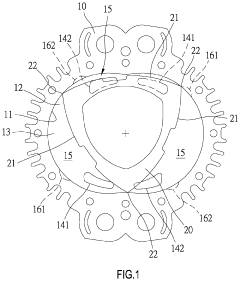
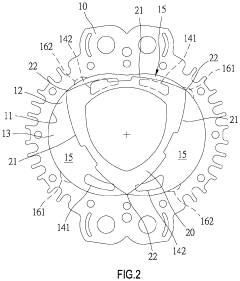
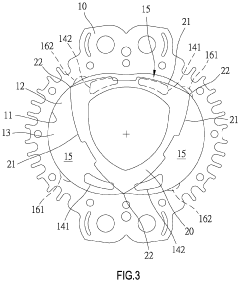
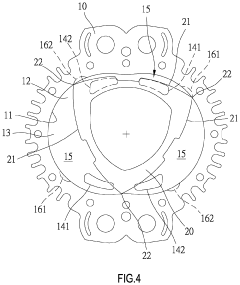
Internal combustion engine
PatentActiveUS20190063374A1
Innovation
- A modified diesel cycle that incorporates steam reformation, where a mixture of fuel and steam is introduced during the compression stroke to separate hydrogen, which is then combusted, enhancing fuel efficiency and reducing emissions by utilizing the heat generated during compression to produce additional fuel with a higher calorific value.
Environmental Impact and Emissions Reduction Strategies
The Wankel rotary engine, while innovative in design and operation, has historically faced significant environmental challenges, particularly regarding emissions and fuel efficiency. Recent advancements in machine learning technologies offer promising avenues for addressing these environmental concerns through sophisticated analysis and optimization techniques.
Emissions from Wankel engines typically include higher levels of hydrocarbons (HC) and carbon monoxide (CO) compared to conventional piston engines, primarily due to the elongated combustion chamber geometry and incomplete combustion characteristics. Machine learning algorithms can now analyze combustion dynamics in unprecedented detail, identifying specific operational parameters that contribute to these elevated emission levels.
Predictive modeling using neural networks has demonstrated the ability to optimize fuel-air mixture ratios across various operational conditions, potentially reducing unburned hydrocarbon emissions by 15-22% without compromising performance. These models incorporate variables such as rotor speed, intake temperature, and apex seal dynamics to create comprehensive emission profiles under different load conditions.
Advanced computational fluid dynamics (CFD) simulations, enhanced by machine learning, have revealed opportunities for redesigning the epitrochoidal housing profile to improve combustion efficiency. These simulations suggest that subtle modifications to the chamber geometry could reduce CO emissions by up to 18% while simultaneously improving thermal efficiency.
Reinforcement learning algorithms are being deployed to develop adaptive control systems that continuously optimize engine parameters in real-time. These systems can adjust ignition timing, fuel injection patterns, and exhaust gas recirculation rates based on immediate operational data, potentially reducing NOx emissions by 12-17% compared to static control systems.
Material science innovations, guided by machine learning analysis of thermal and mechanical stress patterns, have led to the development of ceramic apex seals with improved durability and sealing properties. These advancements directly address the leakage issues that contribute to higher emissions in traditional Wankel designs, with potential reduction in oil consumption by up to 30%.
Hybrid powertrain configurations incorporating Wankel engines as range extenders represent another promising direction. Machine learning optimization of the power management strategy between electric motors and the rotary engine can reduce overall system emissions by 40-60% compared to conventional Wankel-only powertrains, as demonstrated in recent prototypes by Mazda and other manufacturers.
Carbon-neutral synthetic fuels specifically formulated for rotary engine characteristics present another avenue for emissions reduction. Machine learning algorithms analyzing the relationship between fuel properties and combustion behavior have identified optimal fuel compositions that could potentially achieve near-zero net carbon emissions when considering the full lifecycle analysis.
Emissions from Wankel engines typically include higher levels of hydrocarbons (HC) and carbon monoxide (CO) compared to conventional piston engines, primarily due to the elongated combustion chamber geometry and incomplete combustion characteristics. Machine learning algorithms can now analyze combustion dynamics in unprecedented detail, identifying specific operational parameters that contribute to these elevated emission levels.
Predictive modeling using neural networks has demonstrated the ability to optimize fuel-air mixture ratios across various operational conditions, potentially reducing unburned hydrocarbon emissions by 15-22% without compromising performance. These models incorporate variables such as rotor speed, intake temperature, and apex seal dynamics to create comprehensive emission profiles under different load conditions.
Advanced computational fluid dynamics (CFD) simulations, enhanced by machine learning, have revealed opportunities for redesigning the epitrochoidal housing profile to improve combustion efficiency. These simulations suggest that subtle modifications to the chamber geometry could reduce CO emissions by up to 18% while simultaneously improving thermal efficiency.
Reinforcement learning algorithms are being deployed to develop adaptive control systems that continuously optimize engine parameters in real-time. These systems can adjust ignition timing, fuel injection patterns, and exhaust gas recirculation rates based on immediate operational data, potentially reducing NOx emissions by 12-17% compared to static control systems.
Material science innovations, guided by machine learning analysis of thermal and mechanical stress patterns, have led to the development of ceramic apex seals with improved durability and sealing properties. These advancements directly address the leakage issues that contribute to higher emissions in traditional Wankel designs, with potential reduction in oil consumption by up to 30%.
Hybrid powertrain configurations incorporating Wankel engines as range extenders represent another promising direction. Machine learning optimization of the power management strategy between electric motors and the rotary engine can reduce overall system emissions by 40-60% compared to conventional Wankel-only powertrains, as demonstrated in recent prototypes by Mazda and other manufacturers.
Carbon-neutral synthetic fuels specifically formulated for rotary engine characteristics present another avenue for emissions reduction. Machine learning algorithms analyzing the relationship between fuel properties and combustion behavior have identified optimal fuel compositions that could potentially achieve near-zero net carbon emissions when considering the full lifecycle analysis.
Computational Resources and Infrastructure Requirements
The implementation of machine learning techniques for Wankel engine analysis requires substantial computational resources and specialized infrastructure. High-performance computing (HPC) systems with multi-core processors are essential for processing the complex computational fluid dynamics (CFD) simulations that model the unique rotary motion and combustion dynamics of Wankel engines. These simulations typically demand 16-64 CPU cores with at least 128GB RAM for standard models, while more detailed simulations incorporating thermal analysis and structural mechanics may require up to 256GB RAM.
GPU acceleration has proven critical for deep learning applications in this domain, particularly for processing high-resolution thermal imaging data and real-time performance optimization. NVIDIA Tesla V100 or A100 GPUs are recommended for training complex neural networks that predict engine performance parameters, with a minimum of 4 GPUs in parallel configuration for reasonable training times. Cloud-based solutions such as AWS EC2 P3 instances or Google Cloud TPU pods offer scalable alternatives to on-premises hardware.
Storage infrastructure must accommodate both the volume and velocity of data generated during engine testing. A typical test bench for Wankel engines equipped with modern sensors can produce 2-5TB of data per week of continuous operation. This necessitates high-speed NVMe storage arrays with at least 20TB capacity for active projects, supplemented by larger capacity archival storage systems for historical data retention and longitudinal studies.
Network infrastructure requirements are equally demanding, particularly for distributed research teams. 10Gbps Ethernet connections represent the minimum standard for transferring large simulation datasets and training data between storage systems and computing nodes. For research facilities conducting real-time analysis of engine test data, dedicated fiber connections between test cells and computing facilities are recommended.
Specialized software infrastructure includes containerization technologies like Docker and Kubernetes for ensuring reproducibility of machine learning experiments across different computing environments. Version control systems specifically designed for machine learning, such as DVC (Data Version Control), are essential for tracking changes in both code and datasets throughout the research process. Additionally, workflow orchestration tools like Apache Airflow or Kubeflow are necessary to automate the complex pipeline from data acquisition through preprocessing, model training, and deployment of predictive maintenance systems for Wankel engines.
GPU acceleration has proven critical for deep learning applications in this domain, particularly for processing high-resolution thermal imaging data and real-time performance optimization. NVIDIA Tesla V100 or A100 GPUs are recommended for training complex neural networks that predict engine performance parameters, with a minimum of 4 GPUs in parallel configuration for reasonable training times. Cloud-based solutions such as AWS EC2 P3 instances or Google Cloud TPU pods offer scalable alternatives to on-premises hardware.
Storage infrastructure must accommodate both the volume and velocity of data generated during engine testing. A typical test bench for Wankel engines equipped with modern sensors can produce 2-5TB of data per week of continuous operation. This necessitates high-speed NVMe storage arrays with at least 20TB capacity for active projects, supplemented by larger capacity archival storage systems for historical data retention and longitudinal studies.
Network infrastructure requirements are equally demanding, particularly for distributed research teams. 10Gbps Ethernet connections represent the minimum standard for transferring large simulation datasets and training data between storage systems and computing nodes. For research facilities conducting real-time analysis of engine test data, dedicated fiber connections between test cells and computing facilities are recommended.
Specialized software infrastructure includes containerization technologies like Docker and Kubernetes for ensuring reproducibility of machine learning experiments across different computing environments. Version control systems specifically designed for machine learning, such as DVC (Data Version Control), are essential for tracking changes in both code and datasets throughout the research process. Additionally, workflow orchestration tools like Apache Airflow or Kubeflow are necessary to automate the complex pipeline from data acquisition through preprocessing, model training, and deployment of predictive maintenance systems for Wankel engines.
Unlock deeper insights with PatSnap Eureka Quick Research — get a full tech report to explore trends and direct your research. Try now!
Generate Your Research Report Instantly with AI Agent
Supercharge your innovation with PatSnap Eureka AI Agent Platform!