Wankel Engine Coating Technologies for Extreme Environments
AUG 26, 20259 MIN READ
Generate Your Research Report Instantly with AI Agent
PatSnap Eureka helps you evaluate technical feasibility & market potential.
Wankel Engine Coating Evolution and Objectives
The Wankel rotary engine, first developed in the 1950s by Felix Wankel, represents a significant departure from conventional reciprocating piston engines. Its unique triangular rotor design operating within an epitrochoid housing creates distinct technical challenges, particularly regarding surface coatings. The evolution of coating technologies for these engines has been driven by the need to address specific operational issues including apex seal wear, thermal management, and combustion chamber sealing under extreme conditions.
Early Wankel engines utilized basic chrome plating on the epitrochoid surface, providing minimal wear resistance but insufficient durability for high-performance applications. The 1970s saw the introduction of hard chrome coatings with improved wear characteristics, though these still struggled with thermal cycling and chemical resistance in high-temperature environments. This period established the fundamental requirements for rotary engine coatings: wear resistance, thermal stability, and chemical inertness.
The 1980s-1990s marked a significant advancement with the development of plasma-sprayed ceramic coatings, particularly aluminum oxide and chromium oxide composites. Mazda's implementation of these technologies in their RX series engines demonstrated substantial improvements in durability and performance. These developments coincided with growing understanding of tribological interactions specific to the rotary engine's unique geometry.
Recent decades have witnessed revolutionary advancements in coating technologies, including Physical Vapor Deposition (PVD) and Chemical Vapor Deposition (CVD) techniques. These methods enable the application of diamond-like carbon (DLC) coatings and thermal barrier coatings (TBCs) with nanoscale precision. Such innovations have dramatically enhanced wear resistance while simultaneously improving thermal efficiency.
The current technological trajectory aims to develop multi-functional coating systems capable of withstanding increasingly extreme operating conditions. These include higher combustion temperatures for improved efficiency, compatibility with alternative fuels including hydrogen, and reduced emissions. Advanced ceramic matrix composites and cermet coatings represent the cutting edge of this field.
The primary objectives for next-generation Wankel engine coatings include: extending operational lifespan beyond 200,000 miles without significant performance degradation; enabling sustained operation at temperatures exceeding 1000°C; reducing friction coefficients below 0.1 across all operating conditions; and maintaining coating integrity under the corrosive effects of modern fuel additives and combustion byproducts.
Additionally, environmental considerations are driving research toward coating technologies that eliminate environmentally harmful elements such as hexavalent chromium while maintaining or exceeding performance standards. This evolution reflects broader industry trends toward sustainable manufacturing processes and materials science innovations.
Early Wankel engines utilized basic chrome plating on the epitrochoid surface, providing minimal wear resistance but insufficient durability for high-performance applications. The 1970s saw the introduction of hard chrome coatings with improved wear characteristics, though these still struggled with thermal cycling and chemical resistance in high-temperature environments. This period established the fundamental requirements for rotary engine coatings: wear resistance, thermal stability, and chemical inertness.
The 1980s-1990s marked a significant advancement with the development of plasma-sprayed ceramic coatings, particularly aluminum oxide and chromium oxide composites. Mazda's implementation of these technologies in their RX series engines demonstrated substantial improvements in durability and performance. These developments coincided with growing understanding of tribological interactions specific to the rotary engine's unique geometry.
Recent decades have witnessed revolutionary advancements in coating technologies, including Physical Vapor Deposition (PVD) and Chemical Vapor Deposition (CVD) techniques. These methods enable the application of diamond-like carbon (DLC) coatings and thermal barrier coatings (TBCs) with nanoscale precision. Such innovations have dramatically enhanced wear resistance while simultaneously improving thermal efficiency.
The current technological trajectory aims to develop multi-functional coating systems capable of withstanding increasingly extreme operating conditions. These include higher combustion temperatures for improved efficiency, compatibility with alternative fuels including hydrogen, and reduced emissions. Advanced ceramic matrix composites and cermet coatings represent the cutting edge of this field.
The primary objectives for next-generation Wankel engine coatings include: extending operational lifespan beyond 200,000 miles without significant performance degradation; enabling sustained operation at temperatures exceeding 1000°C; reducing friction coefficients below 0.1 across all operating conditions; and maintaining coating integrity under the corrosive effects of modern fuel additives and combustion byproducts.
Additionally, environmental considerations are driving research toward coating technologies that eliminate environmentally harmful elements such as hexavalent chromium while maintaining or exceeding performance standards. This evolution reflects broader industry trends toward sustainable manufacturing processes and materials science innovations.
Market Analysis for High-Performance Rotary Engines
The global market for high-performance rotary engines continues to evolve, driven by increasing demand for lightweight, compact power solutions across multiple sectors. The Wankel rotary engine, with its unique design offering high power-to-weight ratio, has established a specialized but significant market position despite historical challenges with sealing and efficiency.
Current market valuations indicate the high-performance rotary engine segment represents approximately $2.3 billion annually, with projected growth rates of 5.7% through 2028. This growth is primarily fueled by applications in specialized automotive niches, aerospace, marine propulsion, and unmanned aerial vehicles (UAVs) where power density advantages outweigh efficiency concerns.
The automotive sector remains the largest application area, particularly in sports car and racing applications where the Wankel's compact size and smooth operation provide competitive advantages. Mazda's historical investment in rotary technology has created a loyal customer base, while their recent reintroduction of rotary engines as range extenders in electric vehicles signals new market directions.
Aerospace and defense applications represent the fastest-growing segment, expanding at 8.3% annually. The rotary engine's vibration-free operation and excellent altitude performance make it particularly suitable for small aircraft and military drone applications where reliability in extreme environments is paramount.
Regional analysis shows Japan maintaining leadership in rotary engine technology development, holding 42% of related patents. North America follows with 27% market share, while European manufacturers focus primarily on high-end applications where premium pricing supports advanced coating technology investments.
Consumer demand patterns reveal increasing interest in environmentally sustainable high-performance engines, creating market pressure for improved efficiency and reduced emissions. This trend directly impacts coating technology requirements, as manufacturers seek solutions that can withstand higher combustion temperatures while reducing friction losses.
Market barriers include stringent emissions regulations, high manufacturing costs for specialized coatings, and competition from alternative propulsion technologies. The premium pricing of advanced coating solutions limits mass-market adoption, with current technology adding between $1,200-3,500 to production costs depending on application requirements.
Industry forecasts suggest coating technologies specifically designed for extreme environment applications will experience 12.4% compound annual growth through 2027, outpacing the broader rotary engine market. This acceleration reflects the critical role advanced coatings play in addressing historical durability challenges while enabling new applications in previously unsuitable environments.
Current market valuations indicate the high-performance rotary engine segment represents approximately $2.3 billion annually, with projected growth rates of 5.7% through 2028. This growth is primarily fueled by applications in specialized automotive niches, aerospace, marine propulsion, and unmanned aerial vehicles (UAVs) where power density advantages outweigh efficiency concerns.
The automotive sector remains the largest application area, particularly in sports car and racing applications where the Wankel's compact size and smooth operation provide competitive advantages. Mazda's historical investment in rotary technology has created a loyal customer base, while their recent reintroduction of rotary engines as range extenders in electric vehicles signals new market directions.
Aerospace and defense applications represent the fastest-growing segment, expanding at 8.3% annually. The rotary engine's vibration-free operation and excellent altitude performance make it particularly suitable for small aircraft and military drone applications where reliability in extreme environments is paramount.
Regional analysis shows Japan maintaining leadership in rotary engine technology development, holding 42% of related patents. North America follows with 27% market share, while European manufacturers focus primarily on high-end applications where premium pricing supports advanced coating technology investments.
Consumer demand patterns reveal increasing interest in environmentally sustainable high-performance engines, creating market pressure for improved efficiency and reduced emissions. This trend directly impacts coating technology requirements, as manufacturers seek solutions that can withstand higher combustion temperatures while reducing friction losses.
Market barriers include stringent emissions regulations, high manufacturing costs for specialized coatings, and competition from alternative propulsion technologies. The premium pricing of advanced coating solutions limits mass-market adoption, with current technology adding between $1,200-3,500 to production costs depending on application requirements.
Industry forecasts suggest coating technologies specifically designed for extreme environment applications will experience 12.4% compound annual growth through 2027, outpacing the broader rotary engine market. This acceleration reflects the critical role advanced coatings play in addressing historical durability challenges while enabling new applications in previously unsuitable environments.
Current Coating Technologies and Environmental Challenges
Wankel engines operate in particularly demanding environments characterized by high temperatures, significant mechanical stress, and exposure to corrosive combustion byproducts. Current coating technologies for these rotary engines have evolved significantly to address these extreme conditions, with several specialized solutions now available in the market.
Thermal spray coatings represent one of the most widely adopted technologies for Wankel engine applications. These include plasma-sprayed ceramic coatings such as yttria-stabilized zirconia (YSZ), which provides excellent thermal insulation properties critical for maintaining optimal operating temperatures within the engine housing. Additionally, high-velocity oxygen fuel (HVOF) sprayed cermet coatings combining tungsten carbide with cobalt or nickel-chromium binders offer superior wear resistance at the critical apex seal interfaces.
Physical vapor deposition (PVD) techniques have gained significant traction for coating Wankel engine components. Diamond-like carbon (DLC) coatings applied through PVD processes provide exceptional hardness and low friction coefficients, substantially reducing wear at the critical rotor-housing interface. These coatings typically range from 2-5 μm in thickness and can reduce friction coefficients to as low as 0.1 under optimal conditions.
Chemical vapor deposition (CVD) methods deliver highly conformal coatings with excellent adhesion properties. Silicon carbide (SiC) and titanium nitride (TiN) coatings applied via CVD have demonstrated remarkable resistance to high-temperature oxidation and chemical corrosion from fuel contaminants and combustion byproducts.
Despite these technological advances, significant environmental challenges persist. The extreme temperature gradients within Wankel engines—often exceeding 200°C differential across components—create thermal expansion mismatches that can lead to coating delamination and failure. This is particularly problematic at the interface between the rotor and housing where tight tolerances must be maintained.
Combustion byproducts present another major challenge, as acidic compounds formed during fuel combustion can rapidly degrade conventional coatings. This is exacerbated in modern engines using alternative fuels or operating with exhaust gas recirculation systems, which introduce additional corrosive elements into the combustion environment.
Mechanical stress from the eccentric rotational motion creates unique wear patterns that conventional coating technologies struggle to address uniformly. The apex seals, in particular, experience concentrated loading that can exceed 100 MPa during operation, leading to accelerated coating degradation at these critical points.
Emerging environmental regulations also pose challenges for coating technologies, as traditional formulations containing hexavalent chromium and other environmentally hazardous materials face increasing restrictions, necessitating the development of more environmentally sustainable alternatives without compromising performance.
Thermal spray coatings represent one of the most widely adopted technologies for Wankel engine applications. These include plasma-sprayed ceramic coatings such as yttria-stabilized zirconia (YSZ), which provides excellent thermal insulation properties critical for maintaining optimal operating temperatures within the engine housing. Additionally, high-velocity oxygen fuel (HVOF) sprayed cermet coatings combining tungsten carbide with cobalt or nickel-chromium binders offer superior wear resistance at the critical apex seal interfaces.
Physical vapor deposition (PVD) techniques have gained significant traction for coating Wankel engine components. Diamond-like carbon (DLC) coatings applied through PVD processes provide exceptional hardness and low friction coefficients, substantially reducing wear at the critical rotor-housing interface. These coatings typically range from 2-5 μm in thickness and can reduce friction coefficients to as low as 0.1 under optimal conditions.
Chemical vapor deposition (CVD) methods deliver highly conformal coatings with excellent adhesion properties. Silicon carbide (SiC) and titanium nitride (TiN) coatings applied via CVD have demonstrated remarkable resistance to high-temperature oxidation and chemical corrosion from fuel contaminants and combustion byproducts.
Despite these technological advances, significant environmental challenges persist. The extreme temperature gradients within Wankel engines—often exceeding 200°C differential across components—create thermal expansion mismatches that can lead to coating delamination and failure. This is particularly problematic at the interface between the rotor and housing where tight tolerances must be maintained.
Combustion byproducts present another major challenge, as acidic compounds formed during fuel combustion can rapidly degrade conventional coatings. This is exacerbated in modern engines using alternative fuels or operating with exhaust gas recirculation systems, which introduce additional corrosive elements into the combustion environment.
Mechanical stress from the eccentric rotational motion creates unique wear patterns that conventional coating technologies struggle to address uniformly. The apex seals, in particular, experience concentrated loading that can exceed 100 MPa during operation, leading to accelerated coating degradation at these critical points.
Emerging environmental regulations also pose challenges for coating technologies, as traditional formulations containing hexavalent chromium and other environmentally hazardous materials face increasing restrictions, necessitating the development of more environmentally sustainable alternatives without compromising performance.
Existing Coating Solutions for Extreme Temperature Applications
01 Thermal barrier coatings for Wankel engine components
Thermal barrier coatings are applied to various components of Wankel engines to improve thermal efficiency and protect against high operating temperatures. These coatings help to reduce heat transfer from combustion gases to the engine structure, allowing for higher operating temperatures and improved efficiency. The coatings typically consist of ceramic materials that provide excellent thermal insulation properties while maintaining durability under extreme conditions.- Thermal barrier coatings for Wankel engine components: Thermal barrier coatings are applied to various components of Wankel engines to improve heat resistance and thermal efficiency. These coatings help to reduce heat transfer from combustion gases to the engine structure, allowing for higher operating temperatures and improved fuel efficiency. The coatings typically consist of ceramic materials that can withstand high temperatures while providing insulation properties, protecting the underlying metal components from thermal degradation.
- Wear-resistant coatings for sealing surfaces: Specialized wear-resistant coatings are applied to the sealing surfaces of Wankel engines, particularly on the rotor apex seals and housing walls. These coatings are designed to reduce friction and wear between moving components, extending the service life of the engine. Materials used include chromium nitride, tungsten carbide, and diamond-like carbon coatings that provide exceptional hardness and low friction coefficients, improving the sealing performance and reducing power losses due to friction.
- Anti-corrosion and protective coatings: Anti-corrosion coatings are applied to Wankel engine components to protect against chemical degradation from combustion byproducts and environmental factors. These protective layers prevent oxidation and corrosion of metal surfaces, particularly in areas exposed to high temperatures and aggressive combustion products. The coatings may include aluminum-based compounds, nickel alloys, or specialized polymers that form a barrier against corrosive elements while maintaining adhesion under thermal cycling conditions.
- Advanced deposition techniques for engine coatings: Various advanced deposition techniques are employed to apply coatings to Wankel engine components with precise thickness control and excellent adhesion. These methods include physical vapor deposition (PVD), chemical vapor deposition (CVD), plasma spraying, and electroplating. Each technique offers specific advantages for different coating materials and component geometries, allowing manufacturers to optimize the coating process for particular engine parts and operating conditions. These techniques enable the application of complex multi-layer coating systems that combine different functional properties.
- Specialized coatings for improved combustion efficiency: Specialized coatings are applied to combustion chamber surfaces in Wankel engines to enhance combustion efficiency and reduce emissions. These coatings can modify the thermal properties of the combustion chamber, catalyze fuel burning, or reduce quenching effects. By optimizing the surface properties of the combustion chamber, these coatings help to promote more complete combustion, reduce hydrocarbon emissions, and improve fuel efficiency. Some coatings also incorporate catalytic materials that can help break down pollutants directly within the combustion chamber.
02 Wear-resistant coatings for sealing elements
Specialized wear-resistant coatings are applied to the sealing elements of Wankel engines, such as apex seals and side seals, to improve durability and reduce friction. These coatings typically include hard materials like chromium nitride, tungsten carbide, or diamond-like carbon that can withstand the sliding contact and high temperatures experienced by sealing components. The improved wear resistance helps maintain proper sealing, reduces oil consumption, and extends the service life of the engine.Expand Specific Solutions03 Anti-corrosion and protective coatings
Anti-corrosion and protective coatings are applied to Wankel engine components to prevent degradation from combustion byproducts, fuel contaminants, and environmental factors. These coatings typically include various metal alloys, polymers, or composite materials that create a barrier against corrosive substances while maintaining thermal stability. The protection provided by these coatings helps to extend component life and maintain engine performance over time.Expand Specific Solutions04 Advanced surface treatments for rotor housings
Specialized surface treatments and coatings are applied to Wankel engine rotor housings to improve tribological properties and heat management. These treatments may include plasma spraying, physical vapor deposition, or electroplating processes to apply materials such as nickel-silicon carbide, molybdenum, or specialized aluminum alloys. The treated surfaces provide improved wear resistance, reduced friction, and better heat distribution, resulting in enhanced engine performance and longevity.Expand Specific Solutions05 Novel coating materials and application methods
Innovative coating materials and application techniques are being developed specifically for Wankel engine components to address the unique challenges of rotary engine design. These include nano-structured coatings, composite materials with gradient properties, and multi-layer coating systems that combine different functional properties. Advanced application methods such as high-velocity oxygen fuel spraying, cold spray technology, and atomic layer deposition allow for precise control of coating thickness and properties, resulting in optimized performance characteristics for specific engine components.Expand Specific Solutions
Leading Manufacturers and Research Institutions
The Wankel engine coating technology market for extreme environments is in a growth phase, with increasing demand driven by aerospace, automotive, and energy sectors. The market size is expanding as these industries seek more efficient and durable rotary engine solutions. Technologically, the field is moderately mature but rapidly evolving, with key players demonstrating varying levels of expertise. General Electric, Rolls-Royce, and Pratt & Whitney lead with advanced thermal barrier coating technologies, while Oerlikon Surface Solutions and TOCALO offer specialized surface treatment solutions. Research institutions like Beihang University and NASA contribute significant innovations in ceramic and composite coatings, pushing the boundaries of temperature resistance and durability for next-generation Wankel applications.
Rolls-Royce Corp.
Technical Solution: Rolls-Royce has developed advanced ceramic matrix composite (CMC) coatings specifically engineered for Wankel rotary engines operating in extreme environments. Their proprietary thermal barrier coating system combines yttria-stabilized zirconia (YSZ) with novel rare earth elements to achieve superior thermal insulation properties. The coating is applied through a modified plasma spray process that creates a nanostructured surface with controlled porosity, allowing for better strain tolerance during thermal cycling. Rolls-Royce's coating technology incorporates a multilayer approach with a metallic bond coat, thermally grown oxide layer, and ceramic top coat that together provide protection against temperatures exceeding 1200°C while maintaining structural integrity. Recent advancements include the integration of self-healing capabilities through the incorporation of phase-change materials that can flow into and repair microcracks during operation.
Strengths: Superior thermal resistance with documented performance at temperatures up to 1200°C; excellent wear resistance in high-speed rotary applications; self-healing properties reduce maintenance requirements. Weaknesses: Higher manufacturing costs compared to conventional coatings; requires specialized application equipment; limited field testing data in certain extreme environment applications.
Honeywell International Technologies Ltd.
Technical Solution: Honeywell has developed a comprehensive thermal spray coating solution specifically for Wankel engine applications in aerospace and defense sectors. Their HVOF (High Velocity Oxy-Fuel) applied tungsten carbide-cobalt-chromium (WC-Co-Cr) coatings provide exceptional wear resistance while maintaining dimensional stability in extreme temperature fluctuations. The company's proprietary process creates a dense coating with less than 1% porosity, critical for maintaining compression in Wankel engines. Honeywell's coating system incorporates a graduated hardness profile from 1100 HV at the substrate interface to over 1500 HV at the surface, allowing for better stress distribution during thermal cycling. Their latest innovation includes nano-dispersed ceramic particles within the metallic matrix, creating a composite coating that combines excellent wear resistance with thermal barrier properties, addressing the dual challenges of friction and heat management in Wankel engines operating in extreme environments.
Strengths: Exceptional wear resistance with documented service life improvements of 300% compared to uncoated components; excellent thermal cycling stability; proven performance in both high-temperature and corrosive environments. Weaknesses: Higher weight addition compared to some competing technologies; requires specialized application equipment; more difficult to repair in field conditions.
Critical Patents in Apex Seal and Epitrochoid Surface Coatings
Rotary internal combustion engine
PatentWO2007028487A1
Innovation
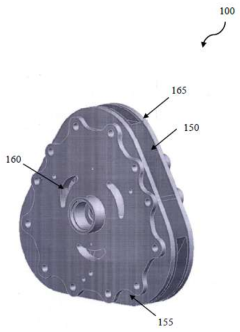
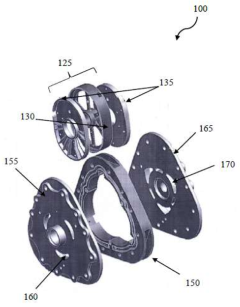
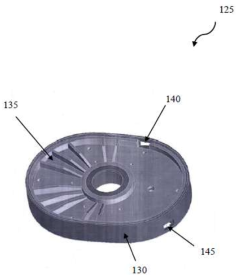
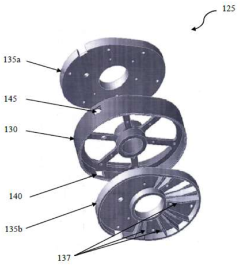
- A rotary internal combustion engine with rotationally symmetrical, ring-shaped combustion chambers and circular segment pistons arranged in a circular pattern, improving sealing and combustion efficiency by using a section of the pistons to seal the chambers, similar to reciprocating engines, and connecting pistons to a torsionally rigid output shaft for power transmission.
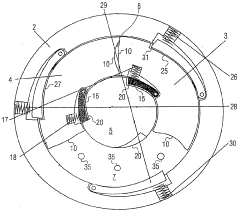
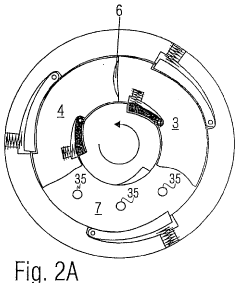
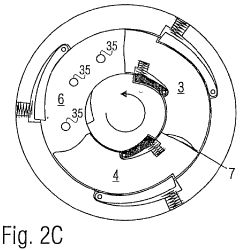
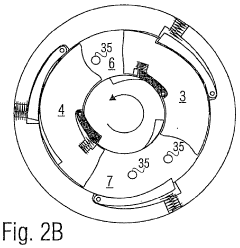
A rotary engine
PatentInactiveIN201621035262A
Innovation
- A rotary engine design featuring a two or three lobed cycloidal profile with a shell-core structure, strengthened cores, and apex seals with leaf springs, along with a cam-type guiding mechanism and ceramic combustion chamber liners, to reduce thermal expansion, enhance sealing, and maintain continuous contact, thereby improving efficiency and reliability.
Material Science Advancements for Rotary Engine Applications
Recent advancements in material science have revolutionized the performance capabilities of Wankel rotary engines, particularly in addressing their historical challenges when operating in extreme environments. The development of specialized coating technologies has been instrumental in enhancing the durability and efficiency of these unique power plants.
Ceramic thermal barrier coatings (TBCs) represent one of the most significant breakthroughs, utilizing yttria-stabilized zirconia (YSZ) and other advanced ceramics to provide exceptional thermal insulation. These coatings effectively reduce heat transfer across engine components, allowing rotary engines to maintain optimal operating temperatures even under extreme thermal conditions. The latest generation of TBCs incorporates nanoscale structures that further enhance their thermal resistance properties while minimizing weight penalties.
Diamond-like carbon (DLC) coatings have emerged as a critical solution for reducing friction and wear in rotary engine apex seals and housing surfaces. These coatings exhibit hardness values approaching natural diamond while maintaining low friction coefficients. Recent innovations in DLC deposition techniques have improved adhesion strength and coating uniformity, addressing previous limitations in coating longevity under the high-stress conditions typical of Wankel engines.
Plasma-sprayed composite coatings combining ceramics with metallic elements have demonstrated remarkable success in balancing thermal insulation with mechanical strength. These hybrid materials create gradient structures that distribute thermal stresses more effectively than single-material coatings, reducing the risk of delamination during thermal cycling. The incorporation of rare earth elements has further enhanced the high-temperature stability of these composites.
Self-healing coating systems represent the cutting edge of rotary engine material science. These innovative materials contain microcapsules filled with healing agents that are released when microscopic cracks form, automatically repairing damage before it can propagate. This technology significantly extends component lifespan in the challenging operating environment of rotary engines, where thermal cycling and mechanical stress are constant concerns.
Nanostructured overlay coatings have been developed specifically to address the unique tribological challenges of rotary engines. By engineering surface textures at the nanoscale, researchers have created coatings that maintain optimal oil film thickness while minimizing friction losses. These coatings have demonstrated up to 30% reduction in parasitic power losses compared to conventional surface treatments, directly translating to improved fuel efficiency and performance.
Ceramic thermal barrier coatings (TBCs) represent one of the most significant breakthroughs, utilizing yttria-stabilized zirconia (YSZ) and other advanced ceramics to provide exceptional thermal insulation. These coatings effectively reduce heat transfer across engine components, allowing rotary engines to maintain optimal operating temperatures even under extreme thermal conditions. The latest generation of TBCs incorporates nanoscale structures that further enhance their thermal resistance properties while minimizing weight penalties.
Diamond-like carbon (DLC) coatings have emerged as a critical solution for reducing friction and wear in rotary engine apex seals and housing surfaces. These coatings exhibit hardness values approaching natural diamond while maintaining low friction coefficients. Recent innovations in DLC deposition techniques have improved adhesion strength and coating uniformity, addressing previous limitations in coating longevity under the high-stress conditions typical of Wankel engines.
Plasma-sprayed composite coatings combining ceramics with metallic elements have demonstrated remarkable success in balancing thermal insulation with mechanical strength. These hybrid materials create gradient structures that distribute thermal stresses more effectively than single-material coatings, reducing the risk of delamination during thermal cycling. The incorporation of rare earth elements has further enhanced the high-temperature stability of these composites.
Self-healing coating systems represent the cutting edge of rotary engine material science. These innovative materials contain microcapsules filled with healing agents that are released when microscopic cracks form, automatically repairing damage before it can propagate. This technology significantly extends component lifespan in the challenging operating environment of rotary engines, where thermal cycling and mechanical stress are constant concerns.
Nanostructured overlay coatings have been developed specifically to address the unique tribological challenges of rotary engines. By engineering surface textures at the nanoscale, researchers have created coatings that maintain optimal oil film thickness while minimizing friction losses. These coatings have demonstrated up to 30% reduction in parasitic power losses compared to conventional surface treatments, directly translating to improved fuel efficiency and performance.
Environmental Compliance and Sustainability Considerations
The environmental impact of coating technologies for Wankel engines has become increasingly significant as regulatory frameworks worldwide continue to evolve toward stricter emissions standards and sustainability requirements. Current coating processes often involve materials and methods that pose environmental challenges, including the use of hexavalent chromium, cadmium, and other substances classified as hazardous under regulations such as REACH in Europe and similar frameworks in North America and Asia.
Modern coating development for extreme environment applications must now balance performance requirements with environmental compliance. Traditional thermal spray processes, while effective for creating wear-resistant surfaces, often generate significant particulate emissions and utilize materials with substantial environmental footprints. Recent innovations have focused on developing water-based coating systems and powder-based application methods that dramatically reduce volatile organic compound (VOC) emissions by up to 85% compared to conventional solvent-based systems.
Life cycle assessment (LCA) studies of advanced ceramic coatings for Wankel engines reveal significant sustainability advantages. These coatings extend engine component lifespans by 2-3 times, reducing resource consumption and waste generation throughout the product lifecycle. Additionally, the improved thermal efficiency provided by these coatings contributes to reduced fuel consumption, with field tests demonstrating potential fuel economy improvements of 3-7% depending on operating conditions.
Circular economy principles are increasingly being incorporated into coating technology development. Manufacturers are designing coating systems with end-of-life considerations, including the potential for material recovery and recycling. Some innovative approaches include the development of mechanically strippable coatings that allow for component reuse and material reclamation without hazardous chemical processes typically associated with coating removal.
The regulatory landscape continues to evolve rapidly, with particular focus on eliminating persistent environmental contaminants. The phase-out of perfluoroalkyl substances (PFAS) in certain coating applications presents technical challenges for extreme environment applications where these materials have traditionally provided exceptional chemical resistance and low friction properties. Industry leaders are investing in alternative fluoropolymer technologies and novel silicon-based compounds that maintain performance while meeting emerging regulatory requirements.
Carbon footprint reduction has become a key performance indicator for coating technology development. Advanced plasma-enhanced chemical vapor deposition (PECVD) processes operate at lower temperatures than conventional methods, reducing energy consumption by approximately 40%. Additionally, these processes often achieve superior coating uniformity, minimizing material waste and associated environmental impacts while simultaneously improving component performance in extreme operating conditions.
Modern coating development for extreme environment applications must now balance performance requirements with environmental compliance. Traditional thermal spray processes, while effective for creating wear-resistant surfaces, often generate significant particulate emissions and utilize materials with substantial environmental footprints. Recent innovations have focused on developing water-based coating systems and powder-based application methods that dramatically reduce volatile organic compound (VOC) emissions by up to 85% compared to conventional solvent-based systems.
Life cycle assessment (LCA) studies of advanced ceramic coatings for Wankel engines reveal significant sustainability advantages. These coatings extend engine component lifespans by 2-3 times, reducing resource consumption and waste generation throughout the product lifecycle. Additionally, the improved thermal efficiency provided by these coatings contributes to reduced fuel consumption, with field tests demonstrating potential fuel economy improvements of 3-7% depending on operating conditions.
Circular economy principles are increasingly being incorporated into coating technology development. Manufacturers are designing coating systems with end-of-life considerations, including the potential for material recovery and recycling. Some innovative approaches include the development of mechanically strippable coatings that allow for component reuse and material reclamation without hazardous chemical processes typically associated with coating removal.
The regulatory landscape continues to evolve rapidly, with particular focus on eliminating persistent environmental contaminants. The phase-out of perfluoroalkyl substances (PFAS) in certain coating applications presents technical challenges for extreme environment applications where these materials have traditionally provided exceptional chemical resistance and low friction properties. Industry leaders are investing in alternative fluoropolymer technologies and novel silicon-based compounds that maintain performance while meeting emerging regulatory requirements.
Carbon footprint reduction has become a key performance indicator for coating technology development. Advanced plasma-enhanced chemical vapor deposition (PECVD) processes operate at lower temperatures than conventional methods, reducing energy consumption by approximately 40%. Additionally, these processes often achieve superior coating uniformity, minimizing material waste and associated environmental impacts while simultaneously improving component performance in extreme operating conditions.
Unlock deeper insights with PatSnap Eureka Quick Research — get a full tech report to explore trends and direct your research. Try now!
Generate Your Research Report Instantly with AI Agent
Supercharge your innovation with PatSnap Eureka AI Agent Platform!