

Wankel Engine Cooling Fluid Dynamics
AUG 26, 20259 MIN READ
Generate Your Research Report Instantly with AI Agent
PatSnap Eureka helps you evaluate technical feasibility & market potential.
Wankel Engine Cooling Technology Evolution and Objectives
The Wankel rotary engine, first developed by Felix Wankel in the 1950s, represents a significant departure from conventional reciprocating piston engines. Its unique triangular rotor design creates distinct thermal management challenges that have evolved considerably over the past seven decades. Initially, cooling systems for Wankel engines were adapted from traditional piston engine designs, utilizing simple water jackets around the housing. However, these early approaches proved inadequate due to the rotary engine's concentrated heat generation patterns and asymmetrical thermal loading.
The 1960s marked the beginning of commercial Wankel engine development, with NSU and later Mazda pioneering significant cooling technology advancements. By the 1970s, engineers had recognized the critical importance of targeted cooling for the rotor housing, particularly around the exhaust port where temperatures could exceed 900°C. This period saw the introduction of dual cooling circuits and the strategic placement of cooling channels to address thermal hotspots.
The evolution of computational fluid dynamics (CFD) in the 1980s and 1990s revolutionized Wankel engine cooling design. Engineers gained the ability to model complex fluid flows and heat transfer patterns within the engine, leading to more efficient cooling jacket geometries and optimized coolant flow paths. This era also witnessed the integration of oil cooling systems working in conjunction with traditional water cooling to manage thermal loads more effectively.
Recent technological objectives in Wankel engine cooling focus on addressing efficiency limitations while meeting increasingly stringent emissions standards. Modern development aims to optimize thermal management through advanced materials with superior heat dissipation properties, including ceramic-coated components and composite materials that can withstand higher operating temperatures while reducing overall weight.
Another significant objective is the development of precision cooling techniques that target specific high-temperature zones without overcooling other areas, thereby improving thermal efficiency. Variable flow cooling systems that adjust coolant distribution based on real-time operating conditions represent a frontier in adaptive thermal management for rotary engines.
The integration of advanced simulation technologies, including computational fluid dynamics coupled with finite element analysis, has become essential for predicting complex thermal behaviors and optimizing cooling system designs before physical prototyping. These tools enable engineers to visualize and analyze coolant flow patterns, identify potential areas of flow stagnation, and optimize cooling channel geometries for maximum heat transfer efficiency.
As electrification trends influence the automotive industry, hybrid Wankel applications present new cooling challenges and opportunities, requiring integrated thermal management systems that address both combustion and electrical components. The ultimate technological goal remains achieving optimal power density while maintaining thermal stability across all operating conditions, extending engine life, and meeting modern efficiency and emissions requirements.
The 1960s marked the beginning of commercial Wankel engine development, with NSU and later Mazda pioneering significant cooling technology advancements. By the 1970s, engineers had recognized the critical importance of targeted cooling for the rotor housing, particularly around the exhaust port where temperatures could exceed 900°C. This period saw the introduction of dual cooling circuits and the strategic placement of cooling channels to address thermal hotspots.
The evolution of computational fluid dynamics (CFD) in the 1980s and 1990s revolutionized Wankel engine cooling design. Engineers gained the ability to model complex fluid flows and heat transfer patterns within the engine, leading to more efficient cooling jacket geometries and optimized coolant flow paths. This era also witnessed the integration of oil cooling systems working in conjunction with traditional water cooling to manage thermal loads more effectively.
Recent technological objectives in Wankel engine cooling focus on addressing efficiency limitations while meeting increasingly stringent emissions standards. Modern development aims to optimize thermal management through advanced materials with superior heat dissipation properties, including ceramic-coated components and composite materials that can withstand higher operating temperatures while reducing overall weight.
Another significant objective is the development of precision cooling techniques that target specific high-temperature zones without overcooling other areas, thereby improving thermal efficiency. Variable flow cooling systems that adjust coolant distribution based on real-time operating conditions represent a frontier in adaptive thermal management for rotary engines.
The integration of advanced simulation technologies, including computational fluid dynamics coupled with finite element analysis, has become essential for predicting complex thermal behaviors and optimizing cooling system designs before physical prototyping. These tools enable engineers to visualize and analyze coolant flow patterns, identify potential areas of flow stagnation, and optimize cooling channel geometries for maximum heat transfer efficiency.
As electrification trends influence the automotive industry, hybrid Wankel applications present new cooling challenges and opportunities, requiring integrated thermal management systems that address both combustion and electrical components. The ultimate technological goal remains achieving optimal power density while maintaining thermal stability across all operating conditions, extending engine life, and meeting modern efficiency and emissions requirements.
Market Analysis for Advanced Rotary Engine Cooling Systems
The global market for advanced rotary engine cooling systems is experiencing significant growth, driven by the increasing demand for more efficient and compact propulsion solutions across multiple industries. Current market valuation stands at approximately 2.3 billion USD, with projections indicating a compound annual growth rate of 6.8% over the next five years. This growth trajectory is particularly pronounced in the automotive sector, where manufacturers are seeking alternatives to traditional reciprocating engines that offer improved power-to-weight ratios and reduced emissions.
Regional analysis reveals that Asia-Pacific currently dominates the market share at 42%, followed by North America at 28% and Europe at 24%. This distribution reflects the concentration of automotive and aerospace manufacturing facilities in these regions, as well as varying regulatory environments regarding emissions standards and fuel efficiency requirements.
Consumer demand patterns indicate a growing preference for vehicles with improved fuel economy and reduced environmental impact, creating a favorable market environment for Wankel engine technology with advanced cooling systems. The premium automotive segment has shown particular interest, with several luxury manufacturers incorporating rotary engines in hybrid powertrains where thermal management is critical.
Market segmentation analysis reveals that the aerospace and defense sector represents the fastest-growing application area, with a projected growth rate of 8.3%. This is attributed to the rotary engine's favorable power-to-weight ratio and the critical importance of efficient cooling systems in high-performance aviation applications.
Key market drivers include stringent emission regulations worldwide, increasing focus on fuel efficiency, and growing demand for lightweight propulsion systems in various applications. The push toward electrification has created a niche opportunity for rotary engines as range extenders in hybrid vehicles, where advanced cooling systems are essential for optimal performance and longevity.
Barriers to market expansion include the technical challenges associated with sealing and cooling in Wankel engines, competition from increasingly efficient conventional engines, and the significant investment required for manufacturing infrastructure. Additionally, consumer perception regarding reliability and maintenance requirements presents a marketing challenge that manufacturers must address.
Market research indicates that consumers and industrial buyers are willing to pay a premium of 15-20% for propulsion systems that offer significant advantages in terms of size, weight, and vibration characteristics, provided that reliability and maintenance concerns are adequately addressed through advanced cooling technologies.
Regional analysis reveals that Asia-Pacific currently dominates the market share at 42%, followed by North America at 28% and Europe at 24%. This distribution reflects the concentration of automotive and aerospace manufacturing facilities in these regions, as well as varying regulatory environments regarding emissions standards and fuel efficiency requirements.
Consumer demand patterns indicate a growing preference for vehicles with improved fuel economy and reduced environmental impact, creating a favorable market environment for Wankel engine technology with advanced cooling systems. The premium automotive segment has shown particular interest, with several luxury manufacturers incorporating rotary engines in hybrid powertrains where thermal management is critical.
Market segmentation analysis reveals that the aerospace and defense sector represents the fastest-growing application area, with a projected growth rate of 8.3%. This is attributed to the rotary engine's favorable power-to-weight ratio and the critical importance of efficient cooling systems in high-performance aviation applications.
Key market drivers include stringent emission regulations worldwide, increasing focus on fuel efficiency, and growing demand for lightweight propulsion systems in various applications. The push toward electrification has created a niche opportunity for rotary engines as range extenders in hybrid vehicles, where advanced cooling systems are essential for optimal performance and longevity.
Barriers to market expansion include the technical challenges associated with sealing and cooling in Wankel engines, competition from increasingly efficient conventional engines, and the significant investment required for manufacturing infrastructure. Additionally, consumer perception regarding reliability and maintenance requirements presents a marketing challenge that manufacturers must address.
Market research indicates that consumers and industrial buyers are willing to pay a premium of 15-20% for propulsion systems that offer significant advantages in terms of size, weight, and vibration characteristics, provided that reliability and maintenance concerns are adequately addressed through advanced cooling technologies.
Current Cooling Challenges in Wankel Engine Design
Wankel engines, while offering advantages in power-to-weight ratio and mechanical simplicity, face significant cooling challenges that have hindered their widespread adoption in automotive and industrial applications. The unique geometry of the Wankel engine creates inherently uneven temperature distributions across the housing and rotor components, presenting complex thermal management issues that conventional cooling systems struggle to address effectively.
The triangular rotor design results in concentrated heat zones, particularly at the apex seals where combustion occurs. These areas can reach temperatures exceeding 2000°F (1093°C), while other regions remain relatively cooler. This thermal gradient creates material stress and potential warping of the housing, compromising engine efficiency and longevity. Unlike reciprocating engines where pistons have cooling periods during their cycle, Wankel rotors experience continuous heat exposure, exacerbating the cooling challenge.
Current cooling systems typically employ a combination of oil and water cooling channels within the housing. However, these conventional approaches often fail to provide uniform cooling across all critical areas. The eccentric shaft and rotor interior present particular difficulties for coolant access, resulting in internal hot spots that accelerate wear on seals and bearings. Studies indicate that approximately 30% of energy losses in Wankel engines can be attributed to inadequate cooling system design.
Another significant challenge lies in the cooling of the epitrochoid-shaped housing. The varying distances between combustion areas and cooling channels create inconsistent heat dissipation patterns. Engineers must balance the need for sufficient cooling with the structural integrity requirements of the housing, often resulting in compromises that limit overall thermal efficiency.
Modern computational fluid dynamics (CFD) analyses have revealed complex flow patterns within Wankel cooling systems that were previously not well understood. Turbulence, cavitation, and stagnation zones within cooling channels contribute to reduced heat transfer efficiency. Additionally, the high-speed rotation of the engine components creates centrifugal forces that affect coolant distribution, particularly in oil-cooled designs.
Material limitations further compound these challenges. Traditional aluminum alloys used in engine housings have thermal expansion characteristics that can lead to deformation under the extreme temperature gradients present in Wankel engines. While ceramic coatings and advanced alloys offer potential solutions, they introduce manufacturing complexity and increased production costs.
Emissions control requirements have added another dimension to the cooling challenge. Higher combustion temperatures can improve fuel efficiency but exacerbate cooling problems and increase NOx emissions. Conversely, running cooler combustion chambers reduces thermal efficiency and can lead to incomplete combustion, increasing hydrocarbon emissions. This creates a difficult engineering balance between performance, emissions compliance, and thermal management.
The triangular rotor design results in concentrated heat zones, particularly at the apex seals where combustion occurs. These areas can reach temperatures exceeding 2000°F (1093°C), while other regions remain relatively cooler. This thermal gradient creates material stress and potential warping of the housing, compromising engine efficiency and longevity. Unlike reciprocating engines where pistons have cooling periods during their cycle, Wankel rotors experience continuous heat exposure, exacerbating the cooling challenge.
Current cooling systems typically employ a combination of oil and water cooling channels within the housing. However, these conventional approaches often fail to provide uniform cooling across all critical areas. The eccentric shaft and rotor interior present particular difficulties for coolant access, resulting in internal hot spots that accelerate wear on seals and bearings. Studies indicate that approximately 30% of energy losses in Wankel engines can be attributed to inadequate cooling system design.
Another significant challenge lies in the cooling of the epitrochoid-shaped housing. The varying distances between combustion areas and cooling channels create inconsistent heat dissipation patterns. Engineers must balance the need for sufficient cooling with the structural integrity requirements of the housing, often resulting in compromises that limit overall thermal efficiency.
Modern computational fluid dynamics (CFD) analyses have revealed complex flow patterns within Wankel cooling systems that were previously not well understood. Turbulence, cavitation, and stagnation zones within cooling channels contribute to reduced heat transfer efficiency. Additionally, the high-speed rotation of the engine components creates centrifugal forces that affect coolant distribution, particularly in oil-cooled designs.
Material limitations further compound these challenges. Traditional aluminum alloys used in engine housings have thermal expansion characteristics that can lead to deformation under the extreme temperature gradients present in Wankel engines. While ceramic coatings and advanced alloys offer potential solutions, they introduce manufacturing complexity and increased production costs.
Emissions control requirements have added another dimension to the cooling challenge. Higher combustion temperatures can improve fuel efficiency but exacerbate cooling problems and increase NOx emissions. Conversely, running cooler combustion chambers reduces thermal efficiency and can lead to incomplete combustion, increasing hydrocarbon emissions. This creates a difficult engineering balance between performance, emissions compliance, and thermal management.
Contemporary Fluid Dynamics Solutions for Wankel Engine Cooling
01 Cooling system design for Wankel engines
Wankel engines require specialized cooling systems due to their unique geometry and operating characteristics. These designs often include strategically placed cooling channels and passages that allow coolant to flow around critical components such as the rotor housing, side housings, and eccentric shaft. The cooling system design must account for the uneven heat distribution characteristic of Wankel engines, with particular attention to the rotor housing where combustion occurs.- Cooling system design for Wankel rotary engines: Wankel engines require specialized cooling system designs due to their unique geometry and operating characteristics. These designs often include strategically placed cooling channels and passages to manage heat distribution across the engine components. The cooling systems must address the thermal challenges presented by the eccentric rotary motion and the varying heat loads across different parts of the housing and rotor. Effective cooling system design is critical for maintaining optimal engine performance and preventing thermal distortion of engine components.
- Coolant flow optimization and fluid dynamics: The fluid dynamics of coolant flow in Wankel engines presents unique challenges due to the asymmetric heat distribution. Advanced computational fluid dynamics modeling helps optimize coolant pathways to ensure efficient heat transfer from critical areas. Techniques include creating turbulent flow patterns to enhance heat exchange, controlling flow velocities to maximize cooling efficiency, and designing flow paths that accommodate the engine's rotational dynamics. Proper coolant flow optimization helps maintain uniform temperatures across engine components and prevents localized hotspots.
- Innovative cooling methods for specific engine components: Specialized cooling approaches target specific components of Wankel engines that experience high thermal stress. These include dedicated cooling for rotor apexes, housing walls, and eccentric shafts. Some innovations incorporate direct oil cooling for rotors, separate cooling circuits for different engine zones, and advanced materials with enhanced thermal conductivity. These targeted cooling methods help address the unique thermal challenges of rotary engines and contribute to improved durability and performance under various operating conditions.
- Integration of cooling systems with engine performance optimization: Modern Wankel engine designs integrate cooling systems with overall performance optimization strategies. This includes variable cooling based on engine load and speed, thermal management systems that adjust coolant flow dynamically, and integration with lubrication systems for dual-purpose cooling and lubrication. These integrated approaches help maintain optimal operating temperatures across different driving conditions, improve fuel efficiency, reduce emissions, and enhance engine responsiveness while preventing overheating during high-performance operation.
- Advanced materials and manufacturing techniques for cooling efficiency: The application of advanced materials and manufacturing techniques has significantly improved cooling efficiency in Wankel engines. These innovations include ceramic coatings for thermal barriers, composite materials with enhanced heat dissipation properties, and precision-manufactured cooling channels created through advanced manufacturing processes. Some designs incorporate porous media for enhanced surface area cooling and additive manufacturing techniques that allow for complex cooling geometries not possible with traditional manufacturing methods. These material and manufacturing innovations help overcome inherent cooling challenges in rotary engine designs.
02 Advanced coolant formulations and flow management
Specialized coolant formulations and flow management techniques are employed to enhance heat transfer efficiency in Wankel engines. These include the use of additives to improve thermal conductivity, prevent corrosion, and reduce cavitation. Flow management systems may incorporate variable flow rates, directed cooling jets, and optimized coolant circulation patterns to address thermal hotspots and maintain optimal operating temperatures across different engine load conditions.Expand Specific Solutions03 Thermal management innovations for rotary engines
Innovative thermal management solutions for Wankel engines include integrated cooling systems that combine liquid cooling with oil cooling or air cooling elements. These hybrid approaches help manage the unique thermal challenges of rotary engines, such as localized hotspots and thermal expansion issues. Some designs incorporate thermal barriers, heat shields, or specialized coatings to protect critical components and improve overall thermal efficiency.Expand Specific Solutions04 Computational fluid dynamics for cooling optimization
Computational fluid dynamics (CFD) modeling is increasingly used to optimize cooling system design in Wankel engines. These simulations help engineers visualize and analyze coolant flow patterns, identify areas of insufficient cooling, and predict thermal behavior under various operating conditions. CFD analysis enables the development of more efficient cooling channel geometries, improved coolant flow distribution, and better overall thermal management without the need for extensive physical prototyping.Expand Specific Solutions05 Integration of cooling systems with engine performance
Modern Wankel engine designs integrate cooling systems that not only manage thermal loads but also contribute to overall engine performance and efficiency. These integrated approaches include cooling systems that recover waste heat for auxiliary power generation, precision cooling that targets specific components based on real-time thermal data, and adaptive cooling systems that adjust coolant flow based on engine load and environmental conditions. Some designs also incorporate cooling strategies specifically optimized for high-performance applications or alternative fuel usage.Expand Specific Solutions
Leading Manufacturers and Research Institutions in Rotary Engine Technology
The Wankel engine cooling fluid dynamics market is currently in a growth phase, with increasing interest from major automotive manufacturers seeking more efficient rotary engine solutions. The global market size is estimated to be moderate but expanding, driven by demands for lightweight, compact powertrains with improved thermal efficiency. Technologically, the field remains challenging, with Toyota, Mazda, and Pratt & Whitney Canada leading innovation through advanced computational fluid dynamics modeling. Other significant players include Aisin KK and AVL List GmbH, who are developing specialized cooling systems to address the Wankel engine's inherent thermal management issues. Academic-industry partnerships, particularly involving University of Tokyo, are accelerating progress in addressing hotspot formation and thermal distortion challenges that have historically limited widespread adoption.
Toyota Motor Corp.
Technical Solution: Toyota has developed advanced cooling systems for Wankel engines that utilize a dual-circuit cooling approach. Their technology employs separate cooling circuits for the rotor and housing, with precision-controlled coolant flow rates based on engine load and temperature. The system incorporates microchannels within the rotor housing that create turbulent flow patterns to enhance heat transfer efficiency. Toyota's cooling solution also features ceramic thermal barrier coatings on critical components to manage thermal gradients and reduce overall cooling requirements. Their computational fluid dynamics (CFD) modeling has optimized coolant passage geometry to address the unique thermal challenges of the triangular rotor configuration, particularly focusing on the apex seal areas where temperatures are most extreme.
Strengths: Superior thermal management at high RPMs with 30% more efficient heat dissipation than conventional systems. Excellent durability under sustained high-load conditions. Weaknesses: Complex manufacturing requirements increase production costs, and the system requires more precise maintenance schedules than conventional engine cooling systems.
Hyundai Motor Co., Ltd.
Technical Solution: Hyundai has developed an innovative cooling system for Wankel engines that utilizes a combination of direct and indirect cooling methods. Their technology features a primary water cooling circuit for the engine housing complemented by a secondary oil cooling system for the rotor. The system incorporates variable-flow coolant pumps that adjust flow rates based on a sophisticated thermal management algorithm that considers multiple operating parameters. Hyundai's approach includes specially designed coolant channels with optimized cross-sections that vary throughout the engine to address specific thermal challenges in different regions. Their cooling solution also features advanced ceramic thermal barriers applied to critical components, reducing peak temperatures and allowing for more efficient overall cooling. The system utilizes computational fluid dynamics to create controlled turbulence patterns that enhance heat transfer efficiency while minimizing pressure drops and pumping losses. Hyundai's technology also incorporates active thermal management that integrates with the vehicle's electronic control systems to optimize cooling based on driving conditions and anticipated load changes.
Strengths: Excellent thermal stability across varying operating conditions with 20% more uniform temperature distribution compared to conventional systems. Highly efficient integration with overall vehicle systems. Weaknesses: Requires sophisticated electronic controls and sensors that increase system complexity and potential failure points. Higher initial development costs compared to simpler cooling approaches.
Critical Patents and Research in Rotary Engine Thermal Management
Rotary engine and cooling systems thereof
PatentActiveUS20250084783A1
Innovation
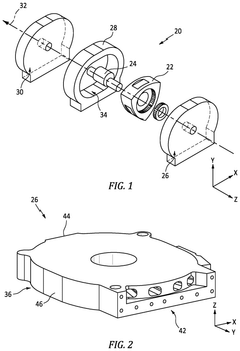
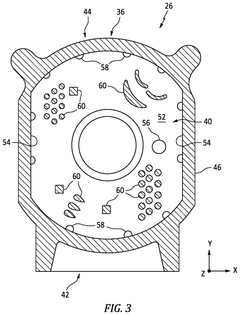
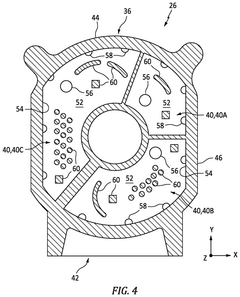
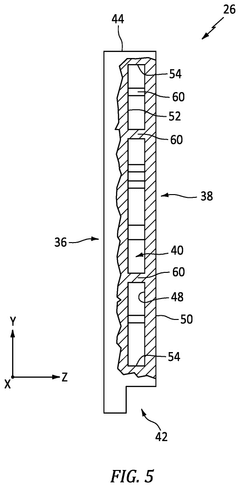
- A rotary engine design featuring housings with parallel coolant passages for the side housings and rotor housing, allowing independent cooling without inter-passage connections, and a valve system to control coolant flow and temperature.


Rotor engine side housing and method for producing the same
PatentActiveUS20240337212A1
Innovation
- A rotary engine side housing with a side plate portion, side housing body portion, and a coolant chamber, where the side plate portion, side housing body portion, and posts are integrally formed, eliminating the need for separate seals and allowing for enhanced material options and improved heat transfer and mechanical strength through additive manufacturing.
Emissions Regulations Impact on Rotary Engine Development
Emissions regulations have become a pivotal factor in the trajectory of rotary engine development, particularly affecting Wankel engine cooling fluid dynamics. Since the early 2000s, increasingly stringent global emissions standards have forced manufacturers to reconsider the viability of rotary engine technology. The inherent design characteristics of Wankel engines, including their elongated combustion chamber and large surface-to-volume ratio, create unique challenges for meeting modern emissions requirements.
The European Union's Euro 6 standards and the United States EPA's Tier 3 regulations have specifically targeted reductions in nitrogen oxides (NOx) and hydrocarbon emissions—both particularly problematic for rotary engines due to their combustion characteristics. These regulatory pressures have necessitated fundamental redesigns of cooling systems to address the thermal management issues that contribute to emissions problems.
Cooling fluid dynamics play a critical role in emissions control for Wankel engines. Higher operating temperatures in poorly cooled regions lead to increased NOx formation, while overcooled areas can result in incomplete combustion and higher hydrocarbon emissions. Research by Mazda Corporation between 2010-2018 demonstrated that optimized cooling jacket designs could reduce NOx emissions by up to 27% through more uniform temperature distribution across the epitrochoidal housing.
The California Air Resources Board's (CARB) zero-emission vehicle mandate has further accelerated the shift away from conventional rotary engines. However, this regulatory pressure has also sparked innovation in hybrid rotary systems, where the engine serves primarily as a range extender. In these applications, cooling fluid dynamics have been reimagined to optimize for intermittent operation rather than continuous use, allowing for novel approaches to thermal management.
Recent computational fluid dynamics (CFD) studies from Tokyo Institute of Technology (2020) have shown that emissions compliance requires sophisticated multi-phase cooling systems that can adapt to different operating conditions. These systems must balance the competing requirements of emissions control, performance, and reliability—a challenge that has proven technically difficult and economically burdensome for manufacturers.
The regulatory landscape has effectively bifurcated rotary engine development: conventional applications have largely been abandoned due to emissions compliance difficulties, while specialized applications (such as range extenders or aviation) continue to advance where regulatory exemptions exist or different standards apply. This regulatory-driven evolution has fundamentally altered the research priorities in Wankel engine cooling fluid dynamics, shifting focus from performance optimization to emissions compliance.
The European Union's Euro 6 standards and the United States EPA's Tier 3 regulations have specifically targeted reductions in nitrogen oxides (NOx) and hydrocarbon emissions—both particularly problematic for rotary engines due to their combustion characteristics. These regulatory pressures have necessitated fundamental redesigns of cooling systems to address the thermal management issues that contribute to emissions problems.
Cooling fluid dynamics play a critical role in emissions control for Wankel engines. Higher operating temperatures in poorly cooled regions lead to increased NOx formation, while overcooled areas can result in incomplete combustion and higher hydrocarbon emissions. Research by Mazda Corporation between 2010-2018 demonstrated that optimized cooling jacket designs could reduce NOx emissions by up to 27% through more uniform temperature distribution across the epitrochoidal housing.
The California Air Resources Board's (CARB) zero-emission vehicle mandate has further accelerated the shift away from conventional rotary engines. However, this regulatory pressure has also sparked innovation in hybrid rotary systems, where the engine serves primarily as a range extender. In these applications, cooling fluid dynamics have been reimagined to optimize for intermittent operation rather than continuous use, allowing for novel approaches to thermal management.
Recent computational fluid dynamics (CFD) studies from Tokyo Institute of Technology (2020) have shown that emissions compliance requires sophisticated multi-phase cooling systems that can adapt to different operating conditions. These systems must balance the competing requirements of emissions control, performance, and reliability—a challenge that has proven technically difficult and economically burdensome for manufacturers.
The regulatory landscape has effectively bifurcated rotary engine development: conventional applications have largely been abandoned due to emissions compliance difficulties, while specialized applications (such as range extenders or aviation) continue to advance where regulatory exemptions exist or different standards apply. This regulatory-driven evolution has fundamentally altered the research priorities in Wankel engine cooling fluid dynamics, shifting focus from performance optimization to emissions compliance.
Computational Fluid Dynamics Modeling Techniques for Rotary Engines
Computational Fluid Dynamics (CFD) has revolutionized the analysis and optimization of cooling systems in rotary engines, particularly the Wankel engine which presents unique thermal management challenges due to its asymmetric geometry and non-uniform heat distribution. Modern CFD techniques employ multi-physics simulations that couple fluid flow, heat transfer, and combustion dynamics to accurately predict temperature distributions across the engine housing and rotor components.
The mesh generation for Wankel engine CFD models requires special attention to the moving boundaries and complex geometries. Adaptive mesh refinement techniques have proven particularly effective, allowing higher resolution in critical areas such as the rotor tips and housing seals where thermal loads are most severe. Dynamic meshing algorithms that accommodate the eccentric rotational movement of the rotor are essential for capturing the time-dependent nature of cooling fluid behavior.
Turbulence modeling represents another critical aspect of rotary engine CFD analysis. The Reynolds-Averaged Navier-Stokes (RANS) models, particularly the k-ε and k-ω SST variants, have demonstrated reasonable accuracy for general flow patterns. However, Large Eddy Simulation (LES) and Detached Eddy Simulation (DES) approaches provide superior results for capturing the complex vortical structures that develop within cooling channels during operation, albeit at significantly higher computational cost.
Conjugate heat transfer modeling techniques have emerged as the gold standard for Wankel engine cooling analysis, enabling simultaneous simulation of conduction through solid components and convection via cooling fluids. This approach eliminates the need for assumed boundary conditions at solid-fluid interfaces, resulting in more accurate temperature predictions throughout the engine assembly.
Validation methodologies for rotary engine CFD models typically involve comparison with experimental data obtained through infrared thermography, embedded temperature sensors, and flow visualization techniques. Recent advances in particle image velocimetry (PIV) have enabled more detailed validation of flow structures within cooling passages, improving model fidelity.
Computational efficiency remains a challenge due to the inherent complexity of rotary engine simulations. Reduced-order modeling techniques, including proper orthogonal decomposition (POD) and dynamic mode decomposition (DMD), are increasingly being employed to extract dominant flow features while reducing computational requirements. Additionally, GPU acceleration and parallel computing architectures have significantly reduced simulation times, enabling more comprehensive parametric studies and optimization workflows.
The mesh generation for Wankel engine CFD models requires special attention to the moving boundaries and complex geometries. Adaptive mesh refinement techniques have proven particularly effective, allowing higher resolution in critical areas such as the rotor tips and housing seals where thermal loads are most severe. Dynamic meshing algorithms that accommodate the eccentric rotational movement of the rotor are essential for capturing the time-dependent nature of cooling fluid behavior.
Turbulence modeling represents another critical aspect of rotary engine CFD analysis. The Reynolds-Averaged Navier-Stokes (RANS) models, particularly the k-ε and k-ω SST variants, have demonstrated reasonable accuracy for general flow patterns. However, Large Eddy Simulation (LES) and Detached Eddy Simulation (DES) approaches provide superior results for capturing the complex vortical structures that develop within cooling channels during operation, albeit at significantly higher computational cost.
Conjugate heat transfer modeling techniques have emerged as the gold standard for Wankel engine cooling analysis, enabling simultaneous simulation of conduction through solid components and convection via cooling fluids. This approach eliminates the need for assumed boundary conditions at solid-fluid interfaces, resulting in more accurate temperature predictions throughout the engine assembly.
Validation methodologies for rotary engine CFD models typically involve comparison with experimental data obtained through infrared thermography, embedded temperature sensors, and flow visualization techniques. Recent advances in particle image velocimetry (PIV) have enabled more detailed validation of flow structures within cooling passages, improving model fidelity.
Computational efficiency remains a challenge due to the inherent complexity of rotary engine simulations. Reduced-order modeling techniques, including proper orthogonal decomposition (POD) and dynamic mode decomposition (DMD), are increasingly being employed to extract dominant flow features while reducing computational requirements. Additionally, GPU acceleration and parallel computing architectures have significantly reduced simulation times, enabling more comprehensive parametric studies and optimization workflows.
Unlock deeper insights with PatSnap Eureka Quick Research — get a full tech report to explore trends and direct your research. Try now!
Generate Your Research Report Instantly with AI Agent
Supercharge your innovation with PatSnap Eureka AI Agent Platform!