Wankel Engine Design for Compact Applications
AUG 26, 20259 MIN READ
Generate Your Research Report Instantly with AI Agent
PatSnap Eureka helps you evaluate technical feasibility & market potential.
Wankel Engine Evolution and Design Objectives
The Wankel rotary engine represents a significant departure from conventional reciprocating piston engines, offering a revolutionary approach to internal combustion since its inception in the mid-20th century. Developed by German engineer Felix Wankel in the 1950s, this engine design has evolved through distinct phases, each marked by technological advancements addressing specific challenges. The initial prototype, completed in 1957, demonstrated the fundamental concept of a triangular rotor revolving within an epitrochoid-shaped housing, creating compression and expansion chambers without traditional reciprocating motion.
The evolution of Wankel engine technology can be traced through several key developmental periods. The 1960s-1970s marked the commercialization phase, with NSU and later Mazda pioneering production vehicles featuring rotary engines. During this period, engineers focused on addressing sealing challenges and improving combustion efficiency. The 1980s-1990s represented a refinement era, with Mazda's continued development resulting in more reliable and powerful variants, culminating in the renowned 13B-REW engine used in the RX-7 sports car.
The early 2000s witnessed a shift toward addressing emissions concerns and fuel efficiency limitations, with Mazda's RENESIS engine in the RX-8 representing significant advancements in port design and combustion control. Recent developments have explored hybrid rotary configurations and alternative fuel adaptations, particularly focusing on hydrogen compatibility due to the Wankel's inherent flexibility with various fuel types.
For compact applications, the technical objectives of modern Wankel engine design center around five key parameters: power density maximization, thermal efficiency improvement, emissions reduction, durability enhancement, and manufacturing cost optimization. The inherent advantages of the Wankel design—including fewer moving parts, smoother operation, and exceptional power-to-weight ratio—make it particularly suitable for compact applications where space constraints are paramount.
Current design objectives specifically target apex seal longevity through advanced materials and cooling strategies, addressing the historical Achilles' heel of rotary engines. Simultaneously, engineers are pursuing improved combustion chamber geometry to enhance fuel efficiency and reduce hydrocarbon emissions, particularly focusing on the "quenching zones" characteristic of the rotary design.
The miniaturization potential of Wankel engines presents compelling opportunities for applications in unmanned aerial vehicles, portable generators, range extenders for electric vehicles, and compact marine propulsion systems. The technical trajectory aims to leverage advanced manufacturing techniques, including precision casting and 3D printing, to overcome traditional production challenges while implementing direct injection systems and variable geometry intake ports to address efficiency concerns.
As compact power solutions become increasingly important across multiple industries, the Wankel engine's evolution continues to be driven by the pursuit of an optimal balance between its inherent advantages in size and weight against the ongoing challenges of efficiency and durability in specialized applications.
The evolution of Wankel engine technology can be traced through several key developmental periods. The 1960s-1970s marked the commercialization phase, with NSU and later Mazda pioneering production vehicles featuring rotary engines. During this period, engineers focused on addressing sealing challenges and improving combustion efficiency. The 1980s-1990s represented a refinement era, with Mazda's continued development resulting in more reliable and powerful variants, culminating in the renowned 13B-REW engine used in the RX-7 sports car.
The early 2000s witnessed a shift toward addressing emissions concerns and fuel efficiency limitations, with Mazda's RENESIS engine in the RX-8 representing significant advancements in port design and combustion control. Recent developments have explored hybrid rotary configurations and alternative fuel adaptations, particularly focusing on hydrogen compatibility due to the Wankel's inherent flexibility with various fuel types.
For compact applications, the technical objectives of modern Wankel engine design center around five key parameters: power density maximization, thermal efficiency improvement, emissions reduction, durability enhancement, and manufacturing cost optimization. The inherent advantages of the Wankel design—including fewer moving parts, smoother operation, and exceptional power-to-weight ratio—make it particularly suitable for compact applications where space constraints are paramount.
Current design objectives specifically target apex seal longevity through advanced materials and cooling strategies, addressing the historical Achilles' heel of rotary engines. Simultaneously, engineers are pursuing improved combustion chamber geometry to enhance fuel efficiency and reduce hydrocarbon emissions, particularly focusing on the "quenching zones" characteristic of the rotary design.
The miniaturization potential of Wankel engines presents compelling opportunities for applications in unmanned aerial vehicles, portable generators, range extenders for electric vehicles, and compact marine propulsion systems. The technical trajectory aims to leverage advanced manufacturing techniques, including precision casting and 3D printing, to overcome traditional production challenges while implementing direct injection systems and variable geometry intake ports to address efficiency concerns.
As compact power solutions become increasingly important across multiple industries, the Wankel engine's evolution continues to be driven by the pursuit of an optimal balance between its inherent advantages in size and weight against the ongoing challenges of efficiency and durability in specialized applications.
Market Analysis for Compact Rotary Engine Applications
The compact rotary engine market has witnessed significant evolution over the past decade, driven primarily by increasing demand for lightweight, high power-density propulsion systems across multiple industries. Current market valuation for compact Wankel engine applications stands at approximately $2.3 billion globally, with projections indicating growth to $3.7 billion by 2028, representing a compound annual growth rate of 8.2%.
The automotive sector remains the largest application segment, accounting for 42% of the total market share. This is primarily fueled by the resurgence of interest in range extenders for electric vehicles, where compact Wankel engines offer significant advantages in terms of packaging efficiency and power-to-weight ratio. Mazda's continued research into hydrogen-powered rotary engines for range extension has sparked renewed industry interest.
The unmanned aerial vehicle (UAV) segment represents the fastest-growing market for compact rotary engines, expanding at 12.7% annually. The inherent advantages of Wankel designs—including minimal vibration, compact form factor, and excellent power-to-weight ratios—make them particularly suitable for medium to large UAV platforms where flight endurance and payload capacity are critical factors.
Marine applications constitute approximately 18% of the market, with particular emphasis on personal watercraft and small recreational boats. The reduced noise and vibration characteristics of Wankel engines provide a competitive advantage in this segment, where user comfort is a significant purchasing factor.
Geographically, North America leads the market with 38% share, followed by Europe (31%) and Asia-Pacific (24%). The Asia-Pacific region is expected to demonstrate the highest growth rate over the next five years, driven by increasing industrialization and rising disposable incomes in countries like China and India.
Customer requirements analysis reveals five key market drivers: fuel efficiency, emissions compliance, power density, reliability, and cost-effectiveness. Recent environmental regulations have created both challenges and opportunities, with the most successful market players focusing on hybrid applications that leverage the Wankel engine's compact size while mitigating its traditionally higher emissions through integration with electric systems.
Market barriers include manufacturing complexity, sealing technology limitations, and competition from improving electric propulsion systems. However, niche applications where the Wankel's unique characteristics provide clear advantages continue to expand, particularly in specialized military applications, portable generators, and range extenders for electric vehicles.
The automotive sector remains the largest application segment, accounting for 42% of the total market share. This is primarily fueled by the resurgence of interest in range extenders for electric vehicles, where compact Wankel engines offer significant advantages in terms of packaging efficiency and power-to-weight ratio. Mazda's continued research into hydrogen-powered rotary engines for range extension has sparked renewed industry interest.
The unmanned aerial vehicle (UAV) segment represents the fastest-growing market for compact rotary engines, expanding at 12.7% annually. The inherent advantages of Wankel designs—including minimal vibration, compact form factor, and excellent power-to-weight ratios—make them particularly suitable for medium to large UAV platforms where flight endurance and payload capacity are critical factors.
Marine applications constitute approximately 18% of the market, with particular emphasis on personal watercraft and small recreational boats. The reduced noise and vibration characteristics of Wankel engines provide a competitive advantage in this segment, where user comfort is a significant purchasing factor.
Geographically, North America leads the market with 38% share, followed by Europe (31%) and Asia-Pacific (24%). The Asia-Pacific region is expected to demonstrate the highest growth rate over the next five years, driven by increasing industrialization and rising disposable incomes in countries like China and India.
Customer requirements analysis reveals five key market drivers: fuel efficiency, emissions compliance, power density, reliability, and cost-effectiveness. Recent environmental regulations have created both challenges and opportunities, with the most successful market players focusing on hybrid applications that leverage the Wankel engine's compact size while mitigating its traditionally higher emissions through integration with electric systems.
Market barriers include manufacturing complexity, sealing technology limitations, and competition from improving electric propulsion systems. However, niche applications where the Wankel's unique characteristics provide clear advantages continue to expand, particularly in specialized military applications, portable generators, and range extenders for electric vehicles.
Technical Challenges and Global Development Status
The Wankel rotary engine presents significant technical challenges despite its compact design advantages. Current development faces several critical obstacles, particularly thermal management issues. The triangular rotor design creates uneven temperature distribution, with apex seals experiencing extreme heat that leads to premature wear and reduced longevity. This thermal challenge remains one of the most persistent barriers to widespread adoption in compact applications.
Sealing technology represents another major hurdle. The apex seals that maintain compression between the rotor and housing face substantial friction and wear under operation. Despite decades of research, achieving optimal sealing without sacrificing efficiency or durability continues to challenge engineers. Modern materials science has improved this situation, but has not fully resolved the fundamental design limitations.
Emissions compliance presents a growing obstacle for Wankel technology. The elongated combustion chamber geometry inherently produces higher hydrocarbon emissions compared to conventional piston engines. This characteristic makes meeting increasingly stringent global emissions standards particularly difficult without significant efficiency penalties or complex after-treatment systems.
Globally, Wankel engine development shows distinct regional patterns. Japan maintains the strongest development ecosystem, with Mazda historically leading commercial applications until recently suspending production of its rotary-powered vehicles. However, the company has recently reintroduced the technology as a range extender in hybrid electric vehicles, signaling a potential new application direction.
European development focuses primarily on specialized applications, with companies in Germany and the UK exploring niche implementations for UAVs, portable generators, and range extenders. These efforts leverage the Wankel's favorable power-to-weight ratio while working around its efficiency limitations.
North American development has diminished significantly since General Motors abandoned its rotary program decades ago, though specialized research continues in aerospace and defense sectors. Several startups have attempted to revitalize the technology with modern materials and electronic controls, but have struggled to achieve commercial viability.
China has shown increasing interest in Wankel technology for compact power generation and specialized mobility applications, with several research institutions actively developing modified designs that address traditional limitations. This emerging development hub may introduce innovations that overcome longstanding technical barriers.
The global technical landscape reveals that while fundamental challenges persist, specialized applications continue to drive incremental improvements in Wankel engine design, particularly for compact implementations where the power density advantages outweigh efficiency concerns.
Sealing technology represents another major hurdle. The apex seals that maintain compression between the rotor and housing face substantial friction and wear under operation. Despite decades of research, achieving optimal sealing without sacrificing efficiency or durability continues to challenge engineers. Modern materials science has improved this situation, but has not fully resolved the fundamental design limitations.
Emissions compliance presents a growing obstacle for Wankel technology. The elongated combustion chamber geometry inherently produces higher hydrocarbon emissions compared to conventional piston engines. This characteristic makes meeting increasingly stringent global emissions standards particularly difficult without significant efficiency penalties or complex after-treatment systems.
Globally, Wankel engine development shows distinct regional patterns. Japan maintains the strongest development ecosystem, with Mazda historically leading commercial applications until recently suspending production of its rotary-powered vehicles. However, the company has recently reintroduced the technology as a range extender in hybrid electric vehicles, signaling a potential new application direction.
European development focuses primarily on specialized applications, with companies in Germany and the UK exploring niche implementations for UAVs, portable generators, and range extenders. These efforts leverage the Wankel's favorable power-to-weight ratio while working around its efficiency limitations.
North American development has diminished significantly since General Motors abandoned its rotary program decades ago, though specialized research continues in aerospace and defense sectors. Several startups have attempted to revitalize the technology with modern materials and electronic controls, but have struggled to achieve commercial viability.
China has shown increasing interest in Wankel technology for compact power generation and specialized mobility applications, with several research institutions actively developing modified designs that address traditional limitations. This emerging development hub may introduce innovations that overcome longstanding technical barriers.
The global technical landscape reveals that while fundamental challenges persist, specialized applications continue to drive incremental improvements in Wankel engine design, particularly for compact implementations where the power density advantages outweigh efficiency concerns.
Current Wankel Engine Design Solutions
01 Compact rotor housing design
Wankel engines achieve compactness through innovative rotor housing designs that minimize the overall engine footprint while maintaining performance. These designs include optimized epitrochoidal housing shapes, integrated cooling channels, and strategic placement of intake and exhaust ports. The compact housing design allows for a significant reduction in engine size compared to conventional piston engines with similar power output.- Compact Rotor Housing Design: Wankel engines achieve compactness through innovative rotor housing designs that optimize the space required for operation. These designs feature specially shaped epitrochoid housings that accommodate the triangular rotor while minimizing the overall engine footprint. The unique geometry allows for a complete four-stroke cycle in one rotor revolution, contributing significantly to the engine's compact nature compared to conventional piston engines of similar power output.
- Multi-Rotor Configurations: Multi-rotor configurations enhance the power-to-size ratio of Wankel engines while maintaining a compact form factor. By arranging multiple rotors on a single eccentric shaft, these designs achieve higher power output without proportionally increasing the engine's overall dimensions. This approach allows for better power distribution, smoother operation, and improved balance while preserving the inherent compactness advantage of the rotary engine design.
- Integrated Peripheral Systems: The compactness of Wankel engines is further enhanced through the integration of peripheral systems directly into the engine block or housing. This includes cooling channels, intake and exhaust ports, and lubrication systems that are designed to occupy minimal space while maintaining optimal functionality. Such integration eliminates the need for external components that would otherwise increase the overall engine dimensions, resulting in a more compact power unit.
- Innovative Sealing Mechanisms: Advanced sealing mechanisms contribute to the compactness of Wankel engines by allowing for tighter tolerances and reduced clearance requirements. These sealing solutions effectively contain combustion gases while minimizing friction and wear, enabling the engine to maintain its compact dimensions without compromising performance or reliability. The specialized apex seals, side seals, and oil seals are designed to function effectively within the confined spaces of the rotary engine.
- Weight Reduction Techniques: Various weight reduction techniques are employed in Wankel engine design to enhance the power-to-weight ratio while maintaining compactness. These include the use of lightweight materials such as aluminum alloys for the housing and rotor components, strategic material removal in non-critical areas, and optimized structural designs that provide sufficient strength with minimal mass. The resulting lightweight construction contributes to the overall compactness and efficiency of the engine system.
02 Multi-rotor configurations for space efficiency
Multi-rotor configurations in Wankel engines allow for increased power output without proportionally increasing the engine size. By arranging multiple rotors on a single eccentric shaft, these designs achieve higher power density in a compact package. The shared components between rotors, such as the eccentric shaft and bearings, contribute to the overall compactness of the engine while improving power-to-weight ratio.Expand Specific Solutions03 Integration of peripheral systems
Wankel engines achieve compactness through the integration of peripheral systems directly into the engine block or housing. This includes cooling systems, lubrication pathways, intake and exhaust manifolds, and even transmission components. By incorporating these systems into the main engine structure rather than adding them externally, the overall package size is significantly reduced while maintaining functionality and performance.Expand Specific Solutions04 Innovative sealing systems for compact design
Advanced sealing systems in Wankel engines contribute to their compactness by allowing for tighter tolerances and smaller clearances between moving parts. These sealing technologies include apex seals, side seals, and oil seals that effectively contain combustion pressure while minimizing friction and wear. The efficient sealing systems enable the engine to maintain a compact form factor without compromising on performance or reliability.Expand Specific Solutions05 Lightweight materials and manufacturing techniques
The use of lightweight materials and advanced manufacturing techniques contributes significantly to the compactness of Wankel engines. Materials such as aluminum alloys, ceramics, and composite materials reduce the overall weight while maintaining structural integrity. Modern manufacturing methods like precision casting, CNC machining, and additive manufacturing enable complex geometries that optimize space utilization within the engine, further enhancing its compact nature.Expand Specific Solutions
Leading Manufacturers and Research Institutions
The Wankel engine design for compact applications market is currently in a growth phase, with increasing interest in its unique rotary design advantages for size-constrained implementations. The global market size for compact rotary engines is expanding, particularly in specialized sectors requiring high power-to-weight ratios. Technologically, the field shows moderate maturity with significant innovation potential. Key players demonstrate varying levels of development: LiquidPiston has made notable advancements in rotary engine efficiency, while established automotive manufacturers like Honda, Audi, and BYD are exploring compact Wankel applications. Research institutions including Chongqing University and University of Tokyo contribute fundamental research, while aerospace entities like Pratt & Whitney Canada and United Technologies leverage rotary technology for specialized propulsion solutions, indicating cross-industry adoption potential.
Honda Motor Co., Ltd.
Technical Solution: Honda has been a significant player in Wankel engine development, particularly for compact applications. Their approach focuses on addressing the traditional challenges of Wankel engines through innovative sealing technology and combustion optimization. Honda's compact Wankel design incorporates advanced ceramic apex seals with specialized coating materials that significantly reduce friction and wear while improving sealing efficiency. Their engines feature a modified trochoid housing profile that optimizes the combustion chamber shape for better fuel efficiency. Honda has implemented direct fuel injection systems specifically calibrated for the rotary motion dynamics, achieving more complete combustion and reduced emissions. For compact applications, Honda has developed a modular design approach allowing their Wankel engines to be configured in various arrangements depending on power requirements. Their latest research includes hybrid-compatible rotary units that can function as compact range extenders in electrified powertrains, leveraging the Wankel's inherent smoothness and compact size advantages.
Strengths: Extensive experience in mass-producing small engines; strong materials science capabilities for addressing sealing issues; excellent NVH (Noise, Vibration, Harshness) characteristics; proven reliability in production vehicles. Weaknesses: Higher manufacturing costs compared to conventional engines; still faces challenges with fuel efficiency at partial loads; emissions compliance requires additional systems that add complexity.
GM Global Technology Operations LLC
Technical Solution: GM has developed a sophisticated compact Wankel engine design focused on addressing the traditional limitations while maximizing the inherent advantages for specific applications. Their approach incorporates a peripheral port design with variable timing control to optimize combustion efficiency across different operating conditions. GM's compact Wankel features an advanced rotor cooling system with internal oil jets that precisely target high-temperature zones, significantly improving thermal management. The company has implemented a proprietary apex seal technology using composite materials with specialized coatings that dramatically reduce friction while improving sealing performance. For compact applications, GM has developed a modular architecture that allows their Wankel units to be configured in various arrangements from single to multi-rotor setups depending on power requirements. Their design incorporates direct fuel injection with multiple injectors positioned to optimize the unique flame propagation characteristics of rotary combustion. GM has also developed specialized manufacturing processes that reduce production costs while maintaining tight tolerances critical for rotary engine efficiency.
Strengths: Extensive engineering resources and manufacturing expertise; advanced materials science capabilities for addressing sealing challenges; modular design approach enables application flexibility; potential for integration with GM's broader powertrain portfolio. Weaknesses: Limited recent production experience with rotary engines; continued challenges with emissions compliance in varying regulatory environments; higher development costs compared to leveraging existing piston engine platforms; market acceptance uncertainty.
Key Patents and Technical Innovations
Pistonless rotary motor for air compressor
PatentActiveUS20220282622A1
Innovation
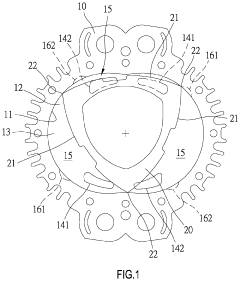
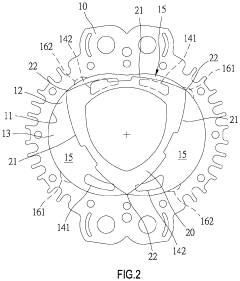
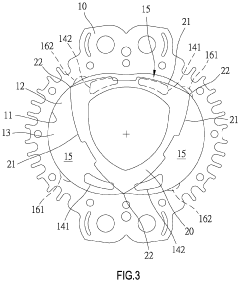
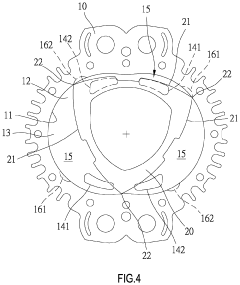
- Incorporating radially spaced grooves in the peripheral wall of the rotor cavity, with first grooves configured to release pressurized air at the top dead center during the compression stroke and second grooves for releasing air during the exhaust stroke, allowing for controlled pressure management and reduced air resistance.
Rotary internal combustion engine
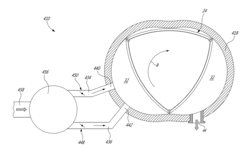
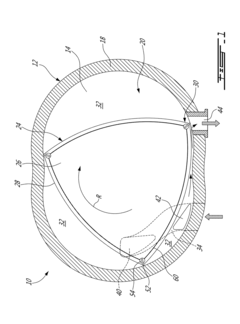
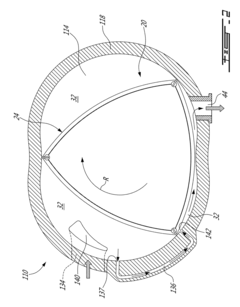
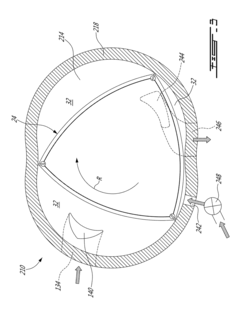
PatentActiveUS20180045110A1
Innovation
- The implementation of a rotary engine design with a primary inlet port, a secondary inlet port (purge port) positioned rearwardly of the primary inlet port and forwardly of the exhaust port, and independently closable communications between air sources and these ports, allowing simultaneous air intake and exhaust gas purging through the secondary inlet port.
Emissions Compliance and Environmental Considerations
The Wankel rotary engine faces significant challenges in meeting modern emissions standards, which has been a primary factor limiting its widespread adoption in compact applications. Traditional rotary engines produce higher levels of unburned hydrocarbons (UHC) and carbon monoxide (CO) compared to conventional piston engines due to their elongated combustion chamber geometry and inherent sealing issues at the rotor tips.
Recent advancements in apex seal technology have shown promise in reducing these emissions by improving combustion chamber sealing. Materials such as silicon nitride composites and carbon-based coatings have demonstrated enhanced durability while maintaining better sealing properties under high-temperature operating conditions, resulting in more complete combustion and lower emissions.
Direct injection systems specifically designed for rotary architecture represent another significant development. By precisely controlling fuel delivery timing and spray patterns, these systems can reduce the fuel trapped in the combustion chamber crevices, addressing one of the primary sources of UHC emissions in Wankel engines. Several manufacturers have reported emission reductions of up to 30% using advanced direct injection technologies compared to traditional port injection systems.
Exhaust gas recirculation (EGR) systems tailored for rotary engines have proven effective in reducing nitrogen oxide (NOx) emissions by lowering combustion temperatures. The unique challenge in rotary applications involves managing the thermal characteristics without compromising the engine's compact form factor. Miniaturized EGR coolers and precise electronic control systems have been developed to address this specific requirement.
Catalytic converter technology has also evolved to better handle the distinct exhaust characteristics of rotary engines. Multi-stage catalytic systems with higher precious metal loadings and specialized washcoats have been engineered to manage the higher exhaust temperatures and different emission profiles typical of Wankel engines. These systems have demonstrated the ability to bring emissions within Euro 6 and EPA Tier 3 compliance levels.
The integration of hybrid electric systems with Wankel engines presents perhaps the most promising pathway for emissions compliance. Using the rotary engine as a range extender or generator in a primarily electric powertrain allows the engine to operate at its most efficient point, significantly reducing emissions while leveraging the engine's compact size and smooth operation. This approach has been successfully implemented in several concept vehicles, achieving up to 80% reduction in overall emissions compared to traditional rotary-only powertrains.
Regulatory frameworks worldwide continue to evolve, with increasingly stringent emissions standards posing ongoing challenges for Wankel engine applications. Manufacturers pursuing rotary technology must now factor in not only current standards but also anticipate future regulatory developments, particularly regarding carbon dioxide emissions and lifecycle environmental impact assessments.
Recent advancements in apex seal technology have shown promise in reducing these emissions by improving combustion chamber sealing. Materials such as silicon nitride composites and carbon-based coatings have demonstrated enhanced durability while maintaining better sealing properties under high-temperature operating conditions, resulting in more complete combustion and lower emissions.
Direct injection systems specifically designed for rotary architecture represent another significant development. By precisely controlling fuel delivery timing and spray patterns, these systems can reduce the fuel trapped in the combustion chamber crevices, addressing one of the primary sources of UHC emissions in Wankel engines. Several manufacturers have reported emission reductions of up to 30% using advanced direct injection technologies compared to traditional port injection systems.
Exhaust gas recirculation (EGR) systems tailored for rotary engines have proven effective in reducing nitrogen oxide (NOx) emissions by lowering combustion temperatures. The unique challenge in rotary applications involves managing the thermal characteristics without compromising the engine's compact form factor. Miniaturized EGR coolers and precise electronic control systems have been developed to address this specific requirement.
Catalytic converter technology has also evolved to better handle the distinct exhaust characteristics of rotary engines. Multi-stage catalytic systems with higher precious metal loadings and specialized washcoats have been engineered to manage the higher exhaust temperatures and different emission profiles typical of Wankel engines. These systems have demonstrated the ability to bring emissions within Euro 6 and EPA Tier 3 compliance levels.
The integration of hybrid electric systems with Wankel engines presents perhaps the most promising pathway for emissions compliance. Using the rotary engine as a range extender or generator in a primarily electric powertrain allows the engine to operate at its most efficient point, significantly reducing emissions while leveraging the engine's compact size and smooth operation. This approach has been successfully implemented in several concept vehicles, achieving up to 80% reduction in overall emissions compared to traditional rotary-only powertrains.
Regulatory frameworks worldwide continue to evolve, with increasingly stringent emissions standards posing ongoing challenges for Wankel engine applications. Manufacturers pursuing rotary technology must now factor in not only current standards but also anticipate future regulatory developments, particularly regarding carbon dioxide emissions and lifecycle environmental impact assessments.
Materials Science Advancements for Rotary Engines
The evolution of materials science has been pivotal in addressing the inherent challenges of Wankel rotary engine design, particularly for compact applications. Traditional materials used in early rotary engines, such as cast iron and basic aluminum alloys, suffered from rapid wear, thermal distortion, and sealing issues that limited their efficiency and longevity. Recent advancements in ceramic-matrix composites have revolutionized apex seal design, offering unprecedented wear resistance while maintaining lower friction coefficients than conventional materials.
Silicon carbide and silicon nitride ceramics, when properly engineered with carbon fiber reinforcement, demonstrate superior thermal stability across the extreme temperature gradients experienced in rotary combustion chambers. These advanced ceramics maintain dimensional stability even under the high-speed rotation and thermal cycling characteristic of Wankel engines, significantly extending service intervals for compact applications where maintenance accessibility is often limited.
Surface coating technologies have similarly transformed rotor housing durability. Plasma-sprayed thermal barrier coatings incorporating yttria-stabilized zirconia provide exceptional insulation properties, reducing heat transfer to the cooling system and improving thermal efficiency. This advancement is particularly valuable for compact applications where cooling system size constraints present significant design challenges.
Nickel-silicon carbide electroless plating processes have enabled the creation of ultra-hard epitrochoid surfaces with enhanced oil retention characteristics. When combined with diamond-like carbon coatings on rotor faces, these treatments have demonstrated up to 40% reduction in friction losses compared to conventional chrome-plated surfaces, directly translating to improved fuel efficiency in compact rotary applications.
High-temperature polymer composites represent another frontier in rotary engine materials. PEEK (polyether ether ketone) and PPS (polyphenylene sulfide) based composites, reinforced with carbon nanotubes, are now being employed for oil seals and secondary sealing elements. These materials offer exceptional chemical resistance against modern synthetic lubricants while maintaining dimensional stability at operating temperatures exceeding 250°C.
Additive manufacturing techniques have enabled the production of complex cooling channel geometries within rotor housings that were previously impossible to manufacture. Direct metal laser sintering of aluminum-silicon alloys with precisely engineered porosity gradients allows for optimized heat dissipation in critical areas while maintaining structural integrity, addressing one of the fundamental challenges in scaling Wankel engines for compact applications.
Silicon carbide and silicon nitride ceramics, when properly engineered with carbon fiber reinforcement, demonstrate superior thermal stability across the extreme temperature gradients experienced in rotary combustion chambers. These advanced ceramics maintain dimensional stability even under the high-speed rotation and thermal cycling characteristic of Wankel engines, significantly extending service intervals for compact applications where maintenance accessibility is often limited.
Surface coating technologies have similarly transformed rotor housing durability. Plasma-sprayed thermal barrier coatings incorporating yttria-stabilized zirconia provide exceptional insulation properties, reducing heat transfer to the cooling system and improving thermal efficiency. This advancement is particularly valuable for compact applications where cooling system size constraints present significant design challenges.
Nickel-silicon carbide electroless plating processes have enabled the creation of ultra-hard epitrochoid surfaces with enhanced oil retention characteristics. When combined with diamond-like carbon coatings on rotor faces, these treatments have demonstrated up to 40% reduction in friction losses compared to conventional chrome-plated surfaces, directly translating to improved fuel efficiency in compact rotary applications.
High-temperature polymer composites represent another frontier in rotary engine materials. PEEK (polyether ether ketone) and PPS (polyphenylene sulfide) based composites, reinforced with carbon nanotubes, are now being employed for oil seals and secondary sealing elements. These materials offer exceptional chemical resistance against modern synthetic lubricants while maintaining dimensional stability at operating temperatures exceeding 250°C.
Additive manufacturing techniques have enabled the production of complex cooling channel geometries within rotor housings that were previously impossible to manufacture. Direct metal laser sintering of aluminum-silicon alloys with precisely engineered porosity gradients allows for optimized heat dissipation in critical areas while maintaining structural integrity, addressing one of the fundamental challenges in scaling Wankel engines for compact applications.
Unlock deeper insights with PatSnap Eureka Quick Research — get a full tech report to explore trends and direct your research. Try now!
Generate Your Research Report Instantly with AI Agent
Supercharge your innovation with PatSnap Eureka AI Agent Platform!