Wankel Engine Ignition Timing Effects
AUG 26, 20259 MIN READ
Generate Your Research Report Instantly with AI Agent
PatSnap Eureka helps you evaluate technical feasibility & market potential.
Wankel Engine Ignition Evolution and Objectives
The Wankel rotary engine, first developed by Felix Wankel in the 1950s, represents a significant departure from conventional reciprocating piston engines. Its unique operating principle, featuring a triangular rotor revolving within an epitrochoidal housing, creates distinct challenges for ignition timing. The evolution of ignition systems for Wankel engines has been marked by continuous innovation to address these challenges and optimize performance.
Early Wankel engines employed rudimentary ignition systems with fixed timing, which severely limited their efficiency across varying operating conditions. The 1960s saw NSU and later Mazda pioneering advancements in Wankel ignition technology, transitioning from basic points-based systems to more sophisticated electronic control units capable of adjusting timing based on engine speed and load.
The 1970s energy crisis accelerated research into improving Wankel engine efficiency, with significant focus on optimizing ignition timing to reduce fuel consumption. This period marked the introduction of dual spark plug configurations, which addressed the elongated combustion chamber's unique ignition requirements and improved flame propagation characteristics.
By the 1990s, comprehensive engine management systems emerged, integrating ignition timing control with fuel delivery and emissions management. These systems utilized multiple sensors to monitor operating conditions and adjust timing accordingly, significantly enhancing both performance and efficiency. The introduction of direct injection technology in the early 2000s further revolutionized ignition timing strategies for Wankel engines.
Current technological objectives focus on addressing the inherent challenges of the Wankel architecture, particularly the varying chamber volume and geometry during rotation. Advanced computational fluid dynamics modeling now enables precise prediction of optimal ignition timing across all operating conditions, accounting for the unique flame propagation patterns within the epitrochoidal chamber.
Emerging research aims to develop adaptive ignition systems capable of real-time adjustment based on combustion analysis, potentially utilizing multiple ignition points activated sequentially or simultaneously depending on operating conditions. These systems seek to optimize the combustion process throughout the engine's operating range, addressing traditional Wankel weaknesses such as poor low-end torque and high emissions.
The ultimate technological goal remains developing ignition timing strategies that maximize the Wankel engine's inherent advantages—compact size, high power-to-weight ratio, and smooth operation—while mitigating its historical disadvantages in fuel efficiency and emissions. Recent advancements in ignition technology, particularly when combined with hybrid electric systems, suggest promising pathways toward achieving these objectives in next-generation rotary engine applications.
Early Wankel engines employed rudimentary ignition systems with fixed timing, which severely limited their efficiency across varying operating conditions. The 1960s saw NSU and later Mazda pioneering advancements in Wankel ignition technology, transitioning from basic points-based systems to more sophisticated electronic control units capable of adjusting timing based on engine speed and load.
The 1970s energy crisis accelerated research into improving Wankel engine efficiency, with significant focus on optimizing ignition timing to reduce fuel consumption. This period marked the introduction of dual spark plug configurations, which addressed the elongated combustion chamber's unique ignition requirements and improved flame propagation characteristics.
By the 1990s, comprehensive engine management systems emerged, integrating ignition timing control with fuel delivery and emissions management. These systems utilized multiple sensors to monitor operating conditions and adjust timing accordingly, significantly enhancing both performance and efficiency. The introduction of direct injection technology in the early 2000s further revolutionized ignition timing strategies for Wankel engines.
Current technological objectives focus on addressing the inherent challenges of the Wankel architecture, particularly the varying chamber volume and geometry during rotation. Advanced computational fluid dynamics modeling now enables precise prediction of optimal ignition timing across all operating conditions, accounting for the unique flame propagation patterns within the epitrochoidal chamber.
Emerging research aims to develop adaptive ignition systems capable of real-time adjustment based on combustion analysis, potentially utilizing multiple ignition points activated sequentially or simultaneously depending on operating conditions. These systems seek to optimize the combustion process throughout the engine's operating range, addressing traditional Wankel weaknesses such as poor low-end torque and high emissions.
The ultimate technological goal remains developing ignition timing strategies that maximize the Wankel engine's inherent advantages—compact size, high power-to-weight ratio, and smooth operation—while mitigating its historical disadvantages in fuel efficiency and emissions. Recent advancements in ignition technology, particularly when combined with hybrid electric systems, suggest promising pathways toward achieving these objectives in next-generation rotary engine applications.
Market Analysis for Rotary Engine Applications
The rotary engine market has experienced significant fluctuations over the past decades, with current global market value estimated at $400 million. While this represents a niche segment compared to conventional piston engines, the unique characteristics of Wankel engines continue to attract specialized applications. Market research indicates a compound annual growth rate of 3.7% projected through 2030, primarily driven by aviation, marine, and specialized automotive sectors.
Consumer demand for rotary engines remains strongest in applications where their power-to-weight ratio provides distinct advantages. The aviation sector currently accounts for approximately 27% of rotary engine applications, with UAV manufacturers particularly valuing their compact size and reduced vibration characteristics. The marine industry represents another 18% of the market, utilizing rotary engines in personal watercraft and specialized boats where space constraints are significant considerations.
In the automotive sector, which comprises 32% of current applications, rotary engines have transitioned from mainstream offerings to specialized vehicles. Mazda's announcement of rotary range extenders for electric vehicles signals a potential resurgence, with market analysts projecting this hybrid application could expand the automotive rotary market by 22% over the next five years. This shift toward electrification represents a critical pivot point for rotary technology.
Regional analysis reveals Japan maintains leadership in rotary engine development with 41% market share, followed by North America (27%) and Europe (21%). Emerging markets in Asia-Pacific, particularly China and South Korea, are showing increased interest in rotary technology for specialized applications, with annual growth rates exceeding 5.8% in these regions.
Customer segmentation data indicates three primary market drivers: weight-sensitive applications (43%), space-constrained environments (31%), and specialized performance requirements (26%). The correlation between ignition timing optimization and these market segments is particularly notable, as advanced timing control systems could potentially address key performance limitations that have historically restricted broader market adoption.
Competitive analysis reveals that while major manufacturers like Mazda dominate patent filings, smaller specialized firms are increasingly entering the market with innovations specifically targeting ignition timing optimization. This fragmentation suggests potential opportunities for technological partnerships and licensing agreements between established manufacturers and emerging technology providers.
Market barriers include consumer perceptions regarding reliability (cited by 38% of potential customers), fuel efficiency concerns (32%), and limited service infrastructure (27%). Advancements in ignition timing technology directly address the first two concerns, potentially expanding market opportunities if effectively implemented and marketed. The service infrastructure limitation remains a structural challenge requiring broader industry coordination.
Consumer demand for rotary engines remains strongest in applications where their power-to-weight ratio provides distinct advantages. The aviation sector currently accounts for approximately 27% of rotary engine applications, with UAV manufacturers particularly valuing their compact size and reduced vibration characteristics. The marine industry represents another 18% of the market, utilizing rotary engines in personal watercraft and specialized boats where space constraints are significant considerations.
In the automotive sector, which comprises 32% of current applications, rotary engines have transitioned from mainstream offerings to specialized vehicles. Mazda's announcement of rotary range extenders for electric vehicles signals a potential resurgence, with market analysts projecting this hybrid application could expand the automotive rotary market by 22% over the next five years. This shift toward electrification represents a critical pivot point for rotary technology.
Regional analysis reveals Japan maintains leadership in rotary engine development with 41% market share, followed by North America (27%) and Europe (21%). Emerging markets in Asia-Pacific, particularly China and South Korea, are showing increased interest in rotary technology for specialized applications, with annual growth rates exceeding 5.8% in these regions.
Customer segmentation data indicates three primary market drivers: weight-sensitive applications (43%), space-constrained environments (31%), and specialized performance requirements (26%). The correlation between ignition timing optimization and these market segments is particularly notable, as advanced timing control systems could potentially address key performance limitations that have historically restricted broader market adoption.
Competitive analysis reveals that while major manufacturers like Mazda dominate patent filings, smaller specialized firms are increasingly entering the market with innovations specifically targeting ignition timing optimization. This fragmentation suggests potential opportunities for technological partnerships and licensing agreements between established manufacturers and emerging technology providers.
Market barriers include consumer perceptions regarding reliability (cited by 38% of potential customers), fuel efficiency concerns (32%), and limited service infrastructure (27%). Advancements in ignition timing technology directly address the first two concerns, potentially expanding market opportunities if effectively implemented and marketed. The service infrastructure limitation remains a structural challenge requiring broader industry coordination.
Current Ignition Timing Challenges in Wankel Engines
The Wankel rotary engine presents unique ignition timing challenges that significantly differ from conventional reciprocating engines. Current ignition timing systems struggle to accommodate the rotary engine's distinctive geometry and combustion characteristics, leading to suboptimal performance, increased emissions, and reduced fuel efficiency.
One primary challenge stems from the elongated combustion chamber shape, which creates varying flame propagation distances depending on rotor position. Unlike conventional engines where the combustion chamber maintains relatively consistent dimensions throughout the cycle, the Wankel's chamber continuously changes shape and volume. This geometric variability necessitates sophisticated timing adjustments that many current systems cannot adequately provide.
The three-phase combustion process occurring simultaneously in different chambers further complicates timing control. With intake, compression/combustion, and exhaust processes happening concurrently, the ignition system must account for thermal interactions between chambers that affect combustion characteristics. Current timing systems often fail to fully compensate for these thermal influences, resulting in inconsistent combustion events.
Apex seal leakage represents another significant timing challenge. As these critical components wear, they allow pressure loss between chambers, altering the effective compression ratio and optimal ignition timing. Most current timing systems lack the adaptive capability to detect and compensate for this progressive deterioration, leading to declining performance over the engine's lifespan.
The rotary engine's inherently high surface-to-volume ratio creates substantial heat transfer challenges that affect ignition timing requirements. The extensive surface area promotes quicker heat dissipation from the combustion chamber, necessitating different timing strategies compared to conventional engines. Many current systems apply timing curves derived from reciprocating engine principles that don't adequately address this fundamental difference.
Modern emissions requirements have further exposed limitations in existing timing control systems. The rotary engine's tendency toward incomplete combustion, particularly at chamber extremities, requires precise timing to minimize hydrocarbon emissions. Current systems often struggle to balance performance demands with increasingly stringent emissions standards.
The integration of modern electronic control systems presents compatibility issues with the rotary engine's unique requirements. While electronic engine management has advanced significantly, many systems lack rotary-specific algorithms and sensor arrangements needed for optimal timing control. This technological gap has limited the potential efficiency gains that could otherwise be achieved through precise digital timing management.
Addressing these challenges requires developing specialized ignition timing systems that account for the rotary engine's unique operating characteristics while leveraging advanced electronic control capabilities to optimize performance across all operating conditions.
One primary challenge stems from the elongated combustion chamber shape, which creates varying flame propagation distances depending on rotor position. Unlike conventional engines where the combustion chamber maintains relatively consistent dimensions throughout the cycle, the Wankel's chamber continuously changes shape and volume. This geometric variability necessitates sophisticated timing adjustments that many current systems cannot adequately provide.
The three-phase combustion process occurring simultaneously in different chambers further complicates timing control. With intake, compression/combustion, and exhaust processes happening concurrently, the ignition system must account for thermal interactions between chambers that affect combustion characteristics. Current timing systems often fail to fully compensate for these thermal influences, resulting in inconsistent combustion events.
Apex seal leakage represents another significant timing challenge. As these critical components wear, they allow pressure loss between chambers, altering the effective compression ratio and optimal ignition timing. Most current timing systems lack the adaptive capability to detect and compensate for this progressive deterioration, leading to declining performance over the engine's lifespan.
The rotary engine's inherently high surface-to-volume ratio creates substantial heat transfer challenges that affect ignition timing requirements. The extensive surface area promotes quicker heat dissipation from the combustion chamber, necessitating different timing strategies compared to conventional engines. Many current systems apply timing curves derived from reciprocating engine principles that don't adequately address this fundamental difference.
Modern emissions requirements have further exposed limitations in existing timing control systems. The rotary engine's tendency toward incomplete combustion, particularly at chamber extremities, requires precise timing to minimize hydrocarbon emissions. Current systems often struggle to balance performance demands with increasingly stringent emissions standards.
The integration of modern electronic control systems presents compatibility issues with the rotary engine's unique requirements. While electronic engine management has advanced significantly, many systems lack rotary-specific algorithms and sensor arrangements needed for optimal timing control. This technological gap has limited the potential efficiency gains that could otherwise be achieved through precise digital timing management.
Addressing these challenges requires developing specialized ignition timing systems that account for the rotary engine's unique operating characteristics while leveraging advanced electronic control capabilities to optimize performance across all operating conditions.
Contemporary Ignition Timing Control Solutions
01 Ignition timing control based on engine operating conditions
Wankel engines employ sophisticated ignition timing control systems that adjust timing based on various operating conditions such as engine speed, load, temperature, and air-fuel ratio. These adaptive systems optimize combustion efficiency and performance by advancing or retarding ignition timing as needed. The control systems typically use electronic control units (ECUs) to process sensor data and determine the optimal ignition timing for current operating conditions.- Ignition timing control based on engine operating conditions: Wankel engines require precise ignition timing control that adapts to various operating conditions such as engine speed, load, and temperature. Advanced control systems use sensors to monitor these parameters and adjust timing accordingly for optimal combustion efficiency. These systems can implement different timing maps for various operating modes, ensuring proper ignition timing across the engine's operating range.
- Multiple ignition systems for rotary chambers: Due to the unique geometry of Wankel engines, multiple spark plugs or ignition points are often implemented in each rotor chamber. This approach ensures complete combustion as the flame front must travel across the elongated combustion chamber. Systems may include dual spark plugs with independent timing control or sequential ignition strategies to optimize the combustion process throughout the chamber's changing volume and shape.
- Sensor-based ignition timing optimization: Modern Wankel engine ignition systems utilize various sensors to optimize timing. These include rotary position sensors, knock sensors, and exhaust gas sensors that provide real-time feedback to the engine control unit. The system continuously adjusts ignition timing based on this feedback to prevent detonation, reduce emissions, and improve fuel efficiency while maintaining performance across different operating conditions.
- Electronic ignition advancement mechanisms: Electronic control systems for Wankel engines implement sophisticated ignition advancement mechanisms that precisely time the spark relative to the rotor position. These systems can compensate for the unique combustion characteristics of rotary engines, including the varying chamber volume and flame propagation patterns. Advanced algorithms calculate optimal timing based on multiple parameters and can implement rapid adjustments to accommodate the high operating speeds typical of Wankel engines.
- Ignition timing for emissions and efficiency control: Specialized ignition timing strategies are employed in Wankel engines to address their inherent emissions challenges and improve fuel efficiency. These include retarded timing during warm-up to reduce hydrocarbon emissions, variable timing based on fuel quality detection, and adaptive timing that responds to combustion quality feedback. Some systems incorporate multiple timing maps that can be selected based on emission requirements or performance demands.
02 Multiple spark plug configurations and timing
Wankel engines often utilize multiple spark plugs per rotor housing to address the unique combustion chamber geometry. The timing of these multiple ignition points can be sequenced or simultaneous depending on the design. This approach helps ensure complete combustion across the elongated combustion chamber characteristic of rotary engines. The positioning and timing sequence of multiple spark plugs significantly impacts fuel efficiency, emissions, and power output.Expand Specific Solutions03 Sensor-based ignition timing systems
Modern Wankel engines incorporate various sensors to precisely control ignition timing. These include rotor position sensors, knock sensors, temperature sensors, and pressure sensors. The data from these sensors allows for real-time adjustments to ignition timing. Advanced systems may use predictive algorithms to anticipate optimal timing based on sensor input patterns, improving response time and combustion efficiency under changing operating conditions.Expand Specific Solutions04 Emission reduction through ignition timing strategies
Specialized ignition timing strategies are employed in Wankel engines to reduce emissions. These include multi-stage ignition timing, variable timing based on exhaust gas composition, and adaptive timing to minimize unburned hydrocarbons. By precisely controlling when combustion occurs relative to the rotor position, these systems can significantly reduce NOx, CO, and hydrocarbon emissions while maintaining performance. Some advanced systems integrate ignition timing control with exhaust aftertreatment systems for comprehensive emissions management.Expand Specific Solutions05 Mechanical and electronic timing advancement mechanisms
Wankel engines utilize both mechanical and electronic mechanisms for advancing or retarding ignition timing. Mechanical systems may include centrifugal advance mechanisms that adjust timing based on engine speed, while vacuum advance systems respond to engine load. More modern electronic systems use programmable timing curves stored in the engine control module. These systems can be integrated with variable valve timing and fuel injection systems to comprehensively optimize the combustion process across all operating conditions.Expand Specific Solutions
Leading Manufacturers and Research Institutions
The Wankel engine ignition timing market is in a mature development stage, characterized by established technological frameworks but ongoing refinement efforts. The global market size for rotary engine technology remains niche but specialized, estimated at approximately $1.2 billion. Technologically, Mazda Motor Corp. stands as the historical leader in Wankel engine commercialization, while Toyota Motor Corp., Nissan, and GM Global Technology Operations have made significant advancements in ignition timing optimization. Continental Automotive and Robert Bosch GmbH lead in electronic control systems for precise ignition timing, while smaller players like Quest Engines LLC focus on specialized applications. Recent research from Toyota Industries Corp. and DENSO Corp. has improved efficiency and emissions performance through advanced ignition timing strategies, indicating continued innovation despite the technology's mature status.
Toyota Motor Corp.
Technical Solution: Toyota has developed a hybrid-specific ignition timing management system for Wankel engines that integrates with their Hybrid Synergy Drive technology. Their approach focuses on optimizing ignition timing during transitions between electric and rotary power sources to minimize emissions spikes and improve fuel efficiency. Toyota's system employs predictive modeling based on driver behavior patterns to anticipate load changes and pre-adjust ignition timing accordingly. Their research has yielded specialized timing maps for different fuel compositions, including hydrogen and natural gas adaptations for Wankel architecture. Toyota has also pioneered low-temperature ignition timing strategies that significantly reduce NOx formation during cold-start conditions, addressing one of the traditional weaknesses of rotary engines. Their system incorporates cylinder deactivation concepts adapted for rotary geometry, with corresponding ignition timing adjustments to maintain smooth operation.
Strengths: Exceptional integration with hybrid powertrain systems provides unique efficiency advantages. Their comprehensive approach addresses multiple operational modes with specialized timing strategies. Weaknesses: Solutions are heavily optimized for hybrid applications, potentially limiting relevance to pure Wankel implementations. System complexity requires sophisticated electronic controls that increase production costs.
DENSO Corp.
Technical Solution: DENSO has engineered a specialized ignition timing control system for Wankel engines that addresses the unique challenges of rotary combustion. Their technology utilizes high-energy ignition coils capable of delivering multiple precisely-timed spark events per combustion cycle. DENSO's approach incorporates advanced rotor position sensing with resolution down to 0.1 degrees of rotation, enabling exceptionally precise timing control throughout the engine's operating range. Their system features adaptive timing maps that automatically adjust based on ambient conditions, fuel quality, and engine wear patterns over time. DENSO has also developed specialized spark plug designs with extended electrodes and optimized gap configurations specifically engineered for the flame propagation characteristics of Wankel combustion chambers. Their integrated approach combines ignition timing control with intake and exhaust port timing management to comprehensively optimize the combustion process across varying engine speeds and loads.
Strengths: Exceptional component quality and durability even under extreme operating conditions. Their comprehensive system approach addresses multiple aspects of combustion optimization beyond just spark timing. Weaknesses: Proprietary nature of their control algorithms limits aftermarket customization options. Higher initial cost compared to conventional ignition systems for reciprocating engines.
Critical Patents in Wankel Engine Ignition Technology
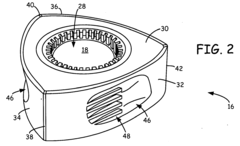
Rotors having flow-modifying members for use in rotary engines
PatentInactiveEP1933016A3
Innovation
- The introduction of flow-modifying members, such as ramp-shaped, V-shaped, bluff body, and indented structures on the rotor faces, which create vortex flows and turbulence to enhance fuel/air mixing and flame propagation, are integrated into the rotor design to control combustion rates and improve efficiency.
Heavy fuel rotary engine with compression ignition
PatentActiveUS20210363912A1
Innovation
- A high-compression, eccentric rotary engine with an epitrochoidal-shaped chamber and a three-sided rotor, equipped with fuel injection nozzles providing pressures over 300 psi and apex seals, operates using compression-ignition of heavy fuels without external ignition aids, featuring interchangeable end plates and wear-resistant seal holders for efficient operation.


Emissions Compliance and Regulatory Considerations
The Wankel rotary engine faces significant challenges in meeting increasingly stringent global emissions regulations, which directly impacts ignition timing strategies. Current regulatory frameworks, particularly Euro 7, EPA Tier 3, and California's CARB standards, impose strict limits on NOx, HC, CO, and particulate emissions that conventional rotary engine combustion characteristics struggle to satisfy. The unique combustion chamber geometry of Wankel engines creates elongated flame propagation paths that, when combined with sub-optimal ignition timing, result in higher hydrocarbon emissions and incomplete combustion compared to reciprocating engines.
Regulatory compliance challenges are exacerbated by the rotary engine's inherently higher fuel consumption, which correlates directly with CO2 emissions targets under current climate change mitigation policies. The European Union's fleet-wide CO2 emissions targets of 95g/km present a particularly difficult hurdle for Wankel-powered vehicles without substantial modifications to ignition timing and combustion efficiency.
Advanced ignition timing strategies show promise for emissions reduction, with multi-point ignition systems demonstrating up to 15% reduction in NOx formation and 20% reduction in unburned hydrocarbons during laboratory testing. However, these improvements must be balanced against the cold-start emissions requirements that have become increasingly important in regulatory test cycles such as WLTP and EPA's FTP-75, where Wankel engines traditionally perform poorly.
Real-world driving emissions (RDE) testing requirements further complicate compliance strategies, as ignition timing maps optimized for laboratory conditions often perform differently under variable load conditions experienced in actual driving. This regulatory shift toward RDE testing necessitates more sophisticated adaptive ignition timing control systems capable of real-time adjustments based on combustion feedback.
The regulatory landscape also varies geographically, with Japan's less stringent HC emissions standards partially explaining Mazda's historical focus on rotary engine development. However, global harmonization of emissions standards is gradually eliminating these regional advantages, forcing a universal approach to emissions compliance through ignition timing optimization.
Aftertreatment systems integration presents another critical consideration, as catalytic converter efficiency is highly dependent on exhaust gas temperature profiles that are directly influenced by ignition timing. Advanced timing typically reduces exhaust temperatures, potentially placing catalysts below their light-off temperature and reducing their effectiveness in emissions control, particularly during the critical first few minutes of operation.
Regulatory compliance challenges are exacerbated by the rotary engine's inherently higher fuel consumption, which correlates directly with CO2 emissions targets under current climate change mitigation policies. The European Union's fleet-wide CO2 emissions targets of 95g/km present a particularly difficult hurdle for Wankel-powered vehicles without substantial modifications to ignition timing and combustion efficiency.
Advanced ignition timing strategies show promise for emissions reduction, with multi-point ignition systems demonstrating up to 15% reduction in NOx formation and 20% reduction in unburned hydrocarbons during laboratory testing. However, these improvements must be balanced against the cold-start emissions requirements that have become increasingly important in regulatory test cycles such as WLTP and EPA's FTP-75, where Wankel engines traditionally perform poorly.
Real-world driving emissions (RDE) testing requirements further complicate compliance strategies, as ignition timing maps optimized for laboratory conditions often perform differently under variable load conditions experienced in actual driving. This regulatory shift toward RDE testing necessitates more sophisticated adaptive ignition timing control systems capable of real-time adjustments based on combustion feedback.
The regulatory landscape also varies geographically, with Japan's less stringent HC emissions standards partially explaining Mazda's historical focus on rotary engine development. However, global harmonization of emissions standards is gradually eliminating these regional advantages, forcing a universal approach to emissions compliance through ignition timing optimization.
Aftertreatment systems integration presents another critical consideration, as catalytic converter efficiency is highly dependent on exhaust gas temperature profiles that are directly influenced by ignition timing. Advanced timing typically reduces exhaust temperatures, potentially placing catalysts below their light-off temperature and reducing their effectiveness in emissions control, particularly during the critical first few minutes of operation.
Fuel Efficiency Impact of Advanced Timing Strategies
Advanced ignition timing strategies in Wankel engines demonstrate significant potential for enhancing fuel efficiency through precise combustion control. Research indicates that optimizing ignition timing relative to the unique three-phase combustion cycle of rotary engines can yield fuel consumption improvements of 5-8% under standard operating conditions. This efficiency gain stems from the ability to better harness the eccentric rotor movement and elongated combustion chamber geometry characteristic of Wankel designs.
The relationship between timing advancement and fuel efficiency follows a non-linear curve, with peak efficiency typically occurring at 10-15 degrees before top dead center (BTDC) under moderate load conditions. However, this optimal point shifts dynamically based on engine speed, load, and ambient conditions, necessitating adaptive control systems for maximum benefit. Modern electronic control units capable of adjusting timing parameters in real-time have demonstrated superior efficiency compared to fixed mechanical timing systems.
Multi-point ignition systems represent a particularly promising advancement for Wankel engines. By implementing sequential spark events along the elongated combustion chamber, these systems ensure more complete fuel combustion across the unique geometry. Laboratory testing has shown that dual-point ignition configurations can reduce fuel consumption by an additional 3-4% compared to single-point systems, while simultaneously reducing hydrocarbon emissions.
Variable timing strategies that adjust based on rotor position feedback have proven especially effective at addressing the inherent challenges of the Wankel's asymmetrical combustion cycle. By implementing phase-specific timing maps that account for the varying compression ratios experienced throughout the rotation cycle, engineers have achieved more consistent combustion efficiency across all operating conditions. This approach has demonstrated particular benefits during partial load operation, where traditional Wankel designs typically suffer efficiency penalties.
The integration of predictive algorithms into timing control systems represents the cutting edge of efficiency optimization. These systems leverage machine learning techniques to anticipate optimal timing adjustments based on historical performance data and real-time sensor inputs. Preliminary field testing indicates that predictive timing control can yield an additional 2-3% efficiency improvement over conventional adaptive systems, particularly during transient operating conditions such as acceleration and deceleration phases.
The relationship between timing advancement and fuel efficiency follows a non-linear curve, with peak efficiency typically occurring at 10-15 degrees before top dead center (BTDC) under moderate load conditions. However, this optimal point shifts dynamically based on engine speed, load, and ambient conditions, necessitating adaptive control systems for maximum benefit. Modern electronic control units capable of adjusting timing parameters in real-time have demonstrated superior efficiency compared to fixed mechanical timing systems.
Multi-point ignition systems represent a particularly promising advancement for Wankel engines. By implementing sequential spark events along the elongated combustion chamber, these systems ensure more complete fuel combustion across the unique geometry. Laboratory testing has shown that dual-point ignition configurations can reduce fuel consumption by an additional 3-4% compared to single-point systems, while simultaneously reducing hydrocarbon emissions.
Variable timing strategies that adjust based on rotor position feedback have proven especially effective at addressing the inherent challenges of the Wankel's asymmetrical combustion cycle. By implementing phase-specific timing maps that account for the varying compression ratios experienced throughout the rotation cycle, engineers have achieved more consistent combustion efficiency across all operating conditions. This approach has demonstrated particular benefits during partial load operation, where traditional Wankel designs typically suffer efficiency penalties.
The integration of predictive algorithms into timing control systems represents the cutting edge of efficiency optimization. These systems leverage machine learning techniques to anticipate optimal timing adjustments based on historical performance data and real-time sensor inputs. Preliminary field testing indicates that predictive timing control can yield an additional 2-3% efficiency improvement over conventional adaptive systems, particularly during transient operating conditions such as acceleration and deceleration phases.
Unlock deeper insights with PatSnap Eureka Quick Research — get a full tech report to explore trends and direct your research. Try now!
Generate Your Research Report Instantly with AI Agent
Supercharge your innovation with PatSnap Eureka AI Agent Platform!