Wankel Engine Simulation Tools for Next-Gen Development
AUG 26, 20259 MIN READ
Generate Your Research Report Instantly with AI Agent
Patsnap Eureka helps you evaluate technical feasibility & market potential.
Wankel Engine Evolution and Simulation Objectives
The Wankel rotary engine, first conceptualized by Felix Wankel in the 1920s and developed into a working prototype by 1957, represents a significant departure from conventional reciprocating piston engines. Its evolution spans over six decades, characterized by periods of intense development, commercial application, and technological refinement. Initially embraced for its mechanical simplicity, compact design, and smooth operation, the Wankel engine gained prominence in the 1960s and 1970s, particularly through Mazda's implementation in vehicles like the Cosmo Sport and later the iconic RX series.
The technological trajectory of Wankel engines has been shaped by persistent challenges including sealing issues, fuel efficiency limitations, and emissions concerns. These challenges have driven continuous innovation in materials science, combustion dynamics, and mechanical engineering. The 1980s and 1990s witnessed significant advancements in apex seal technology and combustion chamber design, while the early 2000s saw renewed interest in rotary technology for hybrid applications and range extenders.
Current technological trends indicate a potential renaissance for Wankel engines in specialized applications. The emergence of advanced materials such as ceramic composites and carbon-based coatings offers promising solutions to historical durability issues. Simultaneously, computational fluid dynamics (CFD) and finite element analysis (FEA) have revolutionized the understanding of rotary engine thermodynamics and structural behavior, enabling more sophisticated design iterations.
The primary objective of next-generation Wankel engine simulation tools is to create comprehensive digital environments that accurately model the complex interplay of thermodynamics, fluid dynamics, structural mechanics, and tribology within rotary engines. These tools aim to enable precise prediction of performance parameters, emissions characteristics, and durability factors across varied operating conditions and design configurations.
Specific technical goals include developing high-fidelity models for the unique three-dimensional combustion process in epitrochoidal chambers, accurately simulating the dynamic behavior of apex seals under thermal and mechanical stress, and optimizing port timing for improved volumetric efficiency. Additionally, these simulation tools must incorporate capabilities for analyzing alternative fuel compatibility, including hydrogen and synthetic fuels, to address future sustainability requirements.
The ultimate aim is to establish a digital development ecosystem that significantly reduces physical prototyping requirements, accelerates design iteration cycles, and enables virtual validation of novel concepts. This approach promises to substantially reduce development costs while facilitating breakthrough innovations that could overcome the historical limitations of Wankel technology, positioning it as a viable solution for specific mobility and power generation applications in an increasingly electrified landscape.
The technological trajectory of Wankel engines has been shaped by persistent challenges including sealing issues, fuel efficiency limitations, and emissions concerns. These challenges have driven continuous innovation in materials science, combustion dynamics, and mechanical engineering. The 1980s and 1990s witnessed significant advancements in apex seal technology and combustion chamber design, while the early 2000s saw renewed interest in rotary technology for hybrid applications and range extenders.
Current technological trends indicate a potential renaissance for Wankel engines in specialized applications. The emergence of advanced materials such as ceramic composites and carbon-based coatings offers promising solutions to historical durability issues. Simultaneously, computational fluid dynamics (CFD) and finite element analysis (FEA) have revolutionized the understanding of rotary engine thermodynamics and structural behavior, enabling more sophisticated design iterations.
The primary objective of next-generation Wankel engine simulation tools is to create comprehensive digital environments that accurately model the complex interplay of thermodynamics, fluid dynamics, structural mechanics, and tribology within rotary engines. These tools aim to enable precise prediction of performance parameters, emissions characteristics, and durability factors across varied operating conditions and design configurations.
Specific technical goals include developing high-fidelity models for the unique three-dimensional combustion process in epitrochoidal chambers, accurately simulating the dynamic behavior of apex seals under thermal and mechanical stress, and optimizing port timing for improved volumetric efficiency. Additionally, these simulation tools must incorporate capabilities for analyzing alternative fuel compatibility, including hydrogen and synthetic fuels, to address future sustainability requirements.
The ultimate aim is to establish a digital development ecosystem that significantly reduces physical prototyping requirements, accelerates design iteration cycles, and enables virtual validation of novel concepts. This approach promises to substantially reduce development costs while facilitating breakthrough innovations that could overcome the historical limitations of Wankel technology, positioning it as a viable solution for specific mobility and power generation applications in an increasingly electrified landscape.
Market Analysis for Rotary Engine Applications
The rotary engine market has experienced significant fluctuations over the past decade, with a notable resurgence in interest driven by potential applications in hybrid powertrains and specialized mobility solutions. Current market valuation for rotary engine technology stands at approximately 1.2 billion USD globally, with projected annual growth rates between 4-6% through 2030, primarily fueled by aerospace, marine, and niche automotive applications.
The automotive sector represents the most visible but challenging market for Wankel technology. While major manufacturers like Mazda have historically championed rotary engines, the market has contracted due to emissions regulations. However, a promising development emerged in 2023 with Mazda's reintroduction of rotary technology as range extenders in hybrid vehicles, creating a potential new market segment estimated at 300 million USD annually.
Aerospace applications constitute a robust and growing market for rotary engines, particularly in unmanned aerial vehicles (UAVs) and small aircraft. The high power-to-weight ratio makes Wankel engines ideal for these applications, with market analysts projecting 8-10% annual growth in this sector. Companies like UAV Engines Ltd and Austro Engine have established significant market presence with their rotary engine offerings.
Marine applications represent another substantial market, valued at approximately 180 million USD, with particular strength in personal watercraft and small boats where the compact design and smooth operation provide competitive advantages. This sector shows steady growth at 5% annually, with minimal regulatory pressure compared to automotive applications.
Specialized industrial applications, including portable generators and specialized equipment, constitute a smaller but stable market segment valued at approximately 150 million USD. The reliability and compact design of rotary engines make them suitable for these niche applications where conventional piston engines may be less optimal.
Regional analysis reveals Asia-Pacific as the fastest-growing market for rotary engine technology, with 7-9% annual growth rates driven by increasing industrial applications and transportation needs. North America and Europe maintain stable markets primarily in aerospace and specialized applications, while showing renewed interest in automotive applications through hybrid systems.
Customer demand patterns indicate growing interest in simulation tools that can address the specific challenges of rotary engine development, particularly regarding sealing technology, emissions control, and thermal management. Engineering firms and R&D departments represent the primary market for advanced Wankel engine simulation tools, with an estimated addressable market of 50-70 million USD for specialized software solutions.
The automotive sector represents the most visible but challenging market for Wankel technology. While major manufacturers like Mazda have historically championed rotary engines, the market has contracted due to emissions regulations. However, a promising development emerged in 2023 with Mazda's reintroduction of rotary technology as range extenders in hybrid vehicles, creating a potential new market segment estimated at 300 million USD annually.
Aerospace applications constitute a robust and growing market for rotary engines, particularly in unmanned aerial vehicles (UAVs) and small aircraft. The high power-to-weight ratio makes Wankel engines ideal for these applications, with market analysts projecting 8-10% annual growth in this sector. Companies like UAV Engines Ltd and Austro Engine have established significant market presence with their rotary engine offerings.
Marine applications represent another substantial market, valued at approximately 180 million USD, with particular strength in personal watercraft and small boats where the compact design and smooth operation provide competitive advantages. This sector shows steady growth at 5% annually, with minimal regulatory pressure compared to automotive applications.
Specialized industrial applications, including portable generators and specialized equipment, constitute a smaller but stable market segment valued at approximately 150 million USD. The reliability and compact design of rotary engines make them suitable for these niche applications where conventional piston engines may be less optimal.
Regional analysis reveals Asia-Pacific as the fastest-growing market for rotary engine technology, with 7-9% annual growth rates driven by increasing industrial applications and transportation needs. North America and Europe maintain stable markets primarily in aerospace and specialized applications, while showing renewed interest in automotive applications through hybrid systems.
Customer demand patterns indicate growing interest in simulation tools that can address the specific challenges of rotary engine development, particularly regarding sealing technology, emissions control, and thermal management. Engineering firms and R&D departments represent the primary market for advanced Wankel engine simulation tools, with an estimated addressable market of 50-70 million USD for specialized software solutions.
Current Simulation Capabilities and Technical Barriers
Current simulation tools for Wankel engine development have evolved significantly over the past decade, yet still face substantial limitations when addressing next-generation rotary engine requirements. Computational Fluid Dynamics (CFD) software packages such as ANSYS Fluent, STAR-CCM+, and OpenFOAM have been adapted to model the unique geometry and combustion dynamics of rotary engines. These tools can simulate basic fluid flow, heat transfer, and combustion processes within the epitrochoidal housing, providing valuable insights into flame propagation and thermal efficiency.
Finite Element Analysis (FEA) capabilities have matured to address structural challenges specific to Wankel engines, including apex seal dynamics, housing deformation under thermal loads, and rotor stress distribution. Modern FEA tools can now incorporate material properties specific to high-temperature applications and simulate wear patterns on critical components like apex seals and rotor housings.
Multi-physics simulation platforms have emerged that attempt to integrate thermal, structural, and fluid dynamics analyses, offering a more holistic approach to rotary engine simulation. These tools have improved prediction accuracy for fuel consumption, emissions formation, and overall engine performance under various operating conditions.
Despite these advancements, significant technical barriers persist. The complex three-dimensional geometry of the Wankel engine creates meshing challenges that often require manual intervention and specialized expertise. Dynamic mesh handling for the continuously changing combustion chamber volume remains computationally expensive and prone to numerical instabilities, particularly at high engine speeds.
Seal dynamics modeling represents perhaps the most significant barrier to accurate simulation. The interaction between apex seals and housing surfaces involves complex tribological phenomena that current simulation tools struggle to capture accurately. This limitation directly impacts predictions of blow-by, oil consumption, and seal wear—all critical factors for next-generation Wankel development.
Combustion modeling in the non-uniform chamber geometry presents another major challenge. Current tools inadequately represent the unique flame propagation patterns in rotary engines, particularly during transient operations and with alternative fuels. The elongated combustion chamber creates regions where conventional turbulence and combustion models show poor predictive capability.
Real-time simulation capabilities remain insufficient for hardware-in-the-loop testing and rapid prototyping applications. The computational demands of accurate Wankel engine models typically preclude integration with electronic control unit development environments, creating a disconnect between mechanical design optimization and control strategy development.
Finite Element Analysis (FEA) capabilities have matured to address structural challenges specific to Wankel engines, including apex seal dynamics, housing deformation under thermal loads, and rotor stress distribution. Modern FEA tools can now incorporate material properties specific to high-temperature applications and simulate wear patterns on critical components like apex seals and rotor housings.
Multi-physics simulation platforms have emerged that attempt to integrate thermal, structural, and fluid dynamics analyses, offering a more holistic approach to rotary engine simulation. These tools have improved prediction accuracy for fuel consumption, emissions formation, and overall engine performance under various operating conditions.
Despite these advancements, significant technical barriers persist. The complex three-dimensional geometry of the Wankel engine creates meshing challenges that often require manual intervention and specialized expertise. Dynamic mesh handling for the continuously changing combustion chamber volume remains computationally expensive and prone to numerical instabilities, particularly at high engine speeds.
Seal dynamics modeling represents perhaps the most significant barrier to accurate simulation. The interaction between apex seals and housing surfaces involves complex tribological phenomena that current simulation tools struggle to capture accurately. This limitation directly impacts predictions of blow-by, oil consumption, and seal wear—all critical factors for next-generation Wankel development.
Combustion modeling in the non-uniform chamber geometry presents another major challenge. Current tools inadequately represent the unique flame propagation patterns in rotary engines, particularly during transient operations and with alternative fuels. The elongated combustion chamber creates regions where conventional turbulence and combustion models show poor predictive capability.
Real-time simulation capabilities remain insufficient for hardware-in-the-loop testing and rapid prototyping applications. The computational demands of accurate Wankel engine models typically preclude integration with electronic control unit development environments, creating a disconnect between mechanical design optimization and control strategy development.
Contemporary Simulation Methodologies and Tools
01 Computational Fluid Dynamics (CFD) for Wankel Engine Simulation
Advanced computational fluid dynamics tools are used to simulate the complex gas flow, combustion processes, and thermal dynamics within Wankel rotary engines. These simulation tools help engineers analyze the unique triangular rotor movement and optimize the combustion chamber design. CFD simulations provide insights into flame propagation, fuel-air mixing, and heat transfer characteristics specific to the rotary engine architecture.- Computational Fluid Dynamics (CFD) for Wankel Engine Simulation: Advanced computational fluid dynamics tools are used to simulate the complex fluid flow and combustion processes within Wankel rotary engines. These simulation tools model the unique geometry of the epitrochoidal housing and triangular rotor, allowing engineers to analyze gas dynamics, heat transfer, and combustion efficiency. CFD simulations help optimize the engine design by predicting performance parameters and identifying potential issues before physical prototyping.
- Thermodynamic Modeling and Performance Analysis Tools: Specialized software tools for thermodynamic modeling of Wankel engines enable detailed analysis of the engine cycle, including compression, combustion, and expansion processes. These tools calculate key performance metrics such as power output, thermal efficiency, and fuel consumption based on various operating conditions. The simulation models account for the unique three-phase combustion process of rotary engines and help engineers optimize parameters like compression ratio and port timing.
- Mechanical Dynamics and Structural Analysis Simulation: Simulation tools focused on the mechanical aspects of Wankel engines analyze the dynamic behavior of the eccentric shaft, rotor, and housing under various operating conditions. These tools model structural stresses, vibration characteristics, and mechanical efficiency of the rotary mechanism. By simulating the unique kinematics of the Wankel engine, engineers can identify potential failure points, optimize component design, and improve durability and reliability.
- Sealing System and Lubrication Simulation Tools: Specialized simulation tools for analyzing the critical sealing systems in Wankel engines, including apex seals, side seals, and oil seals. These tools model the interaction between sealing elements and chamber surfaces under dynamic conditions, predicting wear patterns, friction losses, and potential leakage paths. The simulations also analyze oil distribution and lubrication effectiveness, helping to address one of the traditional challenges of rotary engine design.
- Integrated Multi-physics Simulation Platforms: Comprehensive simulation platforms that combine multiple physics domains to provide holistic analysis of Wankel engine performance. These integrated tools simultaneously model fluid dynamics, thermodynamics, mechanical dynamics, and heat transfer, capturing the complex interactions between different physical phenomena. Such platforms enable engineers to perform system-level optimization, evaluate trade-offs between competing design objectives, and develop innovative solutions for improving rotary engine efficiency and emissions performance.
02 Mechanical Dynamics and Kinematics Simulation
Specialized tools for simulating the mechanical dynamics and kinematics of Wankel engines focus on the eccentric shaft movement, rotor dynamics, and the epitrochoidal housing interaction. These simulations analyze stress distribution, vibration characteristics, and mechanical efficiency of the rotary system. The tools help in optimizing the apex seal behavior, reducing friction, and improving the overall mechanical reliability of Wankel engines.Expand Specific Solutions03 Thermodynamic Cycle Analysis Tools
Thermodynamic simulation tools specifically designed for Wankel engines analyze the unique four-stroke cycle as it occurs in different chambers simultaneously. These tools model compression ratios, expansion processes, heat release patterns, and efficiency metrics specific to rotary engine operation. The simulations help in optimizing fuel consumption, power output, and thermal efficiency by accurately representing the distinctive thermodynamic behavior of Wankel engines.Expand Specific Solutions04 Integrated Multi-physics Simulation Platforms
Comprehensive multi-physics simulation platforms combine various aspects of Wankel engine operation including combustion chemistry, thermal management, mechanical dynamics, and lubrication systems. These integrated tools provide holistic analysis capabilities for rotary engine design, allowing engineers to evaluate interdependent performance factors simultaneously. The platforms often include parameterized models that facilitate rapid design iterations and optimization across multiple physical domains.Expand Specific Solutions05 Emissions and Performance Optimization Tools
Specialized simulation tools focus on emissions characteristics and performance optimization of Wankel engines. These tools model exhaust gas composition, catalytic converter interactions, and emissions formation processes specific to rotary combustion. They help engineers develop strategies to meet stringent emissions regulations while maintaining the power density advantages of Wankel engines. The simulations also support the development of alternative fuel adaptations and hybrid powertrain integrations for rotary engines.Expand Specific Solutions
Leading Companies in Rotary Engine Simulation
The Wankel engine simulation tools market is in a growth phase, characterized by increasing demand for advanced rotary engine development solutions. The market size is expanding due to renewed interest in Wankel technology for next-generation applications, particularly in hybrid powertrains and specialized mobility sectors. From a technical maturity perspective, the landscape shows varying degrees of sophistication, with academic institutions like Beihang University, Nanjing University of Aeronautics & Astronautics, and Xi'an Jiaotong University leading fundamental research, while commercial entities such as AVL List GmbH, Guangxi Yuchai Machinery, and China FAW are developing practical applications. The collaboration between educational institutions and industry players indicates a transitional phase where simulation tools are evolving from research-oriented to commercially viable solutions for mainstream engineering applications.
Beihang University
Technical Solution: Beihang University has developed comprehensive Wankel engine simulation tools with particular emphasis on aerospace applications. Their simulation platform features advanced meshing techniques specifically optimized for the complex geometry of rotary engines, enabling high-fidelity CFD analysis with reasonable computational requirements. The university's tools incorporate detailed chemical kinetics models for various fuels, allowing accurate prediction of emissions and combustion efficiency across different operating conditions. Their simulation environment includes specialized modules for analyzing the unique cooling challenges of Wankel engines, with capabilities for conjugate heat transfer modeling between solid components and working fluids. Recent developments include integration with structural analysis tools to predict apex seal wear and housing deformation under thermal loads.
Strengths: Strong academic foundation with extensive validation against experimental data; excellent balance between computational efficiency and accuracy; specialized expertise in aerospace applications. Weaknesses: Less comprehensive integration with production development workflows; limited commercial support infrastructure; requires significant expertise to utilize effectively.
Guangxi Yuchai Machinery Co., Ltd.
Technical Solution: Guangxi Yuchai has developed specialized simulation tools for Wankel engines focused on commercial and industrial applications. Their platform features detailed models for scaling rotary engine designs across different power outputs, enabling rapid virtual prototyping of new configurations. Yuchai's simulation environment incorporates advanced tribological models specifically for the apex seals and housing interfaces, addressing one of the historical durability challenges of Wankel engines. Their tools include specialized modules for simulating alternative fuel operation, including natural gas, hydrogen, and various biofuels. The company has recently enhanced their platform with optimization algorithms that can automatically suggest design modifications to improve efficiency and reduce emissions. Their simulation tools feature integration with manufacturing process simulation to ensure producibility of complex components.
Strengths: Strong focus on practical industrial applications; excellent capabilities for alternative fuel simulation; good integration with manufacturing considerations. Weaknesses: Less emphasis on fundamental research aspects; limited validation for aerospace or high-performance applications; tools primarily optimized for their own product development rather than general research.
Critical Patents and Research in Wankel Engine Simulation
Pistonless rotary motor for air compressor
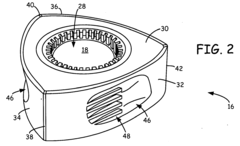
PatentActiveUS20220282622A1
Innovation
- Incorporating radially spaced grooves in the peripheral wall of the rotor cavity, with first grooves configured to release pressurized air at the top dead center during the compression stroke and second grooves for releasing air during the exhaust stroke, allowing for controlled pressure management and reduced air resistance.
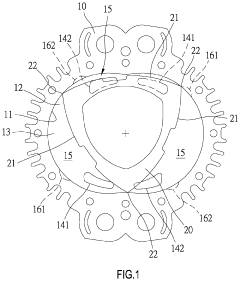
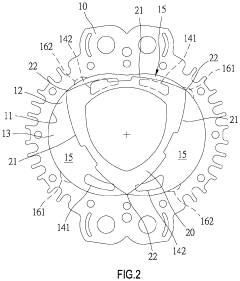
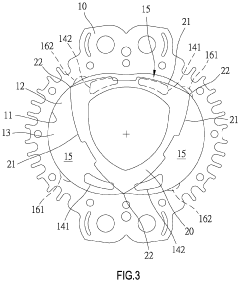
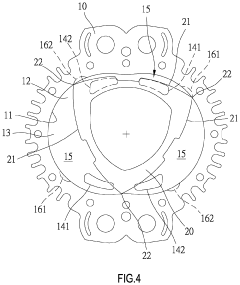
Rotors having flow-modifying members for use in rotary engines
PatentInactiveEP1933016A3
Innovation
- The introduction of flow-modifying members, such as ramp-shaped, V-shaped, bluff body, and indented structures on the rotor faces, which create vortex flows and turbulence to enhance fuel/air mixing and flame propagation, are integrated into the rotor design to control combustion rates and improve efficiency.
Emissions Compliance Strategies for Next-Gen Wankel Engines
Meeting increasingly stringent emissions regulations represents one of the most significant challenges for next-generation Wankel engine development. Traditional rotary engines have historically struggled with higher hydrocarbon (HC) and carbon monoxide (CO) emissions compared to conventional piston engines, primarily due to their elongated combustion chamber geometry and inherent sealing challenges.
Advanced simulation tools are proving essential for developing effective emissions compliance strategies. Computational Fluid Dynamics (CFD) models now incorporate detailed chemical kinetics to accurately predict formation of NOx, particulate matter, and unburned hydrocarbons within the unique geometry of the Wankel combustion chamber. These simulations enable engineers to optimize combustion chamber design, rotor face geometry, and port timing specifically for emissions reduction.
Direct injection technology implementation has shown promising results in simulation environments. By precisely controlling fuel delivery timing and spray patterns, simulations indicate potential HC emissions reductions of 15-30% compared to peripheral port injection systems. The ability to simulate multiple injection events per combustion cycle allows for optimization strategies previously impossible with physical prototyping alone.
Exhaust aftertreatment system design has evolved significantly through simulation-based development. Current tools can model catalytic converter performance under the specific exhaust gas composition and temperature profiles characteristic of Wankel engines. This has led to the development of specialized three-way catalytic converters with modified precious metal loadings and substrate designs optimized for rotary engine applications.
Hybrid-electric powertrain integration represents another promising compliance pathway. Simulation tools now enable comprehensive modeling of Wankel engines operating as range extenders in series hybrid configurations. These models demonstrate how strategic engine operation within optimal efficiency islands can dramatically reduce overall emissions while maintaining performance targets.
Thermal management simulation has become increasingly sophisticated, allowing developers to address the unique cooling challenges of Wankel engines. Improved thermal efficiency directly correlates with reduced emissions, as simulations show that maintaining optimal apex seal temperatures can reduce oil consumption by up to 40%, with corresponding decreases in particulate emissions.
Regulatory compliance testing simulation has also advanced significantly. Virtual emissions certification cycles can now be run against digital engine models, allowing developers to predict certification results and optimize calibration strategies before physical prototypes are built. This capability dramatically reduces development time and costs while increasing the likelihood of first-time certification success.
Advanced simulation tools are proving essential for developing effective emissions compliance strategies. Computational Fluid Dynamics (CFD) models now incorporate detailed chemical kinetics to accurately predict formation of NOx, particulate matter, and unburned hydrocarbons within the unique geometry of the Wankel combustion chamber. These simulations enable engineers to optimize combustion chamber design, rotor face geometry, and port timing specifically for emissions reduction.
Direct injection technology implementation has shown promising results in simulation environments. By precisely controlling fuel delivery timing and spray patterns, simulations indicate potential HC emissions reductions of 15-30% compared to peripheral port injection systems. The ability to simulate multiple injection events per combustion cycle allows for optimization strategies previously impossible with physical prototyping alone.
Exhaust aftertreatment system design has evolved significantly through simulation-based development. Current tools can model catalytic converter performance under the specific exhaust gas composition and temperature profiles characteristic of Wankel engines. This has led to the development of specialized three-way catalytic converters with modified precious metal loadings and substrate designs optimized for rotary engine applications.
Hybrid-electric powertrain integration represents another promising compliance pathway. Simulation tools now enable comprehensive modeling of Wankel engines operating as range extenders in series hybrid configurations. These models demonstrate how strategic engine operation within optimal efficiency islands can dramatically reduce overall emissions while maintaining performance targets.
Thermal management simulation has become increasingly sophisticated, allowing developers to address the unique cooling challenges of Wankel engines. Improved thermal efficiency directly correlates with reduced emissions, as simulations show that maintaining optimal apex seal temperatures can reduce oil consumption by up to 40%, with corresponding decreases in particulate emissions.
Regulatory compliance testing simulation has also advanced significantly. Virtual emissions certification cycles can now be run against digital engine models, allowing developers to predict certification results and optimize calibration strategies before physical prototypes are built. This capability dramatically reduces development time and costs while increasing the likelihood of first-time certification success.
Integration with Hybrid and Electric Powertrain Systems
The integration of Wankel engine simulation tools with hybrid and electric powertrain systems represents a critical frontier in next-generation rotary engine development. As automotive manufacturers increasingly pivot toward electrification, the unique characteristics of Wankel engines—compact size, high power-to-weight ratio, and smooth operation—position them as potentially ideal range extenders or hybrid system components.
Current simulation tools must evolve to accurately model the complex interactions between Wankel engines and electrical components. Advanced computational fluid dynamics (CFD) models are being enhanced to simulate the thermodynamic exchanges between rotary combustion chambers and electric motor cooling systems, a crucial consideration given the Wankel's distinctive thermal profile.
Several leading automotive technology providers have developed specialized modules for their simulation platforms that address this integration challenge. These tools now incorporate parameters for battery thermal management, power electronics efficiency, and regenerative braking systems working in concert with rotary engine operation. The simulation environments increasingly support co-simulation capabilities, allowing simultaneous modeling of mechanical rotary dynamics and electrical system responses.
A significant advancement in this domain has been the development of real-time simulation capabilities that enable hardware-in-the-loop testing. This approach allows engineers to connect actual electronic control units to virtual Wankel engine models, facilitating more accurate calibration of hybrid system controllers before physical prototypes are built.
Machine learning algorithms are being incorporated into these simulation tools to optimize the power split strategies between Wankel engines and electric motors. These algorithms analyze vast datasets from simulated driving cycles to determine ideal operating points that maximize efficiency while minimizing emissions—a particular challenge for rotary engines that have historically struggled with fuel economy and emissions compliance.
The latest simulation platforms also address the unique NVH (Noise, Vibration, Harshness) characteristics of Wankel-hybrid powertrains. The inherently different vibration signature of rotary engines compared to reciprocating engines creates both challenges and opportunities when integrated with the near-silent operation of electric drivetrains. Simulation tools now incorporate sophisticated acoustic modeling to predict and mitigate potential NVH issues in these hybrid configurations.
For manufacturers exploring hydrogen as a fuel for Wankel engines in hybrid applications, specialized simulation modules have emerged that model the distinct combustion characteristics of hydrogen in rotary chambers when operating alongside electric propulsion systems. These tools are essential for developing control strategies that optimize the synergies between these complementary power sources.
Current simulation tools must evolve to accurately model the complex interactions between Wankel engines and electrical components. Advanced computational fluid dynamics (CFD) models are being enhanced to simulate the thermodynamic exchanges between rotary combustion chambers and electric motor cooling systems, a crucial consideration given the Wankel's distinctive thermal profile.
Several leading automotive technology providers have developed specialized modules for their simulation platforms that address this integration challenge. These tools now incorporate parameters for battery thermal management, power electronics efficiency, and regenerative braking systems working in concert with rotary engine operation. The simulation environments increasingly support co-simulation capabilities, allowing simultaneous modeling of mechanical rotary dynamics and electrical system responses.
A significant advancement in this domain has been the development of real-time simulation capabilities that enable hardware-in-the-loop testing. This approach allows engineers to connect actual electronic control units to virtual Wankel engine models, facilitating more accurate calibration of hybrid system controllers before physical prototypes are built.
Machine learning algorithms are being incorporated into these simulation tools to optimize the power split strategies between Wankel engines and electric motors. These algorithms analyze vast datasets from simulated driving cycles to determine ideal operating points that maximize efficiency while minimizing emissions—a particular challenge for rotary engines that have historically struggled with fuel economy and emissions compliance.
The latest simulation platforms also address the unique NVH (Noise, Vibration, Harshness) characteristics of Wankel-hybrid powertrains. The inherently different vibration signature of rotary engines compared to reciprocating engines creates both challenges and opportunities when integrated with the near-silent operation of electric drivetrains. Simulation tools now incorporate sophisticated acoustic modeling to predict and mitigate potential NVH issues in these hybrid configurations.
For manufacturers exploring hydrogen as a fuel for Wankel engines in hybrid applications, specialized simulation modules have emerged that model the distinct combustion characteristics of hydrogen in rotary chambers when operating alongside electric propulsion systems. These tools are essential for developing control strategies that optimize the synergies between these complementary power sources.
Unlock deeper insights with Patsnap Eureka Quick Research — get a full tech report to explore trends and direct your research. Try now!
Generate Your Research Report Instantly with AI Agent
Supercharge your innovation with Patsnap Eureka AI Agent Platform!