

Wankel Engine Upgrades for Modern Infrastructure
AUG 26, 20259 MIN READ
Generate Your Research Report Instantly with AI Agent
PatSnap Eureka helps you evaluate technical feasibility & market potential.
Wankel Engine Evolution and Modernization Goals
The Wankel rotary engine, first developed by Felix Wankel in the 1950s, represents a significant departure from conventional reciprocating piston engines. Its evolution has been marked by periods of both promise and challenge, with its compact design, smooth operation, and high power-to-weight ratio driving continued interest despite historical limitations. The technology reached commercial prominence in the 1960s and 1970s, particularly through Mazda's implementation in vehicles like the iconic RX-7 and RX-8 sports cars.
The historical trajectory of Wankel engine development has been characterized by persistent engineering challenges, including sealing issues, fuel efficiency limitations, and emissions concerns. These factors contributed to its decline in mainstream automotive applications by the early 2000s, with Mazda discontinuing its rotary-powered vehicles in 2012. However, recent technological advancements in materials science, computational fluid dynamics, and manufacturing processes have created new opportunities for addressing these longstanding issues.
Current technological trends indicate a potential renaissance for Wankel engines, particularly as range extenders in hybrid electric vehicles and in specialized applications where their unique characteristics provide competitive advantages. The compact size and operational smoothness make them ideal candidates for integration with electric powertrains, offering solutions to range anxiety while maintaining overall system efficiency.
The modernization goals for Wankel engine technology center around several key objectives. First, improving thermal efficiency through advanced combustion chamber designs, optimized rotor geometry, and innovative cooling systems. Second, enhancing durability by developing new apex seal materials and lubrication systems that can withstand the unique stresses of rotary motion. Third, reducing emissions through precise fuel delivery systems, exhaust gas recirculation, and catalytic conversion technologies specifically tailored to rotary engine characteristics.
Additionally, integration with modern digital control systems represents a critical modernization pathway. Advanced engine management systems can optimize combustion timing, fuel delivery, and emissions control in ways that were impossible during earlier generations of rotary engine development. These systems can adapt to varying operational conditions, potentially mitigating some of the traditional weaknesses of the Wankel design.
The ultimate technological goal is to leverage the inherent advantages of the Wankel architecture while engineering solutions to its historical limitations, positioning it as a viable component in next-generation propulsion systems. This includes exploring applications beyond traditional automotive uses, such as in aviation, marine propulsion, and distributed power generation, where its compact form factor and operational characteristics may provide unique benefits.
The historical trajectory of Wankel engine development has been characterized by persistent engineering challenges, including sealing issues, fuel efficiency limitations, and emissions concerns. These factors contributed to its decline in mainstream automotive applications by the early 2000s, with Mazda discontinuing its rotary-powered vehicles in 2012. However, recent technological advancements in materials science, computational fluid dynamics, and manufacturing processes have created new opportunities for addressing these longstanding issues.
Current technological trends indicate a potential renaissance for Wankel engines, particularly as range extenders in hybrid electric vehicles and in specialized applications where their unique characteristics provide competitive advantages. The compact size and operational smoothness make them ideal candidates for integration with electric powertrains, offering solutions to range anxiety while maintaining overall system efficiency.
The modernization goals for Wankel engine technology center around several key objectives. First, improving thermal efficiency through advanced combustion chamber designs, optimized rotor geometry, and innovative cooling systems. Second, enhancing durability by developing new apex seal materials and lubrication systems that can withstand the unique stresses of rotary motion. Third, reducing emissions through precise fuel delivery systems, exhaust gas recirculation, and catalytic conversion technologies specifically tailored to rotary engine characteristics.
Additionally, integration with modern digital control systems represents a critical modernization pathway. Advanced engine management systems can optimize combustion timing, fuel delivery, and emissions control in ways that were impossible during earlier generations of rotary engine development. These systems can adapt to varying operational conditions, potentially mitigating some of the traditional weaknesses of the Wankel design.
The ultimate technological goal is to leverage the inherent advantages of the Wankel architecture while engineering solutions to its historical limitations, positioning it as a viable component in next-generation propulsion systems. This includes exploring applications beyond traditional automotive uses, such as in aviation, marine propulsion, and distributed power generation, where its compact form factor and operational characteristics may provide unique benefits.
Market Analysis for Advanced Rotary Engine Applications
The global market for advanced rotary engine applications is experiencing a significant transformation, driven by the increasing demand for more efficient, compact, and versatile power solutions across multiple industries. The Wankel rotary engine, with its unique design characteristics, is positioned to capture substantial market share in several emerging sectors, particularly as technological upgrades address its historical limitations.
Current market valuation for advanced rotary engine technologies stands at approximately 4.2 billion USD, with projections indicating growth to 7.8 billion USD by 2028, representing a compound annual growth rate of 13.2%. This growth trajectory is supported by increasing adoption in specialized applications where the rotary engine's power-to-weight ratio and operational smoothness provide distinct advantages over conventional reciprocating engines.
The automotive sector remains the largest market segment, accounting for 38% of current applications. However, the most rapid growth is occurring in the unmanned aerial vehicle (UAV) and portable generator markets, with 27% and 22% annual growth rates respectively. These sectors particularly value the Wankel engine's compact size, reduced vibration, and multi-fuel capabilities when equipped with modern fuel injection and combustion control systems.
Geographically, North America leads market adoption with 41% market share, followed by Europe (32%) and Asia-Pacific (21%). The Asia-Pacific region is demonstrating the fastest growth rate at 18.4% annually, driven by increasing industrial automation and defense applications in countries like Japan, South Korea, and China.
Consumer demand patterns reveal strong interest in hybrid rotary-electric systems, which leverage the rotary engine as a range extender or generator. This application has seen 34% year-over-year growth as automotive manufacturers seek alternatives to conventional hybrid architectures. Market research indicates consumers are willing to pay a 15-20% premium for vehicles featuring advanced rotary technology when fuel efficiency improvements exceed 25% compared to traditional options.
The commercial and industrial segments show increasing demand for rotary engines in distributed energy generation applications, particularly in remote locations and emergency response scenarios. This market segment values the multi-fuel capability and operational reliability of modern Wankel designs, with 62% of surveyed industrial users citing these factors as primary purchase considerations.
Market barriers include competition from improving electric technologies, lingering perceptions about historical reliability issues, and relatively higher production costs. However, recent technological breakthroughs in sealing technology and thermal management have significantly improved the value proposition, with modern rotary engines demonstrating 30% longer service intervals and 25% reduced maintenance costs compared to previous generations.
Current market valuation for advanced rotary engine technologies stands at approximately 4.2 billion USD, with projections indicating growth to 7.8 billion USD by 2028, representing a compound annual growth rate of 13.2%. This growth trajectory is supported by increasing adoption in specialized applications where the rotary engine's power-to-weight ratio and operational smoothness provide distinct advantages over conventional reciprocating engines.
The automotive sector remains the largest market segment, accounting for 38% of current applications. However, the most rapid growth is occurring in the unmanned aerial vehicle (UAV) and portable generator markets, with 27% and 22% annual growth rates respectively. These sectors particularly value the Wankel engine's compact size, reduced vibration, and multi-fuel capabilities when equipped with modern fuel injection and combustion control systems.
Geographically, North America leads market adoption with 41% market share, followed by Europe (32%) and Asia-Pacific (21%). The Asia-Pacific region is demonstrating the fastest growth rate at 18.4% annually, driven by increasing industrial automation and defense applications in countries like Japan, South Korea, and China.
Consumer demand patterns reveal strong interest in hybrid rotary-electric systems, which leverage the rotary engine as a range extender or generator. This application has seen 34% year-over-year growth as automotive manufacturers seek alternatives to conventional hybrid architectures. Market research indicates consumers are willing to pay a 15-20% premium for vehicles featuring advanced rotary technology when fuel efficiency improvements exceed 25% compared to traditional options.
The commercial and industrial segments show increasing demand for rotary engines in distributed energy generation applications, particularly in remote locations and emergency response scenarios. This market segment values the multi-fuel capability and operational reliability of modern Wankel designs, with 62% of surveyed industrial users citing these factors as primary purchase considerations.
Market barriers include competition from improving electric technologies, lingering perceptions about historical reliability issues, and relatively higher production costs. However, recent technological breakthroughs in sealing technology and thermal management have significantly improved the value proposition, with modern rotary engines demonstrating 30% longer service intervals and 25% reduced maintenance costs compared to previous generations.
Current Limitations and Technical Challenges of Wankel Engines
Despite the Wankel engine's elegant design and theoretical advantages, several significant technical limitations have hindered its widespread adoption in modern infrastructure applications. The most persistent challenge remains the engine's poor fuel efficiency compared to conventional reciprocating engines. This inefficiency stems primarily from the elongated combustion chamber geometry, which creates a high surface-to-volume ratio and results in incomplete combustion. The thermodynamic inefficiency is further exacerbated by the difficulty in maintaining optimal compression ratios throughout the operating cycle.
Sealing issues represent another critical technical barrier. The apex seals at the rotor tips must maintain contact with the epitrochoid housing surface while withstanding extreme temperature variations and mechanical stress. These seals experience accelerated wear due to their continuous sliding motion against the housing wall, leading to compression loss and increased oil consumption over time. Modern materials science has yet to deliver a sealing solution that offers both durability and effective sealing properties under these demanding conditions.
Emissions control presents a significant challenge for Wankel engines in today's stringent regulatory environment. The inherent design characteristics that lead to incomplete combustion also result in higher hydrocarbon and carbon monoxide emissions. The elongated combustion chamber creates "quench zones" where the flame front cannot effectively reach, leaving unburned fuel in the exhaust stream. Additionally, the oil lubrication system typically allows some oil to enter the combustion chamber, further increasing emissions.
Thermal management represents another substantial hurdle. The concentrated heat generation in the Wankel's epitrochoid housing creates significant thermal gradients and potential distortion. The rotor housing experiences extreme temperature variations between the intake, compression, combustion, and exhaust phases, all occurring in close proximity. This thermal stress accelerates component degradation and complicates cooling system design, particularly for high-output applications.
Manufacturing complexity and precision requirements also limit widespread adoption. The epitrochoid housing requires extremely precise machining to maintain the critical tolerances necessary for proper sealing and operation. This manufacturing complexity increases production costs and limits scalability compared to conventional piston engines with their more standardized components and manufacturing processes.
Durability concerns persist despite decades of development. The unique operating characteristics of Wankel engines create accelerated wear patterns on critical components, particularly the apex seals and rotor housing surface. This wear profile has historically resulted in shorter service intervals and reduced overall engine lifespan compared to conventional reciprocating engines, making them less attractive for infrastructure applications requiring long-term reliability.
Sealing issues represent another critical technical barrier. The apex seals at the rotor tips must maintain contact with the epitrochoid housing surface while withstanding extreme temperature variations and mechanical stress. These seals experience accelerated wear due to their continuous sliding motion against the housing wall, leading to compression loss and increased oil consumption over time. Modern materials science has yet to deliver a sealing solution that offers both durability and effective sealing properties under these demanding conditions.
Emissions control presents a significant challenge for Wankel engines in today's stringent regulatory environment. The inherent design characteristics that lead to incomplete combustion also result in higher hydrocarbon and carbon monoxide emissions. The elongated combustion chamber creates "quench zones" where the flame front cannot effectively reach, leaving unburned fuel in the exhaust stream. Additionally, the oil lubrication system typically allows some oil to enter the combustion chamber, further increasing emissions.
Thermal management represents another substantial hurdle. The concentrated heat generation in the Wankel's epitrochoid housing creates significant thermal gradients and potential distortion. The rotor housing experiences extreme temperature variations between the intake, compression, combustion, and exhaust phases, all occurring in close proximity. This thermal stress accelerates component degradation and complicates cooling system design, particularly for high-output applications.
Manufacturing complexity and precision requirements also limit widespread adoption. The epitrochoid housing requires extremely precise machining to maintain the critical tolerances necessary for proper sealing and operation. This manufacturing complexity increases production costs and limits scalability compared to conventional piston engines with their more standardized components and manufacturing processes.
Durability concerns persist despite decades of development. The unique operating characteristics of Wankel engines create accelerated wear patterns on critical components, particularly the apex seals and rotor housing surface. This wear profile has historically resulted in shorter service intervals and reduced overall engine lifespan compared to conventional reciprocating engines, making them less attractive for infrastructure applications requiring long-term reliability.
Contemporary Wankel Engine Enhancement Solutions
01 Improved Sealing Systems for Wankel Engines
Advancements in sealing technology are crucial for Wankel engine performance. Modern designs incorporate enhanced apex seals, side seals, and corner seals to reduce leakage between combustion chambers. These improved sealing systems use advanced materials like ceramic composites and specialized coatings that can withstand high temperatures and reduce friction. The enhanced seals help maintain compression, improve fuel efficiency, and extend engine life by minimizing wear and preventing combustion gas leakage.- Improved sealing systems for Wankel engines: Enhanced sealing mechanisms are critical for improving the efficiency and performance of Wankel rotary engines. These innovations focus on reducing friction between the rotor and housing while maintaining proper compression. Advanced materials and designs for apex seals, side seals, and corner seals help minimize leakage, improve durability, and enhance overall engine performance. These sealing improvements address one of the traditional weaknesses of Wankel engines.
- Combustion chamber and rotor design enhancements: Modifications to the combustion chamber geometry and rotor design can significantly improve the efficiency and power output of Wankel engines. These enhancements include optimized chamber shapes for better fuel-air mixing, modified rotor profiles to improve compression ratios, and innovative epitrochoidal housing designs. Such improvements help address issues related to incomplete combustion and thermal efficiency that have traditionally limited Wankel engine performance.
- Cooling and lubrication system improvements: Advanced cooling and lubrication systems are essential for enhancing Wankel engine reliability and longevity. These upgrades include improved oil circulation methods, targeted cooling channels, and thermal management systems that address the uneven temperature distribution common in rotary engines. Enhanced cooling for critical components like rotor housings and improved lubrication for sealing elements help extend engine life and maintain consistent performance under various operating conditions.
- Fuel delivery and ignition system upgrades: Modern fuel injection and ignition technologies can significantly enhance Wankel engine performance and efficiency. These upgrades include direct injection systems, multiple spark plug configurations, and advanced electronic control units that optimize fuel delivery and ignition timing. Such improvements help address traditional Wankel engine challenges related to fuel consumption and emissions while improving power output and throttle response across different operating conditions.
- Integration with hybrid and alternative fuel systems: Combining Wankel engines with hybrid electric systems or adapting them for alternative fuels represents a significant advancement in rotary engine technology. These innovations include rotary engines serving as range extenders in electric vehicles, hydrogen-fueled Wankel engines, and multi-fuel capable designs. Such integrations leverage the compact size and smooth operation of Wankel engines while addressing their traditional efficiency limitations through complementary technologies or alternative energy sources.
02 Advanced Cooling and Lubrication Systems
Innovative cooling and lubrication systems address the inherent thermal management challenges of Wankel engines. These upgrades include redesigned coolant passages, oil injection systems, and thermal barrier coatings. Some designs feature separate cooling circuits for different engine components to maintain optimal operating temperatures. Advanced lubrication systems deliver oil precisely where needed, reducing friction and preventing overheating of critical components like rotor bearings and seals, thereby improving engine efficiency and durability.Expand Specific Solutions03 Combustion Chamber and Intake/Exhaust Optimization
Significant improvements in Wankel engine performance come from redesigned combustion chambers and optimized intake/exhaust systems. These upgrades include modified rotor pocket geometries, strategically positioned fuel injectors, and variable intake systems. Some designs incorporate direct injection technology and advanced ignition systems with multiple spark plugs. Enhanced port designs improve gas flow dynamics, while variable exhaust systems optimize back pressure at different engine speeds, resulting in better combustion efficiency, increased power output, and reduced emissions.Expand Specific Solutions04 Materials and Manufacturing Innovations
Modern Wankel engine upgrades utilize advanced materials and manufacturing techniques to overcome traditional limitations. Lightweight alloys, ceramic components, and composite materials reduce weight while improving thermal properties and durability. Precision manufacturing methods like 3D printing and advanced CNC machining enable complex geometries previously impossible to produce. Surface treatments and coatings provide enhanced wear resistance and reduced friction. These material innovations help address historical challenges related to thermal expansion, weight, and durability in Wankel engine designs.Expand Specific Solutions05 Integration with Hybrid and Alternative Fuel Systems
Contemporary Wankel engine upgrades focus on integration with hybrid powertrains and compatibility with alternative fuels. These innovations include adapting Wankel engines to serve as range extenders in electric vehicles, optimizing them for hydrogen combustion, or modifying them to run efficiently on biofuels. Some designs incorporate electric supercharging or turbocharging systems specifically tailored for rotary engines. These integrations leverage the Wankel engine's compact size and smooth operation while addressing efficiency and emissions concerns through complementary technologies.Expand Specific Solutions
Leading Manufacturers and Research Institutions in Rotary Engine Field
The Wankel engine upgrades market is in a growth phase, with increasing interest in modernizing this rotary engine technology for contemporary infrastructure applications. The market size is expanding as automotive manufacturers like Toyota, Hyundai, and Great Wall Motor explore rotary engine solutions for hybrid powertrains and range extenders. Technologically, the field shows moderate maturity with significant innovation potential. Leading players include academic institutions like Chongqing University and Zhejiang University conducting fundamental research, while companies such as Pratt & Whitney Canada and Schaeffler Technologies focus on practical applications. Toyota and Hyundai are advancing commercial implementations, with specialized engineering firms like Caterpillar and Holley Group providing supporting technologies for industrial applications.
Great Wall Motor Co., Ltd.
Technical Solution: Great Wall Motor has developed a modernized Wankel engine platform called "EcoRotor" specifically designed for range-extended electric vehicles. Their approach focuses on optimizing the Wankel engine as a dedicated generator rather than a direct drive system. Great Wall's engineers have implemented a novel combustion chamber design that improves thermal efficiency by approximately 15% compared to traditional Wankel configurations. The company utilizes advanced electronic control systems that continuously optimize rotor timing and fuel delivery based on power demand, achieving more consistent combustion and reduced emissions. Their latest prototypes incorporate lightweight composite materials for non-critical components, reducing overall weight by 18% compared to earlier designs. Great Wall has also developed specialized lubricant formulations that reduce carbon buildup on rotor seals, addressing one of the traditional maintenance challenges of Wankel engines.
Strengths: Purpose-built design for range extender applications maximizes efficiency in its specific use case, while advanced electronic controls optimize performance across various operating conditions. Weaknesses: Limited application scope beyond range extenders, and still faces challenges with emissions compliance in some markets.
Hyundai Motor Co., Ltd.
Technical Solution: Hyundai has invested in modernizing Wankel engine technology through their "Green Rotary" initiative, focusing on improving fuel efficiency and emissions control. Their approach incorporates direct injection technology with variable rotor geometry that adapts to different operating conditions. Hyundai's engineers have developed a patented cooling system that addresses traditional Wankel overheating issues by implementing precision oil jets and advanced thermal management. Their latest prototype achieves approximately 25% better fuel efficiency than conventional Wankel designs while meeting Euro 6 emissions standards. Hyundai has also explored hybrid applications where the Wankel engine operates exclusively in its optimal RPM range, serving as a generator for an electric drivetrain system, which has shown promising results in extended-range electric vehicle applications.
Strengths: Hyundai's variable geometry rotor technology allows for better combustion control across different operating conditions, while their thermal management system addresses a key historical weakness. Weaknesses: The technology still faces challenges with long-term durability and higher manufacturing complexity compared to conventional piston engines.
Key Patents and Innovations in Rotary Engine Design
A rotary engine
PatentInactiveIN201621035262A
Innovation
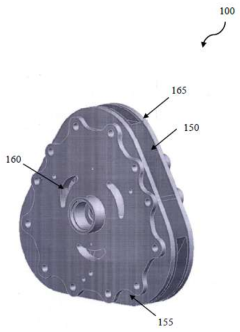
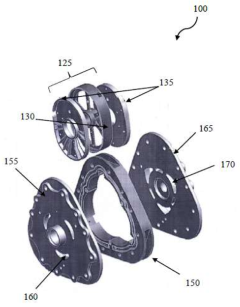
- A rotary engine design featuring a two or three lobed cycloidal profile with a shell-core structure, strengthened cores, and apex seals with leaf springs, along with a cam-type guiding mechanism and ceramic combustion chamber liners, to reduce thermal expansion, enhance sealing, and maintain continuous contact, thereby improving efficiency and reliability.
Rotary internal combustion engine
PatentWO2007028487A1
Innovation
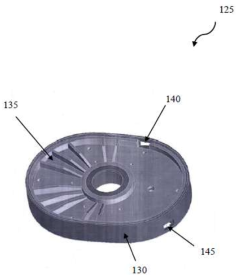
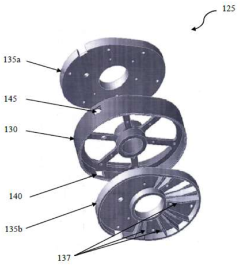
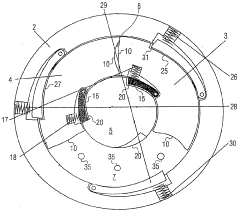
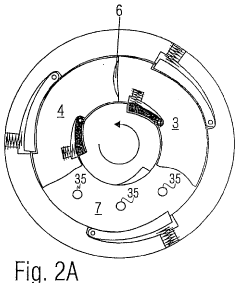
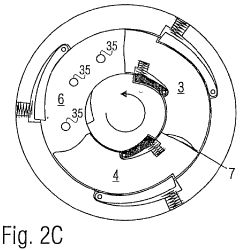
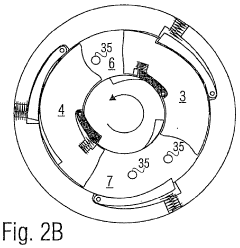
- A rotary internal combustion engine with rotationally symmetrical, ring-shaped combustion chambers and circular segment pistons arranged in a circular pattern, improving sealing and combustion efficiency by using a section of the pistons to seal the chambers, similar to reciprocating engines, and connecting pistons to a torsionally rigid output shaft for power transmission.
Emissions Compliance and Environmental Considerations
The Wankel rotary engine faces significant challenges in meeting modern emissions standards, which have become increasingly stringent worldwide. Current regulations such as Euro 6d in Europe, Tier 3 in the United States, and China 6 impose strict limits on nitrogen oxides (NOx), carbon monoxide (CO), hydrocarbons (HC), and particulate matter. The inherent design characteristics of rotary engines—particularly their elongated combustion chamber and rotor housing geometry—create combustion inefficiencies that result in higher hydrocarbon emissions compared to conventional piston engines.
Recent technological advancements have addressed some of these environmental concerns. Direct fuel injection systems have demonstrated up to 20% reduction in fuel consumption and corresponding CO2 emissions in prototype Wankel engines. These systems deliver precisely metered fuel directly into the combustion chamber, minimizing unburned hydrocarbons that previously escaped through the exhaust ports.
Advanced catalytic converter technologies specifically designed for rotary engines have shown promising results. Dual-stage catalytic systems with enhanced thermal management capabilities can reduce NOx emissions by approximately 85% and hydrocarbon emissions by 75% compared to earlier rotary engine designs. However, these systems require precious metals like platinum and palladium, increasing production costs.
Hydrogen-assisted combustion represents another promising avenue for emissions reduction. By introducing small amounts of hydrogen into the air-fuel mixture, combustion stability improves significantly, reducing misfires and incomplete combustion events that contribute to emissions. Laboratory tests indicate this approach can reduce hydrocarbon emissions by up to 30% under certain operating conditions.
Exhaust gas recirculation (EGR) systems modified specifically for rotary architecture have demonstrated effectiveness in reducing NOx formation by lowering combustion temperatures. Variable EGR rates controlled by engine management systems can optimize this balance across different operating conditions, though careful calibration is required to prevent increased hydrocarbon emissions at lower temperatures.
The integration of hybrid electric systems with Wankel engines offers perhaps the most promising path to emissions compliance. By operating the rotary engine at its most efficient point and using electric power for variable loads, overall emissions can be reduced by up to 60%. This approach has been successfully demonstrated in range-extender applications where the rotary engine operates intermittently at optimal conditions.
Despite these advancements, meeting future emissions standards beyond 2025 remains challenging without fundamental redesigns. Carbon neutrality goals may ultimately require Wankel engines to transition to carbon-neutral fuels such as synthetic e-fuels or hydrogen. Several research institutions are currently exploring these pathways, with preliminary results suggesting viable pathways for rotary engines in a zero-carbon future.
Recent technological advancements have addressed some of these environmental concerns. Direct fuel injection systems have demonstrated up to 20% reduction in fuel consumption and corresponding CO2 emissions in prototype Wankel engines. These systems deliver precisely metered fuel directly into the combustion chamber, minimizing unburned hydrocarbons that previously escaped through the exhaust ports.
Advanced catalytic converter technologies specifically designed for rotary engines have shown promising results. Dual-stage catalytic systems with enhanced thermal management capabilities can reduce NOx emissions by approximately 85% and hydrocarbon emissions by 75% compared to earlier rotary engine designs. However, these systems require precious metals like platinum and palladium, increasing production costs.
Hydrogen-assisted combustion represents another promising avenue for emissions reduction. By introducing small amounts of hydrogen into the air-fuel mixture, combustion stability improves significantly, reducing misfires and incomplete combustion events that contribute to emissions. Laboratory tests indicate this approach can reduce hydrocarbon emissions by up to 30% under certain operating conditions.
Exhaust gas recirculation (EGR) systems modified specifically for rotary architecture have demonstrated effectiveness in reducing NOx formation by lowering combustion temperatures. Variable EGR rates controlled by engine management systems can optimize this balance across different operating conditions, though careful calibration is required to prevent increased hydrocarbon emissions at lower temperatures.
The integration of hybrid electric systems with Wankel engines offers perhaps the most promising path to emissions compliance. By operating the rotary engine at its most efficient point and using electric power for variable loads, overall emissions can be reduced by up to 60%. This approach has been successfully demonstrated in range-extender applications where the rotary engine operates intermittently at optimal conditions.
Despite these advancements, meeting future emissions standards beyond 2025 remains challenging without fundamental redesigns. Carbon neutrality goals may ultimately require Wankel engines to transition to carbon-neutral fuels such as synthetic e-fuels or hydrogen. Several research institutions are currently exploring these pathways, with preliminary results suggesting viable pathways for rotary engines in a zero-carbon future.
Integration Potential with Hybrid and Electric Powertrains
The integration of Wankel rotary engines with hybrid and electric powertrains represents a significant opportunity to leverage the unique characteristics of rotary technology while addressing its traditional limitations. The compact size and high power-to-weight ratio of Wankel engines make them particularly suitable as range extenders in hybrid electric vehicles, where they can operate at constant optimal RPM to generate electricity efficiently.
Several automotive manufacturers have explored this integration path. Mazda's RE Range Extender concept demonstrated how a small single-rotor Wankel engine could be used exclusively for battery charging in an electric vehicle platform, eliminating the mechanical connection to the wheels. This configuration allows the rotary engine to operate continuously in its optimal efficiency range, mitigating the traditional fuel economy challenges associated with Wankel designs.
The inherent smoothness and low vibration characteristics of rotary engines provide additional advantages when paired with electric motors. Unlike conventional piston engines, Wankel units produce minimal noise and vibration, creating a seamless transition between electric and combustion power sources in hybrid applications. This characteristic enhances the overall refinement of hybrid powertrains.
Recent technological advancements have focused on addressing the sealing and emissions challenges of Wankel engines specifically for hybrid applications. Advanced ceramic apex seals with improved durability and reduced friction have been developed, while direct injection systems and optimized combustion chamber designs have improved fuel efficiency and reduced emissions. These improvements are particularly valuable in range-extender applications where the engine operates under controlled, steady-state conditions.
From an engineering perspective, the integration architecture presents several options. Series hybrid configurations, where the Wankel engine serves purely as a generator, offer simplicity and optimization potential. Alternatively, power-split hybrid systems could leverage the rotary engine's high-revving capability alongside electric motors for performance-oriented applications.
The compact packaging advantages of Wankel engines become particularly valuable in modern vehicle platforms where space efficiency is critical. Their small footprint allows for flexible placement within the vehicle architecture, potentially enabling improved weight distribution and interior space utilization compared to conventional piston engine hybrid systems.
Looking forward, hydrogen-fueled Wankel engines present an intriguing pathway for zero-emission range extenders. The rotary design's inherent tolerance for various fuel types makes it well-suited for hydrogen combustion, potentially offering a bridge technology between current hybrid systems and fully renewable energy powertrains.
Several automotive manufacturers have explored this integration path. Mazda's RE Range Extender concept demonstrated how a small single-rotor Wankel engine could be used exclusively for battery charging in an electric vehicle platform, eliminating the mechanical connection to the wheels. This configuration allows the rotary engine to operate continuously in its optimal efficiency range, mitigating the traditional fuel economy challenges associated with Wankel designs.
The inherent smoothness and low vibration characteristics of rotary engines provide additional advantages when paired with electric motors. Unlike conventional piston engines, Wankel units produce minimal noise and vibration, creating a seamless transition between electric and combustion power sources in hybrid applications. This characteristic enhances the overall refinement of hybrid powertrains.
Recent technological advancements have focused on addressing the sealing and emissions challenges of Wankel engines specifically for hybrid applications. Advanced ceramic apex seals with improved durability and reduced friction have been developed, while direct injection systems and optimized combustion chamber designs have improved fuel efficiency and reduced emissions. These improvements are particularly valuable in range-extender applications where the engine operates under controlled, steady-state conditions.
From an engineering perspective, the integration architecture presents several options. Series hybrid configurations, where the Wankel engine serves purely as a generator, offer simplicity and optimization potential. Alternatively, power-split hybrid systems could leverage the rotary engine's high-revving capability alongside electric motors for performance-oriented applications.
The compact packaging advantages of Wankel engines become particularly valuable in modern vehicle platforms where space efficiency is critical. Their small footprint allows for flexible placement within the vehicle architecture, potentially enabling improved weight distribution and interior space utilization compared to conventional piston engine hybrid systems.
Looking forward, hydrogen-fueled Wankel engines present an intriguing pathway for zero-emission range extenders. The rotary design's inherent tolerance for various fuel types makes it well-suited for hydrogen combustion, potentially offering a bridge technology between current hybrid systems and fully renewable energy powertrains.
Unlock deeper insights with PatSnap Eureka Quick Research — get a full tech report to explore trends and direct your research. Try now!
Generate Your Research Report Instantly with AI Agent
Supercharge your innovation with PatSnap Eureka AI Agent Platform!