
Vehicle side mirror
A technology for reversing mirrors and vehicles, which is applied to vehicle parts, optical observation devices, transportation and packaging, etc. It can solve the problems of incomplete identification of dead-end areas, illusions caused by drivers, accidental traffic accidents, etc., to achieve easy identification, prevent illusions, The effect of low manufacturing cost
- Summary
- Abstract
- Description
- Claims
- Application Information
AI Technical Summary
Problems solved by technology
Method used
Image

Examples
Embodiment 1
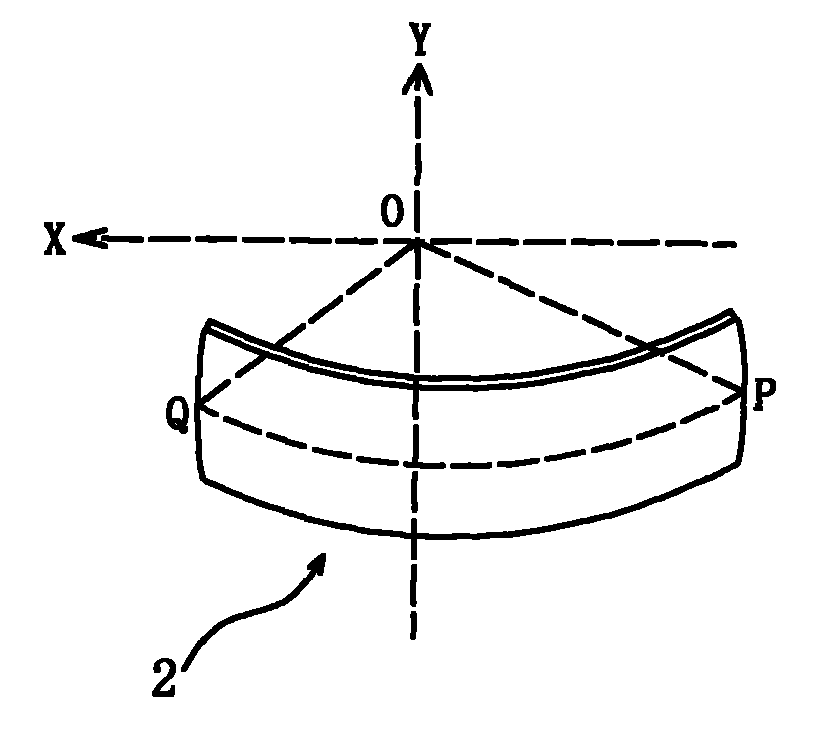
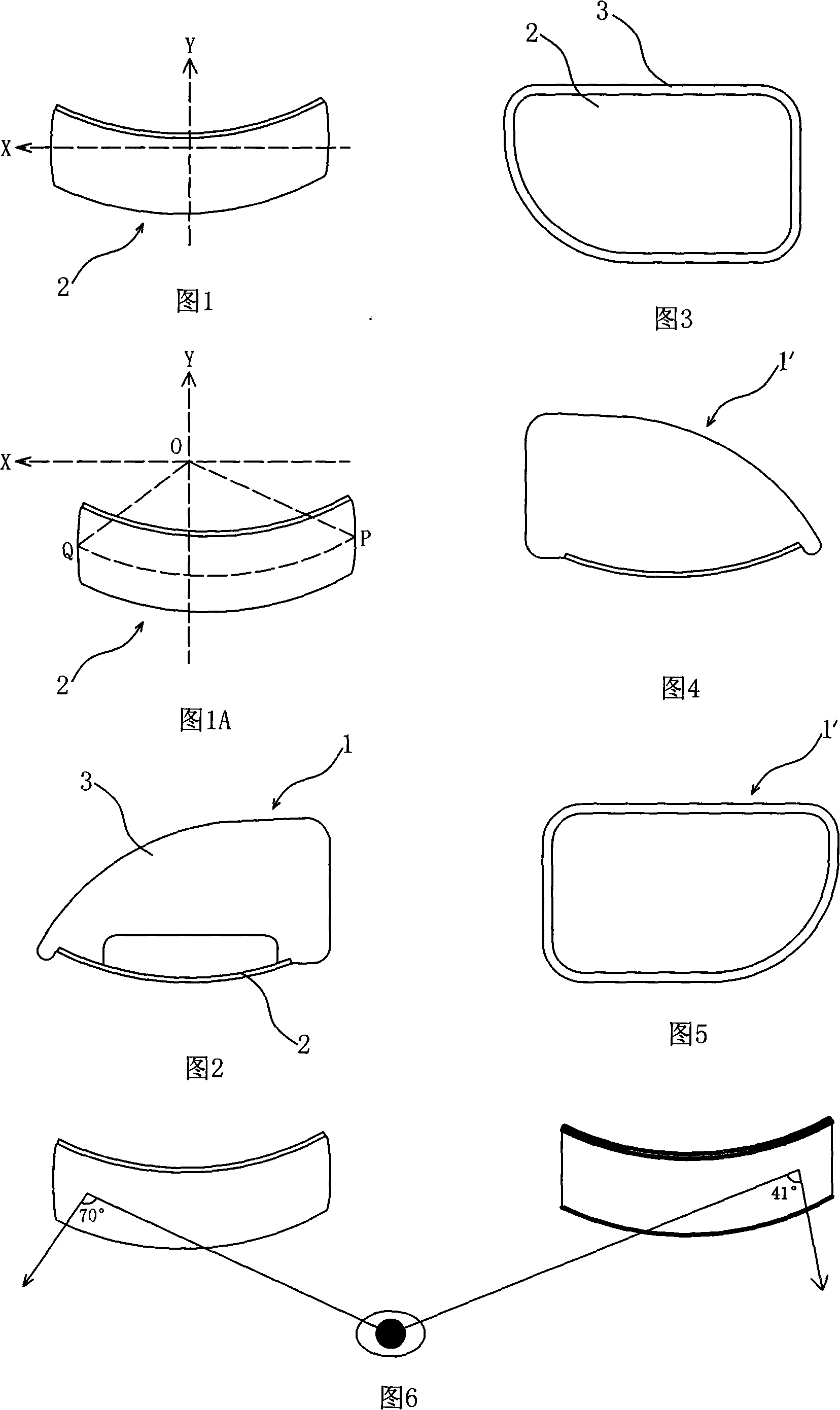
[0021] Embodiment 1: Referring to Figures 2 and 3, the vehicle rearview mirror 1 described in this embodiment is suitable for being installed outside the vehicle body on one side of the driver's cab, and includes a housing 3 and a lens 2 installed in the housing. 3 When installed on the rearview mirror base of the vehicle body, it can rotate relative to the vehicle body. The contribution feature of the present invention is that wherein said eyeglass 2 is an aspherical convex mirror with integral structure, the structure of this eyeglass can be understood in this way: the direction of the eyeglass from the side of the vehicle body to the outside of the car is regarded as the length direction of the eyeglass, that is In the X-axis direction shown in Figure 1, the Y-axis direction is the width direction of the lens, and the lens is cut along the Y-axis, that is, the width direction of the lens, and the longitudinal section of the lens can be regarded as a circular arc, close to th...
Embodiment 2
[0023] Embodiment 2: Referring to Fig. 4, 5, the vehicle rearview mirror 1' described in this embodiment is suitable for being installed outside the vehicle body on the side of the passenger's cab, and also includes a housing and a lens installed in the housing. When the body is installed on the rearview mirror base of the vehicle body, it can rotate relative to the vehicle body. The structure of the lens in this embodiment and the way of forming the lens are the same as those in the embodiment, the difference is that the curvature of the arc where the lens is located from the side of the vehicle body to the longitudinal section of the outside of the vehicle increases gradually from 0.2 to 1.2.
[0024] If you look at the side mirrors on the left and right sides from the driver's position, the lenses on both sides of the body should have different curvatures due to the different distances and angles from the side mirror 1′. If the curvature of the arc of the longitudinal secti...
PUM
 Login to View More
 Abstract
Description
Claims
Application Information
 Login to View More