Reagent for classifying leukocytes

A white blood cell and reagent technology, applied in the field of blood cell analysis, can solve the problems of narrow temperature range, easy to destroy white blood cells, inaccurate white blood cell classification, etc., and achieve the effect of accurate classification

CN101975851AInactive Publication Date: 2011-02-16南京卡博生物科技有限公司
2 Cites 6 Cited by

Patent Information

Authority / Receiving Office
CN · China
Patent Type
Applications(China)
Current Assignee / Owner
Publication Date
2011-02-16
Estimated Expiration
Not applicable · inactive patent

Smart Images

  • Figure 1
    Figure 1
  • Figure 2
    Figure 2
  • Figure 3
    Figure 3
Patent Text Reader

Abstract

The invention discloses a reagent for classifying leukocytes, which can be used for classifying leukocytes into five groups corresponding to lymphocytes, monocytes, eosinophilic granulocytes, neutrophilic granulocytes and basophilic granulocytes. The reagent comprises a buffering agent and a hemolytic agent, wherein the hemolytic agent comprises at least two types of betaine type amphoteric surfactants. The reagent can be applied in wide pH value and temperature ranges, does not damage the leukocytes and can be used for accurately classifying white blood cells.
Need to check novelty before this filing date? Find Prior Art

Description

technical field

[0001] The invention belongs to the field of blood cell analysis, in particular to a reagent for classifying white blood cells. Background technique

[0002] Differential cell counting of human whole blood samples is of great significance in clinical diagnosis. The reagent for classifying white blood cells involved in the present invention refers to a five-classification reagent that can classify white blood cells into lymphocytes, monocytes, eosinophils, neutrophils and basophils. So far, there have been a variety of such agents, such as two cationic surfactants, an organic compound with a hydrophobic group and an anionic group in the formula; a cationic surfactant and a non-ionic surfactant in the formula Surfactant etc. However, these reagents have the following problems: first, they can only be used within a narrow pH range; second, they have a narrow temperature range; and third, they are easy to destroy white blood cells, resulting in inaccurate class...

Examples

Embodiment 1

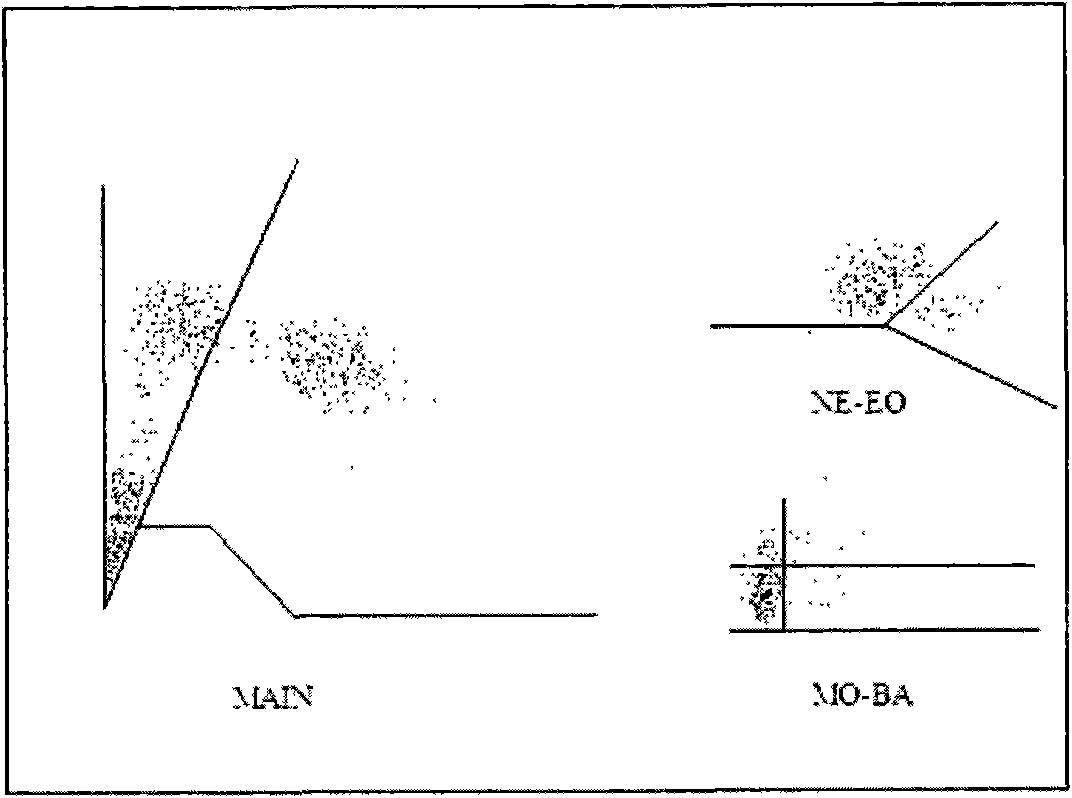
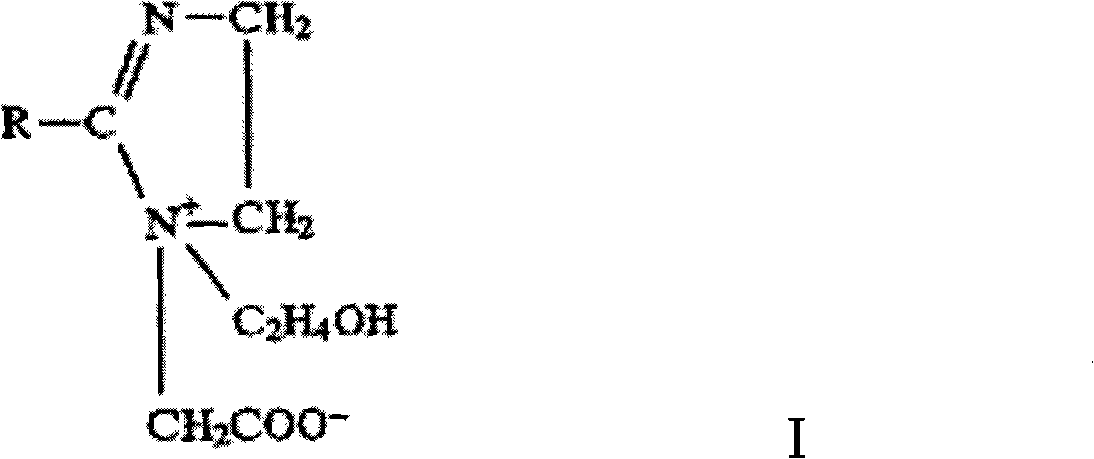
[0013] Reagents for sorting white blood cells, including a buffer and a hemolytic agent consisting of two betaine-type zwitterionic surfactants, lauryl betaine and hexadecyldimethyl betaine . The betaine-type zwitterionic surfactant has the structure shown in formula I, and the content range of hemolytic agent is 10.5g / L. The buffer is N-(2-acetamide)iminodiacetic acid. Using Nippon Kohden MEK7222K blood cell analyzer as the detection instrument, fresh healthy human whole blood samples were added to the blood cell analyzer, the pH value was controlled in the range of 1 to 10, and the temperature was 8°C. The test results are as follows: figure 1 shown.

[0014] from figure 1 It can be seen that Example 1 can accurately classify white blood cells into lymphocytes, monocytes, eosinophils, neutrophils and basophils.