
Non-isolated DC-DC converter assembly
A technology of DC converters and converters, applied in the direction of conversion of DC power input to DC power output, output power conversion equipment, conversion equipment without intermediate conversion to AC, etc., can solve the problem of pulsating current, DC-DC converter The output voltage cannot be adjusted, reducing system availability and other problems, so as to avoid EMI problems, large volume and cost, and high cost
- Summary
- Abstract
- Description
- Claims
- Application Information
AI Technical Summary
Problems solved by technology
Method used
Image

Examples
Embodiment Construction
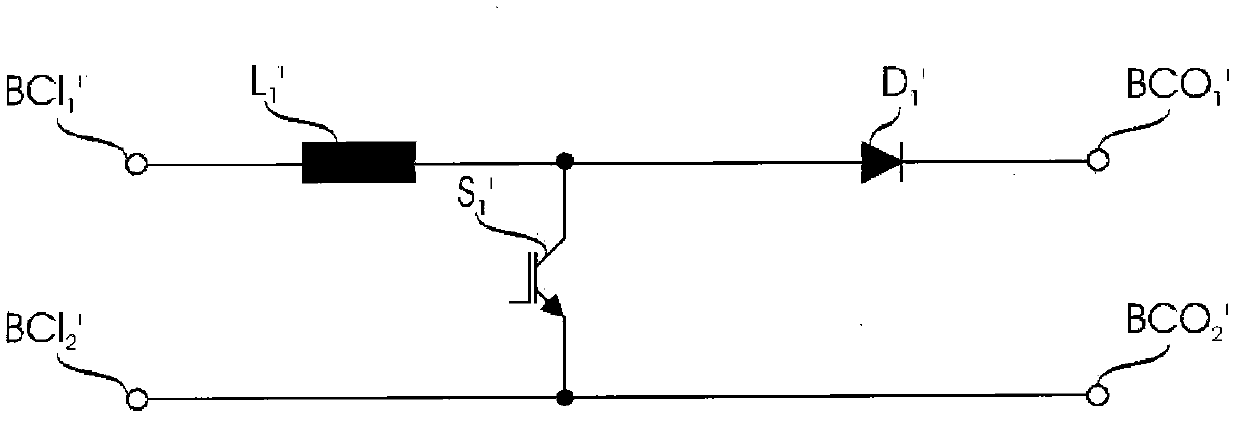
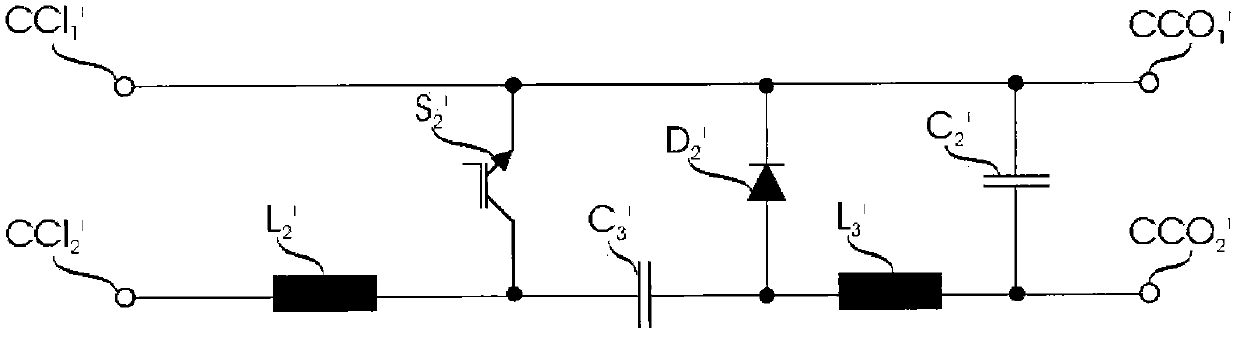
[0016] figure 1 A conventional boost converter suitable for boosting an input voltage to a higher output voltage is shown. The boost converter includes an inductor L 1 ’, diode D 1 ’ and the controllable switch S 1 '. The boost converter has a first input terminal BCI 1 ’, the second input terminal BCI 2 ', the first output terminal BCO 1 ’ and the second output terminal BCO 2 '. Input DC voltage through the first input terminal BCI 1 ’ and the second input terminal BCI 2 'enter. First input terminal BCI 1 ’ is the positive terminal while the second input terminal BCI 2 ’ is the negative terminal. The output voltage appears at the first output terminal BCO 1 ’ and the second output terminal BCO 2 ’, the first output terminal BCO 1 ’ is the positive terminal while the second output terminal BCO 2 ’ is the negative terminal.
[0017] Inductor L 1 ’ and the diode D 1 ’ connected in series at the first input terminal BCI of the boost converter 1 ’ and the firs...
PUM
 Login to View More
 Abstract
Description
Claims
Application Information
 Login to View More