
Method for rapidly raising high-quality 'three-current' well-bred seedlings of Carya illinoensis
A thin-shell hickory, high-quality technology, applied in the field of horticultural cultivation, can solve the problems of grafted seedlings failing to reach the nursery standard, long rootstock seedling cultivation time, and long seedling cultivation cycle, so as to reduce the probability of environmental stress and overcome container restrictions And the effect of labor-intensive management and well-developed root system
- Summary
- Abstract
- Description
- Claims
- Application Information
AI Technical Summary
Problems solved by technology
Method used
Image

Examples
Embodiment 1
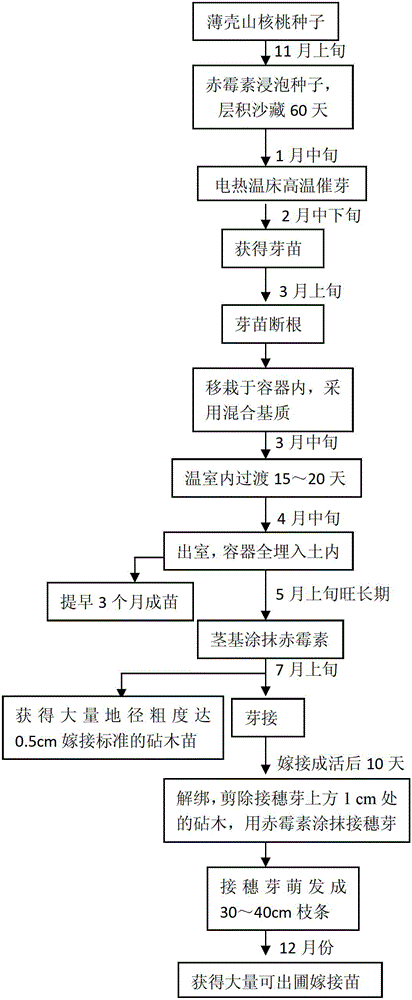
[0040] A method for quickly cultivating the high-quality "three-dang" seedlings of Carya carya with thin shells, the process flow chart is as shown in Figure 1, and the specific steps are as follows:
[0041] (1) On November 5, 2010, 100,000 pecan seeds with 300mg·L -1 After soaking in the gibberellin solution for 12 hours, put them in a north-facing room for stratification and sand storage for 60 days. The temperature is kept at 5-10°C, and the seeds are turned every 10 days during this period.
[0042] (2) On February 3, 2011, put the dormancy-broken ones in batches into the plastic greenhouse electric heating hotbed, control the temperature at 25-28°C for high-temperature germination for about 40 days, and obtain sprouts in late February, and the germination rate up to 92%.
[0043] (3) On March 3, 2011, when the radicle reaches more than 5cm, use a knife to cut off the root tip of the radicle (sprout root breaking);
[0044] (4) The root-cut sprouts were planted in batch...
Embodiment 2
[0048] A method for quickly cultivating the high-quality "three-dang" seedlings of Carya carya with thin shells, the process flow chart is as shown in Figure 1, and the specific steps are as follows:
[0049] (1) On November 9, 2009, 100,000 pecan seeds with 320mg·L -1 After soaking in the gibberellin solution for 10 hours, put them in a north-facing room for stratification and sand storage for 65 days. The temperature is kept at 5-10°C, and the seeds are turned every 10 days during this period.
[0050] (2) On January 28, 2010, the dormancy-broken ones were placed in batches in electric hotbeds in plastic greenhouses, and the temperature was controlled at 25-28°C for high-temperature germination for 38 days. The sprouts were obtained in late February, and the germination rate reached 94%.
[0051] (3) On March 8, 2010, when the radicle reaches more than 5cm, use a knife to cut off the root tip of the radicle (sprout root breaking);
[0052] (4) The root-cut sprouts were pla...
Embodiment 3
[0056] A method for quickly cultivating the high-quality "three-dang" seedlings of Carya carya with thin shells, the process flow chart is as shown in Figure 1, and the specific steps are as follows:
[0057] (1) On November 2, 2010, 100,000 pecan seeds with 280mg·L -1 After soaking in the gibberellin solution for 11 hours, they were placed in a north-facing room for stratification and sand storage for 65 days, the temperature was kept at 5-10°C, and the seeds were turned every 10 days during this period.
[0058] (2) On January 25, 2011, put the stratified dormancy-broken ones into electric heating hotbeds in plastic greenhouses, and control the temperature at 25-28°C for 38 days of high-temperature germination. The sprouts were obtained in late February, and the germination rate reached 92%.
[0059] (3) On March 10, 2011, when the radicle reaches more than 5cm, use a knife to cut off the root tip of the radicle (sprouts are broken);
[0060] (4) The root-cut sprouts were ...
PUM
| Property | Measurement | Unit |
|---|---|---|
| Length | aaaaa | aaaaa |
| Diameter | aaaaa | aaaaa |
| Length | aaaaa | aaaaa |
Abstract
Description
Claims
Application Information
 Login to View More