
Preparation and application of flag peptide tagged recombinant protein immunoaffinity purification and enrichment column
A recombinant protein and enrichment column technology, which is applied in the preparation method of peptides, peptides, organic chemistry, etc., can solve the problems of metal ion shedding, non-specific adsorption, and severe elution conditions, and achieve high coupling density and elution Mild conditions and high specificity
- Summary
- Abstract
- Description
- Claims
- Application Information
AI Technical Summary
Problems solved by technology
Method used
Image

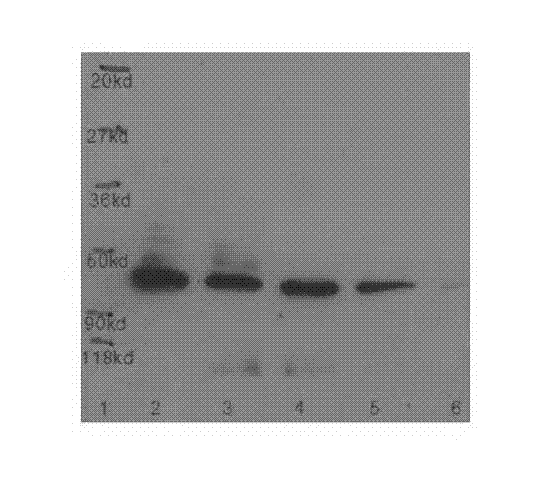
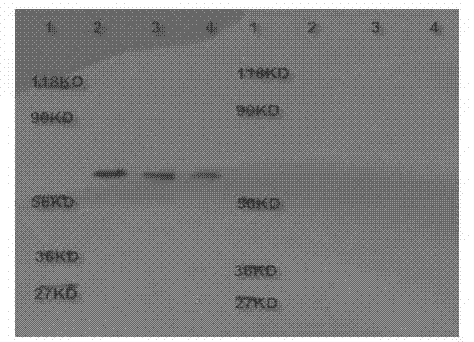
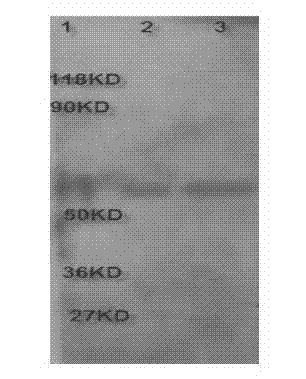
Examples
Embodiment 1
[0045] Example 1 Preparation of Immunoaffinity Purified D-tag-specific Polyclonal Antibody
[0046] 1.1 Design of D-tag short peptide hapten
[0047] Using a short peptide composed of 8 amino acid residues, namely aspartyl-tyrosyl-lysyl-aspartyl-aspartyl-aspartyl-aspartyl-lysine, using These 8 amino acid residues are divided into two kinds and the cysteine sulfhydryl SH group is introduced in opposite directions to prepare sulfhydrylated D-tag short peptides.
[0048] 1.2 Preparation of D-tag short peptide immunogen
[0049] Take 5 mg / mL KLH 10 mL, add 100 μL saturated Na 2 CO 3 , then add 1 mL of 10% SDS, mix well, boil for 5 minutes to denature, then react with iodoacetyl-NHS to generate iodoacetylated KLH, remove excess iodoacetic acid by G25 Sephadex, add 55 mg of D-tag short peptide half For the antigen, adjust the pH to 8.5, react at room temperature for 60 minutes, and obtain the D-tag-KLH covalent bond complex, which is the immune antigen after desalting with G25...
Embodiment 2
[0063] Example 2 Preparation of enrichment column for immunoaffinity purification of recombinant protein with high-density D-tag tag.
[0064] 2.1 Transfer 3 mL of Agarose activated by sodium iodate to the column, wash with 100 mL of distilled water, drip dry, and pass through 0.1 mol / L Na 2 CO 3 , drip dry and set aside;
[0065] 2.2 Dilute 300 mg of immunoaffinity-purified D-tag-specific polyclonal antibody with 0.1 mol / L Na 2 CO 3 Dissolve to make the concentration reach 20 mg / mL, centrifuge to get the supernatant after complete dissolution;
[0066] 2.3 Add the supernatant to the affinity column in step 2.1, collect the effluent and pass through the column again, repeat 3-5 times;
[0067] 2.4 Wash out the unbound antibodies with 20 mL of distilled water and collect them together;
[0068] 2.5 Prepare 1.2 mL of sodium borohydride solution with a concentration of 10 mg / mL with distilled water, add it to the column, shake and mix, and react at 4°C for 30 minutes;
[00...
Embodiment 3
[0072] Example 3 D-tag-specific antibody-labeled horseradish peroxidase
[0073] 3.1 Weigh 5 mg immunoaffinity purified D-tag specific polyclonal antibody, dissolve in 100 μL 0.1 mol / L Na 2 CO 3 , react for 10 minutes, according to the amount of antibody: horseradish peroxidase = 1: 1, add 5 mg of activated horseradish peroxidase, mix well;
[0074] 3.2 Add 1 mg of sodium borohydride, mix well and exhaust, place at -20°C for 1 minute, then move to 4°C for 2 hours;
[0075] 3.3 Desalted by G25 Sephadex desalting column;
[0076] 3.4 Add BSA so that the final concentration of BSA is 1 mg / mL, add 50% glycerol, and detect the titer of the labeled antibody by ELISA.
PUM
 Login to View More
 Abstract
Description
Claims
Application Information
 Login to View More